
Peter Jackson | 187 mins | Blu-ray | 2.40:1 | USA & New Zealand / English | 12 / PG-13
 At the start of their audio commentary on The Desolation of Smaug, co-screenwriters Peter Jackson and Philippa Boyens note that, when the decision was made to extend the already-shot Hobbit duology to a trilogy, it wasn’t a third movie that need to be created but a second. That is to say, it was the middle instalment that required the most extra material, including a new prologue and climax. The theatrical version rather felt like that had happened, too, and now we have a cut with 16% more again.
Fortunately for new-stuff spotters, most of these additions come in the form of whole scenes, rather than tiny extensions here and there. In total, there’s almost 27 minutes of new material, plus a little over 90 seconds removed (all of it moments that seem to have been added to the theatrical edition to cover for now-reinserted scenes). That’s a pretty significant amount, and it does impact on some facets of the story, but not enough to change the overall feel. That said, I did like the film a little better, but I’d attribute that as much to simply watching it again: things that bugged me last time felt less irksome, like how long was spent on Legolas fighting orcs at the end, for instance.
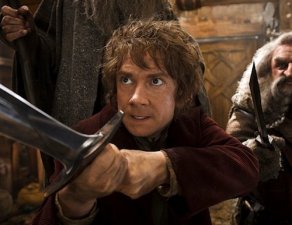
One thing I never had a problem with, unlike some others, is the film’s proportion of Bilbo: some say the titular hero is sidelined, with too much focus on Thorin and Gandalf as a result. Two things: one, despite the title, this is clearly structured as an ensemble movie — of course other characters are going to get some of the focus. Second, there’s actually loads of Bilbo! He saves everyone from spiders in Mirkwood, he saves everyone from imprisonment by the wood elves, he’s the one who finds the keyhole at Erebor, he goes into the mountain and has a long confrontation with Smaug, he’s the first face we see after the prologue and the last we see before the credits. And those are just the highlights. 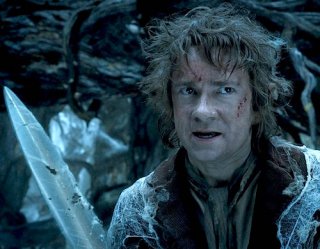 The extended cut amps him up even more, with an extra part in Mirkwood and a moment where he stands up for Thorin in Laketown. In fairness, he doesn’t have as much character development in this film as the first, while Thorin is on a definite arc and Gandalf is off on his own side-plot, but he’s undoubtedly a key character. I really don’t understand that complaint.
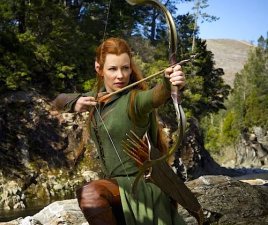
Of the new stuff, however, the best addition is more Beorn, authoritatively played by Mikael Persbrandt. He felt underused and half-arsed in the theatrical version, like they’d cut out a book character to make way for more film-added stuff later on. I have no idea how big his role is in the novel, but Tauriel and her dwarven love triangle aren’t in there at all, so I can well imagine some would rather have more of the skin-changer (whether from the novel or not) than the interspecies romance. Here, we get more of a sense of him as a character, with two whole worthwhile scenes supplementing his sole one from the other cut.
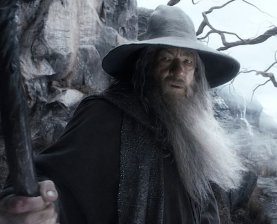
Other notable additions include an extended bit in Mirkwood, where the party have to cross a river; some more of Stephen Fry as the Master of Laketown; and a whole additional character encountered by Gandalf at Dol Guldur, played by renowned actor Sir Antony Sher, under so much make-up you’d never even know. There are more bits and bobs, including additional lines that set up some of the aforementioned new scenes, but nothing as significant as these. Some build on storylines first included in the extended cut of An Unexpected Journey, others are just on the level of “we shot this so here it is”.
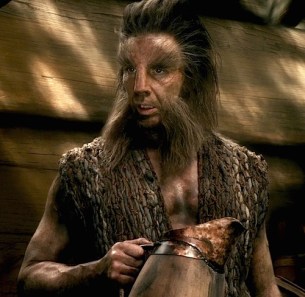 Even if some of the additions are worthless, on balance this is a better version of the film: more Beorn, more of the atmospheric Mirkwood, an additional character whose appearance will hopefully pay off in the extended Battle of the Five Armies (presuming it can’t have done in the theatrical version); plus simply watching the film for a second time helps iron out some of the pacing and emphasis problems I had on my first viewing. It’s still the weakest of Jackson’s Middle-earth films, and there are many issues with splitting one film in two (which I expect to rear their head again in the third film, with how some of the decisions pan out), but it isn’t all bad.

In case you missed it, my review of the theatrical cut can be read here.
The concluding part of the trilogy, The Battle of the Five Armies, is 2015’s #36. It’s released on DVD and Blu-ray in the US tomorrow and in the UK on 20th April. I’ll have a review nearer that time.
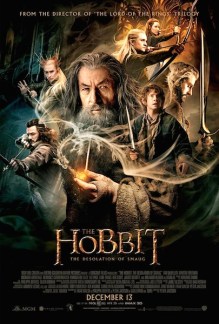 The Desolation of Smowg-not-Smorg begins in the same way
  It’s my understanding that the originally-planned (and shot) two-part version of Jackson’s Hobbit adaptation was transformed into a trilogy by, essentially, taking what was to be film #2 and splitting it in half. That might explain why individual sections are allowed to go on so long here: to bulk up the running time to the kind of epic proportions audiences expect from a Middle-earth movie. Anything less than two-and-a-half hours isn’t going to cut it. But when your climax is a battle between a giant dragon (cool!) and a small army of dwarves (kick ass!) around a deserted underground city (hell yeah!), but my main thought afterwards is, “God that went on a bit”, then you’ve failed at something.
 Meanwhile, Luke Evans’ Bard is as Welsh as the actor’s name suggests, which is a little bit of a surprise. But then the dwarves’ accents have all the rest of the UK covered, so why not. Benedict Cumberbatch sounds like Benedict Cumberbatch playing ‘big’ as Smowg-not-Smorg. It feels like this should be an iconic villain performance but, while good, I found it somehow lacking. Expectation may be scuppering him; maybe I’ll warm to it on future viewings.
 I haven’t picked apart everything that’s wrong with the film (what purpose is there switching from one made-up-for-the-film orc general to another?!), but then nor have I praised everything that works (there are some quality actors in amongst all that crashing and banging). It seems a fair few people liked this Hobbit instalment more than the first; the best explanation I can find is, “because it’s got more action”. Far be it from me to accuse other film viewers of being shallow, but… really? I genuinely enjoyed An Unexpected Journey as a return to the beloved realms and peoples of Middle-earth. The Desolation of Smowg-not-Smaug has some of that, and the charm of introducing us to new parts of the world too, but it’s drowned out by so much aimless noise. Here’s hoping it improves with repeat viewings and/or the inevitable extended edition, because this time I nearly slipped down to a lowly 3 stars.
 100Films.co.uk