
Country: USA & Germany
Language: English, French, Klingon, Korean & Arabic
Runtime: 98 minutes
BBFC: 15
MPAA: R (cut)

Original Release: 15th October 2004 (USA)
UK Release: 14th January 2005
First Seen: cinema, 2005
Stars
Trey Parker (BASEketball, Despicable Me 3)
Matt Stone (BASEketball, South Park: Bigger, Longer & Uncut)
Kristen Miller (Cherry Falls, Puff, Puff, Pass)
Masasa (Kingdom Come, Angels & Demons)
Daran Norris (Comic Book: The Movie, Veronica Mars)
Director
Trey Parker (Orgazmo, South Park: Bigger, Longer & Uncut)
Screenwriters
Trey Parker (Cannibal! The Musical, The Book of Mormon)
Matt Stone (South Park: Bigger, Longer & Uncut, The Book of Mormon)
Pam Brady (South Park: Bigger, Longer & Uncut, Hot Rod)
The Story
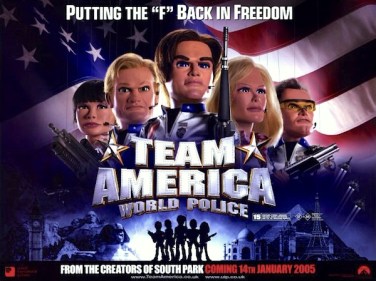
Global paramilitary protectors Team America: World Police must battle both the machinations of terrorists and the criticism of Hollywood actors.
Our Heroes
Gary Johnston is just a Broadway actor, until he’s recruited into counter-terrorism force Team America: World Police to use his acting skills to save the world. The rest of the team include its boss, Spottswoode; Lisa, a psychologist; Sarah, who thinks she’s psychic; Joe, an all-American jock; and Chris, a martial artist with a hatred of actors — like Gary! There’s also their supercomputer, I.N.T.E.L.L.I.G.E.N.C.E., which stands for… um…
Our Villains
Kim Jong-il, the lonely leader of North Korea, and his threats to global security. His positions is strengthened by those liberal FAGs — that’d be the Film Actors Guild.
Best Supporting Character
Matt Damon!
Memorable Quote
“We’re dicks! We’re reckless, arrogant, stupid dicks. And the Film Actors Guild are pussies. And Kim Jong-il is an asshole. Pussies don’t like dicks, because pussies get fucked by dicks. But dicks also fuck assholes — assholes who just want to shit on everything. Pussies may think they can deal with assholes their way, but the only thing that can fuck an asshole is a dick, with some balls. The problem with dicks is that sometimes they fuck too much, or fuck when it isn’t appropriate — and it takes a pussy to show ’em that. But sometimes pussies get so full of shit that they become assholes themselves, because pussies are only an inch-and-a-half away from assholes. I don’t know much in this crazy, crazy world, but I do know that if you don’t let us fuck this asshole, we are going to have our dicks and our pussies all covered in shit.” — Gary
Quote Most Likely To Be Used in Everyday Conversation
“Matt Damon.” — Matt Damon
Memorable Scene
Puppets having sex. Sex, by puppets. Sexing puppets. Puppet sex.
Best Song
The titular refrain (“America! Fuck yeah!”) is perhaps the most memorable, though it has strong competition from Kim Jong-il’s I’m So Ronery, but my favourite song has always been the in-jokey, film-fan-y Montage. I certainly laughed far louder than anyone else in the cinema, anyway.
Technical Wizardry
Puppets! Considering the Gerry Anderson shows they’re emulating took multiple iterations and years of work to really perfect, Team America does a remarkable job out of the gate — and isn’t adverse to some puppet-based humour either, naturally.
Making of
Originally the Matt Damon character had a proper speaking part, because he’s a pretty intelligent guy really and Parker and Stone knew that. But then the puppet came out looking a bit, shall we say, ‘special’. With no time to remake it, they decided to have the character live up to how he looked: only capable of saying his own name. So it’s less a grand piece of satire on the self-involvement of Hollywood lefties, more an in-joke.
Awards
1 Empire Award (Comedy)
1 MTV Movie Awards nomination (Action Sequence for “the desert terrorist assault”)
What the Critics Said
“it’s hard not to guffaw with glee at the gross libelling and on-screen dismemberment of an array of ‘aware’ Hollywood stars (albeit in puppet form) and in which George W Bush’s war on terror is rendered in risible sub-‘Supermarionation’ form. The whole thing plays like Thunderbirds Goes to Hell and will doubtless offend all those numskulls who complained about the BBC’s transmission of Jerry Springer: The Opera. For that alone, it gets my vote.” — Mark Kermode, New Statesman
 Score:
 77%
77%What the Public Say
“The idea of the puppets in the first place is very clever, because when you make everything a puppet, everything becomes funnier. I think that the puppets themselves work so well because the creators knew their strengths and weaknesses. The puppets they use are pretty detailed and can do a lot of different kinds of movements. The team use these functions of the puppets for simpler actions (moving limbs and heads and so on) and make it look realistic. But how do you make a fistfight between two puppets look realistic? You don’t, just make some very basic and crude movements and the joke basically tells itself.” — Felix, FelixMovieThoughts

The guys behind South Park spoof Michael Bay-style action movies — and by extension right-wing America’s view of its place in the world — through the medium of Thunderbirds-style puppets, which just heightens the ridiculousness. It’s a neat mix of clever satire and baser laughs, bolstered by surprisingly listenable musical numbers. It’s not always clever, and it’s never big (they’re puppets!), but it is funny.

#90 will be… following yonder star.
 For generations of people, the work of Gerry Anderson and AP Films / Century 21 are an irrevocable part of their childhood. For my part, I grew up during their big ’90s revival — the era of Anthea Turner’s make of Tracy Island on Blue Peter (though as no one in my family is particularly crafty (as it were) I had a Proper One), etc — so memories of
  And finally (for this summary, at least), Anderson’s ever-present desire for realism led him to invent an aid system to aid his puppeteers. In order to control the puppets, the operators were positioned above the sets, afforded only a bird’s eye view — a hard position from which to make them perform well, considering they couldn’t see what they were actually doing as it appeared on camera. So Anderson devised a way for a video feed to be run from the film camera up to a TV monitor for the puppeteers. The process also meant the director and cinematographer could see exactly what the camera saw, including the ability to rewind and review footage, meaning that, if there was a worry about a mistake, it was no longer necessary to either wait for the film to be developed or shoot another take just in case. This system, if you aren’t familiar with it, is known as video assist and is an industry standard on film shoots (digital filming removes the need for it, of course, but that’s a very recent development).
 For instance: for all his achievements in the field, Anderson never actually wanted to work with puppets — as a burgeoning TV production company desperate for work in the ’50s, AP Films were approached by a writer to produce a puppet series, so they did; that led to her commissioning another; they thought they could do better work by themselves, so they did; and it continued to spiral from there. Anderson constantly pushed for the puppets to be better — for their movements to be more realistic, for their lip-sync to be genuinely synced (again, innovating new technology to achieve this), for their proportions to be like humans rather than caricatures. But these advances eventually went too far, at times angering the puppeteers. They didn’t approve of the realistically-scaled puppet heads featured from Captain Scarlet onwards — they were harder to puppeteer convincingly, divorced of the margin of error that bigger heads allowed (and, arguably, needed); and they removed the puppet-ness of the puppets.
 I’ve wound up telling interesting stories of Anderson & co rather than really reviewing Filmed in Supermarionation per se, but that’s because it’s an interesting story and the film tells it so very well (better than me. Oops.) For anyone who grew up with these programmes, this is an insightful, informative tribute to their ingenuity and quality. If you’re not familiar with them — if you don’t feel that ineffable childhood affection — I guess it doesn’t offer quite as much. Nonetheless, it remains the story of an incredible, pioneering endeavour that helped put the quality of British filmmaking on the map. It’s fun to think that, at a time when British culture was conquering the world and breaking new ground, through the likes of the grand extravagance of the James Bond movies and the subversive brilliance of the Beatles, standing toe to toe with them were a bunch of people in a tin shed with some puppets.
 100Films.co.uk