2024 Statistics!

When Andy Williams sang “it’s the most wonderful time of the year”, he was on about Christmastime; but ’round these parts, the real most wonderful time of the year comes a little later: in early January, with the annual statistics post. And, friends, that time is here again.

Before the onslaught of numbers and graphs begin, a couple of quick reminders. Primarily: these stats cover my first-time feature film watches from 2024, as listed here. Shorts and rewatches are only factored in when expressly mentioned.

Secondly, and finally: as a Letterboxd Patron member, I get a yearly stats page there too, which can be found here. The numbers will look a bit different, because I also log whatever TV I can, plus it factors in shorts and rewatches more thoroughly, but that’s part of what makes it interesting as an addition/alternative to this post. It also breaks down some interesting things not covered here, like my most-watched and highest-rated stars and directors.

Now, without further ado, here’s what you came for…


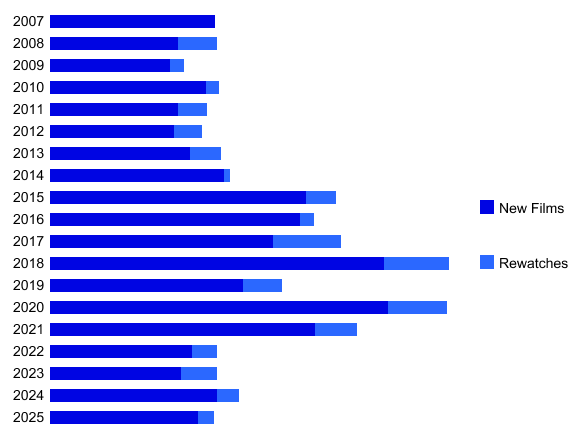
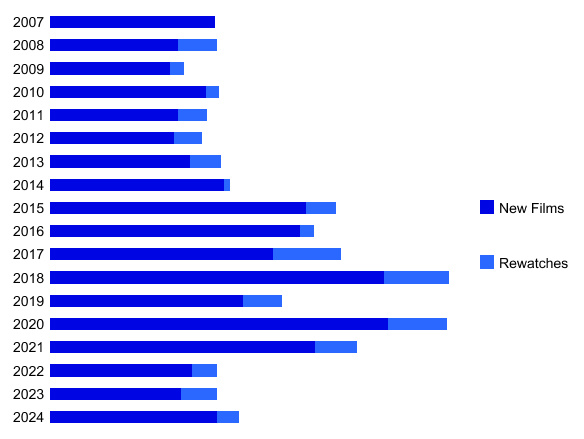
I watched 131 feature films for the first time in 2024. That puts it right in the middle of the history of 100 Films: out of 18 years, it ranks ninth largest (or tenth smallest).

Of those 131 films, 85 counted towards my 100 Films in a Year Challenge. Alongside 15 rewatches, that means I finally reached all 100 films for my Challenge for the first time in its new form. More thoughts about that in the Final Standing and December review posts.

Outside of the Challenge, I rewatched only two further films for a total of 17 rewatches. That’s my lowest number since 2016, which was the last year before I started to make a concerted effort to up my rewatches (first with the Rewatchathon from 2017 to 2020, then by including them as a category in my Challenge). Any number going down is a shame, but there are always going to be compromises somewhere — if I’d rewatched more, I likely would’ve watched fewer new films.


NB: I have no rewatch data for 2007 and only incomplete numbers for 2008.

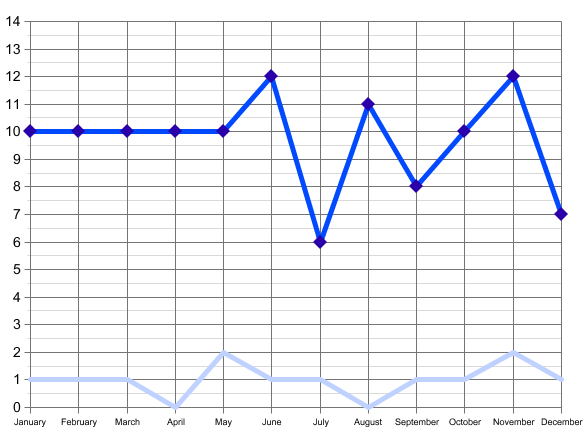
Here’s how that viewing played out across the year, month by month. The dark blue line is my first-time watches and the pale blue is rewatches. Both lines are much flatter than normal (I mean, look at 2023’s), which is because I was consistently hitting my “ten films per month minimum” goal but rarely managing to exceed it (the spikes in April and December being notable exceptions).

I also watched 16 short films. That might not sound like a lot, but it’s actually my third highest total ever, behind only 2019’s 20 and 2020’s 65 (which was so high thanks to watching many for film festivals I was working on), and just ahead of last year’s 15. On the other hand, only 11 were ones I’d never seen before, down marginally from 12 last year. (For some reason I didn’t make that distinction in last year’s stats, but it does affect the total running time, because only the new ones count.)

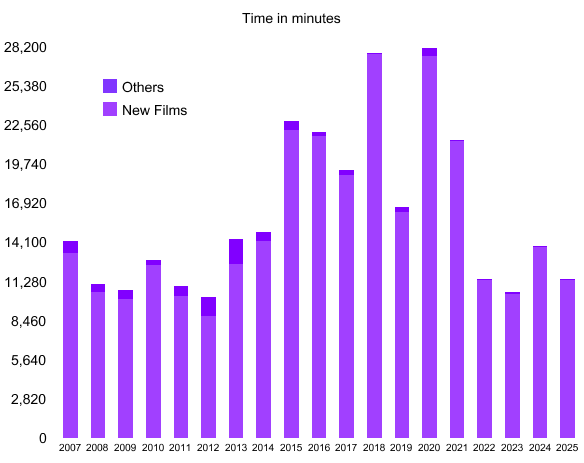
The total running time of my first-watch features was 229 hours and 3 minutes. That’s my highest since I revamped the site for 2022, but only ninth overall. The same ranking as for the film count? It’s almost as if there’s a correlation! I jest, but what it does suggest is that I rarely, if ever, watch a disproportionate number of especially-short or especially-long films. Talking of short things, add in the (new) short films and that total rises by only just over an hour to 230 hours and 14 minutes. (The additional bit is labelled as “other” on the graph because it would also include any alternate cuts of features that I watched for the first time, but there weren’t any this year. In fact, it’s been five years since there were.)

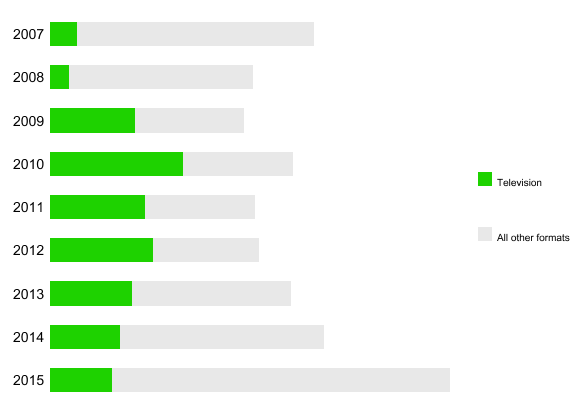
Formats next, and after disappearing last year, TV is back! Okay, it’s only got one film to its name (thanks to the BBC for premiering a new Wallace & Gromit feature on Christmas Day), but it’s something, I guess. Unless there’s another similar must-watch-live event in 2025 (doubtful), I imagine it will drop off again next year.

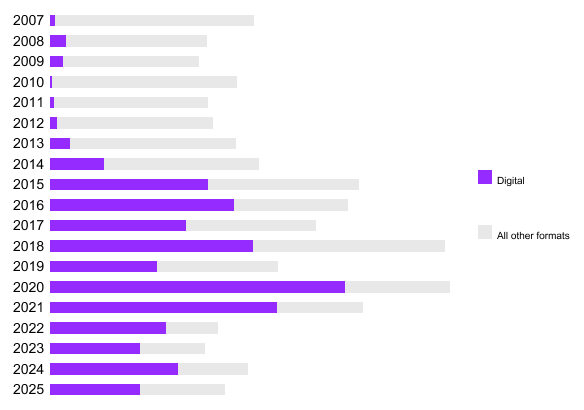
It will come as no surprise that the year’s most prolific viewing format was digital with 85 films. At 64.9% of my viewing, it’s an increase on last year, though still below the peak of 2020–2022. It was below 50% in 2019, and I’d like to get it back down there in favour of Blu-rays.

“Digital” encompasses a multitude of different platforms and viewing methods, and this year it was downloads that topped them with 20 films (23.5% of digital). Of the streamers, it was actually NOW that emerged victorious for the first time, with 18 films (21.2%), knocking Netflix and Amazon Prime into shared third place with 16 films (18.8%) each. Surging slightly ahead of the “also ran”s, iPlayer accounted for eight films (9.4%), while bringing up the rear were Apple TV+ on three (3.5), Disney+ and MUBI each on two (2.4%), and newcomer Crunchyroll with one (1.2%). Crunchyroll is all about TV and has hardly any films (I think I found a grand total of four), so don’t expect to see them return (although it’s not an impossibility).

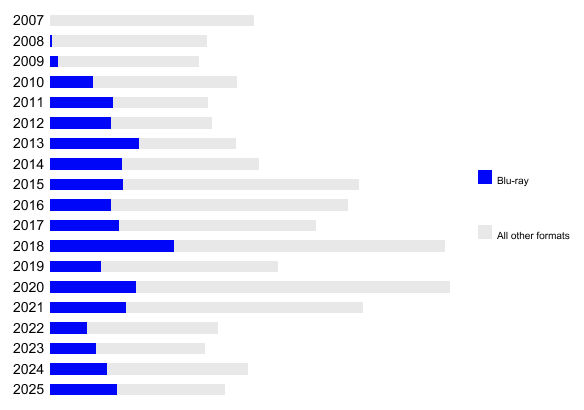
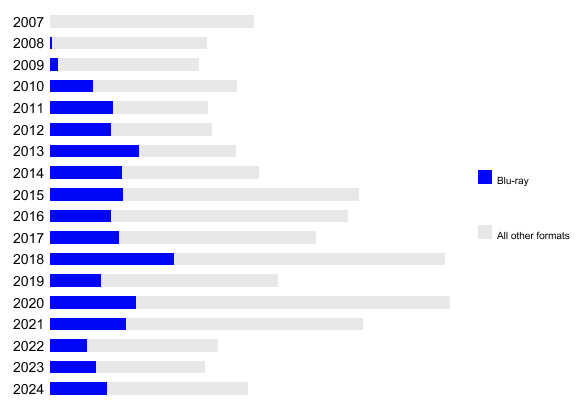
Back to the main ranking, Blu-ray did come second with 38 films (29.0%), a raise in number but drop in percentage from last year.

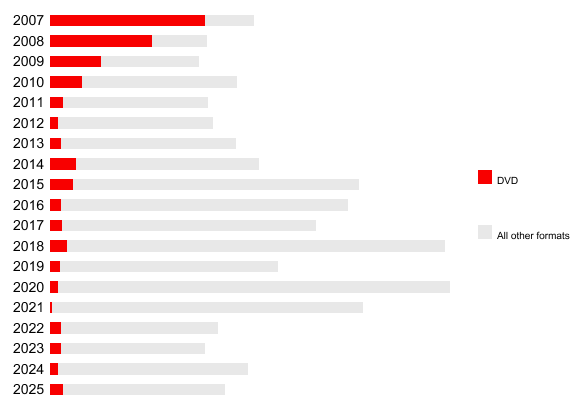
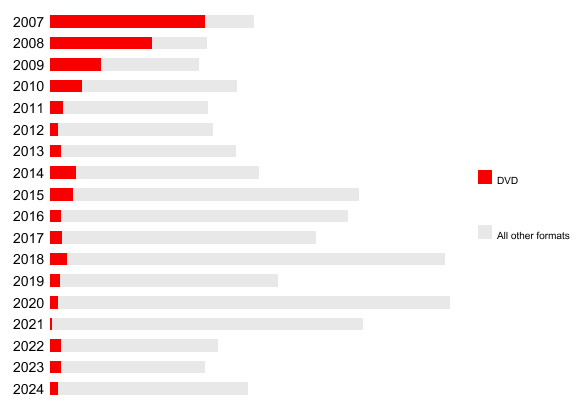
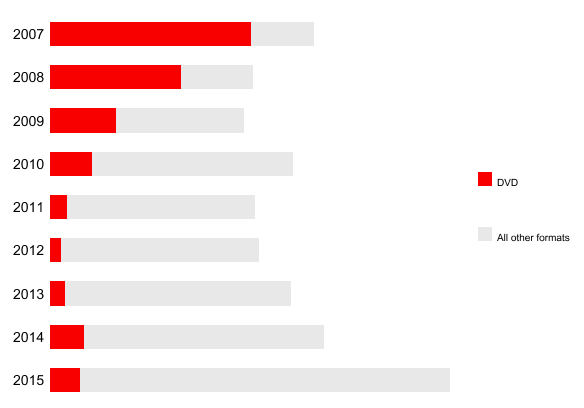
Last year I noted that the addition of a Physical Media category to my Challenge hadn’t actually done much to boost the number of DVDs I watched. This year I took that category away, and DVD did drop slightly, down to six (4.6%); but, considered over a longer timescale, it’s held pretty steady — just look at the graph:

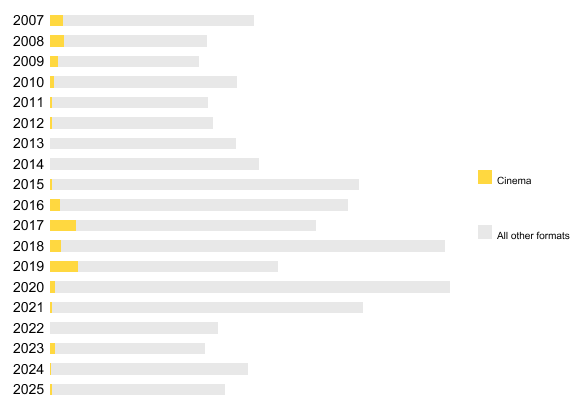
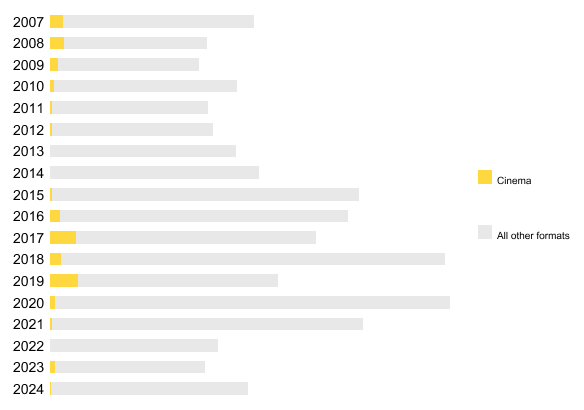
Finally, I made just one trip to the cinema this year (for Dune: Part Two). Other things piqued my interest, but nothing else panned out. Will 2025 fare any better? Well, I’ll be sure to catch the next Mission: Impossible, at least. Hey, one is still better than I managed some years (2013, 2014, and 2022, I’m looking at you).

Looking at formats from a different angle, now. First: in 2024, I watched as many new films in 3D as I did in 2021–2023 combined. Okay, that was still only four, but it’s an improvement. Looking at my Blu-ray collection, I own 63 films in 3D that I’ve never seen (plus about the same again that I’ve seen but not in 3D), so this number should be significantly higher. Maybe I’ll finally boost it up in 2025. (The first number to beat is 2020’s 13. The best ever is 2018’s 18.)

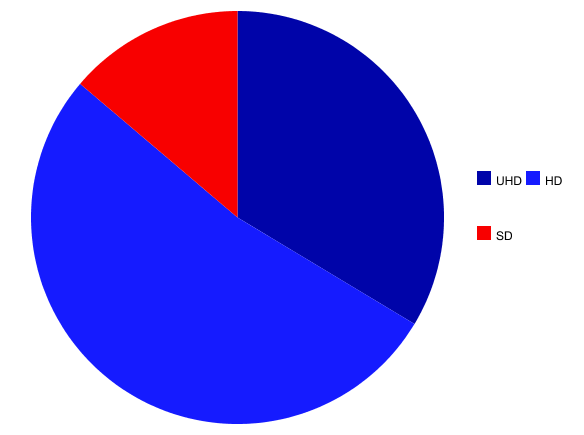
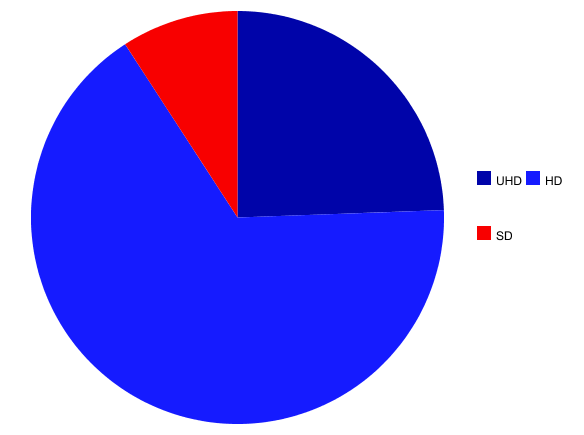
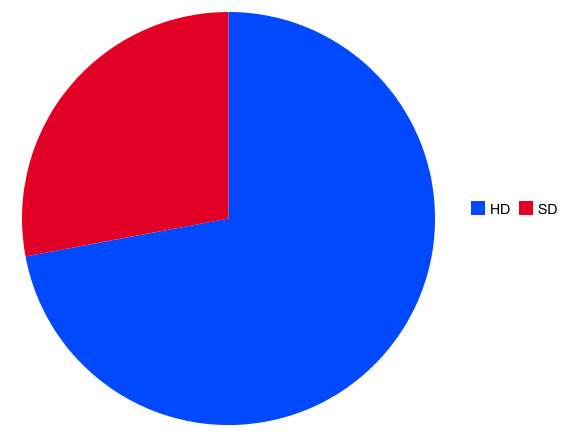
Next, the format du jour, 4K Ultra HD (it still feels pretty new to me, though 4K discs are about to hit their 9th anniversary). I watched 32 films in UHD in 2024, which is a numerical increase from 2023’s 27, but a percentage drop: 24.4% vs last year’s 26.2%. Still, it’s my second best percentage ever, so that’s not nothing. 1080p HD remains the standard, of course, representing a sliver under two-thirds of my viewing at 66.4%. Meanwhile, SD lingers on with 12 films — a hold from last year, but a percentage drop to 9.2%, only the second year it’s been under 10%. Will it ever go away entirely? It would be nice, but there remain plenty of films without even a DVD-quality SD copy out there, never mind all the DVDs that have never received an HD release.

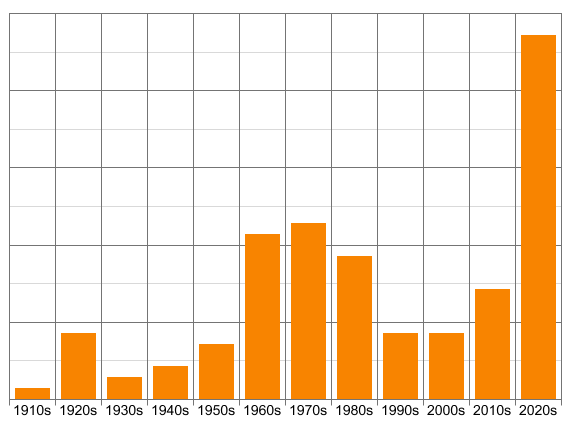
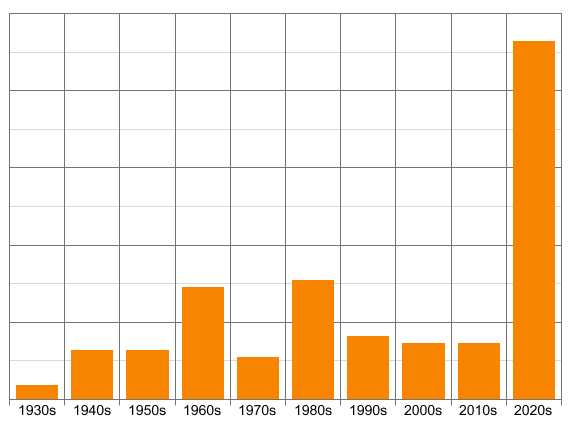
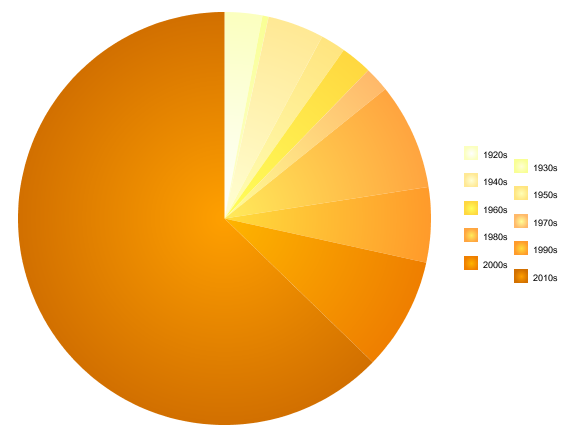
Some people would think that the fact I’m watching so many films in high quality means I’m mostly watching new stuff, but those people are misinformed. Okay, so the the 2020s remains my top decade with 51 films (38.9%), its highest total yet; but other recent decades fare less well, with the 2000s and the 2010s in joint fifth with just eight films (6.1%) each. That’s the third year in a row that my top two decades haven’t been the most recent two; before that, it only happened in 2010 (understandably) and 2019.

The decade that actually landed second place was the 1980s with 17 films (12.98%), closely followed by the ’60s on 16 (12.2%), while the ’90s took fourth with on nine (6.9%). After the first two decades of this century, we come to another tie: the ’40s and the ’50s on seven (5.3%) each. Things are rounded out by the ’70s on six (4.6%) and the ’30s on two (1.5%). No features from before 1932 this year, although I did watch two shorts from the 1920s, five from the 1900s, and even one from the 1890s.

You might think no films from before 1932 would mean no silent films, but there was actually one. At this point I think we’re all aware they still make technically-silent films sometimes, and this year the qualifier was Robot Dreams. I still need to watch more genuine silents from the actual era though, and (minor spoiler alert!) some are almost guaranteed to feature in 2025.

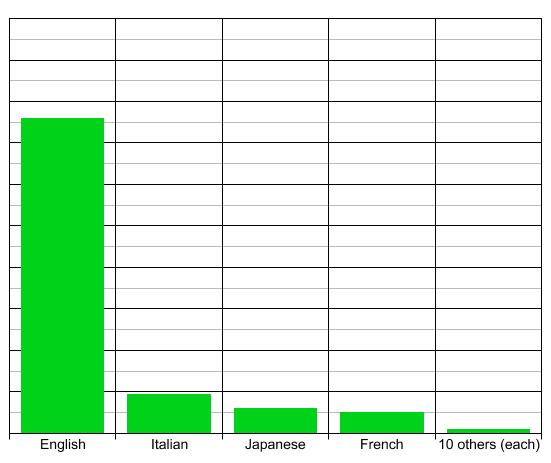
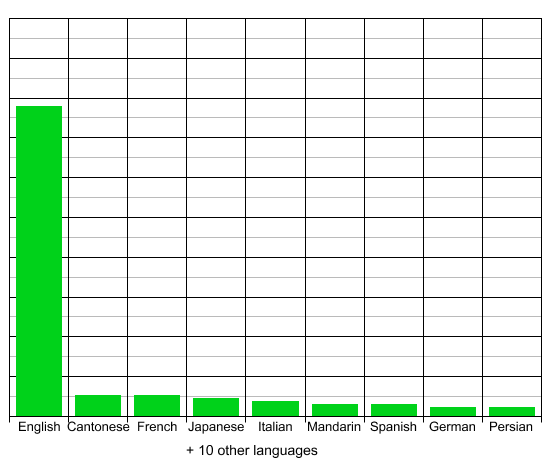
As for spoken languages, English dominated as always, with 102 films wholly or significantly in my mother tongue. At 77.9%, it’s a couple of points up on last year, but still below any previous year. Nonetheless, second place is a distant tie between French and Cantonese in seven films (5.3%) each. They’re closely followed by Japanese in six (4.6%), Italian in five (3.8%), Mandarin and Spanish each in four (3.1%) each, and German and Persian in three (2.3%) apiece. In total, 19 languages were spoken in 2024’s viewing, including Czech and Telugu for the first time on record, and Swedish for the first time since 2020. That tally is better than 2022 or 2023, but still below 2015–2021.

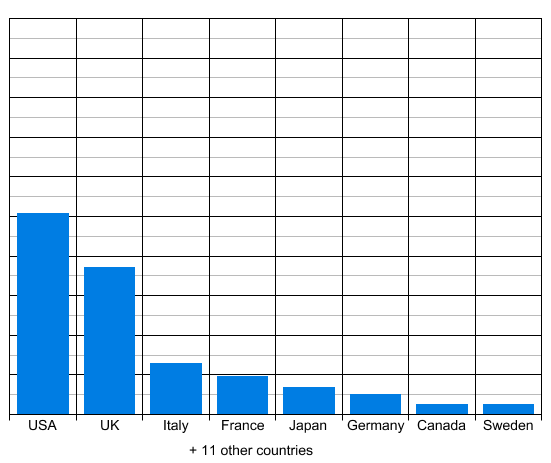
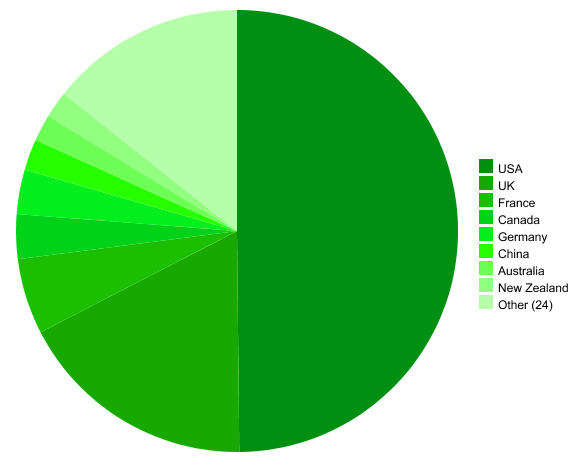
In terms of countries of production, the USA drops below 50% for the first time ever, its 64 films accounting for just 48.85%. Meanwhile, the UK reaches a new percentage high, with 43 films coming out at 32.8%. Lest you think I’m going to brag about being worldly, I’ll note that only 29.0% of films didn’t feature either the US or UK among their listed production countries. Still, there were 31 countries in total in 2024, which is among the better years since I started recording this stat (the highest is 2020’s 40). France were third for the fourth year in a row with 17 films (12.98%), followed by Japan with 11 (8.4%), Hong Kong with nine (6.9%), Italy with eight (6.1%), then a three-way tie between Australia, Canada, and Germany each with five (3.8%).

A total of 114 directors plus eight directing partnerships helmed the feature films I watched in 2024, with a further six directors and four partnerships behind my short film viewing. For the second year in a row, no one was responsible for more than two features, but those with a duo on the list were Abbas Kiarostami, Denis Villeneuve, Joseph Kuo, Joseph L. Mankiewicz, Oliver Parker (not to be confused with Ol Parker, who also had one), Robert Tronson, Sammo Hung, W.S. Van Dyke, and Wellson Chin. Plus I watched three shorts credited to British cinema pioneer Cecil Hepworth.

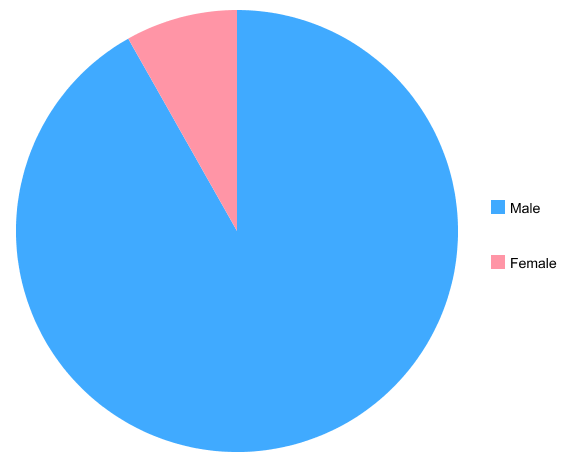
This is my tenth year charting the number of female directors whose work I’ve watched each year. I’d love to say the number and percentage of women-directed films I watch has steadily grown in that time, but it’s actually fluctuated wildly. The low point was 2016, at just 1.66%; the high was 2020, at a still-measly 11.4%; last year, it was 11.2%. In 2024, I watched 10 films with a female director, though two of those were a shared credit (one as part of a duo, one a trio). Counting those shared credits as the appropriate fractions means those 10 films represent 6.74% of my viewing. As terrible as that sounds, it’s still my third best year — so, even worse, then. As I’ve said before, I neither avoid nor especially seek out female directors — arguably I should do more of the latter, but the fact I just watch what I watch and this is how low the percentage is suggests that it’s the industry who really need to do more. That said, as revealed earlier, I watch a relatively high percentage of older films, and you can’t change the past. I hope this graph will improve further in the future, but I doubt it will ever come close to 50/50.

Every year, I track my progress at completing the IMDb Top 250, but this year it’s a bit special because I made it a whole category in my 2024 Challenge. When I made that decision, it wasn’t guaranteed I’d finish the Top 250: the category only required 12 films to complete it and I had a few more than that left on the list. My thinking was: at the very least it will be significant progress; at best, maybe I’d watch a couple more than the prescribed 12 and get the list close to done. Well, I didn’t specifically watch any ‘extra’ films, but titles do come and go (Godzilla Minus One was on the list when I announced my plans in January, but was gone by the time I watched it in September) so maaaybe… but no, I’m still 10 films away from completing it. Goddammit. Comings and goings aside, at the time of writing this article there were 13 films from my 2024 viewing still on the Top 250 — the 12 I watched for the Challenge (listed here) plus Dune: Part Two. Their current positions range from 41st (Spider-Man: Across the Spider-Verse) to 237th (My Father and My Son). Well, there’s always next year…

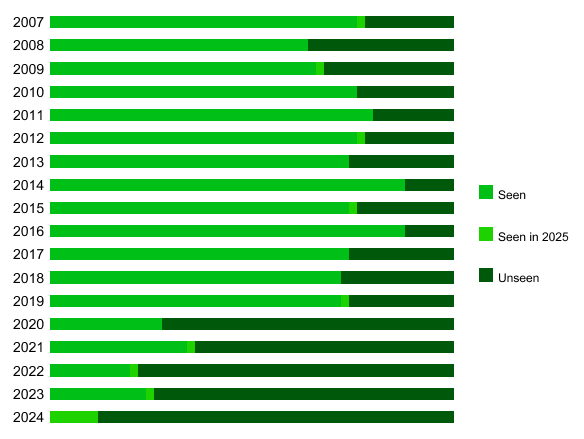
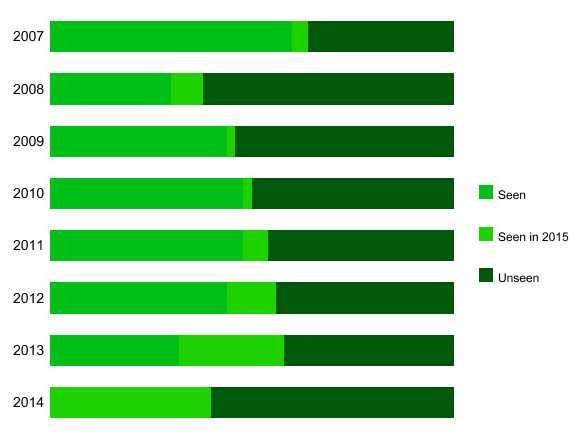
As I’m sure you’re aware, at the end of every year I publish a list of 50 notable films I missed from that year’s new releases, which I call my “50 Unseen”. I’ve tracked my progress at watching those ‘misses’ down the years — progress that has been very variable: I didn’t watch too many of them at the start, then went through a period of several years where I made serious inroads, but recently I’ve dropped off again. Put in more practical terms: I hit a high of 68 watched from all previous lists during 2018, but only watched 10 during 2023. There’s a nice bounce in 2024, doubling to 20 films across all 17 lists, although it’s still one of my weaker years (only four were worse). That’s dominated by 12 from 2023’s 50 — a big improvement on the six from 2022 I watched last year, but still my fourth-worst ‘first year’ (historically, I’ve watched the most from any given list in its first year of existence).

In total, I’ve now seen 543 out of 850 ‘missed’ movies. That’s 63.9%, a further drop from last year, though still a little above 2017 (2018 was the first year I got it above 70%). I’d like to get it above 70% again, but to do it by the end of 2025 I’d have to watch 87 films, which is almost double the number I watched in 2022 to 2024 combined. To even hold the percentage steady I’d have to watch 32 films, which is still more than 2023 and 2024 combined, so it’s not looking great. (As usual, 2024’s 50 will be listed in my “best of” post.)

And so we reach the finale of every review; a fitting climax to these statistics: the scores.

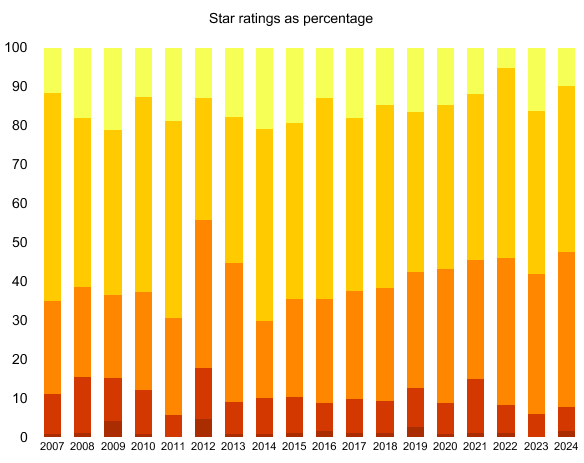
For the avoidance of doubt, this stat factors in every new film I watched in 2024, including those I’ve not yet reviewed (this year, that’s 92% of them — an improvement on last year’s 95%, albeit not by much). That does mean there are some where I’m still flexible on my final score; usually films I’ve awarded 3.5 or 4.5 on Letterboxd, but which I insist on rounding to a whole star here. For the sake of completing these stats, I’ve assigned a whole-star rating to every film, but I reserve the right to change my mind when I eventually post a review (it’s happened before). It only applies to a small handful of films, so hopefully this section will remain broadly accurate.

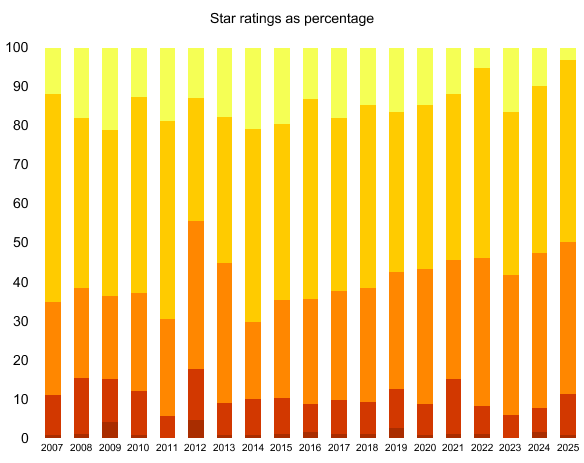
At the top end of the scale, in 2024 I awarded 13 five-star ratings (9.92% of my viewing). That’s down slightly from last year, though not close to as low as 2022. (I’d make comparisons to all other years, but that’s only down fairly as a percentage and I don’t have that to hand. I should compile a list of them, really.) At the scale’s other end, I gave two one-star ratings (1.53%), which is more or less normal for me — indeed, my all-time average is 1.94 per year. Even when I watch more films, it doesn’t change much, because I avoid giving it to all but the most terrible rubbish, and I try to avoid watching such things, on the whole.

The largest group this year was four-stars, given to 56 films (42.75%). Three-stars has only been the majority awarded once (in 2012), but it came pretty close this year, as there were 52 three-star films (39.69%). Finally, there were only eight two-star films (6.11%), which is roughly in-keeping with the last couple of years (before that there were a lot more, but then I watched a lot more in general. I really ought to get those percentages ready for comparison…)

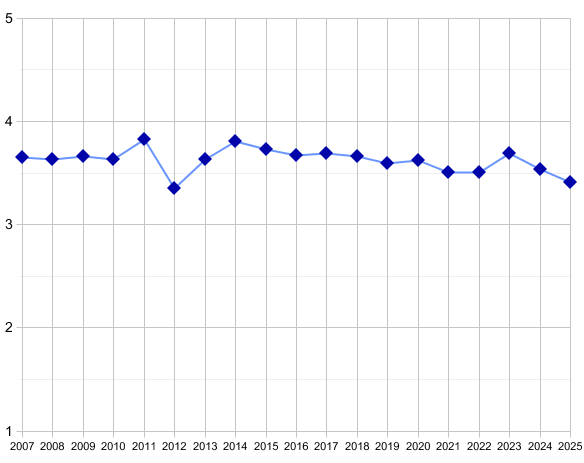
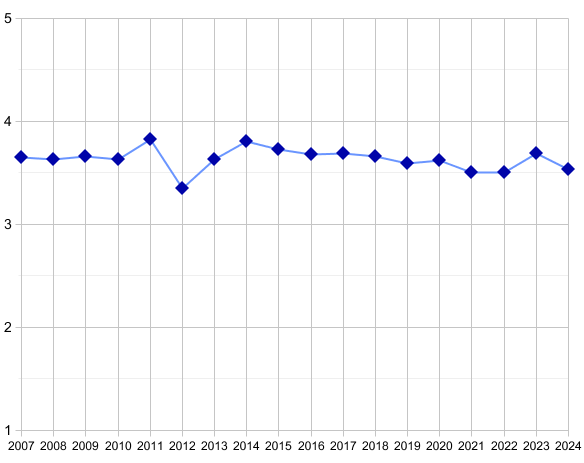
And so to the big final number: the average score for 2024. Oo-ooh! The short version is 3.5 out of 5 — down from last year, but the same as the two years before that. To get more precise (for the sake of comparison, as all of my years fall within a spread of 0.4), at three decimal places the score is 3.534 — that’s above 2021 and 2022, then, but the only other year it bests is 2012 (a real outlier, as you can see on the below chart). As my fourth lowest-scoring year, it’s almost the antithesis to last year, which was fifth highest.

What can we conclude from all that? Nothing much, really. The fact that line is pretty flat (a few oddities aside) suggests both my film choosing and my scoring have remained consistent over the years, for good or ill. Should I choose better films? Should I score more leniently? Or more harshly? To be honest, I don’t really think about such questions. I take these stats as an indication of what’s happened, not as a learning exercise in what I should or shouldn’t change.


Talking of scores and finales, next up is the finale of the 2024 review: my pick of the best from my 131 first-time watches.

2017 Statistics

Yesterday I published the full list of my 2017 viewing. Well, I say “full” — I didn’t put my Rewatchathon viewing in there. I’m not going to include it in these stats either (mostly). Maybe I’ll do something differently about that at the end of 2018, but for now this all remains focused on my primary goal: watching at least 100 films every year that I’ve never seen before.

In today’s post we do the fun stuff: look at all sorts of statistics about that viewing. Hurrah!

In the end, I watched 174 new feature films in 2017. That’s my third highest final total, behind 2016’s 195 and 2015’s 200, though it’s quite far ahead of fourth place, 2014’s 136.

I also watched two extended or altered cuts of features I’d seen before. They’ll be included in all the stats that follow (except the running time one we’ll get to in a sec).

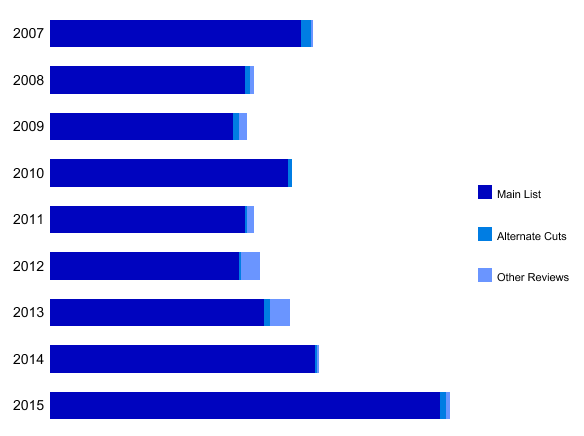
However, those 176 films are not the full story. As I mentioned in my introduction, this year I set myself a secondary goal — Rewatchathon — in which I aimed to make myself watch again at least 52 films I’d seen before. Obviously this took viewing time away from my main goal, and I became curious how 2017 would compare to previous years if those rewatches had been main list views. To keep things fair I had to go back and tot up my rewatches from previous years. Fortunately, I have complete records for that as far back as 2009 (I have a little over half of 2008, which suggests it was a good year, but not good enough to challenge the last couple). The number of films I rewatched fluctuated wildly at times (21 in 2013, 4 in 2014, 20 in 2015, etc), but unsurprisingly the biggest overall totals came in the years when 100 Films was also high. The only years that passed 200 were the last two: altogether I watched 206 films in 2016 and 223 in 2015. In 2017, I watched… 228. So, yes, this is officially my most film-filled year on record.

(An additional bit of stats business: in previous years there was the odd rewatch that I also reviewed, meaning it was included in the stats (it’s the “other reviews” bit in the graph above). My Rewatchathon is putting an end to that. I’ve reviewed some stuff from it but certainly not everything, so it would be a bit weird to just count the handful of films I did happen to review. I could count every single film I watched for the Rewatchathon, but that feels somehow against the point. It means my stats for previous years don’t compare with 100% accuracy to these, but I was always inconsistent on which rewatches I counted anyway.)

Additionally to all that, I also watched five short films. They don’t count in any stats… except the one they do, which we’ll get to in half a sec.

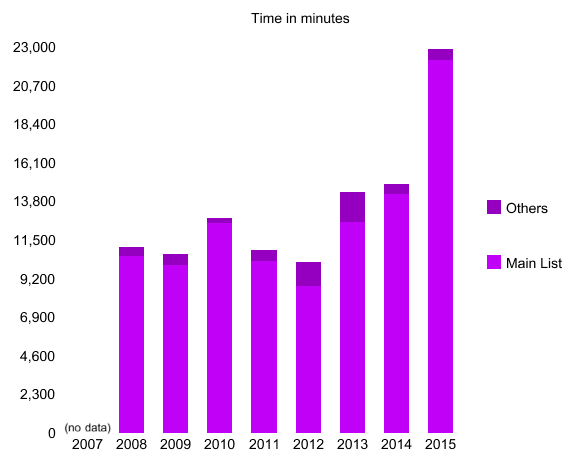
The total running time of the 174 new features was 316 hours and 43 minutes, which (as the graph shows) is in line with what you’d expect given the number of films. Add in the two alternate cuts and five shorts and the total running time of all films was 321 hours and 59 minutes.

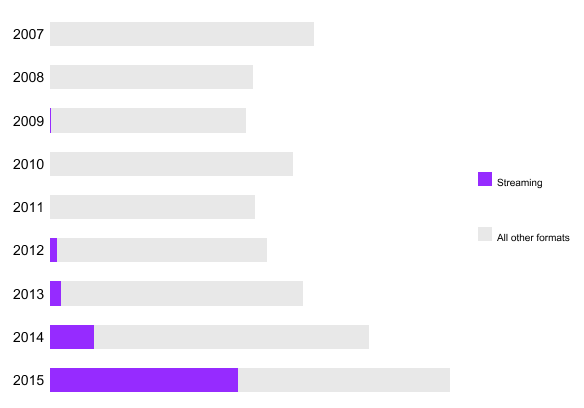
This year’s most prolific viewing format was streaming for the third year in a row, but it suffered a bit of a drop: it accounted for 76 films, which was 43.2% of my viewing — down from 57% last year, and even below the 47% from the year before. Where did those percentage of views go? Well, a few different places. I’ll get onto those in a sec. Firstly: this year I bothered to count up which streaming services I used. It was all divided between the three main players on this side of the pond: Netflix, Amazon (including both Prime and rentals), and Now TV. Amazon accounted for precisely 50% (38 films), with Netflix on more-or-less 30% (23 films), and Now TV bringing up the rear on 20% (15 films). I’ve mostly used Netflix for series this year, mind, whereas I don’t think I’ve watched more than a couple of episodes of anything on Amazon (and Now TV do TV as a separate subscription).

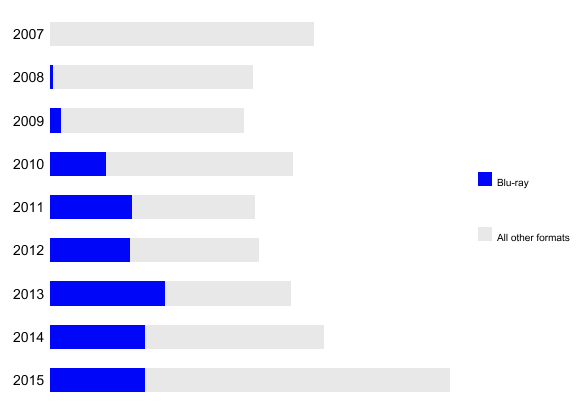
Second place went to Blu-ray, with 46 films (26.1%) — up from last year, but otherwise my lowest since 2012. As I say every year: I own hundreds of the things, I need to watch them more. (It’s worse for DVD, mind, but we’ll come to that.)

There’s more of an ‘upset’ in third place, however: cinema! It’s been in last place for five of the last six years (the one exception, 2012, it was second-last), and it didn’t have a particular strong showing before that. Indeed, 2017 marks my greatest number of cinema trips in one year since this blog began, with 18 films (10.2%). In fact, that’s more than the last seven years combined. I intend for this to continue in 2018, but I don’t know if it’ll increase — it’s so much more cost effective to wait for films at home these days…

Next, there’s a small increase for downloads, with 14½ films (8.2%) — the half because I had to download City of God when my DVD copy crapped out halfway through. It’s overleaped television, which continues its slide from dominance (it was first from 2009 to 2012) with 13 films (7.4%).

Bringing up the rear is an even more ignominious faller: the humble once-beloved DVD, with 8½ films (4.8%) — actually a slight increase from last year! I mean, it’s up from 8 to 8½ and from 4% to 4.8%, but still…

In amongst all that, I watched 11 films in 3D (a mix of Blu-rays, downloads, a TV rental, and one in the cinema) and 1 in 4K. I have a feeling the latter will increase in 2018, but I’ve no idea by how much.

Which brings me to the HD vs. SD, to which I’ve added that meagre UHD offering this year. HD includes all but one stream, all of Blu-ray and cinema, all but one download, and just under a third of my TV viewings. In the SD camp there’s one streamer and one download (obv.), just over two-thirds of my TV viewing, and the handful of DVDs. The final result is 88.4% in HD, boosted by 0.6% in UHD. It’s slightly up on last year, but not a huge amount.

In terms of the films’ age, the most popular decade was the 2010s (same as since 2012) with 114 films (64.8%). That number’s down on last year, though the percentage went up (I watched about 20 fewer films overall, remember). In second, however, the 2000s saw real gains (albeit small ones), going from 18 up to 21 (11.9%). The only other decade to make double figures was the ’90s, holding steady on 15 (8.5%).

Below that, there were a smattering of films for every decade back to the ’20s: the ’80s clocked eight (4.6%), the ’70s reached seven (3.98%), the ’60s had four (2.3%), the ’50s only two (1.1%), the ’40s a slightly better three (1.7%), and the ’30s and the ’20s netted just one each (0.6%).

Last year, the percentage of films I watched in English dipped below 90% for the first time. This year it was back over it, though only at 90.1%. That’s 160 films wholly or partially in English. However, there were more others than recently: 32 languages were spoken in total (plus one silent film), up from 24 in the 2015 and 2016. Distant second was an uncommonly strong showing for Japanese in 15 films (8.5%), while everything else was in single figures. Of particular note is American Sign Language cropping up in three films, and Ancient Egyptian and Pawnee both putting in appearances for the second year in a row.

It’s the same story in countries of production, with the USA producing 138 films — 78.4%, up from last year’s 73.6%. Distant second was the UK with 42 films — that’s 23.9%, identical to last year. Again mirroring the language stats, Japan had an unusually strong showing with 14 films (7.95%), by far its best result (its previous high on record was six). Just behind were Canada and France on 13 (7.4%) each. Next was China, its nine representing a continuing increase, mostly co-productions as Hollywood continues its interests there, I’d wager. Concurrently, former co-production fave Germany is on the way down, with just six (almost half its figure from last year), which is tied with Australia.

Running down the list, there’s Hong Kong on five (after a big bump last year thanks to a load of Shaw Brothers films, this is back to normal), New Zealand on four, and three each for Denmark and Ireland. Five more countries had two apiece, and 12 countries contributed to a single film each. That’s a total of 29 countries represented, just one down from last year.

A total of 143 directors plus 13 directing partnerships appear on 2017’s main list. Of those, 18 had multiple credits. The man with the most was David Lynch on four — and that doesn’t even include Twin Peaks: The Return (or whatever we’re calling it nowadays). Behind him on three apiece we find Clint Eastwood and Keishi Ōtomo (the Rurouni Kenshin trilogy). Then there’s Taika Waititi, who directed two films himself plus one as co-director; and Michael Bay, who directed two films plus an alternate cut; and George Miller, who only has one main list film to his solo name, but was also behind an alternate cut and a quarter or another film. Keeping things simple with a pure two each there’s Mel Brooks, Paul Feig, Ron Howard, Duncan Jones, Shūsuke Kaneko, David Mackenzie, Penny Marshall, Tokuzô Tanaka, and Adam Wingard. Finally, Wes Anderson and David Leitch both helmed a main list feature and a short, while this blog’s most-featured director of all time, Steven Spielberg, had one new feature and a quarter of another. The rest took one each, although in the shorts we can find Luke Scott, son of Ridley, taking charge of two of the Blade Runner 2049 prequels.

For the past two years I’ve specifically charted the number of female directors whose work I’ve watched. There were just four female directors in 2017’s viewing, with five films between them, which is 2.84%. That’s better than last year, but worse than 2015 — and none of them are very good figures in any case.

On a brighter note (for me), 11 films from the main list currently appear on the IMDb Top 250 (or whatever it’s called nowadays). Their positions ranges from 21st (City of God) to 210th (Thor: Ragnarok). However, because that list is ever-changing, the number I have left to see has only gone down by seven, to 69.

At the end of my annual “top ten” post I always include a list of 50 notable films I missed from that year’s releases, and continue to track my progress at watching those ‘misses’. In 2017, I’ve seen at least one more movie from every year’s list. To rattle through them (including the overall total seen in brackets), this year I watched: one from 2007 (34); four from 2008 (24); three from 2009 (29); three from 2010 (30); one from 2011 (33); two from 2012 (32); one from 2013 (32); five from 2014 (41); and four from 2015 (32).

Finally, in the first year of watching 2016’s 50, I saw 30 of them. That’s the best ‘first year’ ever, just beating the 28 from 2015’s list that I watched during 2016.

In total, I’ve now seen 317 out of 500 of those ‘missed’ movies. That’s 63.4%, up from the 58.4% I’d got through by the end of last year. Basically, I’m watching them faster than I add them — which is a good thing. (As usual, this year’s new 50 will be listed in my next post.)

To finish off 2017’s statistics, then, it’s the climax of every review: the scores.

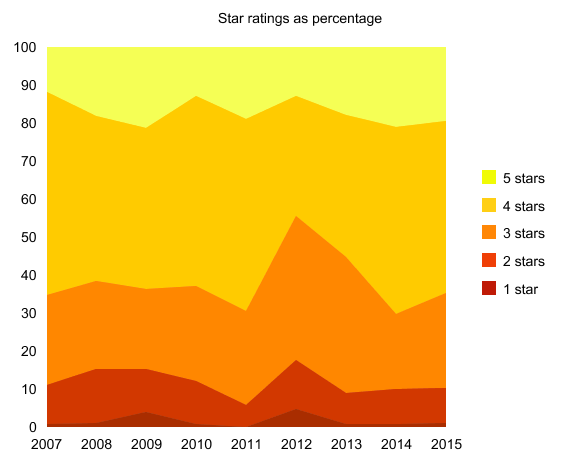
At the top end of the spectrum, I awarded 32 five-star ratings in 2017. That’s more than last year, even though I watched fewer films, meaning the percentage was well up — 18.2% vs. 2016’s 13.2%. It’s above my all-time five-star average too, which is 16.85%. Am I getting more generous or just picking better films? Such is always the debate. Maybe it’s the latter, though, because my four-star ratings dipped to 78 films — still second place, but at 44.3% it’s well down on last year and below the all-time average of 45.8%. Commensurately, the percentage of three-star ratings were above average: those 49 films equal 27.8%, over the all-time 26.4%. All that said, we’re not talking numbers that massively outside the norm here (as we’ll see shortly).

Rounding things out at the bottom end, there were 15 two-star films (8.5%), which is very much a normal amount, and a mere two one-star films (1.14%), which is also pretty normal (across ten years the average number is 2.1 a year).

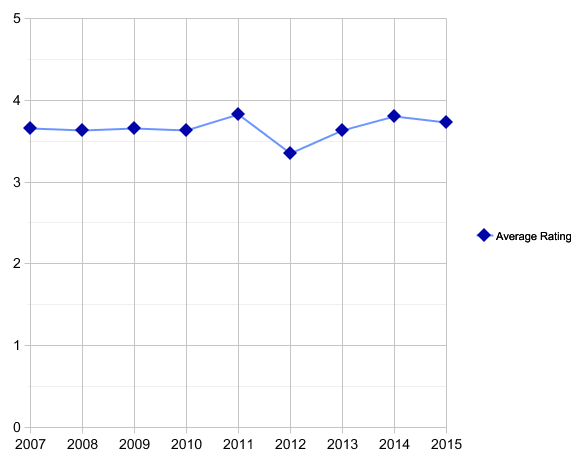
And so all of that brings us the average score — the single figure that (arguably) asserts 2017’s quality compared to other years. The short version is 3.7, the same as the last two years, as well as 2007 and 2009. We have to add a few more decimal places to get a precise idea, however (if we don’t, seven out of eleven years score either 3.6 or 3.7). To three decimal places, 2017 scores 3.699. That’s 0.024 higher than 2016, meaning it takes fourth place on the all-time chart, sitting just 0.031 behind 2015 in third. These are tiny margins, as always — I guess that means my scoring is pretty consistent.

And that’s all your numbers and graphs done for another year! It’s OK, you can read them again if you want.


More quality assessments, with my lists of the best and worst films I saw last year.

2016: The Full List

2016 is set to go down as a very bad year: everybody died, nasty people won things, and it felt like there was a lot of disappointment at the movies too. Will 2017 be better? Probably not. I mean, people will still die, and we’ve got the fall-out of last year’s votes to endure for the next goodness-knows-how-many years.

…I hadn’t intended to be so doom and gloom. Sorry.

In the world of 100 Films, it was my 10th year (did I mention that already?) Part of that was my celebratory 100 Favourites series, which I covered pretty thoroughly in its own conclusion so won’t get into again here. As for the main point of this site, I watched 195 new-to-me films — not as many as last year, but then I expressly didn’t want to go that crazy again. I was thinking a little less than almost-the-same-again, though!

Anyway, it’s time to wrap all that up. Today, the usual array of factual analysis of my viewing (lists! statistics! yay statistics!), then later in the week (whenever I’ve finished writing it) will be my top ten & all that.

But first of all: as this post is a long scroll past a lot of words and pictures if you don’t like reading a long list of films (I mean, you can read it all if you like — that’s why it’s here), some handy links so you can jump straight to the good bit.


Below is a graphical representation of my 2016 viewing, month by month. Each image links to the relevant monthly update, which contains the numbered list of everything I watched this year — plus other thrills, like my monthly Arbie awards.


Alternate Cuts
Shorts
10 Cloverfield Lane

The Adventures of Buckaroo Banzai Across the 8th Dimension

Barry Lyndon

Beverly Hills Cop II

Brooklyn

Captain America: Civil War

Dallas Buyers Club

Deep Blue Sea

Electric Boogaloo

Ex Machina

The Good Dinosaur

The Hateful Eight

Invasion of the Body Snatchers

Jack Ryan: Shadow Recruit

The Last Temptation of Christ

The Magnificent Seven

The Man from UNCLE

Napoleon

Our Kind of Traitor

Pride

Return of the One-Armed Swordsman

Road Games

The Second Best Exotic Marigold Hotel

Star Trek Beyond

The Survivalist

Ted 2

The Visit

White God

Independence Day

The Present

.

In the end, I watched 195 new feature films in 2016. (They’re all included in the following stats, even if there’s no review yet.) That’s not quite as high as last year’s 200, but is otherwise far ahead of every other year — it’s more than double my worst year.

I also watched three extended or altered cuts of films I’d seen before, one of which (Batman v Superman: Ultimate Edition) was different enough to count on the main list. For the first time since 2010 I didn’t review any films & cuts I’d seen before — other than the 100 in my Favourites series, of course.

And if you did happen to be wondering what that might look like with my 100 Favourites included… well…

Finally, I watched seven short films this year — though four of those are counted in the main list as The Quay Brothers in 35mm. For the purposes of these statistics, that will be counted as one feature rather than four shorts. As usual, none of the other shorts are counted in the following statistics (except the one stat that mentions them).

The total running time of new features was 362 hours and 58 minutes, which — as will become a running theme if I keep mentioning it — is a little way behind 2015 but far ahead of every other year. Throw in those handful of alternate cuts and shorts and the total running time of all films was 367 hours and 57 minutes.

For the second year in a row my most prolific viewing format was streaming. In fact it saw an increase on last year, accounting for 113 films, 57.4% of my viewing. For most people the reason for that would be Netflix, but I only subscribe to that sometimes — there’s also Now TV, Amazon Prime, renting stuff, plus YouTube, Vimeo, and iPlayer too. Unfortunately I didn’t bother to keep a record of which service I used when and can’t be bothered to go back through 113 films and work it out, but maybe I’ll note it next year.

Second place once again belonged to Blu-ray, but with a reduced 41 films, which amounts to just 20.8%. Considering I keep buying the things (I know exactly how many I acquired in the last year and, compared to how many I watched, it’s embarrassing), I really ought to upend this equation. Maybe in 2017. (Yeah, right.)

It’s another repeat of last year in third place, where television accounts for 19 films, under 10% of my viewing. That’s also down from last year, continuing a slide that’s been going on for four years now. I keep recording stuff, but then they’re always there, just waiting, while stuff on streaming services has a habit of getting removed…

In a number that has held exactly the same, nine films were downloads, but this year that’s enough to boost it to fourth place. The number of DVDs I watched halved to just eight, a little over 4%. Considering I have literally hundreds of these unwatched, this is getting silly.

The final format was cinema, though the seven trips I made this year is my highest since 2008. I was going to go more over the summer but sometimes life gets in the way. Is there enough exciting stuff due in 2017 to boost this number next year? Time will tell.

As the final word on formats, I’ve once again tallied how many I watched in HD vs. SD. In the former camp we’ve got the vast majority of my streaming views (94.7% of them, to be precise), all the Blu-rays, most of the downloads, over half the TV viewings, and all the cinema visits. In ye olde standarde definitione there’s a handful of streaming and TV views, a single download, and those meagre DVD spins. The final tally says that 88.3% of my 2016 viewing was in glorious high definition. Hurrah!

It wasn’t just the technology that was modern: the most popular decade among my 2016 viewing was the 2010s with 121 films (61.4%). That’s marginally down from 2015, but it’s not like the gains were particularly felt elsewhere: distant second went to the 2000s with 18 (9.1%), exactly the same number of films as last year, while the ’90s came third with 15 (7.6%).

In fourth place was an uncommonly strong turnout for the ’70s with 14 films (7.1%), while the last decade in double figures was the ’80s with 12 (6.1%). As for the next few, they showed an element of name/tally synergy: the ’60s had six (3%), the ’50s had five (2.5%), and the ’40s had four (2%). Finishing it off, there was one each for the the ’20s and ’30s.

In another case of unsurprising business-as-usual, this year’s dominant language was English, featuring in 177 films. However, that works out as 89.8% of the films I watched — the first time that percentage has dipped below 90%. Nothing else comes even vaguely close, but nonetheless second place is a surprise: Russian, with 14 (7.1%). I watched two Russian films and one Russian co-production this year, so quite where the other 11 come from I don’t know. US/UK-produced spy movies, probably. Just behind that is Mandarin with 13 (6.6%), which is more explicable as I watched all those Shaw Brothers movies. Fifth place was split four ways, with eight films (4.1%) each for French, German, Japanese, and Spanish. In all, there were 24 languages this year (plus one “silent”), which is the exact same number as last year. More unusual ones included Ancient Egyptian, American Sign Language, Pawnee, and Xhosa.

It’s a similar story in countries of production: the USA remains dominate with 145 films, but the percentage — 73.6% — is marginally down from last year. In its usual second place, but also with its numbers slightly down, was the UK, with a hand in 47 films (23.9%). As always, these aren’t all films you’d identify as “American” or “British”, but most of the other countries I’ll mention are present thanks to co-productions as well, so it kinda balances out.

Among the rest, France was third with 18; joint fourth were Canada and Hong Kong on 12 each; and just behind them was Germany with 11. Counting down to round out the field were Australia (eight), China (seven), Japan (six), Ireland (five), Spain (four), and three each from Belgium, Italy, and Russia. A further five countries could claim two films, and 11 countries contributed to one apiece. Those with a definite claim to “country of origin” include Hungary, Indonesia, South Africa, and Taiwan.

A total of 157 directors plus 13 directing partnerships appear on 2016’s main list — and one film where I only credited an editor, too. Of those, 15 had multiple credits to their name. Easily the most prolific director on my blog this year was Steven Spielberg: his five main list films join his six entries in my 100 Favourites to almost triple the number of his films I’ve covered in this blog’s lifetime. Denis Villeneuve was second with four films, while Shaw Bros regular Chang Cheh had three plus a fourth with a co-director. There were three features from John Carpenter, Liu Chia-liang, and Zack Snyder (thanks to counting BvS twice), while Wes Anderson has two features plus one short. With two features there was Alexander Payne, Ben Wheatley, Bryan Singer, Guy Ritchie, Kenneth Branagh, Paul Feig, Ridley Scott, and the Spierig Brothers. Finally, David Ayer has one main list film and one alternate cut… of the same film. Unlike studio stablemate Snyder, he didn’t make enough changes to get on the main list twice.

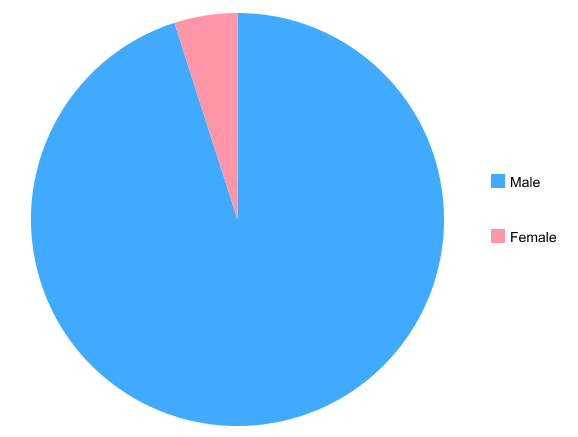
Last year I specifically counted the number of female directors. The number wasn’t pretty… and this year it’s even worse: there were just two female directors in this year’s viewing, plus one who’s half of a partnership and another who’s a third of one. That’s 1.66%, which looks like this:

If that was a graph of the population, we’d be bloody extinct. I could blame myself, or I could blame the state of the industry. Maybe it’s a bit of both.

On a cheerier note, as of New Year’s Day 2017, 19 films from the main list appear on the IMDb Top 250 — more than last year, or the year before! Their positions ranges from 16th (One Flew Over the Cuckoo’s Nest) to 239th (Barry Lyndon). However, I still have 76 left to see, which is only seven less than last year. How’d that happen? I guess new stuff came on and barged out stuff I’d seen. Shame.

At the end of my annual “top ten” post I always include a list of 50 notable films I missed from that year’s releases, and continue to track my progress at watching those ‘misses’. In 2016, I’ve seen at least one more movie from every year’s list. To rattle through them (including in brackets the overall total I’ve now seen), this year I watched: one from 2007 (33); one from 2008 (20); three from 2009 (26); two from 2010 (27); five from 2011 (32); two from 2012 (30); two from 2013 (31); and 16 from 2014 (36).

Finally, in the first year of 2015’s 50, I watched 28 of them. That’s the best ‘first year’ ever, and the first time I’ve seen over 50% of the 50 in a first year. It’s also more in one year than I’ve managed in the six since 2010, seven since 2009, and eight since 2008. Tsk.

In total, I’ve now seen 263 out of 450 of those ‘missed’ movies. That’s 58.4% of them, a jump up from last year’s 50.75%, and even more from two years ago’s 43.7%. (As usual, this year’s new 50 will be listed in my next post.)

To finish off 2016’s statistics, then, it’s the climax of every review: the scores.

At the top end of the spectrum, this year I awarded 26 five-star ratings. That’s a lot less than last year’s 40 — indeed, it’s 13.2% of my viewing this year, while my all-time five-star percentage is 16.7%. On the bright side, I gave 101 four-star ratings, the most ever. Representing 51.27% of this year’s viewing, it’s well above the lifetime percentage of 45.99%.

A distant second were the 53 three-star films. That’s also their highest total ever, though at 26.9% it’s only just higher than the all-time figure of 26.18%. There were also 14 two-star films, which is pretty normal, and an above-average total of three one-star films — though, at 1.5% of my viewing, I’m not going to be losing any sleep over that.

Last but not least, the average score — the single figure that (arguably) asserts 2016’s quality compared to other years. The short version is 3.7, the same as last year (and 2007 and 2009 before that). Looking with greater precision, it’s actually a bit down: to three decimal places, 2016’s score is 3.675. That places it 4th all time (behind 2011, 2014, and 2015, and just a smidge ahead of 2009).

And that’s 2016’s statistics!

I know, it’s sad they’re over. It’s okay, you can read them again — I know I will.


Next time: the best (and worst) films I saw for the first time in 2016.

2015: The Full List

At one point, people were calling 2015 the “best year for movies ever”. The current superhero craze was going to reach new heights with both Batman vs Superman and the sequel to the highest grossing film of all time not directed by James Cameron, Avengers 2; there was to be a follow-up to the first billion-dollar Bond; and there was the little matter of the return of Star Wars to boot. Of course, things didn’t pan out that way: Batman v Superman (not vs) got kicked to 2016; Avengers 2 disappointed quite a few people and didn’t set any box office records (which these days is essentially a failure, right?); but hey, at least Bond and Star Wars turned up… to a predictably mixed response.

Even if the wider world was mired in some form of disappointment or other, at least 2015 was the best year for movies ever for me. Regular readers will have already learnt about some of this year’s extraordinary numbers through my monthly progress reports, and there are even more to be found in the statistics section of this post — aka the best part of the entire year. And this year, there are more graphs than ever before!

So without further ado…


Here’s a graphical representation of my 2015 viewing, month by month. Handily, each of these images links to the relevant monthly update, where you’ll find the numbered list of everything I watched this year (amongst plentiful other jollities).


And now, in alphabetical order…


Alternate Cuts
Other Reviews
Shorts

I watched a record-obliterating 200 new feature films in 2015. (All are included in the stats that follow, even if there’s no review yet.) That’s far and away my highest tally ever, beating last year’s previous best, 136, by 47%.

I also watched three features I’d seen before that were extended or altered in some way, and chose to review two others for the fun of it. Four of those films are included in the statistics that follow, the exception being Transformers: Age of Extinction, which I ‘reviewed’ without actually watching.

I also watched five short films, which is within my usual range. Also as usual, none of them are counted in the following statistics (apart from the one that mentions it includes them).

The total running time of new features this year was a mind-bending 369 hours and 56 minutes. Put another way, that’s just shy of 15½ days. Unsurprisingly, it’s a new record. How much so? Well, for perspective, 2013’s running time was also a record-setter, exceeding the previous best by 58 minutes. Then 2014 broke that record by a massive 28 hours. Now 2015’s done it by almost 133 hours. That increase alone is equivalent to 5½ days of solid viewing. To round that out, the total running time of all films (including shorts) was 381 hours and 31 minutes. Here’s all that as a graph:

Now: the who, what, where, when, and how of that viewing. (This is a theme that will become apparent as we go, I promise.)

In a massive upset to the status quo, this year’s most prolific format was streaming — and not just by a little: it accounted for 96 films, a massive 47% of my total. Who’d’ve thunk that a few years ago?! It was ‘big news’ last year when it was in third place with 23, but this year more than quadruples that. Partly that’s because this year I’ve finally used some free trials: at one time or another in the past 12 months I’ve had Now TV (i.e. Sky Movies), Amazon Prime Instant Video, MUBI, and Netflix, not to mention taking advantage of those digital discounts Amazon sometimes give to rent newer movies.

That means the previous two years’ victor, Blu-ray, comes second. I watched 49 films on that format, the exact same number as last year… which of course means it’s lower in percentage terms, at 24% vs. last year’s 35%. I really ought to shift my viewing habits away from streaming and in favour of Blu-ray, because I have tonnes of the things stacked up.

Third place belongs to television, with 32. A slight decrease from last year (and even more so in percentage terms, obviously). Why? Who knows. Partly, I expect, because a lot of channels seem to show the same films on loop. I’m also not very good at being beholden to TV schedules (I barely watch any TV ‘live’ either) and my V+ box is permanently almost-full with stuff I’ve already recorded and not got round to.

In fourth we have the once-mighty DVD, with just 16 (7.8%). That’s better than 2010 to 2012, but a bit down on last year. I have even more of these unwatched than I do Blu-rays, so I ought to get stuck into them more. I say that every year, though.

Penultimately, downloads accounted for nine films this year. Bigger news, though, is last place: this year, I actually bothered to go to the cinema for the first time since 2012 — twice. Such is the lure of new Bond and new Star Wars. And y’know, it reminded me that sometimes it’s worth the extra effort and expense. With some big spectacle-y movies coming up this year, maybe I’ll make the effort more often.

Finally for formats, I thought I’d tally up how many films I watched in HD vs. SD. In the superior quality camp, you’ve got all the Blu-rays and my pair of theatrical viewings, plus 86 on streaming, seven on download, and three on TV. For SD, that just leaves the remaining 29 TV viewings, 16 DVDs, 10 streamed films, and two downloads. To summarise, 72.1% of my viewing was in glorious high definition.

That’s the ‘how’ I watched my films, but what about the ‘when’: how old were the films I watched in 2015? Well, last year the most popular decade was our current one, contributing a “whopping” (to quote year-ago me) 50.7% of my viewing. That was the first time a single decade had accounted for over half my viewing since 2009. This year, the 2010s are top again, with 128 films — which is 62.75%! I’m always trying to catch up on recent films, and I guess the deeper we get into the decade, the more “recent films” are from it.

In second place, unsurprisingly, was the next-most-recent decade, the ’00s. With 18 films, aka 8.8%, it wasn’t even close. What it was close to was third, which is a surprise-high finish for the ’80s, on 17 (8.3%). I must say, it definitely felt like I watched a lot of ’80s movies this year, exacerbated by their mini stylistic revival in films like The Guest. In fourth place is the only other decade to make double figures, the ’90s, with 12 (5.9%).

Moving further back in time, every decade since the ’20s was represented. Last year I managed to stretch back to the 1910s, but I skipped the ’20s, so it’s all equal. In fact, the last time I watched a film from the ’20s was 2010. They fared considerably better this year, reaching six (2.9%). Just ahead of them were the ’40s with nine (4.4%), and just behind were the ’60s with five (2.5%). Rounding out the field, the ’50s and the ’70s tied on four (2%), and the ’30s brought up the rear with one (0.5%).

Next up: ‘where’ — as in, where were the films from? We’ll begin with the better indicator: language (because, as we’ll see, “country” gets all mixed up with co-productions). As ever, English was massively dominant, featuring wholly or in part in 187 of the 204 films. That’s 91.67%, a minor increase on last year’s 91.3%, but hardly a meaningful one. For one thing, several films you would certainly label as “foreign language”, like Force Majeuere and Le Mépris, feature enough English to have it as a listed language and therefore contribute to this total. Despite the possibility of such shared languages, nothing else comes close: French is second with eight (3.9%), closely followed by silent films with seven (3.4%). Better were the number of different languages heard: last year reached a high of 15, which 2015 exceeds with 24 (plus one for “silent”, in each case). More uncommon ones include Acholi, Hawaiian, and Scottish Gaelic.

There’s a similar increase in countries of production: last year there were 27, this year it’s 32. It’ll come as no surprise that the USA once again dominated, with 153 films. As ever, thanks to co-productions these aren’t all films you’d identify as “American”, but I guess that’s balanced out in the final tally by all the international co-productions that you wouldn’t consider to hail from those countries either. Nonetheless, 153 is exactly 75% of this year’s films, which is slightly down on the 80.4% the US represented last year.

In second place, an equally-unsurprising showing for my home team, i.e. the UK. Producing or contributing to 54 films gives it 26.5%, a nice increase on last year’s 18.1%. Last year there were only five other countries that could claim a part in three or more films, but this year there are 11. Heading up the board is France with 17; joint fourth are Germany and Canada with 10 apiece; China had a hand in seven; and Antipodean cousins Australia and New Zealand both tallied six (with significant help from George Miller to the former and Peter Jackson to the latter). Also with 3+ were: Hong Kong (five), Japan and Ireland (four each), and Belgium and Sweden (three each). That leaves six countries with two, and thirteen with one. Those with a definite claim to “country of origin” include Argentina, India, and the Soviet Union.

In terms of ‘what’ I watched, there are a few different observations. First up: how the BBFC and MPAA classified them. Showing the parity everyone always perceives, both the BBFC’s 12 and MPAA’s PG-13 totalled 41 films this year. That’s about the same number as last year, meaning the 20.1% it represents is down. The most prolific certificates this year are, respectively, the 15 (83 films, 40.7%) and R (86, 42.2%), because I’m a growned-up, innit. You can never discount the MPAA’s unrated category, which bests even the PG-13 with 50 titles (24.5%). Rounding out the field, the BBFC seem more prepared to go for their child-friendly U (20, 9.8%) than the MPAA do their G (four, 2%), while the figures for PG are about equal, with the BBFC on 26 (12.7%) and the MPAA on 23 (11.3%). In fact, in both instances the increase is likely thanks to older films, which tend to sit at the U/PG level, and the BBFC still have to classify but the MPAA don’t (so they go into unrated). Oh, and the BBFC’s 18 equalled the U with 20 (9.8%), while somehow 14 films (6.9%) managed to go BBFC-free.

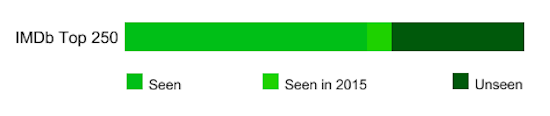
15 films from the main list appear on the IMDb Top 250 at the end of 2015 — the exact same number I achieved last year. It would’ve been slightly more if I’d finished What Do You Mean You Haven’t Seen, as the three of those I missed are also on there. The positions of the ones I did see range from 29th (Interstellar) to 231st (High Noon). I currently have 83 of the Top 250 left to see — the first time I’ve got that number below 100. Lovely.

Now, a new addition to the stats: as I’ve started including a “most read new post” part in my monthly progress reports, I thought I’d do so here too. As if to prove the endurance of having a review archive, this year’s most read (or, at least, most visited) new post was only the 12th most-read post of the year. It slips in behind not only three Harry Potters but a few (well, eight, obviously) other randomers (2 Fast 2 Furious is third — why?!) And that victor is… a little surprising, because I have no idea why it’s been so well-read — it wasn’t posted for a blogathon; it didn’t get retweeted by a fan group, member of the production team, or Film4 (all of which have happened to other of my reviews this year). It is a damn fine film, though: it’s Requiem for a Dream.

Speaking of additions, every year I feel I’d like to include stats on which genres I most watched, or which actors were regularly represented. This year, for instance, it felt like I watched a lot of Channing Tatum films (there were five), and Rachel McAdams kept cropping up towards the end (three times in December) — but is that so unusual? I mean, for starters, there were three supporting-lead roles for Harrison Ford in my viewing this year, but they were less noticeable because they were more spread out. I never add these things because, due to the way I compile my stats (I shan’t bore you with the details), it would be very hard/impossible. Hey, maybe next year.

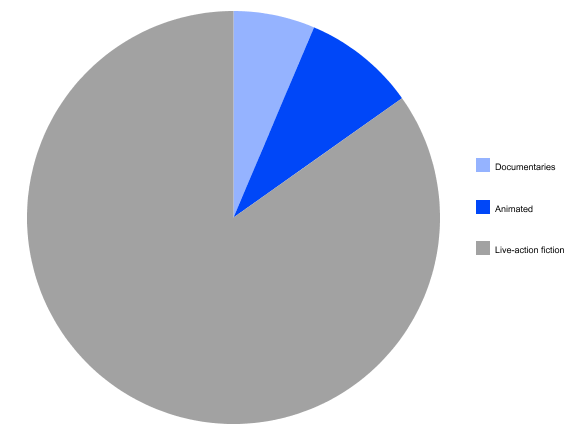
One thing I did do this year, however, was inspired by my comment that I seem to have watched a lot of documentaries. Consequently, I tallied how many of the films I watched were documentaries, how many were animated, and dumped the rest into “live-action fiction”. Not quite a genre stat, more a form one. And the results were: 13 documentaries (6.4%), 18 animated movies (8.8%), and 173 live-action fiction movies (84.8%). Obviously the last category dominates, but I don’t think that’s by any means a bad showing for the first two. (For what it’s worth, I counted The Dark Crystal as live-action, because it’s puppets filmed in real-time rather than, say, stop-motion animation.)

At the end of every previous year-end summary I’ve included a list of 50 notable films I’d missed from that year’s releases, and have since tracked my progress at watching those ‘misses’. In 2015, I’ve seen more movies from every year’s list. To rattle through them, with the overall total I’ve now seen in brackets, this year I watched: two from 2007 (32); four from 2008 (19); one each from 2009 (23) and 2010 (25); three from 2011 (27); six from 2012 (28); and 13 from 2013 (29). That’s a moderately consistent number watched from each year, with the exception of 2008’s lowly tally. I don’t know what I did wrong with that year’s 50, but it’s become a real black sheep.

Finally, in the first year of 2014’s 50, I watched 20 of them. That’s the best ‘first year’ ever (besting the 17 from 2007 I watched in 2008), and is more in one year than I’ve managed in the seven since 2008. Seriously, what was wrong with that list?!

The graph shows my progress year by year (obviously), but I can tell you I’ve seen 203 out of 400 ‘missed’ movies, which is 50.75% — a tidy improvement on last year’s 43.7%. Of course, I own or have access to over 100 of the remaining 197, so I could do even better.

After ‘what’, ‘where’, ‘when’, and ‘how’, all that remains is ‘who’ — who made these 204 feature films? A total of 155 solo directors and 17 directing partnerships appear on 2015’s main list. Obviously that’s the most ever — considering this year is up 47% on even the next-best year, which was itself a significant record-breaker, then of course the director total is up a lot too. It’s not up 47% though, but 33.3%.

That’s because a massive 23 of those directors have multiple films on the list (for perspective, last year it was just 10). Most prolific is Steven Soderbergh, with four. Next, George Miller has three to his own name, plus he was part of a partnership. There are three each from Jamie Benning, Bill Condon, David Cronenberg, Roger Michell, and Roy William Neill, while Bryan Singer has two main list films and an extended cut, and Peter Jackson has one main list film but two extended cuts. With two main list films each we find David Ayer, Brad Bird, John Carpenter, Clint Eastwood, David Fincher, Ron Howard, Richard Linklater, Carol Morley, Martin Scorsese, Steven Spielberg, Colin Trevorrow, and Adam Wingard, while Stanley Kubrick has one main list film and one other review. Finally, Dean DeBlois has a solo credit and another as part of a partnership.

At a time when their prevalence (or lack thereof) is a point of discussion, I can say that eight of those directors were female, as was half of one directing partnership. I’m sure that’s better than it has been in the past, but, as you can see from this graph, it’s not actually very many…

And so we come to the climax of the statistics: how I rated 2015’s viewing.

I’ll start by saying that almost all of these are their highest-ever total — no surprise considering how many more films than normal I watched this year. The only exception, happily, is one-star films, of which there were two. Appropriately, that rating usually only totals ‘one’, so for it to come to double that in the year I watched exactly double my target… well, that’s just synergistic.

At the other extreme, this year there were 40 five-star films. That’s 11 more than the next best year, which will surely make compiling my top ten fun, but it’s still just 19.6% of 2015’s viewing. For perspective, my all-time percentage of five-star films is around 17.2%, so it is marginally above average. In terms of all previous years’ percentages, it ranks third.

The most prolific ranking, for the eighth year (of nine), is four-stars, of which there were 92 in 2015. At 45.1% that’s almost bang-on average (44.8%), and ranks fourth all-time. Second most prolific, for the seventh year, is three-stars, with 51 films, or exactly 25%. That’s also darn close to the all-time average (26.2%) but ranks joint third, just behind the anomalously high percentages of 2012 (38%) and 2013 (35.8%). Have I got more lenient since then? If anything, I think I’ve started marking a little tougher… I just endeavour to watch fewer weak/middling films. Finally, there were 19 two-star films, which at 9.3% is — as you’ve likely guessed — broadly in line with the previous average (10.3%).

Finally, the all-important average score — the marker of the overall quality of my viewing this past year. Officially, it comes out as 3.7, the same as 2007 and 2009, but I can tell you that it’s actually the third best year ever, with the more precise figure being 3.730. If I scored in percentages, that would be 74.6%, slipping in behind 2011’s 76.6% and 2014’s 76.1%, and ahead of 2009’s 73.1%.

And that’s it for another year, ladies and gents.


Next time: the best and worst films I saw for the first time in 2015.