
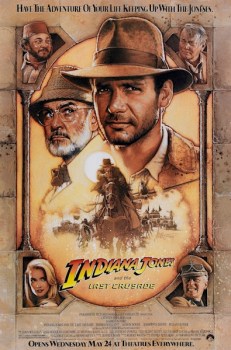
And this time he’s bringing his dad.
Country: USA
Language: English, German & Greek
Runtime: 127 minutes
BBFC: PG
MPAA: PG-13

Original Release: 24th May 1989 (USA)
UK Release: 30th June 1989
First Seen: VHS, c.1991
Stars
Harrison Ford (Blade Runner, Star Wars: The Force Awakens)
Sean Connery (Dr. No, The Hunt for Red October)
Denholm Elliott (Brimstone & Treacle, A Room with a View)
John Rhys-Davies (The Living Daylights, The Lord of the Rings: The Fellowship of the Ring)
Alison Doody (A View to a Kill, We Still Kill the Old Way)
Julian Glover (For Your Eyes Only, We Still Steal the Old Way)
Director
Steven Spielberg (The Lost World: Jurassic Park, Indiana Jones and the Kingdom of the Crystal Skull)
Screenwriter
Jeffrey Boam (The Dead Zone, Lethal Weapon 2)
Story by
George Lucas (Ewoks: The Battle for Endor, Strange Magic)
Menno Meyjes (The Color Purple, Max)
“Pretty much responsible for every line of dialogue”, according to Spielberg, but not credited
Tom Stoppard (Empire of the Sun, Rosencrantz & Guildenstern Are Dead)
The Story
When an old professor goes missing while searching for the Holy Grail, there’s only one man to track him down: his son, Indiana Jones. With his father’s cryptic diary as a guide, Indy embarks on a race against the Nazis to be the first to find the Grail.
Our Heroes
Indiana Jones, the fedora-wearing, whip-wielding, quip-delivering, snake-fearing, Nazi-fighting archeologist adventurer. This time joined by his dad, Henry — who still has it with the ladies, apparently.
Our Villains
A pair of deceptive deceivers: respectable American businessman Walter Donovan sets both Indy and his father in search of the Holy Grail, but he’s secretly working with the Nazis because he wants the prize for his own selfish ends. Then there’s Dr Elsa Schneider, who seduces both Joneses (bit creepy) and is also secretly working with the Nazis. But might she come good in the end…?
Best Supporting Character
Indy’s dad, Henry Sr, is along for the ride this time. Sean Connery was always Spielberg’s first choice for the role, as an inside joke that Indy’s father is James Bond. (Not literally, obviously.) The father-son sparring is one of the highlights of the film.
Memorable Quote
Prof. Henry Jones: “I’ve got to tell you something.”
Indiana Jones: “Don’t get sentimental now, dad. Save it ’til we get out of here.”
Prof. Henry Jones: “The floor’s on fire, see? And the chair.”
Quote Most Likely To Be Used in Everyday Conversation #1
“He chose… poorly.” — Grail Knight
Quote Most Likely To Be Used in Everyday Conversation #2
“Nazis. I hate these guys.” — Indiana Jones
Memorable Scene
Any time you get Ford and Connery playing off each other is fantastic, but the scene where they’re tied back-to-back to be interrogated by the Nazis, then have to escape the burning fortress (see: memorable quote) is one of the best and (importantly, for this category) most memorable.
Technical Wizardry
In previous films, computer-generated effects elements had been printed onto film and composited into final shots the old fashioned way, using optical printers. For Donovan’s death scene in Last Crusade, several states of the character’s decay were created with make-up and puppets, filmed, then ILM scanned the footage and morphed the takes together digitally. This was the first time film had been scanned, digitally manipulated, and then output back to film as a finished shot.
Truly Special Effect
The “leap of faith” trial — a bridge rendered ‘invisible’ with the help of false perspective — doesn’t make a great deal of sense if you stop and think about it, but is a very effective special effect nonetheless. It’s actually a model bridge in front of a painted background (because it was cheaper than building a full-size set), with Harrison Ford shot on bluescreen and composited in. (More details on how it was done can be found in this article about the film’s post-production.)
Letting the Side Down
Conversely, some of the other special effects have aged pretty badly — see-through planes and that kind of thing. On the bright side, Lucas never tried to Special Edition it.
Making of
According to Robert Watts, who was a producer on the first three Indys, “The Last Crusade was the toughest Indiana Jones picture to do because of its scope. First of all, we had virtually every form of transportation people used during that period, planes, trains, boats, cars, horses, zeppelins, bicycles, motorbikes with sidecars, everything except skis. Also, we shot the movie in Spain, London, Venice, Jordan, Austria, Germany, Colorado, New Mexico, Utah, California and, finally, Texas. So it was quite a world tour.”
Previously on…
Indiana Jones made his debut in Best Picture nominee Raiders of the Lost Ark. He returned in Indiana Jones and the Temple of Doom, which used to be regarded as The Bad One (despite having its fans), until 2008…
Next time…
Some people would be very keen to tell you that Last Crusade is the last Indiana Jones movie, but, of course, they’re wrong: 19 years later, everyone returned for Indiana Jones and the Kingdom of the Crystal Skull, which certainly isn’t the best Indy movie but quite probably isn’t as bad as you remember. They’ll be doing the same again in a couple of years for a fifth adventure. There are further adventures of Indy in the three-season TV series The Young Indiana Jones Chronicles (I don’t know what the consensus on it is, but I used to love it). In print, Indy is the star of 13 adult novels, plus eight German novels that have never been translated into English, 11 “choose your own adventure”-style books, 33 Young Indiana Jones novels, and numerous comic books. There have been eight computer games based on the films, two Lego Indiana Jones games, and nine games with original storylines, at least one of which, Indiana Jones and the Fate of Atlantis, is a classic (which I’ve just discovered is available on Steam. It might be re-play time…)
Awards
1 Oscar (Sound Effects Editing)
2 Oscar nominations (Score, Sound)
3 BAFTA nominations (Supporting Actor (Sean Connery), Sound, Special Effects)
4 Saturn nominations (Fantasy Film, Actor (Harrison Ford), Writing, Costumes)
Won the Hugo for Best Dramatic Presentation
What the Critics Said
“Take a good look at this movie. In fact, go back four or five times and take four or five good looks. In this imperfect world, you’re not likely to see many manmade objects come this close to perfection. Director Steven Spielberg has taken all the best elements of Raiders of the Lost Ark (with little of the mystical mumbo jumbo) and Indiana Jones and the Temple of Doom (without the gratuitous violence and child abuse) and combined them into an adventure film that is fast, muscular, playful, warmhearted and sheer pleasure.” — Ralph Novak, People
 Score:
 88%
88%What the Public Say
“Raiders is lots of fun but it didn’t have the depth of characterization that The Last Crusade brings to Indy (in my opinion) and Steven Spielberg himself said that he enjoyed having the opportunity to do a real character study in the third movie. […] it’s just amazing to see [Sean Connery] and Harrison Ford play off one another. I love the subtle softening of their relationship […] There’s a depth to their father-son relationship that goes beyond mere banter and friendly insults” — Eva, Coffee, Classics, & Craziness

I know we’re all supposed to love Raiders most, but I think Last Crusade is actually my favourite Indy movie. After the darkness of Temple of Doom, and the resultant criticism, Spielberg and co set out to make a lighter adventure more in the vein of Raiders. It’s possibly the funniest Indy movie because of that, but without tipping over into all-out comedy, thanks to plenty of the requisite derring-do, an almost Bondian globetrotting storyline, and a high-stakes climax, complete with gruesome death for the villain. Spielberg once said it was his favourite Indy movie too, so I’m in good company.

#46 will be… the first of two films whose title begins with “J”, only one of which is directed by Steven Spielberg…
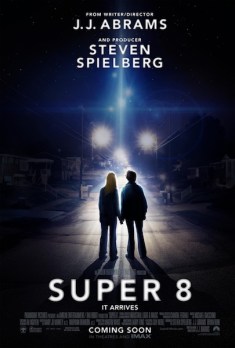 Before he started star warring and between bouts of star trekking, director J.J. Abrams teamed up with producer Steven Spielberg for this homage to the kind of movies Spielberg produced in the ’80s. Those films have endured down the decades; I’m not sure Super 8 endured as far as Abrams’ next
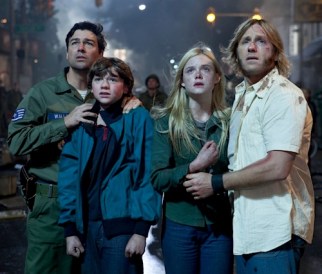
 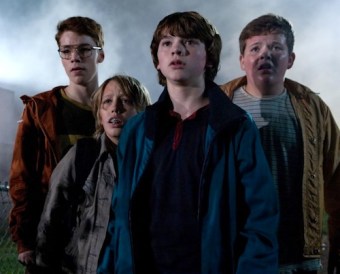 Unfortunately, the longer the film goes on the more it runs away with itself, as characters dash back and forth all over the place, sometimes in credibility-stretching fashion (we never do see how a group of kids manage to escape a heavily-guarded military base and drive back to an evacuated and blockaded town). The adults stumble through the story to little dramatic effect; Joe’s dad even has to be secretly locked up for a good chunk of the film (with no other characters noticing his disappearance) so that his storyline can be paused until he’s wheeled out for his part in the climax. The grown-ups do serve a role — giving us a perspective on events that the kids lack, and being tied to the emotional arcs of the leads — but it wouldn’t have harmed anything to limit them to those functions, rather than trying to half-heartedly give them stories of their own.
 In some respects, the kids’ short film (which plays during the end credits) encapsulates the whole movie: a semi-thought-through SF/F plot, a tacked on emotional arc, the apexes of both tied together in the climax, and a couple of sometimes-shoehorned effects set pieces along the way. Yet for all that, it does enough right that I’d quite like to see Abrams attempt more work along these lines.
 These days, Steven Spielberg is as well-known for his Oscar-worthy historical prestige pictures as he is for his action-adventure genre movies, so it’s kinda strange (at least for me) to imagine the time in his career at which this film came about. I mean, it’s an adaptation of a controversial literary novel about the miserable lives of black women in the American South during the early decades of the 20th Century, directed by the white guy known for
 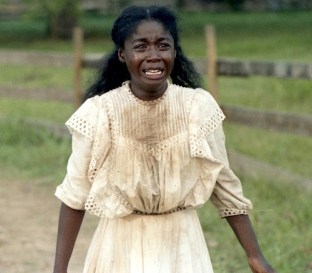 it never quite feels like we’re getting the full force of the story’s brutality. That’s a mixed blessing: as a viewer, we’re spared all the horrors you can infer from what actually happens; at the same time, how much should a story about such horrors be sparing us from them? Though as it was at one point advertised with the tagline, “
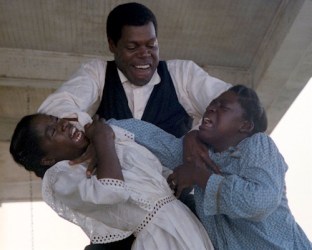 Spielberg’s first foray into Serious filmmaking is a long way from being an unqualified success, but it’s not a bad movie either, and at least it was the gateway to him making some superior dramas. Bonus points, too, for a mainstream big name director tackling a story about the historical lives of black women — depressingly, that still feels like it would be a noteworthy move 30 years later.
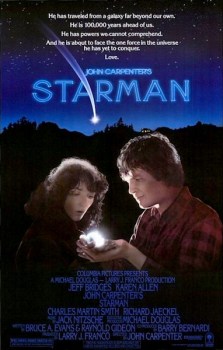 In this sci-fi romance, an alien intercepts the invitation included on the Voyager 2 space probe and tries to visit Earth, but is shot down. Taking the form of Karen Allen’s recently deceased husband, Jeff Bridges, he forces her to drive him to Arizona, where his people will rescue him in three days — if they can escape the attention of the government agents chasing them, anyway.
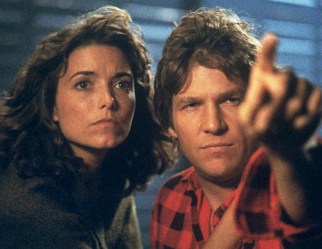 there are stalking POV shots as the alien arrives at Allen’s house, and then it grows a human body, a sequence in which the ugliest (prosthetic) baby you’ve ever seen stretches and creaks as it grows into an adult in mere minutes. It’s pretty freaky. Indeed, as per the BBFC, Starman “contains mild language, sex, violence and sci-fi horror”, but is rated PG. Ah, the good old days!

 #45 Chappie (2015)
 #53 Beverly Hills Cop II (1987)
 #60
#60 



























 Favourite Film of the Month
 2013 Academy Awards
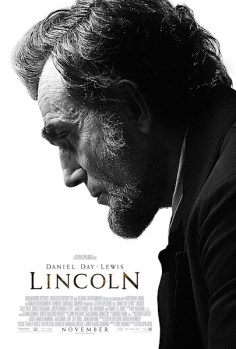 Daniel Day-Lewis allegedly stars in this account of the final months of President Abraham Lincoln’s life, which might more pertinently be called The 13th Amendment due to where its focus lies. I say “allegedly” because I’m not convinced they didn’t find a way to resurrect Lincoln to appear as himself, then just pretended it was Day-Lewis acting.
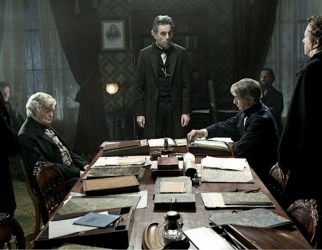 who might be persuaded to vote which way, and how they might be persuaded, and what they will want in return, and what deals need to be struck, and so on and so forth — sounds like it might make for an engrossing movie, then there’s a fair chance Lincoln will be your cup of tea. A not-insignificant proportion of viewers protest that it is boring, however, and while I in no way agree with them, your mileage may vary.
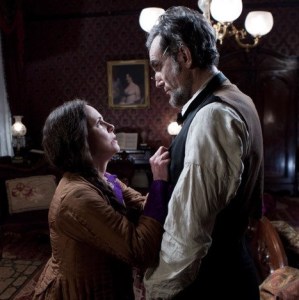 Not to do anyone else in the film — or, indeed, any other performance in any film ever — a disservice, but Day-Lewis embodies the President in a way few other actors have ever embodied a role. It’s quite remarkable.
 For me, there are few black marks (unfortunate choice of phrase…) to be held against Lincoln. Does it give in to Spielberg’s sentimentality? Yeah, a little — but it’s a long, long way from the worst case of that, and I think you’d be nitpicky (or have a different opinion on history, which, you know, is a matter of opinion) to criticise the film too harshly for that. As to whether it’s boring, that’s entirely a matter of preference. If you think The West Wing is boring, people who write lists of “the greatest TV shows ever” will disagree with you, and you also likely won’t like Lincoln. I like The West Wing, though.
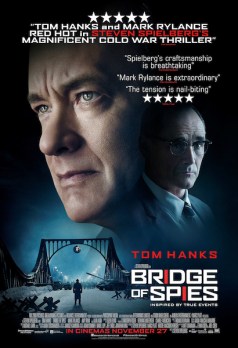 Steven Spielberg’s true-story Cold War drama stars Tom Hanks as insurance lawyer James B. Donovan, who is tapped to defend captured Soviet spy Rudolf Abel (Mark Rylance). After Donovan insists on doing his job properly, he manages to spare Abel the death penalty — which comes in handy when the Soviets capture spy-plane pilot Francis Gary Powers (Austin Stowell) and a prisoner exchange is suggested, which the Russians want Donovan to negotiate.
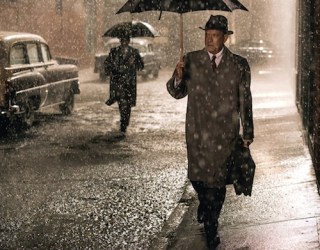 If we’re talking storytelling oddities, another is the manner in which Powers’ backstory is integrated. As Donovan continues to defend Abel, the film suddenly becomes subjected to scattered interjections, in which we see pilots being selected and then trained to fly secret reconnaissance missions in a new kind of plane. Any viewer who has read the blurb will know where this is going, but it’s so disconnected to the rest of the narrative that it felt misplaced, at least to me. The same is true when we suddenly meet Frederic Pryor (Will Rogers), an American student in Berlin who’s mistaken for a spy and arrested by the East. It turns out we need to know about him because Donovan attempts to use his negotiations to get a two-for-one deal, exchanging Abel for both Powers and Pryor. Knowing the stories of the men Donovan will be negotiating for is not a bad point, but I can’t help but feel there was a smoother way to integrate them into the film’s overall narrative.
 hints at emotions under the surface rather than declaiming them. A lesser film would’ve made a point of this — would’ve had Hanks’ lawyer struggling to understand and relate to his client’s low-key nature — but, instead, Donovan is a man who can identify with this mode of being, at least to an extent. There’s a reason they talk a couple of times about the ‘stoikiy muzhik’.
 allows the whole film to be equally as subtle, even as it remains gripping and entertaining. However, the storytelling quirks are a mixed success, the pace they sometimes lend offset by the almost non sequitur style of the captured Americans’ backstories. Nonetheless, this is a classy but still enjoyable dramatic thriller, which takes a seat among Spielberg’s better works.
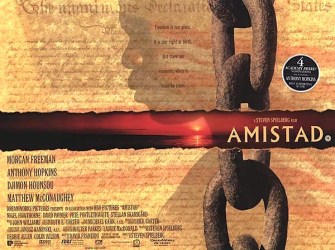 Feeling in need of more intellectual fare after helming
  Though Spielberg is certainly not immune to the Africans’ plight — the depiction of life on a slave ship is appropriately harrowing — it’s clear from early on which side he expects us to identify with, in terms of cultural background if not shared morality: as survivors of the mutiny talk the next day, the slavers’ Spanish dialogue is subtitled but the slaves’ African dialect is not. It’s a simple but effective technique to align us with one side — as I say, not morally (in no regard is Spielberg trying to apologise for the slavers), but socially. Unfortunately, it’s not sustainable: later, when we need to understand the Africans to follow a scene’s point, their dialogue is suddenly subtitled, and from then it’s sporadically translated as needed. I can see why that choice was made, but it makes the unsubtitled bits feel like a cheat.
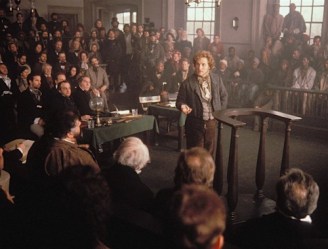 This can be said of Spielberg’s approach to the drama, too. Some of the courtroom stuff is suitably mired in legal technicalities and argument, but by film’s end it gets a little bit too… what’s the word? Not “preachy”. Not “sentimental”, exactly, though it’s born of that old criticism of Spielberg. “Melodramatic” may be on the money, though. It doesn’t help that everything reaches a climax — not only narratively, but also in the way it’s written, shot, acted, and scored — only for it to be revealed that it’s just the end of act two. Okay, that’s the truth of what happened (or near enough, for the purposes of this dramatisation), and by adapting it in that way it emulates the emotions the characters experienced; but from the audience’s perspective, you feel like you’ve reached the end… only to be served up another half-hour of movie. And it’s a long film too, so you feel that. It gets by because it’s fundamentally a good film, with strong performances and technical merits, but it’s a little bumpy for a bit.
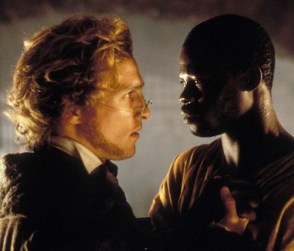 It’s easy to criticise Amistad, because Spielberg makes the production of very good movies look effortless, so the missteps stand out all the more. The story of La Amistad and its ‘cargo’ is a powerful one, and Spielberg has — naturally — turned it into a good film; but by remixing history to over-egg the message, it loses a little something. A valiant effort, but a film like
 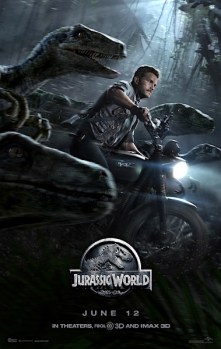 22 years ago,
  awe is front and centre once again. Even some of the film’s ‘problems’ aren’t, in my eyes. Does it spend too long wandering around the park before the big action starts? Not for me… which I guess is a viewpoint that comes with all the caveats of my opening paragraph. I rather suspect this is a movie that was very literally made by fans, for fans.
 but 2.35:1 can feel a little too wasteful of screen real estate (as a believer in presenting films in their original ratio (as we all should be) you tend not to question it, but looked at objectively, 2.35:1 on a 16:9 telly is kinda silly. (Not that I’m advocating those daft-looking 21:9 TVs they made a couple of years ago, mind.)) I’ve no idea if 2:1 is likely to catch on more widely (I bet
 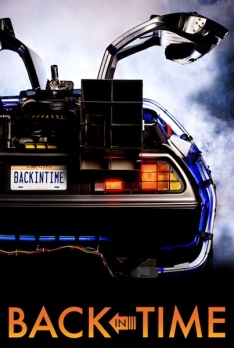 If you’re on social media (or even just frequent pop culture news sites), you can’t fail to have noticed that Wednesday just passed was “Back to the Future Day”, the exact date Marty McFly and Doc Brown (and Marty’s girlfriend) travel to in
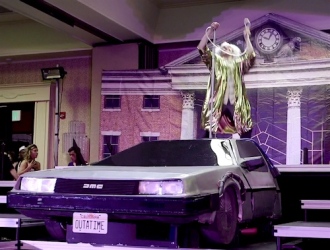
 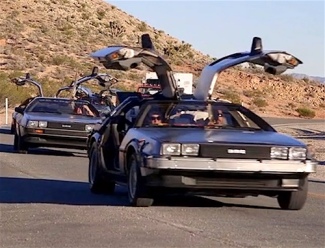 Then it moves on to the fans — what the film means to them, and what that’s led them to do. Those we meet include a couple who travel around the US in a DeLorean fundraising for Michael J. Fox’s charity; the team of aficionados who restored Universal Studios’ decrepit display DeLorean; the family of collectors who own the only film-used DeLorean that will ever be in private ownership; a guy who built a mini-golf course in his yard with a Back to the Future-themed hole that he’s used for charity events with some of the films’ cast; the people who have had some success developing a real-life hoverboard; and the guy who set up a fansite that was so good it became the official site, and is now regularly employed as an official consultant about the films, not least for the rafts of merchandise that comes out these days. We also get a look at the Secret Cinema event in London from a year or two ago that made headlines for all the wrong reasons. Naturally, none of that gets mentioned here (in fairness, because it has nothing to do with Back to the Future itself).
 That glaring error aside, Back in Time is not a bad film, provided you know what to expect. It’s a shade too long and the storytelling is occasionally a little jumbled, but there are some nice interviews and stories — hearing Michael J. Fox recount the Royal Premiere where he was sat next to Princess Diana pretty much makes the whole exercise worthwhile.
 100Films.co.uk