
Douglas Mackinnon | 89 mins | TV (HD) | 16:9 | UK / English | 15
 Screened in UK cinemas simultaneously with its TV premiere (and coming to the big screen in various other countries over the next week or so, too), the latest episode of the BBC’s modern-day Sherlock Holmes series is actually a standalone adventure set in the character’s original Victorian time period.
The rest of this review will be spoiler-filled, but before I get into that I’ll say this: if you’re someone who’s a Sherlock Holmes fan but not keen on Sherlock and are wondering if the changed temporal setting means this special might be of interest to you, then I think it’s fair to say it won’t.
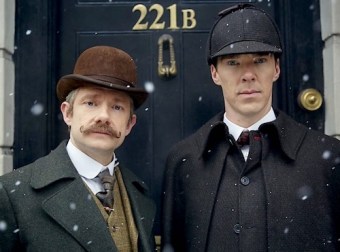
1895: detective Sherlock Holmes (Benedict Cumberbatch) and his sidekick / companion / chronicler Dr. Watson (Martin Freeman) learn of the case of Emelia Ricoletti, who committed suicide by shooting herself in the head in public… and then later that evening murdered her husband. Despite the intriguing impossibility of the crime, Holmes’ thoughts are for some reason preoccupied with his deceased nemesis, Prof. Moriarty…
It would’ve been a bit weird if Sherlock completely abandoned everything that has marked the series out for an aside of an adventure in Victorian London, and so it is from the start. While there is certainly a different feel — not just the obvious trappings of horse-drawn carriages, candlelight, costuming, and so forth, but in the way the characters speak and behave — it’s still spun from the same cloth as the regular series. These are recognisably the Holmes and Watson we commonly know as Sherlock and John, surrounded by versions of Mrs Hudson, Mary Watson and Inspector Lestrade that aren’t so very different from their present-day incarnations.
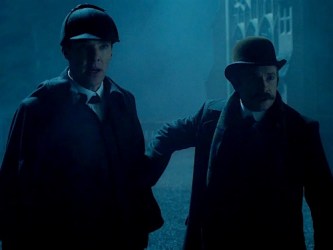 The case they find themselves embroiled in is a little more period than usual, however, with lashings of Gothic and some of the trappings of a Christmas ghost story. The episode is co-written by series creators Mark Gatiss and Steven Moffat, and anyone familiar with Gatiss’ wider work can clearly see his influence here. Moffat brings his trademark fast-paced intricately-tricksy plotting, for which individual viewers’ mileage varies greatly: some find it genius, some find it tedious. Is it clever, or does it just think it’s clever? Is it impossible to follow, or were you just not paying enough attention? As to the first question, I think it’s a bit of both; as to the second, I think the episode ultimately answers everything, but you might need to realise a few things for yourself.
Much of The Abominable Bride is a lot of fun. The mystery is fairly engrossing, though we’re frequently sidetracked into character interplay — such is Sherlock’s way. There are many entertaining scenes of this, however, not least Holmes and Watson’s arrival at the Diogenes Club and the state of the version of Mycroft they find therein. Douglas Mackinnon’s direction is atmospheric, retaining the series’ usual flashy, whizzing editing and camerawork at times, and incorporating suitably horror-esque elements at others. Anyone after a fully traditional take on a Victorian Holmes and Watson can always revisit Jeremy Brett — here we have Victorian Holmes through the filter of Sherlock, and it works.
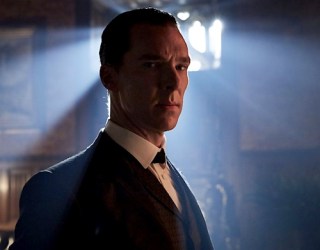 Until the last half-hour or so, anyway, when the modern version suddenly comes crashing in. At first it seems like a clever interlude; a little reminder of the true time period for this version of the characters, and a tease for season four. But it quickly transpires that, no, this episode isn’t actually a wholly standalone aside from the main series — Gatiss and Moffat have found a way to integrate it into continuity. For me, this is where the special begins to come apart at the seams; not because I inherently object to this integration, but because from that point on the episode begins to jump back and forth between the present, the imagined past, and various other dream-state asides. It’s almost entirely justified by the beautifully-shot Reichenbach Falls sequence, but a spot of cinematographic prettiness doesn’t really excuse the way the story goes a little haywire. The least successful part of all, for me, is that it calls into question the solution for the case we’ve just been presented with… but then doesn’t get round to offering another, meaning you kind of feel like the case hasn’t been solved, even though it presumably has been, with the first solution. I think.
All of which kerfuffling makes The Abominable Bride a tricky beast. From the promotional trailers and blurbs, it may’ve looked like a standalone Victorian Sherlock Holmes adventure that happens to star the cast of the present-set Sherlock — hence why I felt it worth offering that clarification back in paragraph two, because, despite not being connected to a full series (the next one of which will probably appear in exactly one year’s time), in reality this is Episode 10 of Sherlock — and, tonally, feels like it.
 As someone who enjoys Sherlock Holmes in his proper era but is also a fan of this modern day version (I would say “a big fan”, but I’m not one of those people), I’d rather they’d played this a little more straightforward. Not a lot — it’s still under the umbrella of Sherlock after all, and the era-transposed stylistic flourishes in the first hour-ish worked very nicely in my opinion — but the mixed-up mishmash of the final act dilutes the effectiveness of the entire experience. There’s fun and thrills to be had along the way, but in another form it could perhaps have been a Sherlockian classic in its own right.

Sherlock: The Abominable Bride is available on the BBC iPlayer for most of January. It’s in cinemas worldwide over the next few days, including in the US on the 5th and 6th. An extras-filled two-disc special edition is out on the 11th.
 1981: Steven Spielberg reads a French review of his movie
  Apparently some Tintin purists weren’t so keen on the actual adaptation — elements of The Crab with the Golden Claws have been mixed in to a plot primarily taken from The Secret of the Unicorn, the sequel/second half of which, Red Rackham’s Treasure, is reportedly used sparingly. Plus, in the original tale Sakharine is a minor character who wasn’t responsible for much, apparently. As someone who’s only read one of those three volumes, and even then not since I was young, such things didn’t trouble me. What superstar screenwriters Steven “
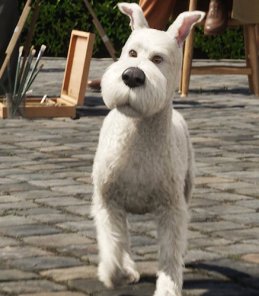 The slapstick is mainly hoisted by Simon Pegg and Nick Frost as the physically-identical Thomson and Thompson — a true advantage of animation, that. I imagine some find their parts tiresome because of their inherently comic role, but they’re likeable versions of the characters. Even more joyous is Snowy, though. Well, I would like him, wouldn’t I? His internal monologue, such a memorable part of Hergé’s books, is omitted (as it is from every film version to date, I believe), but he’s full of character nonetheless. Some of the best sequences involve Snowy running in to save the day. I don’t think they quite got the animation model right (the one glimpsed in test footage included in behind-the-scenes featurettes looks better, for my money), but his characterisation overcomes that.
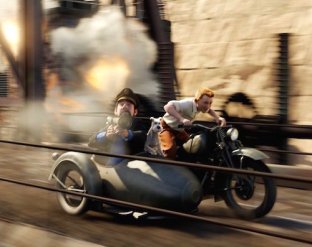 Of course, one very important person is neither British nor Belgian: Spielberg. The screenplay’s balance between peril and comedy is spotlessly enhanced by his peerless direction. In a world stuffed to the gills with lesser blockbusters that palely imitate the groundwork Spielberg and co laid in the ’70s and ’80s, work like this should remind people why he’s still the master of the form. The film is shot with an eye for realism (so much so that some viewers have been convinced it was filmed on real locations with real actors, with some CG augmentation for the cartoonish faces, of course), which helps lend a sense of plausibility and also genuine jeopardy. It’s easy to get carried away when working in CG animation, but often the most impressive works are ones that behave as if they’ve been shot largely within the limitations of real-world filmmaking technology.
 The tone on the whole is resolutely PG — actually, like many an action-adventure blockbuster used to be before everything went slightly darker and PG-13. So, for example, Tintin wields a gun on occasion, but never at another human being. The focus is on the story, which happens to lead to some adrenaline-pumping sequences, rather than a lightweight excuse to link together a bunch of punch-ups and chases. Ironically (though, for anyone who knows what they’re talking about, entirely expectedly) this makes the action all the more exciting. It also mean there’s a lighter touch than many current blockbusters offer; a greater presence for humour, including among the action. I guess that’s not fashionable these days, when everyone’s become so po-faced about their big-budget entertainment. However, with the likes of
  but some viewers would have seen it (even subconsciously) as more of a “real movie”.
 100Films.co.uk