
Martin Brest | 105 mins | streaming (HD) | 16:9 | USA / English | 15 / R
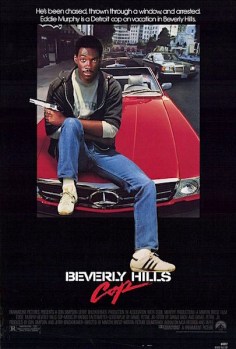 The last time I watched the first entry in a once-popular ’80s comedy cop movie series, it didn’t end well. And that was directed by Richard Donner, of Superman and The Omen fame — Beverly Hills Cop, on the other hand, was helmed by the man who would go on to give us “worst film of all time” contender Gigli. Oh dear. Truth be told, my main reason for watching Beverly Hills Cop is so that I can one day watch Beverly Hills Cop II, directed by Tony Scott, and Beverly Hills Cop III, directed by John Landis. So, I didn’t expect to care for this all that much…
But I actually thought it was really fun. It’s not the funniest movie ever, nor does it have the most thrilling action, or the most engrossing or surprising plot, but it does all those things — well, the first two — well, maybe just the first one — well enough. It’s sort of incessantly likeable.
The term “star vehicle” could have been coined for this film — it’s all about Eddie Murphy as Axel Foley. It’s mad to think he was brought on late in the day, because you just can’t imagine it with anyone else. It’s his performance, his style, that makes the movie worth watching. Without him — with a straightforward lead like Sylvester Stallone, who was originally attached — it would be a painfully rote action/revenge thriller. The plot is no great shakes at all; what works is the fish-out-of-water element of putting Murphy’s black, working-class Detroit cop in white, posh Beverly Hills, plus his engaging performance and humour.
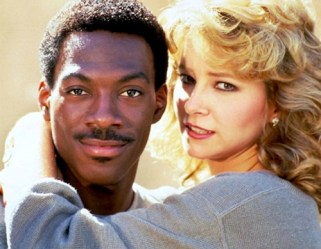 Murphy’s not the only good thing, though. Judge Reinhold and John Ashton make an excellent double act as the pair of cops assigned to keep an eye on Foley in Beverly Hills; Ronny Cox is their amenable boss; Steven Berkoff pretty much just has to turn up to be an excellent villain; Lisa Eilbacher is decent as the girl (presumably changed from being a love interest after they cast a black guy). Her part doesn’t exactly call for a great deal, but she’s fine enough in it; as good as anyone ever is in such a limited role.
There’s also the iconic theme music, Axel F, perhaps better known to The Youth of Today thanks to Crazy Frog (you’d forgotten that, hadn’t you? Sorry). It makes its debut ten minutes into the film during an exciting sequence where… Axel parks his car outside his home. I guess no one knew what they had on their hands… except perhaps composer Harold Faltermeyer, who seems to have written the theme, thought “my work here is done,” and laid it over most of the movie. (That’s unfair — there is other music. Sometimes.)
Beverly Hills Cop’s plot is colour-by-numbers, and sometimes advanced by magic (the way they track Axel and co at the climax just looks like GPS today, but no such system existed in 1984);  the mystery is non-existent (even if it wasn’t obvious Berkoff would be the villain, the henchman who did the deed is shown to be in his employ the first time we meet him); Brest’s direction is unremarkably static… you could probably go on. But thanks to Eddie Murphy and the rest of the cast, Beverly Hills Cop winds up a highly watchable, very likeable spot of entertainment.

This review is part of the 100 Films Advent Calendar 2015. Read more here.
 Stieg Larsson’s much-hyped novel comes to the screen for the second time in David Fincher’s much-hyped English-language re-adaptation. Somewhere between the pre-release build-up (do you remember the fuss over the trailer’s release? And all those magazine covers and articles?) and now, something clearly went awry: its UK TV premiere back in March was buried mid-week on ITV2.
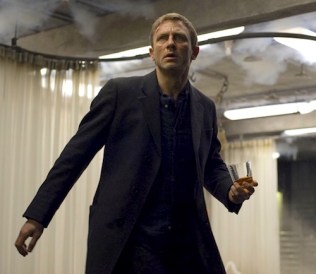 There are certainly changes, but nothing especially major. For example, the ending has been tweaked — not “completely changed”, as some reports had it, but just streamlined slightly. Some will struggle to even remember the difference if their experience of a previous version was long enough ago. Die hard fans, however, seem to regard it as a massive re-visioning of events. It isn’t.
 in particular, it’s beautifully shot, and there’s a vein of interest to be mined in discussing the fact it was consciously made using a five-act (as opposed to the usual three-act) structure (but not here today, sorry) — it feels unable to innovate or hone the genre in quite the way Se7en or
  So my rating may come as a bit of a surprise given the focus of this review, which is primarily my fault for finding it so tough to shrug off all those contexts and comparisons. But hey, that’s something the film itself struggles with in many people’s eyes, too. If the viewer can divorce it from those ties, however, I think it’s still an exceptionally good thriller.
 100Films.co.uk