
Bo Burnham | 94 mins | digital (HD) | 1.85:1 | USA / English | 15 / R
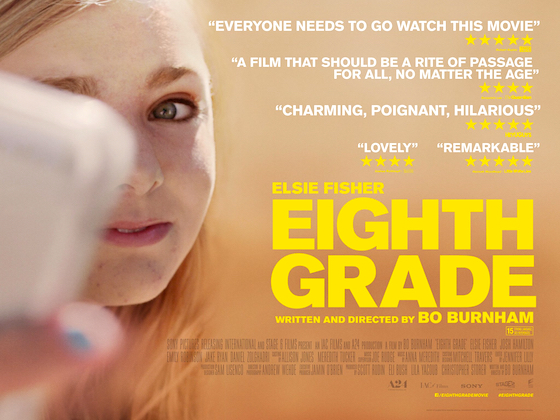
I confess to never having heard of Bo Burnham before the buzz generated by this, his debut film as writer-director. According to his Wikipedia page, he started out as a YouTuber, turned that into a standup career, and from there has been a musician, actor, screenwriter, and poet — plus, with this, film director. It’s the kind of trajectory that challenges your perception of what being a YouTuber is good for. Of course, other “content creators” have jumped beyond the confines of the video streaming site before, but generally to eye-rolling effect for any of us old enough to be outside the sway of popular youth culture. But Burnham bucks that trend too, because in Eighth Grade he’s produced a mini masterpiece of distilling the teenage experience.
The film introduces us to the life of Kayla (a star-making performance by Elsie Fisher), a 13-year-old girl so shy and insecure that she doesn’t seem to have any friends at school, but who still spends most of her time engaged in typical modern teenage activities: glued to her phone scrolling through social media, and posting her own content that no one anyone actually views. (At this point we’ve all been there, right?) The videos she posts online are perky and optimistic, presenting a front of having her life together. In reality, Kayla’s middle school experience has been miserably lonely, and as it comes to an end she hopes for a better time in high school. (If the American high school movies we’ve all seen are anything to go by, her chances can’t be good…)
In some respects, Eighth Grade is wholly focused on showing us the present day. The specifics of what it depicts are very much “modern American teenager”, with pool parties, active shooter drills, living through social media, their eyes glued to phones, etc; even the plot-prompting transition from middle to high school isn’t necessarily relevant to those of us outside the US education system. But if you look past the modern milieu to the fundamental feelings underneath, they’re universal and speak across the generations. This is the most truthful movie about what it’s actually like to be a teenager I think I’ve ever seen. It really captures the uncomfortableness of being a not-popular teen, both for good (well done Burnham & co, you conveyed your point) or ill (it can be as squirm-inducing as living the real thing). And if you watch it and think “eh, I don’t remember my teenage years being like this”, I’m afraid to inform you that you were quite possibly one of those kids making life a bit awkward for the rest of us. Sorry.

Much like bullies, indie movies often revel in taking nice people and kicking them down, because, hey, life’s shit and that’s probably what’s gonna happen. Without spoiling where the story goes, it makes a welcome change to see a film where realism isn’t abandoned (Kayla’s life doesn’t become plain-sailing) but in which the nice, sweet, quiet character nonetheless sees their life improve, rather than believe things are gonna get better only to have their expectations crushed. Well, there’s a certain degree in which the optimistic hopefulness of being a tween is contrasted with the crushing reality of being a teenager, but there’s a positive message along the lines of “these things shall pass” that I think remains good advice to many people struggling with a particular time in their life.
Talking of specific times in one’s life (this is a tenuous transition, I admit), the certifications handed to Eighth Grade (at least in the UK and US) are a bit daft. To clarify for the benefit of those of us on the outside, the US’s 8th grade is for 13- to 14-year-olds; the equivalent of Year 9 in England (other UK and Anglosphere countries may vary). So it’s somewhat amusing that a film explicitly titled Eighth Grade is officially limited to over-15s in the UK and over-17s in the US (I know R is a little looser than that, but you get what I mean). You feel that the certifiers are, not for the first time, somewhat out of step when it comes to the realities of kids’ life experiences. I doubt that’s a major problem (I’m sure plenty of people don’t stick rigidly to the ratings), but it is, perhaps, a stark reminder that things like the boundaries of film certificates require constant review and revision if they want to remain relevant.
Something that I think will remain relevant is Eighth Grade. As I said, it already transcends its depiction of current teenage lifestyles, so it stands to reason that, as time goes on, while it will cease to accurately reflect the specifics of young people’s lives, it will continue to encapsulate how it feels to be that age.

Eighth Grade placed 9th on my list of the Best Films I Saw in 2019.
 Much like the Bond films to which they’re so often compared, the Bourne movies have their devotees while only fitfully pleasing the critical establishment. This fifth movie — which is notable for marking the return of star Matt Damon and director Paul Greengrass after the semi-reboot of
  Action sequences ensue, shot with all the ShakyCam you’d expect from Greengrass. By now I imagine you have your own view on whether his style works or not. Personally, I think it’s considerably less bamboozling than when it made its debut in
  Frankly, Jason Bourne is at pains to mix in hyper-current iconography; the reasoning for Damon and Greengrass’ return now being that the world has changed and how does Bourne fit into that? So as well as social media and Greek riots we’ve got references to and riffs on hacking, Edward Snowden, government surveillance of its own citizens, the prevalence of Facebook/Twitter-esque tech companies, and so on. Sadly, I’m not sure the film’s actually got anything to say about any of these things. Greengrass and his co-writer, editor Christopher Rouse, have appropriated all these zeitgeisty concepts to make the film feel very Now, but that surface sheen is more or less where it ends. I mean, there’s a whole subplot starring Riz Ahmed as the Zuckerberg-like CEO of a social media company that I didn’t even mention in my plot summary because it’s kind of an aside. It’s kind of ironic, really, that it always seemed as if Greengrass’ more natural stomping ground was his documentary-ish real-world-exposé type movies, with his contributions to the Bourne series an unusual sideline; yet when he finally marries the two halves of his filmmaking career, it’s the action rather than current-affairs commentary that takes precedence.
 The end result is that Jason Bourne does thrill as an action movie, which seems to have been the primary goal of its makers, at the end of the day. As an action-thriller, however, the rinsed-and-repeated plot is a slightly faded imitation of former successes; a through-the-motions way to provide those impressively staged chases and punch-ups. It’s not the definitive Bourne movie one might’ve expected from the returning star/director combo (why else come back if not to perfect, or at least add to, the formula?), but instead means the film ends on an odd note: even though it wasn’t a wholly satisfying experience, and even though it doesn’t end with questions still blatantly hanging (as every Bourne movie bar Ultimatum has done), I want Damon and Greengrass to come back and do it all again, please. Only do it properly next time, yeah guys?
 100Films.co.uk