
Christopher McQuarrie | 147 mins | cinema | 2.39:1 | USA & Hong Kong / English & French | 12A / PG-13

You can keep your Infinity Wars and your Incredibles 2s — this is the movie I’m most hyped for in 2018. I’ve been looking forward to it ever since it was announced we’d be getting another impossible mission from writer-director Christopher McQuarrie, who knocked it out of the park with the superb Rogue Nation. Anticipation only intensified with the fantastic trailers (that first one, scored to a Lalo Schifrined-up version of Imagine Dragons’ Friction, is a work of art in itself), and reached fever pitch with the influx of super-positive reviews in the past couple of weeks. Living up to the hype began to seem like an impossible mission all of its own.
Well, if there’s one thing Ethan Hunt and his IMF teammates can pull off, it’s… a rubber mask. But if there’s another, it’s the impossible — and how!
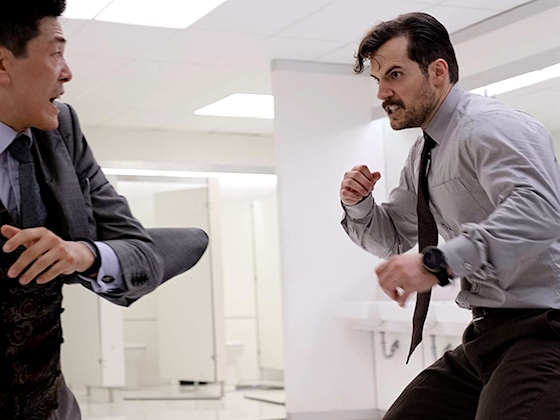
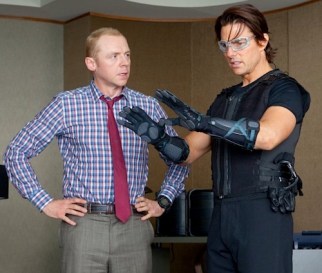
Two years after the events of Rogue Nation, Hunt (Tom Cruise, obv.) and his regular sidekicks Benji Dunn (Simon Pegg) and Luther Stickell (Ving Rhames) are after three stolen plutonium cores that could be used to make nuclear bombs. They must stop them falling into the hands of The Apostles, a radical group seeking to execute the manifesto of John Lark, a shadowy figure the intelligence services have been unable to identify, who seeks to bring about a seismic change in the world order. When the IMF’s attempt to acquire the plutonium goes sideways, Hunt is assigned a CIA minder, August Walker (Henry Cavill), with orders to let nothing get in his way of finding The Apostles — including Hunt.
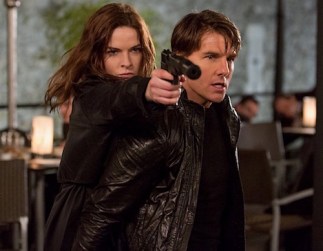
From there, we’re heading into proper spoiler territory (I already rewrote that last paragraph to avoid giving away an early twist. You’re welcome, readers). However, as the trailers have already revealed, the storyline brings back into action the last film’s antagonist, Solomon Lane (Sean Harris), as well as Ilsa Faust (Rebecca Ferguson), the MI6 agent whose allegiances were constantly under question in Rogue Nation. She was ultimately confirmed to be on the side of good, but was supposed to be leaving the game. Why is she back? And whose side is she on now?
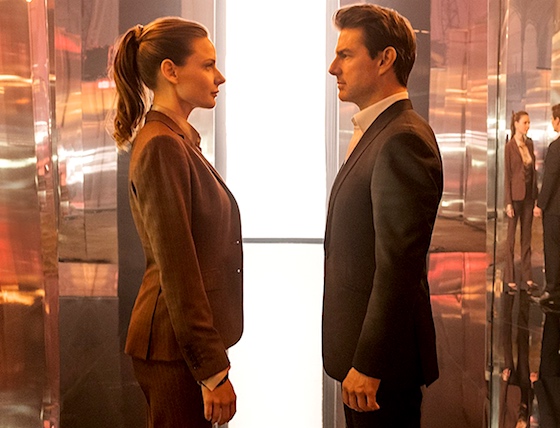
The plot that mixes all of this together gets… complicated. In some respects there’s a clear throughline from one action set piece to the next, but in others it can leave you reeling as it rockets from twist to reveal to counter-twist to counter-reveal. Mostly I think you have to go with the flow and accept whatever’s happening in the moment — if you start to think about the bigger picture (how people knew what when, and how they planned for this, that, and the other), it’ll make your head spin. Naturally, I was trying to do the latter, and got completely lost at one point in the middle when there’s an assault of back-and-forth twists about who has the upper hand. Again, if you just accept it and go with it, it’s fine, but try and unpick the logic of the whole thing in the moment and, well, you’ll be so busy thinking that you’ll probably miss another twist. Personally, I have a lot of faith in McQuarrie as a screenwriter, and I have no doubt the whole thing does make sense (or enough of it, at any rate), but he’s too busy racing along to let the film stop and allow you to confirm it for yourself.
Fiddly plots are nothing new to the Mission franchise, of course: the very first one was (and often still is) criticised for having a story that’s more impossible to follow than a typical IMF mission is to execute. What is new to Fallout’s story is that it’s a sequel. Obviously, there are four other Mission: Impossible sequels, but they’re all standalone movies really. With the return of Lane and Faust, plus some of the baggage they had with them, a lot of Fallout spins out of Rogue Nation — it’s unquestionably a direct sequel. And, once again without wanting to get spoilery (though, again, this is partially given away in the trailers), it also picks up on hanging threads from movies even further back in the series. In this respect it’s a great film for certified Mission fans: there are a number of payoffs and answers to questions that are only still thought about by such devotees; but it’s also done in such a way that it never obstructs the fun for casual viewers. That goes for the whole sequel thing: although the storyline is grounded in the events of Rogue Nation, Fallout gives you enough info that you could watch it as a standalone.

Talking of Rogue Nation, about 24 hours before seeing Fallout I listened to Empire’s legendary three-hour Rogue Nation spoiler podcast, in which McQuarrie talks a lot about the writing process of a Mission movie, and what he learned about that during Rogue Nation. With his observations fresh in my mind, it shed an interesting light on Fallout — how and why it was doing certain things, as well as about when it chose to do them. Perhaps that’s why I was able to spot some of the reveals and stuff, because I knew the (self-imposed) rules McQuarrie was playing by. But there are some fascinating contrasts, too. For one not-really-spoilery example (because I’m going to talk about literally the first scene of the movie now), in the podcast he talks about how Mission films have to begin with a burst of action — no plot, no story, just straight into an action scene. It’s partly about giving the audience an instant thrill, but it’s more about letting them settle into watching the movie before you throw important information at them. But Fallout does literally the opposite: the first scene sees Hunt receive one of the series’ famous briefings (delivered, as always, in a completely different manner to how we’ve seen it done before), and that, as it’s precisely designed to do, delivers a massive infodump of plot. Now, how much of it you need to take in I’m not sure — various bits are explained again later as they become pertinent — but it certainly implies you should be paying attention. I’m in no way criticising this (I really liked everything in the pre-titles), it’s just an interesting contrast to how McQuarrie said things ‘needed’ to be done last time.
Another thing from the podcast: one rule they set themselves on Rogue Nation, which ended up being a massive thorn in their side, was that there had to be constant escalating tension, meaning the film had to end with the biggest action sequence of all. This was a self-imposed rule, but they struggled with it for ages before they finally realised it just wasn’t what the story demanded, which was when they alighted on the ending that saw Hunt outsmart Lane rather than engage in a massive action scene with him. Clearly McQuarrie came into Fallout more prepared, however, because while there are big stunts and action scenes throughout the film, the finale is the largest, most complicated, most dynamic, and most impressive sequence of the lot.
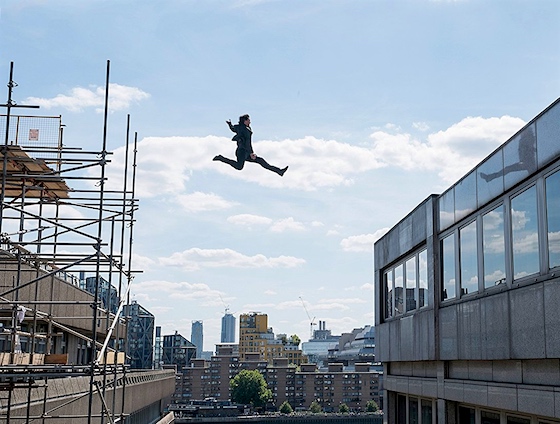
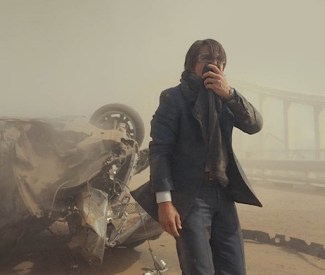
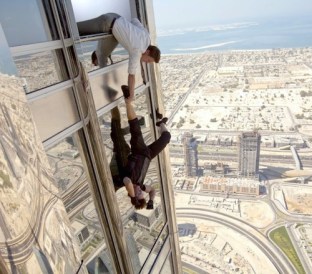
And so we’ve come to the real point of the movie; the thing the trailers and posters and behind-the-scenes videos have all sold it on: the action sequences. Simply, they’re incredible. Cruise’s dedication to giving the audience something new and exciting and awe-inspiring to watch is second to none. He spent literally years preparing for this film, learning to fly a helicopter and perform HALO skydives. That’s him flying the helicopter. That’s him jumping out of a plane. That’s him doing all sorts of other stuff too, like riding against traffic on a speeding motorbike, or jumping across rooftops, or falling off the side of a mountain. The only effects work here is for the odd spot of safety-rig removal or, I presume, one or two moments that would be impossible to achieve safely in real life. And this dedication has paid off: it’s so much more thrilling when you know this has all been performed for real than it is to watch some pixels or someone on a green screen. Those kinds of effects have their place in other movies, and can provide a thrill within the context of the story, but they nonetheless lack the tangibility that doing it for real provides, and the knowledge it’s a genuine feat you’re watching adds a whole extra thrill of its own.
In filmmaking terms, McQuarrie does all he can to match Cruise’s drive to entertain us with his daring — not by being daring himself, but by showing off Cruise’s efforts in the best way possible. McQuarrie favours going without score for the action scenes, letting the sounds of revving engines, squealing brakes, thumping punches, and all kinds of crunching and smashing and thudding, be the only music you need. The tension and excitement comes purely from the physical feats on display, plus the camerawork and editing that showcase them. It works like a charm. I’ve seen music-less action sequences in the past where you feel the absence on the soundtrack; like something more is required. Early on in Fallout, I noticed the absence of music during these scenes only because I was aware McQuarrie favoured it that way, and because of how much it wasn’t needed. But by the end of the film, I was too hooked to care — I honestly can’t tell you if Fallout’s big finale sequence has music or not, because it grabs the attention so thoroughly that I’d just stopped being aware.
Of course, other parts of the movie do have a score, provided by Lorne Balfe. Thanks to where it’s been applied, much of it is atmospheric rather than the pulse-racing theatrics you expect of an action movie score, though he makes nice use of Lalo Schifrin’s original themes — both the main one and The Plan — to provide grace notes where required. Plus there’s the big title sequence to really show off that iconic main number — and, like Rogue Nation, we’re treated to it twice. At my screening the houselights came up and people started walking out during the second one, which kind of bugged me — it’s not just names scrolling, it’s part of the movie, McQuarrie using it as a kind of final hurrah to send you away with (just as he did in Rogue Nation — he’s repeating the ‘trick’ because it works so damn well). Personally I prefer Joe Kraemer’s rendition of the title theme from last time, but Balfe’s is a worthy alternative.
Also new to the franchise is cinematographer Rob Hardy, who’s delivered some gorgeous photography here. Not in a showy way, but there’s a richness to some shots, plus consistently great choices of angles and camera moves. The entire thing is about forward momentum — from set piece to set piece to set piece — and that’s conveyed by the way the camera moves, too. Even, for example, when cars drive up to buildings: rather than just observe it, the camera’s behind them, low to the ground, speeding along. Rarely has some people arriving at a near-empty airfield to get on a plane felt so exciting. I believe the film was shot mostly on 35mm, and those who care about such things will surely notice the benefit in many sequences. The big exception is the couple of sequences that use an IMAX ratio if you attend such a screening, which were shot in digital 8K (the need for small, light cameras precluded the use of genuine IMAX ones). Long gone are the days when mixing film and digital would make the difference obvious, however, and the switch between formats is entirely unnoticeable.
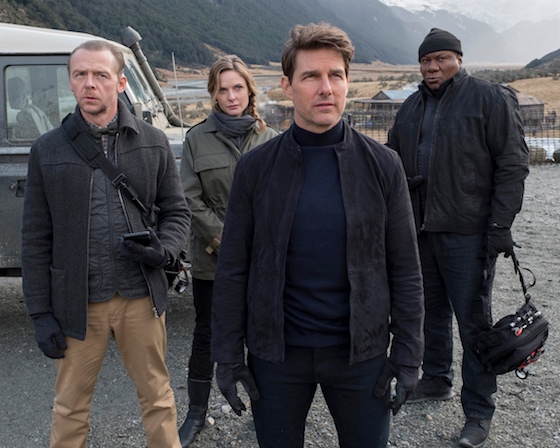
If there’s one disappointment, it’s that the trailers gave too much away. Technically there’s a shedload of plot stuff they didn’t reveal, but honestly, the plot’s not where the real entertainment value lies. For one thing, seasoned viewers will see most or all of the twists coming. Maybe they could’ve kept some returning characters a surprise, but they’re all in the trailer too. No, this film is all about the incredible action, and story context only adds so much to that. What it does add, at least, is tension: the “oh my God, Tom Cruise is doing what?” factor may’ve been burned up by the trailers, but the edge-of-your-seat suspense about whether Ethan Hunt can achieve his goals is still there. And while the mind-boggling-ness of a first impression may be gone, the stunts are still genuinely spectacular — so much so that you can watch them again and again and still be thrilled, which means they do survive being in the trailers. Of course, if you were lucky (or sensible) enough to avoid those advertisements… boy, are you in for a treat!
Even if you didn’t, I still think it’s a treat — they went and put all the best bits in the trailer and yet it’s still bloody spectacular. I think Rogue Nation may’ve had a better story, but nothing beats Fallout for adrenaline and spectacle. Well, every Mission movie is different in its own way, has its own strengths, and it’s clear what Fallout’s are. Personal preference will therefore dictate where you rank it next to the other movies, but what I’ll say is this: in a series where the level of consistency is so high that my personal favourite is usually whichever one I happen to be watching at the time, Fallout easily stands toe to toe with the rest.

Mission: Impossible – Fallout is in UK cinemas now, and in the US from this evening.
It placed 1st on my list of The 26 Best Films I Saw For the First Time in 2018.

 2016 Academy Awards
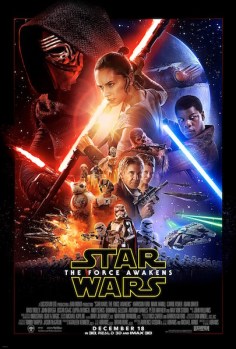 Star Wars: The Force Awakens is not the best film of 2015. Not according to the Academy of Motion Picture Arts and Sciences, anyway, who didn’t see fit to nominate it for Best Picture at tomorrow’s Oscars. Many fans disagree, some vociferously, but was it really a surprise? The Force Awakens is a blockbuster entertainment of the kind the Academy rarely recognise. Okay, sci-fi actioner
  I too could talk about the likeable new heroes; the triumphant return of old favourites; the underuse of other old favourites; Daisy Ridley’s performance; John Boyega’s performance; the relationship between Rey and Finn; the relationship between Finn and Poe; the success of Kylo Ren and General Hux as villains (well, I thought they were good); the terrible CGI of Supreme Leader Snoke; the ridiculous overreaction to the alleged underuse of Captain Phasma; that awesome fight between the stormtrooper with that lightning stick thing and Finn with the lightsaber; the mystery of Rey’s parentage; the mystery of who Max von Sydow was meant to be (and if we’ll ever find out); some elaborate theory about why Ben wasn’t called Jacen (there must be one — elaborate theories that will never be canon are what fandoms are good for); the way it accurately emulates the classic trilogy’s tone; the way it’s basically a remake of
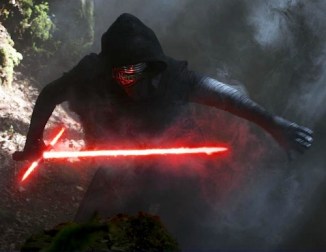 J.J. Abrams seems to have tricked some people into thinking he’s a great director with The Force Awakens (rather than just a helmer of workmanlike adequacy (when he’s not indulging his lens flare obsession, at which point he’s not workmanlike but is inadequate)), and I think that’s partly because it’s quite classically made. Yeah, it’s in 3D, but the style of shots used and — of most relevance right now — the pace of the editing help it feel in line with the previous Star Wars movies. Some of the more outrageous shots (often during action sequences) stand out precisely because they’re outside this norm. Perhaps we take for granted that Abrams delivered a movie in keeping with the rest of the series, because that’s The Right Thing To Do, but that doesn’t mean he had to do it. And the transitional wipes are there too, of course.
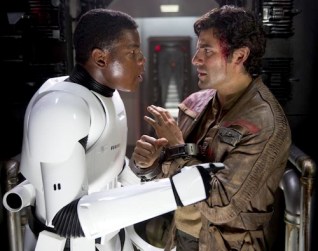 No one knows what the difference is between these two categories. I’m not even sure that people who work in the industry know. As a layperson, it’s also the kind of thing you tend to only notice when it’s been done badly. The Force Awakens’ sound was not bad. It all sounded suitably Star Wars-y, as far as I could tell. That’s about all I could say for it. It feels like these are categories that get won either, a) on a sweep, or b) on a whim, so who knows who’ll take them on the night?
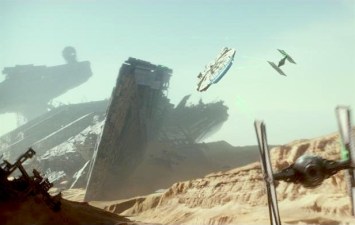 “restraint […] applying the basic filmmaking lessons of the first trilogy,” according to
 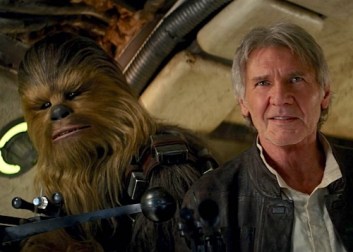 those elements aren’t gone about in an awards-grabbing fashion anyway. In the name of blockbuster entertainment, however, they’re all highly accomplished.
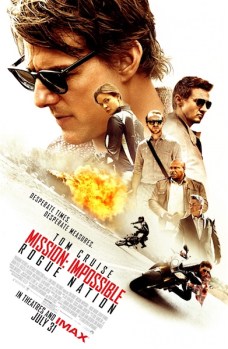 It’s an overcrowded year for spies on the big screen (as
 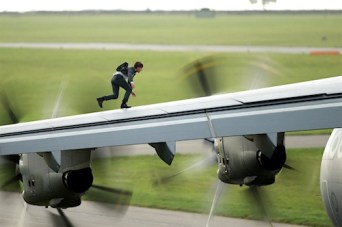 Obviously this uncertainty is also thanks to the story constructed by writer-director Christopher McQuarrie. Some automatically dismiss the plots of the Mission films, saying they’re just an excuse to link some death-defying stunts performed by Mr Cruise. Although there may be an element of truth to that, I don’t think this is a bad storyline by any means. As I said, it’s fairly straightforward (there’s no mole in IMF! Hurrah!), but the intricacies keep it engrossing and keep you guessing. And anyway, the action sequences it ties together are first-rate. You’ve pretty much seen the opening plane stunt in the trailer — heck, you’ve seen it on
  As alluded to above, this is probably the most globetrotting Mission film yet: it starts in Belarus, before taking in Washington D.C., Cuba, Paris, Vienna, Casablanca, and London. It’s things like this that lead me to describe it as a James Bond film. There’s also the balance of a serious plot line with plenty of humour, the use of outlandish just-ahead-of-reality gadgets, and the fact that the series can’t retain a female cast member for more than one film (though that last one isn’t a positive). For all the effort Spectre made to bring classical Bond elements back into the fold, Rogue Nation arguably feels more like a classically-styled Bond movie. It’s not a faultless like-for-like comparison — one of Rogue Nation’s best points as a Mission movie is that the whole team are necessary to complete the mission, a defining factor of the TV series that many felt went awry in the movies, with their focus on Cruise — but the almost-indefinable sensation of this experience is Bondian. It’s not stealing that style, though: considering Ghost Protocol had it too, and Craig-era Bond has abandoned it for a ‘classier’ action-thriller mode, it’s something the M:I series has come to own.
 So on the one hand the recent news that McQ (as current regular collaborator Cruise calls him) is returning to write and direct the sixth Mission is a shame, because it breaks a twenty-year rule; but on the other, I’m not sure it matters. Plus, by taking on the dual role of sole writer and director, you could argue McQ’s Missions are the most auteur-y of the lot, even in spite of the lack of a terribly unique visual style. Which is all a very long-winded way of saying that I was a little disappointed when it was announced there wouldn’t be a sixth director for the sixth film, because I always thought that was a neat idea; but as the idea hasn’t actually had much effect, who better to ask back than the man who wrote and directed arguably the best Mission: Impossible film of them all?
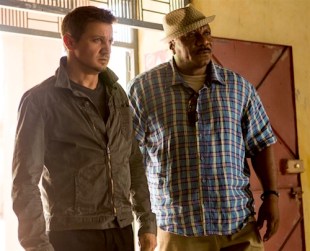
 The cast are liable to get lost among all the grandiose goings-on in a film like this, so its a testament to the skilled team that’s been assembled over the past few movies that they absolutely do not. Cruise is Cruise — surely by now you know whether you like him or not. I always feel like I should dislike him, especially given his crazy real-life religious views, but on screen I find him very entertaining. Rogue Nation is no different. Hunt is on the back foot for a lot of the film, and Cruise is at his best when he’s playing someone who’s almost the underdog. He’s also a more talented comic actor than he’s normally given credit for, and that glimpses through here too. Most of the time comedic duty is handled by Pegg, of course, who provides a good foil as Hunt’s sidekick for much of the film. More surprising, perhaps, is the amount of humour Jeremy Renner brings. It’s much less obvious, dryer and more sarcastic, so the contrasting tone is fun. He’s paired with Ving Rhames for a long stretch, who returns wholesale after sitting out Ghost Protocol but for a cameo. The pairing may come up just short of feeling inspired, but nonetheless makes for an entertaining change. Elsewhere, Baldwin offers a neat, not-too-clichéd turn as the CIA ‘villain’, while Tom Hollander pops in for a funny cameo-level turn as the British Prime Minister.
 As the fifth film in a franchise that has always carried a slight “pretender to the throne” air, Rogue Nation should feel played out and tired. Instead it seems fresh and invigorated, with a spot-on tone, likeable and fun characters, a real sense of jeopardy and menace (missing in so many modern action films), and some of 2015’s very best action scenes — and in the year of Fury Road, that’s really saying something. McQuarrie has
  With Bond going “real world” and gadget-free in the Daniel Craig era, and the Bourne series having blazed a trail of “we shot it all handheld and shaky and grainy so it must be real” veracity, it seems the task of providing audiences with a contemporary version of the spy action, just-ahead-of-reality gadgets, and larger-than-life spectacle that the Bond movies specialised in during the ’60s and ’70s, has fallen upon the Mission: Impossible franchise. For my money, it’s taken the baton with aplomb.
 Somewhat unfortunately for pacing, they come halfway through. The climax is a mano-a-mano fight in an automated car park. It’s good, but feels underwhelming by comparison, with Michael “
 There’s a host of other gadgets to be going on with, though. It may be a side effect of having the writer-director of
  Still, that’s a fault of the home entertainment release, not the film itself. In all other respects, Bird’s work is first-rate. I like that the series consciously changes director with each new film to provide new ideas and voices, but if they were going to break the pattern then Bird would’ve been a good guy to allow back (certainly a superior pick than the third film’s J.J. Abrams, anyway, who was originally slated to tackle this sequel too).
 1981: Steven Spielberg reads a French review of his movie
  Apparently some Tintin purists weren’t so keen on the actual adaptation — elements of The Crab with the Golden Claws have been mixed in to a plot primarily taken from The Secret of the Unicorn, the sequel/second half of which, Red Rackham’s Treasure, is reportedly used sparingly. Plus, in the original tale Sakharine is a minor character who wasn’t responsible for much, apparently. As someone who’s only read one of those three volumes, and even then not since I was young, such things didn’t trouble me. What superstar screenwriters Steven “
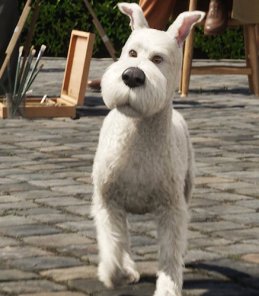 The slapstick is mainly hoisted by Simon Pegg and Nick Frost as the physically-identical Thomson and Thompson — a true advantage of animation, that. I imagine some find their parts tiresome because of their inherently comic role, but they’re likeable versions of the characters. Even more joyous is Snowy, though. Well, I would like him, wouldn’t I? His internal monologue, such a memorable part of Hergé’s books, is omitted (as it is from every film version to date, I believe), but he’s full of character nonetheless. Some of the best sequences involve Snowy running in to save the day. I don’t think they quite got the animation model right (the one glimpsed in test footage included in behind-the-scenes featurettes looks better, for my money), but his characterisation overcomes that.
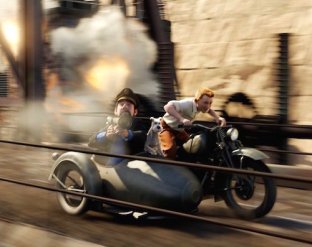 Of course, one very important person is neither British nor Belgian: Spielberg. The screenplay’s balance between peril and comedy is spotlessly enhanced by his peerless direction. In a world stuffed to the gills with lesser blockbusters that palely imitate the groundwork Spielberg and co laid in the ’70s and ’80s, work like this should remind people why he’s still the master of the form. The film is shot with an eye for realism (so much so that some viewers have been convinced it was filmed on real locations with real actors, with some CG augmentation for the cartoonish faces, of course), which helps lend a sense of plausibility and also genuine jeopardy. It’s easy to get carried away when working in CG animation, but often the most impressive works are ones that behave as if they’ve been shot largely within the limitations of real-world filmmaking technology.
 The tone on the whole is resolutely PG — actually, like many an action-adventure blockbuster used to be before everything went slightly darker and PG-13. So, for example, Tintin wields a gun on occasion, but never at another human being. The focus is on the story, which happens to lead to some adrenaline-pumping sequences, rather than a lightweight excuse to link together a bunch of punch-ups and chases. Ironically (though, for anyone who knows what they’re talking about, entirely expectedly) this makes the action all the more exciting. It also mean there’s a lighter touch than many current blockbusters offer; a greater presence for humour, including among the action. I guess that’s not fashionable these days, when everyone’s become so po-faced about their big-budget entertainment. However, with the likes of
  but some viewers would have seen it (even subconsciously) as more of a “real movie”.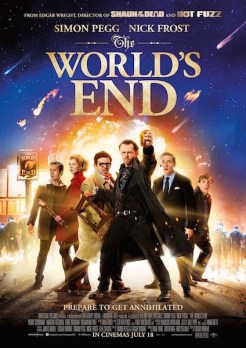
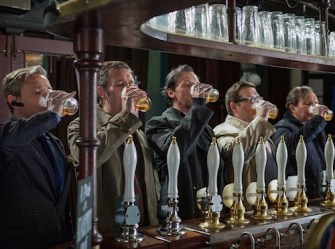 “zombie movie” or “Hollywood action movie”, and occasionally co-writers Pegg and Wright have substituted character development and thematic points for send-up. It may not play to the genre-loving fan-audience that the trio’s previous work has accumulated (demonstrably so, based on many a viewer review), but it does make for a more grown-up film.
 It will definitely reward multiple viewings: it’s littered with signs, omens and portents (in fairness, a good few can be grasped on an attentive first go). There’s a featurette on the BD (but not the DVD) which helps point out any major ones you may’ve missed; though I have to say, even at seven minutes long, and even with it pointing out some that felt too obvious to be worth mentioning, I swear it left some stuff out. That could be a deliberate decision of course, to leave some things for people to just spot.
 100Films.co.uk