
Приключения Шерлока Холмса и доктора Ватсона: Собака Баскервилей
Priklyucheniya Sherloka Kholmsa i doktora Vatsona: Sobaka Baskerviley
The Adventures of Sherlock Holmes and Dr. Watson: The Hound of the Baskervilles
Igor Maslennikov | 146 mins | DVD | 4:3 | Soviet Union / Russian | PG
 Sherlock Holmes has appeared in more films than any other fictional character (yep, even those Marvel ones that are everywhere), which also means that Sir Arthur Conan Doyle’s Great Detective has been portrayed by a staggering number of actors. “Who’s the best?” debates usually settle around Basil Rathbone, Jeremy Brett and, these days, Benedict Cumberbatch, though there are ardent fans of Douglas Wilmer, Peter Cushing, Robert Downey Jr… I could go on. In certain rarified circles, however, the “Sherlockian’s Sherlock” is, believe it or not, a Russian: Vasily Livanov, who starred in five popular (in their homeland) Russian miniseries/TV movies between 1979 and 1986 that some regard as definitive adaptations. We even gave him an MBE for them in 2006, so I guess he’s state-recognised.
The most famous Holmes adventure of them all, The Hound of the Baskervilles, was the subject of the third series, a two-part feature-length adaptation. (So yes, technically it’s not a film, but it’s the length of a film and it’s ever-so filmicly made, so I’m counting it.) The story, if you don’t know it, sees Devon gent Sir Charles Baskerville dying and his Canadian heir, Henry Baskerville (Nikita Mikhalkov), coming to England to inherit the estate. However, Sir Charles’ physician, Dr Mortimer (Evgeny Steblov), fears the old chap was murdered, and that it’s somehow connected to an ancient legend of a dog-like beast that roams the moors and torments the Baskerville family. Who better to investigate such phenomenon, and the potential threat to the new Sir Baskerville’s life, than famed detective Sherlock Holmes and his trusty sidekick, Dr Watson.
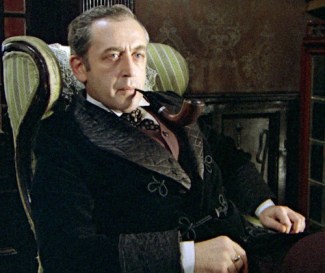 As many a Holmes fan will know, Baskervilles is not the best choice to get a handle on an actor’s interpretation of Holmes. Written by Doyle in the period after he’d killed Holmes off because he was tired of writing him, but before he later brought him back to life (as it were), presumably the author was still a bit bored with his creation, because Holmes disappears for a good chunk of the tale — in this adaptation, cited by many as the most faithful yet made, he’s in roughly the first and last half-hours, leaving a 72-minute stretch in the middle where he doesn’t appear at all. From what we do see of him, Livanov portrays a nicely understated Holmes. Clearly fiercely intelligent, but without the terseness of Cumberbatch’s version or the somewhat-jolly-hockey-sticks take of Rathbone. I’m compelled to get hold of the rest of the series to see what else he had to offer. (Sadly, only Baskervilles has reached UK DVD, but English-friendly imports are available. It’s also been released on Blu-ray, but I believe without English subtitles.)
The weight of the tale falls on Dr Watson, played here by Vitaly Solomin, who starred alongside Livanov in all his adventures. His is an excellent version of the character. Hopefully the Nigel Bruce-inspired image of Watson as a bumbling, useless sidekick has faded now, thanks to a couple of decades of strong interpretations from the likes of Edward Hardwicke, Ian Hart and Martin Freeman, but when this was produced it was presumably still de rigueur. Faithful to the original stories, however, Solomin’s Watson is highly competent; not expert at applying Holmes’ incredible deductive methodology, but nonetheless capable of maintaining an investigation in Holmes’ absence. Whatever Livanov’s merits, I’d happily watch the rest of the adaptations for Solomin’s Watson.
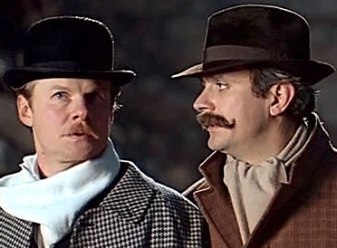 Several other cast members manage to be both faithful to the novel and different to how their characters are usually depicted on screen. For instance, Dr Mortimer is usually played as an older gent, but is quite young in the novel — this is a rare (the only?) instance of that being followed. It’s the first time I’ve seen him played as being a bit shifty and suspicious, too. It benefits the storytelling here, because there really aren’t many suspects — it’s abundantly clear whodunnit, even if you don’t know, because there are no other options! Perhaps most memorable from the supporting cast is “internationally acclaimed actor/director” Nikita Mikhalkov as Henry Baskerville. The role is usually played as young, handsome, keen and brave (in the Rathbone version, Richard Greene even gets top billing in the role, and his incarnation is at the centre of a played-up romantic subplot). Here, Henry is a little older, prone to drinking, readily amused in a larger-than-life fashion, frequently baffled by events, somewhat cowardly, and most often used for comic relief.
There’s certainly a stronger strand of humour than I recall from either the book or any previous adaptation (though I’ve not seen the Peter Cook/Dudley Moore comedy version, which one would hope is funnier), but it’s all texture with Sir Henry rather than a narrative driving force. It also plays down the supernatural or Gothic side of things, which other versions tend to ramp up — the Rathbone film and the 2002 BBC TV movie both insert a seance sequence, even, which works so well that I’d forgotten it wasn’t actually in the novel. It’s a good addition partly for the atmosphere, but also for playing up the sense of community amongst the small band of characters. Here, everyone feels very isolated and rarely seen — there are even scenes where they’re surprised to actually run into one another.  There’s more of an emphasis on people spying on each other suspiciously, which at least is rather appropriate to a murder mystery.
Indeed, I suppose this adaptation plays the story mostly as a detective mystery, if that’s not too obvious a thing to observe. Hound is far from the strongest mystery in the canon, mind, especially as presented here, with the the list of suspects seriously depleted by that absence of community. On the bright side, it makes up for it by having the ultimate revelation seem like proper detective work by Holmes. Normally the reveal hinges on him happening to spot a telling painting, an explanation that is implausible enough even without the element of happenstance. Here, the painting merely suggests a motive and a new line of enquiry to prove that theory. Nonetheless, the final summary contains a goodly number of “I don’t know, Watson”-type answers to dangling motivations/practicalities/etc. Anyone after a solid murder mystery, rather than a detective-led adventure, should look elsewhere.
The film itself is very well made. There’s some gorgeous cinematography by Dmitri Dolinin and Vladimir Ilyin; in particular, the cold morning on which Dr Mortimer examines Sir Charles’ body, mists drifting around some of the village houses, and anything on the moor in evening light, like when Watson finally finds Holmes. Also, just generally, it’s often very filmically shot — a shallow depth of field can pay dividends. The Russian city used as a double for Baker Street and its surroundings doesn’t look the least bit like Victorian London, though in fairness they’ve done their best to hide that, 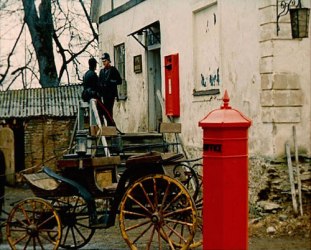 including scattering iconic red VR post boxes around willynilly. The Russian countryside probably doesn’t look very much like Dartmoor either, but its qualities work for the story: very desolate, barren, bare trees, waterlogged dirt tracks for roads, rubble strewn around, the buildings rundown… All very atmospheric for a Gothic horror-tinged mystery, and far superior to the picture-postcard look of some adaptations.
Sonically, Vladimir Dashkevich’s score is succinctly described as quirky, with a main theme that’s very pompously British (apparently based on a familiar piece from the BBC World Service, which the Russian audience would therefore immediately identify with Britishness), but graduating to some quite contemporary riff-y guitar stuff later on.
(Unfortunately, the UK DVD is a little messy. For all the lovely film-ness of much of the PQ, there’s occasionally some nasty video/digital artifacting. Similarly, the subtitles are mostly fine but with sporadic lapses. A few lines are missed, and homophonic substitutions abound: “here” for “hear” (several times), “stake” for “steak”, “to” for “too”, and the second vowel in “Sheldon” changes a few times to boot. Shame.)
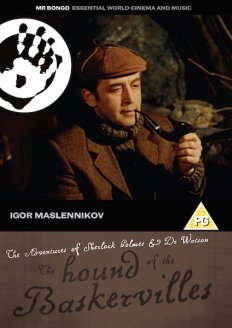 The Hound of the Baskervilles has been filmed far too many times (a quick search of IMDb throws up a couple of dozen versions, for starters), which makes it tricky for any version to stand out from the crowd. This one picks up bonus points for reportedly being the most faithful of them all, backing that up with some strong performances, atmospheric locations and classy direction by the series’ regular helmsman, Igor Maslennikov. It’s not perfect, but then I can’t think of an adaptation of Baskervilles I’ve seen that is. Is it the best Baskervilles? It depends what exactly you want in the mix, but I think you’d have to say it’s a contender.

This review is part of the Russia in Classic Film Blogathon. Be sure to check out the many other fantastic contributions collated by host Movies Silently.
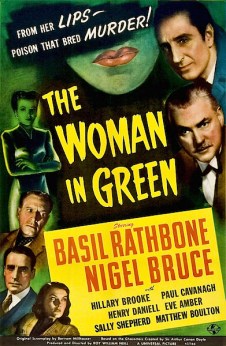 Basil Rathbone’s Sherlock Holmes starred in films which, although they typically involve murder, are best described as “adventures”. The series’ 11th film, The Woman in Green, is one of the few — perhaps the only one — that could genuinely be described as dark and grim.
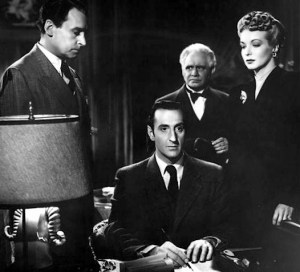 The evil is carried off with aplomb by Daniell. Reportedly a cold actor to work with, he chills on the screen too. This is a man you can believe would carry out such a scheme without a single twang to his conscience. His comeuppance, even with its surprising finality, is welcomed. The titular woman, played by Hillary Brooke, is one of Moriarty’s cohorts, posing as the ‘girlfriend’ of the aforementioned widower in order to set him up. The film is of course in black & white, so we can’t see what colour she’s wearing, and no one ever refers to it — even when they’re hunting for her based on looks alone. I guess someone thought it was an evocative title nonetheless.
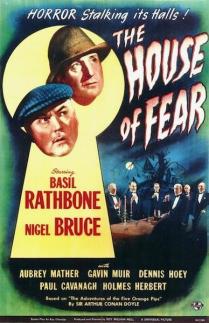 Adapted very loosely from the early Conan Doyle story The Five Orange Pips, this outing for Basil Rathbone’s Sherlock Holmes and Nigel Bruce’s Dr Watson sees them summoned to Scotland to investigate the suspicious deaths of the members of a club, where each killing is preceded by an ominous postal warning.
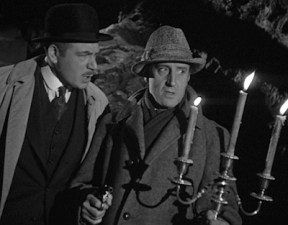 While the club having seven members does mean there’s a fair few suspects, it also means it takes a long time to get through them all being bumped off! It doesn’t sink so low as to be deemed repetitive, but does border it.
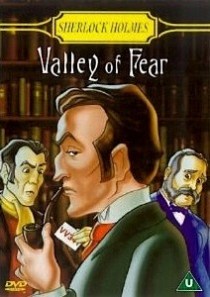 I don’t recall how exactly I came across these animated Sherlock Holmes adaptations starring the voice of Peter O’Toole as the eponymous detective, or how I came to decide to view all of them, but it’s been almost four years since I reviewed the first… and three years since I reviewed the third. Now, finally, I get to the final episode. Such is the erraticism of using LOVEFiLM. (At least I have an excuse for my dawdling here — my incredibly slow viewing of all the Rathbone/Bruce Holmses is entirely my own tardiness.)
 From the company that brought you such pinnacles of cinematic excellence as
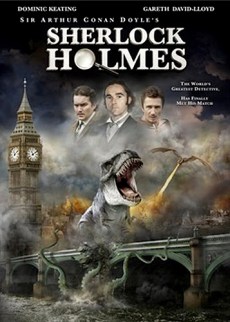
  But, in The Asylum’s favour, their Sherlock Holmes doesn’t hide what it is. Yes, it’s called simply Sherlock Holmes rather than Sherlock Holmes and the Implausible CGI Monsters, but at least said monsters are plastered all over the DVD cover (both US and UK). If you see that and still expect something faithful to Conan Doyle, more fool you. That said, at times it’s surprisingly faithful to Doyle’s spirit. There’s some decent-ish investigation and deduction, the story structured like a mystery rather than an action-adventure.
 Anachronisms abound, the best being the first: the film opens in London, 1940, the middle of the Blitz, and the opening shot foregrounds the Millennium Bridge. I don’t think you have to be too familiar with London to know when that was built. Elsewhere we get intercoms on houses, incongruous light switches and period inaccurate telephones, just to mention a couple. It’s shoddy, yes, but almost part of the fun.
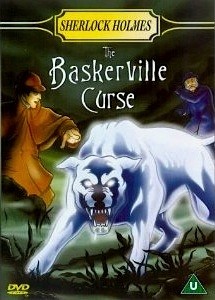 Peter O’Toole is Sherlock Holmes (well, his voice) once again in this animated Conan Doyle adaptation from the ’80s (see also my reviews of two others,
 Peter O’Toole is again the voice of the famous sleuth in this disappointing animated adaptation of the first Sherlock Holmes mystery.
 A slightly unusual one to review, this: it’s a 49-minute animated Sherlock Holmes adaptation from the ’80s, one of four in this particular series. But, as best I can tell from IMDb, it’s not specifically TV-based, and it does feature the voice of Peter O’Toole. Vocally he makes for a good Holmes, though the character design could be a little better. I can’t recall the original story well enough to comment on this as an adaptation, but it’s a decent mystery that’s well explained. The animation is not bad; certainly no worse than most kids’ TV animation from the ’80s and ’90s, and better than the flat Flash-animated stuff of today. A solid production.
 100Films.co.uk