
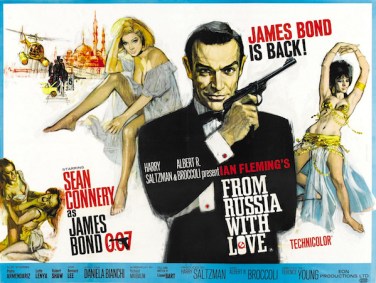
His new incredible women!
His new incredible enemies!
His new incredible adventures!
Country: UK
Language: English, Russian, Turkish & Romany
Runtime: 115 minutes
BBFC: A (1963) | PG (1987)
MPAA: GP (1971) | PG (1994)

Original Release: 11th October 1963 (UK)
US Release: 8th April 1964
First Seen: TV, c.1995
Stars
Sean Connery (Darby O’Gill and the Little People, Zardoz)
Daniela Bianchi (Special Mission Lady Chaplin, Operation Kid Brother)
Pedro Armendariz (Fort Apache, 3 Godfathers)
Lotte Lenya (The Threepenny Opera, The Roman Spring of Mrs. Stone)
Robert Shaw (A Man for All Seasons, Jaws)
Director
Terence Young (Dr. No, Wait Until Dark)
Screenwriter
Richard Maibaum (Bigger Than Life, Licence to Kill)
Adapted by
Johanna Harwood (Dr. No, Call Me Bwana)
Based on
From Russia with Love, the fifth James Bond novel by Ian Fleming — one of John F. Kennedy’s favourite novels.
The Story
When Soviet consulate clerk Tatiana Romanova offers to defect, she has one condition: that she is extracted by James Bond. Although M smells a trap, as collateral Tatiana offers a Lektor, a decoding machine MI6 have wanted for years. Bond travels to Istanbul to steal the Lektor, unaware he’s being manipulated by the criminal organisation SPECTRE…
Our Hero
The name’s Bond, James Bond. In only his second big-screen outing, so Connery is still establishing the character here — considering all the ‘fun’ antics that came since, Bond is quite a hard bastard in Dr. No and From Russia with Love (which is only appropriate for a government-sponsored killer, of course).
Our Villains
They may not be as grandiose as the volcano-dwelling types that came later in the series, but From Russia with Love has two of Bond’s most memorable adversaries: the hard former KGB officer Rosa Klebb, with her deadly shoe (well, it sounds silly when you put it like that), and assassin Red Grant, who may not know what wine to have with fish but could certainly gut you like one. A fish, that is. Not wine. You can’t gut wine.
Best Supporting Character
Kerim Bey, British Intelligence’s man in Turkey. An affable, witty soul, he’s also an invaluable ally during Bond’s time in Istanbul.
Memorable Quote
Tatiana: “I think my mouth is too big.”
Bond: “I think it’s a very lovely mouth. It’s just the right size… for me, anyway.”
Memorable Scene
On the Orient Express, SPECTRE assassin Red Grant manages to corner Bond in his compartment. Although he has Bond at gunpoint, Grant is distracted by the offer of gold coins hidden in Bond’s case. Bond tricks Grant into setting off the case’s booby trap, allowing Bond to tackle him. A rough close-quarters fight ensues.
Write the Theme Tune…
Having arranged and performed Monty Norman’s James Bond Theme for Dr. No (for which he didn’t receive a credit), John Barry was the main composer for Bond’s second adventure. However, the producers tapped Lionel Bart — then popular from Oliver! — to write the title song. Barry didn’t like that Bart’s lyrics had nothing to do with the film’s story, a point he set out to rectify when given full control of the soundtrack to Goldfinger.
Sing the Theme Tune…
A good answer if you’re ever faced with a trivia question about James Bond theme singers, Matt Monro was — so Wikipedia tells me — known as “The Man With The Golden Voice” and “became one of the most popular entertainers on the international music scene during the 1960s and 1970s.” With the Bond formula not yet fully established, a snippet of his song is heard on a radio early in the film, but not played in full until the end credits. (The title credits are scored with an instrumental version of the song, plus the James Bond Theme.)
Technical Wizardry
Projecting the title credits on writhing half-naked girls? It’ll never catch on.
Making of
Although Red Grant is presented as a physically-imposing male specimen, including showing off his half-naked physique the first time he appears, in reality actor Robert Shaw had to stand on a box when opposite Sean Connery because he was so much shorter than the Scot. (4 inches shorter, according to CelebHeights.com. Yes, that’s a real website.)
Previously on…
This is the second film about the adventures of James Bond, after the previous year’s Dr. No.
Next time…
The next film, Goldfinger, set the template for much of the rest of the Bond series. To date, that has encompassed a further 22 canonical movies, with the series’ 25th already in development. From Russia with Love was adapted for radio in 2012, the third of (to date) five Bond radio adaptations starring Toby Stephens as 007.
Awards
1 BAFTA nomination (British Cinematography (Colour))
What the Critics Said
“Don’t miss it! This is to say, don’t miss it if you can still get the least bit of fun out of lurid adventure fiction and pseudo-realistic fantasy. For this mad melodramatization of a desperate adventure of Bond with sinister characters in Istanbul and on the Orient Express is fictional exaggeration on a grand scale and in a dashing style, thoroughly illogical and improbable, but with tongue blithely wedged in cheek.” — Bosley Crowther, The New York Times
 Score:
 96%
96%What the Public Say
“From Russia with Love turned out to be amongst the best of the Bonds. Distinctly low key, and relying on the strength of its cast over the spectacular thrills and gadgetry that would come to define the series, it’s a great couple of hours’ cinema that may delight viewers who come to it expecting the same old nonsense from 007.” — Mike, Films on the Box

Elsewhere on 100 Films…
I reviewed From Russia with Love as part of a retrospective on Connery’s Bond back in 2012, when I noted it was “a very faithful rendition of the book. That makes it a Cold War spy thriller, albeit one with fantastical touches […] Mostly, though, it feels remarkably plausible. Sequences like the theft of a decoding machine from the Russian consulate, or the famous confined train carriage fight with Red Grant, have real-world heft rather than typical Bond action sequence fantasticism.”
It’s only the second Bond movie, so there’s no template yet, but in retrospect From Russia with Love is an oddity among the Bond flicks of the ’60s and ’70s. Although it has many of the series’ regular trappings — exciting action, exotic locations, beautiful women, grotesque villains, nifty gadgets — it also functions as a straight-up ’60s Cold War spy thriller, with few of the fantastical touches the Bond films would become known for. Such atypicality means anyone looking for a “Bond formula” movie will be disappointed, but otherwise it’s an accomplished thriller, and one of the series’ finest instalments.

The first rule of #29 is… don’t talk about #29.
 Murder on the Orient Express is arguably Agatha Christie’s most famous novel, perhaps because of its widely-known twist ending, or perhaps because it’s inspired in part by a high-profile true story, or perhaps because of this multi-Oscar-nominated all-star adaptation.
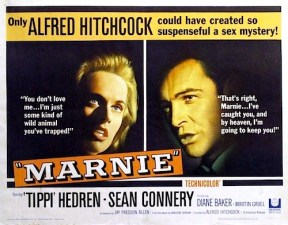 Marnie is a film grounded in the field of psychoanalysis, though that word is never used and none of the characters are a therapist. Instead, it just concerns itself with a main character suffering under the strain of repressed childhood memories, though this isn’t revealed until the end. Unfortunately, psychoanalysis was only an emerging area at the time of production, and the price Marnie pays for being ahead of the pack in the mid ’60s is that it looks dated and inaccurate now.
 100Films.co.uk