2015 #26a
1968 | Stanley Kubrick | 149 mins | Blu-ray | 2.20:1 | USA & UK / English | U / G
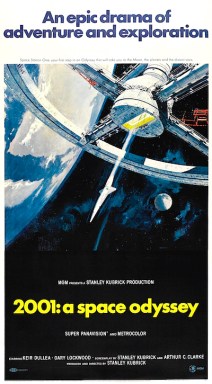 As suggested (and named) by the ghost of 82, this is the first in an occasional series* in which I revisit films that are highly acclaimed but I didn’t enjoy first time round. First up, Stanley Kubrick’s monumental sci-fi opus, 2001: A Space Odyssey.
Now, let me begin with a point of clarification: I don’t remember when I first saw 2001, but I was very young, and most likely looking for SF films in the vein of others I’d enjoyed, like, say, Star Wars. I think we can all agree that 2001 is not like Star Wars. Nonetheless, while I wouldn’t have said I disliked 2001, I didn’t understand it either — and not in the “let’s debate its meaning” way in which no one else really understands it either, but in a more “well I didn’t get that, let’s ignore it” kinda way. I tried to watch it again in my teens, but it was late and I fell asleep. Some bits of it are very calming…
I think whenever it is someone first watches 2001, it’s the kind of film a viewer needs to be ‘prepared’ for. You can’t just watch it like “any other film”; it doesn’t quite play by the normal rules of mainstream narrative cinema. There is a story, but it’s slight, and told almost incidentally, half in asides and snatched exposition amongst other goings-on, and it’s never thoroughly elucidated. It exists to serve the film’s themes, or explorations, or whatever you want to call them, which I think is contrary to how most people (outside of the arthouse crowd) view cinema.
In reality, 2001 probably is an arthouse film. The final 20 minutes, with their bizarre and initially-inexplicable imagery, certainly are. The opening Dawn of Man sequence probably is too. The long, slow shots of spacecraft drifting, or of people silently riding said spacecraft, fit in that box ‘n’ all. These may be groundbreaking special effects, but the feelings they generate aren’t exactly the same as Star Wars, are they. The everyday mundanity of the space travel as seen in the film is almost its point, even if it’s conveyed through awe-inspiring effects work. Today, a mainstream director producing an expensive effects-heavy movie 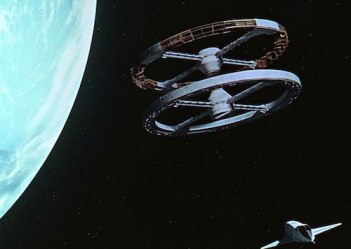 with this kind of pace and uncertainty would be unthinkable, but I guess audiences were a little more mature in the Good Old Days. Even then, Kubrick cut 19 minutes after the film’s premiere in order to “speed up the pacing”. Maybe he succeeded, but no one’s going to be calling this a fast-paced thrillride any time soon.
The effects, incidentally, are magnificent. They still look spectacular today — one can only imagine the impact they had on the big screen in the mid-’60s, nearly a decade before Star Wars came along to blow people’s minds. There are incredible sets too, which, even when you know the kind of behind-the-scenes techniques they likely employed, make the mind boggle — “that circular room on the Discovery is massive; it can’t be one giant rotating set, surely?” The sound design, an often overlooked element of filmmaking, is amazing as well. The EVA with Dave’s breathing echoing constantly around the soundstage, making the experience feel claustrophobic even when what you’re seeing is a giant craft in the vastness of space… And the music, of course. It’s completely unnerving whenever the monolith is near, a score filled with freaky voices that wouldn’t be out of place in a horror movie. The movie’s influence is perhaps most clearly seen in what you might call its title track, Richard Strauss’ Thus Spoke Zarathustra, which 2001 established as the soundtrack of space exploration.
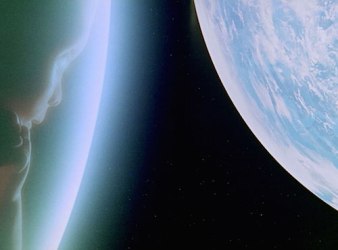 Technically, then, 2001 is undeniably stunning. Thematically, though… what’s it all about? What does it mean? Author Arthur C. Clarke once said that “if you understand 2001 completely, we failed. We wanted to raise far more questions than we answered.” Some find such goals unsatisfying, especially when it comes to storytelling, but the very spirit of space exploration, of science, is to keep asking questions that don’t necessarily have answers. Of course, the ending is actually very easy to explain: the evil alien monolith kidnaps Dave, ages him to death, then mutates him into a giant Space Foetus, which it sends back to Earth. Why they didn’t make 2002: Invasion of the Giant Space Baby, I don’t know. Who doesn’t want to see that movie?
(Just so we’re clear, I’m being facetious. Probably. Though if 2010 is actually about an invasion by a giant space baby, somebody please let me know.)
Having said the film looks to expound the scientific virtues of asking questions and pushing forward, it’s interesting that it’s very easy to read it as technophobic — arguably, the entire point might be, “be wary of technology”. Such themes are expressed succinctly in possibly the most striking, probably the most audacious, and certainly the most famous, jump cut in movie history. The strange presence of the monolith leads ape-man to discover tools, 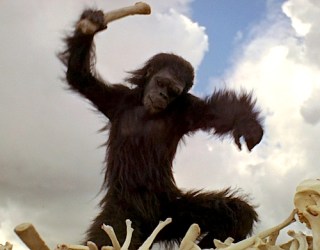 and almost immediately use them to kill, first a beast for food, then another ape for territory. Then, in a literal split second, we jump forward millennia, as that simple tool turns into a nuclear weapon drifting in orbit — the entirety of human technological innovation summed up in a single cut.
And then there’s a new monolith and things all go to shit again.
The simple point is, technology has led us to develop, to literally reach for the stars, but it also drove us to savagery, and still does. So is it a good thing? Surely the film can’t be condemning it entirely…? Whether it is or isn’t, it’s ironic that themes of “bad technology” should be expressed in the most technologically-driven of all entertainment media (at the time), and created largely through advanced and innovative technological effects at that.
Leaving aside those effects and themes and all the questions we’re left with, what amazes me most about 2001, in a way, is how well-regarded it remains by a general audience, exemplified by public-voted lists like the IMDb Top 250. Of course critics still love it, but you’d think its artiness would have caused a gradual decline over time as the wider viewership immatures. But no; or, at least, not enough that it’s disappeared from consideration. Yet.
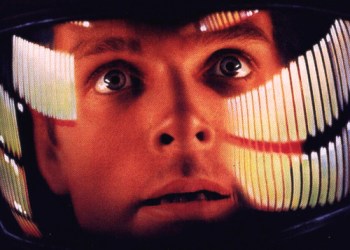 In the end, I think 2001 is a film that’s very easy to admire, for all sorts of reasons, but to enjoy in the traditional sense of “enjoyment”? Surely it’s far too removed, too obtuse, too joyless, for that? Some people will like those qualities, of course, and all power to them. For me, 2001 is a film to be impressed, even awed, by; but not one to love.
2001: A Space Odyssey is on BBC Two, in HD, tonight at 11:05pm.
* Read: there may be more but I’ve not got any planned. ^

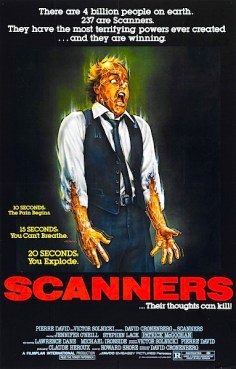 If you’re versed in sci-fi/fantasy cinema, you’ve heard of Scanners even if you haven’t seen it: it’s the one with the (in)famous exploding head. That moment is distinctly less shocking for those of us coming to the film as a new viewer at this point: gore perpetuates genre cinema nowadays, so it’s less striking,* and the scene it’s in is quite obvious, so you know it’s coming. Fortunately, Scanners is so much more than one famous moment.
 emotional journey or something is the core of the film. As if to make up for it, McGoohan is of course excellent, acting everyone else off the screen, while Ironside makes for an excellent villain, naturally. Some say that the final psychic battle, between Lack and Ironside, is underwhelming, but I thought it was excellently realised, a tense and effective struggle. Such brilliant effects and sequences are scattered throughout the film.
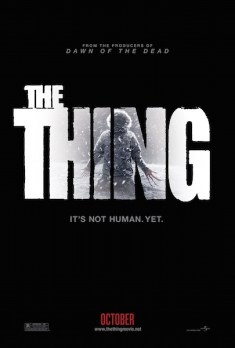 At some point during the process of remaking John Carpenter’s seminal 1982 sci-fi/horror
  Of course, it isn’t as good. There are many reasons for this, one of which is the fact that, because they haven’t just remade the other film, every homage/rip-off they come up with is inferior. So the blood testing scene from the ’82 film is replaced by shining a torch in someone’s mouth to see if they have fillings. God help you if you’ve taken care of your dental hygiene. The climax is typically overblown — this isn’t a spoiler, I’m preparing you if you’ve not seen it: the survivors venture into the alien’s spacecraft to stop it taking off. Some people get a kick out of getting to see inside the ship, and I suppose you could say that at least the remake-makers are trying to offer something new. Unfortunately, new is exactly what it’s not. The Thing is a bizarre creature, growing and morphing and warping in disgusting ways — what strange kind of spaceship would it call home? A bog-standard metal-corridors kind of one, apparently. The lack of imagination is staggering.
 The other element the making-of material is keen to underline is just how much effort was put in to make sure this ties back to its predecessor. Essentially, they looked at what was revealed about the Norwegian base in Carpenter’s film and used that to reverse engineer the events that had to occur in this film. However, the final result could’ve made some of these connections more explicit. For example, we don’t see when the guy who slit his throat performs that act. The moment is actually included among the disc’s deleted scenes, but why did they cut it?! The movie’s final scene, which directly links the two films, is intercut with the end credits — why?! It comes across as apologetic, like they’d rather it wasn’t there but feel it has to be. Either put the scene in the film proper, or put it as an after-credits easter egg for die hard fans; the halfway-house used in the final cut is just messy. If someone’s argument was, “casual viewers will find those linking scenes meaningless”, then watch your own movie! The helicopter being away for refuelling is referenced earlier in the film; Joel Edgerton’s character says they didn’t kill Lars but never says what they did do with him; and the last time we see Colin he’s alive (until a single shot of his frozen corpse, that is). To put it another way: they’ve done a bang-up job of making those things matter within the film itself, as well as in the context of linking up to the ’82 film, so why were they deleted or included only as an embarrassed afterthought?
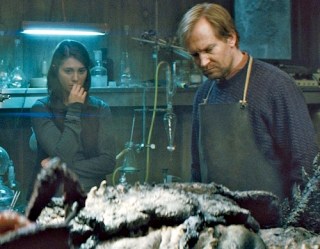 Or maybe they wouldn’t, because The Thing 2011 is a lesser film than the original. It does still offer some suitably gross effects work, albeit lessened by it being obvious CGI rather than gruesomely physical constructions, but there are still some resultantly tense sequences. Heck, it’s the first film in I-don’t-know-how-long that actually made me jump, once. Some viewers complain that there’s no “who might be an alien?”-type tension because the characters aren’t well-drawn enough, but I had that problem with Carpenter’s film too.
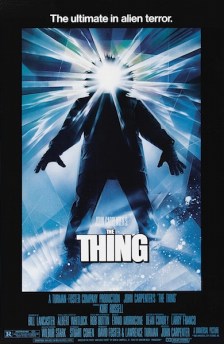 It’s just an ordinary day at the US Antarctic research base staffed by helicopter pilot MacReady (Kurt Russell) and his compatriots, until a helicopter buzzes overhead dropping grenades on a dog it’s pursued across the ice fields. The dog finds sanctuary in the US base; the helicopter and its crew are less fortunate. Realising it’s from a Norwegian facility an hour’s flight away, MacReady and the doctor brave inclement conditions to investigate. They find numerous corpses and the base burnt to ruins. What horrors befell the Norwegian base? And have they inadvertently brought them into their own…?
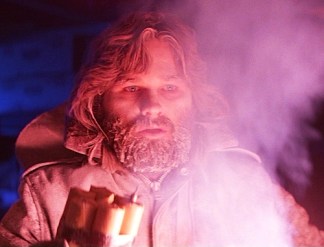 Even if you don’t want to get deep about it, The Thing has the “who’s human?” thrills to keep you engaged on that level. Accusations of boredom no doubt stem from the fact it’s a bit of a slow burn, the early acts building suspicion and unease as MacReady and co investigate. Even after the true nature of the threat is revealed, Carpenter paces himself, though the frequency of incidents begins to mount inexorably as we head towards the climax. Well, that’s just good structure.
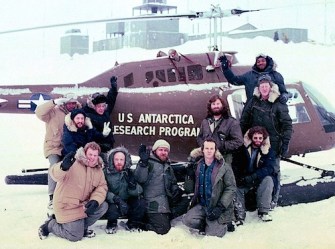 For me, it’s the psychological quandaries that are gripping and exciting, rather than any enjoyed disgust at the emetic special effects. However, knowing the characters a little better — thus caring if they’d been replaced or not, and also perhaps allowing us a chance to try to guess for ourselves — would have just made it that bit superior.
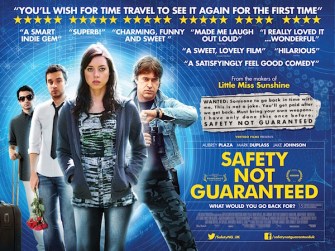 The debut feature from the director of all-conquering box office behemoth
  Maybe I’m missing something, I don’t know, but where other directors currently making a similar transition (Gareth Edwards, Josh Trank, Duncan Jones) showed some signs of a reason for the upgrade in their debut and/or sophomore features, I can’t fathom what singled Trevorrow out. He seems to have done alright with it though, so never mind.
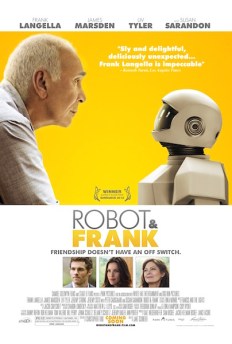 In “the near future”, Frank (Frank Langella) is an ageing jewel thief in denial about his dementia, contenting himself with visits to the local library, which is being taken over by a bunch of yuppies to turn into “the library experience”, and shoplifting from the beauty store that used to be his favourite restaurant. Concerned for his wellbeing, his son (James Marsden) gets him some home help in the form of a humanoid robot (voiced by Peter Sarsgaard). Initially reluctant to accept its presence, when the robot attempts to help by also shoplifting from the beauty store, Frank senses an opportunity…
 (part of a half-realised almost-subplot about robot rights, or something), we not only feel Frank’s (temporary) loss of his friend, but also urge the film to turn the robot back on and get back to what’s really making the movie work. The event serves a purpose (it’s the point Frank realises he’s stopped just putting up with the damn robot and actually come to appreciate its presence), but still.
 Equally, this is of a branch of science-fiction we see all too rarely on the big screen, but which is fertile ground for those wishing to explore it: using fantastical concepts to explore and enlighten our own world. Even if you learn nothing revelatory about old age and the rigours of dementia, the friendship between the robot and Frank is reason enough to enjoy.
 The very low-key nature of Time Lapse will put some people off. If you like your sci-fi full of action or scientists or world-saving/changing endeavours, it’s not for you. If you like sci-fi where an impossible concept throws ordinary people into dilemmas about themselves and each other, this is a well-conceived drama. Add in an engrossing mystery element that keeps you questioning and guessing until the end, and you have a minor gem.
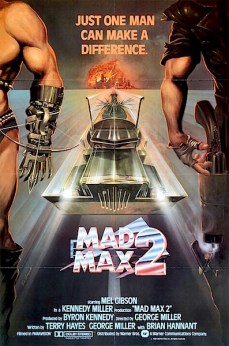 Roaming the outback of a gasoline-desperate post-apocalyptic Australia, “Mad” Max Rockatansky (Mel Gibson) comes across a commune-like oil refinery, whose inhabitants are under siege by a brutally violent gang. Max strikes a bargain: he’ll help them escape with their oil, in exchange for a tank full for himself.
 The most memorable part, however, is the climax. They escape the oil refinery, Max driving the tanker — fitted out with weaponry and defences — and the gang give chase. An almighty action sequence follows, a speeding battle through the outback. It feels wrong to just call it “an action sequence”, like that’s selling it short. You get the sense that this is why the movie exists; that co-writer/director George Miller’s goal with the entire rest of the film has been to get us to this point. It’s not just “the climax”, it’s “the third act”, and it’s stunning — the choreography of it, the editing, the stunts, as dozens of vehicles chase each other, people run around on top of them, jump between them… I don’t think it’s hyperbolic to say it must be one of the greatest action sequences ever committed to film. One of the reasons
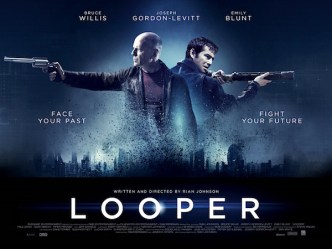 Writer-director Rian Johnson re-teams with the star of
 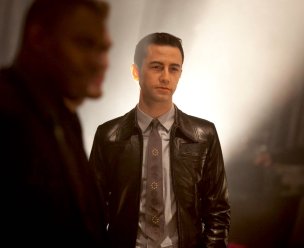 Firstly, the less you know the better. I pretty much knew the above before I went in, and that meant the film had surprises from the get-go. For instance, the near-future world most of the action takes place in has been well-realised by Johnson and his design and effects teams, and time travel is not the only SF concept or imagery employed here, which I wasn’t aware of. Their vision is
 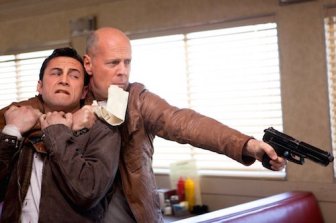 Heading up the cast, Gordon-Levitt does a good Bruce Willis impersonation — believable, but not a slavish impression. That was probably quite necessary, because I don’t imagine Willis has the thespian chops to emulate an older Gordon-Levitt. Notoriously, the younger actor does the whole thing under prosthetics designed to make it more plausible he’d age into Willis. They’re a bit weird: not badly done — far from it, in fact — but you’re always kind of aware they’re there. A highly able supporting cast flesh out the rest of the characters, though most memorable is young Pierce Gagnon as an imperilled child you wouldn’t necessarily mind getting killed. And I mean that in a nice way; about the film and his performance, if not the character.
 Even if there are some logic issues, it doesn’t fatally undermine the movie. Looper comes with the joys of a well-imagined future, a captivating storyline, engaging characters, and enough twists and turns along the way to keep you guessing at the outcome. The best genre movie of 2012? That was a year of stiff competition among SF/F pictures, but Looper may have the edge.
 Alex Cox was once the director of noticed movies like
  The way he’s gone about filming it is as, essentially, a giant student film. Cox currently teaches film at the University of Colorado at Boulder, and it was along with his students (plus some professional colleagues from previous films) that this movie was produced — that’s partly why there’s the lengthy list of directors (Cox actually directed “most of the first act and all the third”, as discussed in
  but there’s no transition from it into the black-and-white live-action main film, just an abrupt cut (a good place to have put the title credits, at the very least!) Worst of all, no effort whatsoever is made to establish that the cartoon guy we saw being enlisted at the start is now a live-action guy with a teddybear strapped to his spacesuit. It took me a minute to get it, and I’ve read the book.
 After a hurried start, the film does settle down to slightly longer scenes with more of a point, like Bill’s encounter with the Laundry Officer-cum-Chaplain, and some of these work pretty well. Sadly, too much of the time it’s a race through the novel’s story, feeling like a filmed recap for those who’ve read the book. Goodness knows what someone who hasn’t would make of it all. Goodness knows if they’d even be able to follow it at all, to be frank.
 Bill the Galactic Hero might be best described as a noble failure. It’s been created with the best of intentions, both in terms of adapting a quality novel that Hollywood had no interest in, and in training up a new generation of filmmakers in an independent and proactive way. It’s a shame the end result isn’t wholly as enjoyable as it might’ve been.
 100Films.co.uk