Anthony & Joe Russo | 136 mins | Blu-ray | 2.40:1 | USA / English | 12 / PG-13
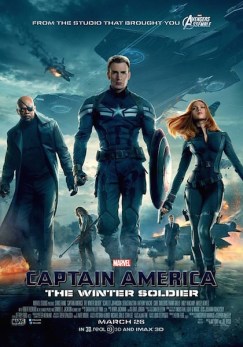 After the dullest, messiest movie of their first phase, and his goody-two-shoes depiction in The Avengers, Marvel finally nailed Captain America earlier this year with his second solo outing. Sadly, it’s still undermined by its share of niggles.
The Winter Soldier picks up two years after the Avengers assembled, with man-out-of-time Steve Rogers, aka Captain America (Chris Evans), a fully-fledged member of Team America: World Police S.H.I.E.L.D., working alongside Black Widow (Scarlett Johansson) to run all kinds of black ops missions. But when the life of director Nick Fury (Samuel L. Jackson) is threatened by a mysterious assassin known only as the Winter Soldier (Sebastian Stan), Cap begins to uncover a massive conspiracy of nefarious nastiness…
To say much more would be spoilerific, though chances are you’ve heard what happens even if you haven’t seen the film, because it’s had major implications for much of the rest of the Marvel Cinematic Universe. Still, I’ll assume you don’t know, just in case.
That said, the problem with Marvel’s massive shared universe (where the events of one film impact not only on future films but tie-in TV series, etc) is that, watching Cap 2 just seven months after its release, the film already feels like very old news. It was dissected into the ground by bloggers and commentators while it was still in cinemas; it had a huge effect on Agents of S.H.I.E.L.D., which by now has rolled past it into new territory; and it feels like 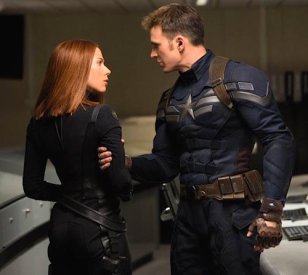 everybody moved on to being more excited about Marvel’s end-of-summer new-franchise-launcher, Guardians of the Galaxy. Cap 2 still has things to offer as a standalone film, but watching it now feels like watching a press conference after you’ve read a summary of the key points: there’s probably something to be gained from experiencing the whole thing, but it’s also like a slow-paced unveiling of surprises you already know.
It’s probably best to put aside the parts of Winter Soldier that have an impact beyond the film itself and just focus on it being a story in its own right, then. They promised us a ’70s-style conspiracy thriller, and there’s some of that DNA in there, although it’s been cleverly reworked to fit the slick CGI-filled world of the modern epic action blockbuster. So the conspiracy plot is actually not too complex, but there’s enough of it to give the film a different flavour. Many bonus points are earnt for trying to do more things with superhero narratives. It’s been widely noted that there are only about three or four superhero plotlines (and that’s if we’re being generous), so it’s good for Marvel — who are currently churning out two superheroic movies a year, and before long will be upping that to three — to be bringing something new to the table.
The style of story also becomes the springboard for a different tone to the action sequences: grounded, almost gritty, with practical effects and stuntwork — it could almost be a Bourne movie rather than a superhero one. They even manage to take a minor and silly Marvel villain, Batroc the Leaper, and turn him into a cool and worthwhile adversary. Until the climax, anyway, which is your usual CGI blow-out — an increasingly familiar pattern for Marvel films (and one we’ll come to again soon in Guardians of the Galaxy).
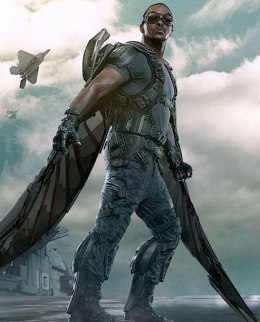 Also introduced is sidekick hero the Falcon (Anthony Mackie), who I have little to say about directly. He’s a sidekick who’s introduced fully-formed — he’s been using his ‘superpower’ for years as just part of the military; it’s not new or exciting to him, which lessens some of its power for the viewer too. “Origin story” may be the most over-used of all the superhero stock stories, but there’s a reason for that. If you skip it then you cut to the chase, that’s true, but does it also lessen the impact of characters to not see how they started? Maybe storytellers just need to come up with fresh ways of giving origins, rather than skipping them altogether.
Despite his presence in the title, the Winter Soldier also has a fairly small part to play in the final mix. He’s a henchman, not the main villain — but he’s an important character in the comics, so naming the film after him is really a signal to fans. Unfortunately, the Big Reveal of who he is has been a little bungled: comic book fans already know, so it doesn’t matter to them; and the element it ties back to in The First Avenger was so throwaway that casual viewers aren’t going to remember it. The Winter Soldier does its best to retrospectively big up the necessary elements, with callbacks to the first film and new flashbacks to bolster relationships. Whether it’s too little too late is perhaps a matter of personal preference.
Talking of that shared universe again — well, it’s hard to avoid, because Winter Soldier is every inch grounded in what has come before and what will come after. Mackie described the film as “Avengers 1.5”, and that’s pretty true. It picks up on events and characters from both The First Avenger and The Avengers, some of which have very significant roles to play in the film’s own storyline; 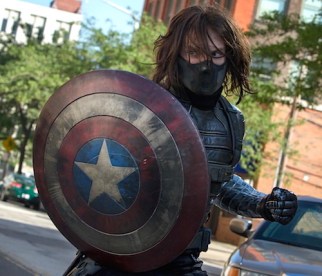 and then it refuses to wrap everything up, putting certain things in place ready for Age of Ultron and leaving still other doors open for Cap 3 — including the bloody Winter Soldier, despite his name being in the title! Goodness knows when or how they’re going to deal with that, considering the next Cap film is based on another highly significant comic book story arc, Civil War.
For me, however, the way it ties in to and impacts on the wider Marvel universe is when the film is at its weakest. There’s a benefit in utilising our relationships to these characters for emotional or dramatic effect, and at times it does that well, but when it’s raising more questions than answers, and when it can’t even complete the storyline that’s in its own title, is that a good thing? This isn’t part of a TV series, it’s a movie — is it so much to ask for a complete experience, one that builds on previous movies and has teases for the future (if it must), rather than just the latest segment of an apparently-never-ending story? Marvel’s shared universe is turning out to not be a group of films which happen to feature the same characters crossing over, but ones where the status quo between a film and its own sequel can be completely changed by events in a ‘separate’ series. Is that OK? It seems to work for them, and many people are getting a great amount of enjoyment from spotting the links and piecing together the arcing stories, so I guess it is.
The audacity of certain twists, plus the unusualness (for a superhero movie) and quality of the action sequences, is likely responsible for the massively positive reception that greeted The Winter Soldier on its cinematic release. With the surprise value of the former removed, and arguably exposed as just another round of questions to be answered in future instalments, 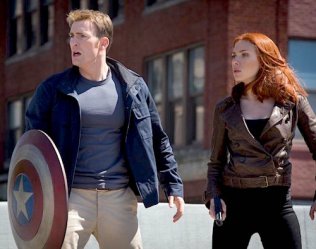 what’s left? There is strong action, albeit undermined by muddled character investment; and there is an interesting thriller/conspiracy story, albeit undermined by a feeling of “once you know it, you know it” — it’s not all that complicated or all that surprising, including the revelation that the one character significant enough to be behind it all is behind it all (gasp!)
Believe it or not, I did quite like The Winter Soldier while I was watching it; but the more I write, the more it frustrates me. There’s undoubtedly some quality filmmaking here (as far as superhero blockbusters go — it’s never going to please a sniffy cineaste), so perhaps I need to stop getting so hung up on its connections to other films. Or perhaps Marvel need to stop tying all their movies so tightly together. There’s surely a reason this doesn’t have a number in the title — it’s meant to be Captain America vs. the Winter Soldier, not Marvel’s Avengers Universe: Episode 9. But, however many borderline-unique elements it’s at pains to include, the latter is what it is.

Captain America: The Winter Soldier is on Sky Movies from Boxing Day.
This review is part of the 100 Films Advent Calendar 2014. Read more here.
 Comic book creator Frank Miller brings what he learnt co-directing
 I’ve always contended that the first
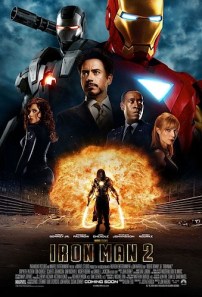
  For starters, it relies on the story rather than the action. There are certainly some good sequences of the latter (more about those later), but there’s also a lot of story in between them — it’s not wall-to-wall explosions and punch-ups. Neither was the first, if you remember, and so it fits in that respect. It’s helped along by the ending of the first film, in which Tony Stark revealed he was Iron Man. That’s not something you do in superhero movies, which immediately lends this one a few new plot devices to play around with. Considering the burgeoning critical assessment that all superhero movies ever only tell the same two or three stories (an argument I think has a lot of validity), it’s nice to see anything to challenge the norm.
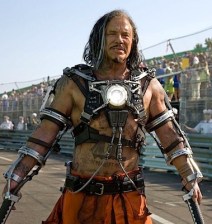 it’s the Penguin and whover-Christopher-Walken’s-character-was rather than Mr Freeze and Poison Ivy, if you will. They play to different sides of the hero: one is fighting Stark, one Iron Man (though there is naturally crossover); though they’re both intelligent, one functions as the brains and the other as the brawn. Mickey Rourke may go slightly underused, but it’s also part of the character, a quiet, thoughtful, intelligent hulk partnered with Sam Rockwell’s jabbering wannabe-Stark.
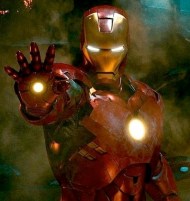 watched again later on Blu-ray, I enjoyed it a lot more. With Iron Man 2 I’m obviously distanced from trailers by a good year or so, and though one of their best moments is missing from the final cut, and the suitcase-suit is unavoidably spoilt by being so thoroughly screened during the promotion, watching now doesn’t have all the trailer-generated expectation to live up to. That famous Onion spoof about the first film’s trailer is, perhaps, even more applicable to the sequel.
 Aside from one unnecessary scene featuring Captain America’s shield and Agent Coulson leaving for New Mexico, and the fact that the film assumes everyone will know who Nick Fury is despite him being introduced fleetingly after the credits of the last film, the whole S.H.I.E.L.D./Avengers Initiative thing is worked into the plot well. If we didn’t know it was the beginning of the build-up to The Avengers, I think it would have sat much better with viewers. Even if it does end up blatantly laying the foundation for further stories, that’s hardly uncommon in franchise films of all kinds these days — at least we know this series will definitely pay it off, unlike so many franchise-wannabes that don’t make it past their first film. Plus, the film’s primary plot has its own villains and comes complete with a resolution; Fury, S.H.I.E.L.D. and co are a subplot that feed other subplots.
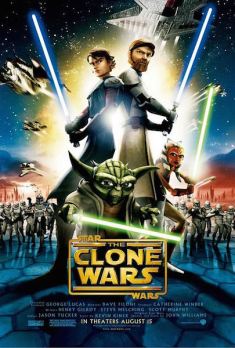 The Clone Wars can boast an awful lot of firsts within the
  Catherine Taber’s Padmé impression is probably the most convincing of the lot and, coincidentally sharing the same scenes, Corey Burton’s Truman Capote impression as Ziro the Hutt is entertainingly obvious. Count Dooku doesn’t particularly benefit from the involvement of Christopher Lee, but at least Samuel L. Jackson is vaguely recognisable lending his actual voice to Mace Windu. Most of the cast deliver the kind of performance you typically find in kids’ cartoons — i.e. not all that good, no doubt due to the pressures of producing as many episodes as possible as cheaply as possible. Dubious line readings abound, though in fairness this may be down to the awkward lines they’re forced to deliver.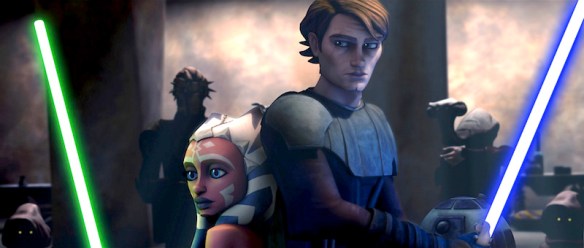
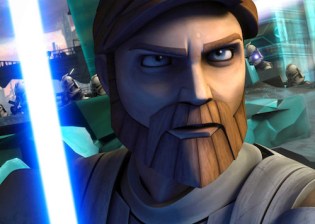 It may sound like a piece of trivia that this was originally conceived as three episodes of
  it just doesn’t have the epic quality that imbued all the other Star Wars films. Not every film has to be an epic, even ones set within the same universe/storyline, but by wheeling out all the main characters and then showing them complete just one moderately low-key mission, The Clone Wars does feel like a single instalment of a TV series and not an appropriately-scaled cinematic experience.
 100Films.co.uk