

Country: USA
Language: English
Runtime: 145 minutes
BBFC: 12
MPAA: PG-13

Original Release: 20th June 2002 (Australia)
US Release: 21st June 2002
UK Release: 4th July 2002
First Seen: cinema, July 2002
Stars
Tom Cruise (Born on the Fourth of July, Mission: Impossible)
Samantha Morton (Morvern Callar, Synecdoche, New York)
Colin Farrell (Tigerland, In Bruges)
Max von Sydow (The Virgin Spring, Shutter Island)
Director
Steven Spielberg (Close Encounters of the Third Kind, War of the Worlds)
Screenwriters
Scott Frank (Out of Sight, The Wolverine)
Jon Cohen
Based on
The Minority Report, a short story by Philip K. Dick.
The Story
Washington, D.C., 2054: a special police department, PreCrime, arrests murderers before they even commit a crime, using information gained from three ‘precogs’ who have visions of the future. When the precogs report PreCrime’s captain, John Anderton, will kill a man he doesn’t even know, he goes on the run to prove his innocence.
Our Hero
PreCrime Captain John Anderton believes in the infallibility of the system, no doubt motivated by the disappearance of his son years earlier, which has also left him a divorced drug addict. He’s played by Tom Cruise, so of course he’s charming and heroic nonetheless.
Our Villains
The PreCrime unit is under consideration for nationwide adoption, so is being audited by sceptical Department of Justice agent Danny Witwer when Anderton is accused. While Witwer might seem antagonistic, you know there’s some other Big Bad behind the whole thing…
Best Supporting Character
Agatha, the lead precog, who sometimes has a different vision to the other two, which produces the so-called ‘minority report’ that may prove Anderton’s innocence — so he breaks her out. Unsurprisingly, an individual who spends her life hooked up to a machine in some kind of dream-state while having visions of different futures isn’t necessarily suited to the real world.
Memorable Quote
Fletcher: “John, don’t run.”
Anderton: “You don’t have to chase me.”
Fletcher: “You don’t have to run.”
Anderton: “Everybody runs, Fletch.”
Memorable Scene
So he can’t be identified by the future’s ubiquitous iris scanners, Anderton has undergone an eye transplant with a dodgy backstreet surgeon. He’s told he can’t take the bandages off for 12 hours or he’ll go blind. While he’s still convalescing, police searching for him arrive at his location. With thermal imaging confirming how many people are in the building, they unleash spider robots to scour each floor and scan everyone’s eyes. Hearing their approach, Anderton attempts to hide in an ice bath, but the thermal scan notices his disappearance. The officers close in on his location, as do the spiders… but he can’t take his bandages off… but the officers will recognise him…
Technical Wizardry
Cinematographer Janusz Kamiński gave the film a very distinctive visual style, described by one critic as looking “as if it were shot on chrome, caught on the fleeing bumper of a late ’70s car”. Aiming for a film noir feel, the shoot was deliberately overlit, then the film was bleach-bypassed in post-production, a process that desaturates the colours but gives the blacks and shadows a high contrast. Kamiński used the same technique on Saving Private Ryan. Here, coupled with the chrome-and-glass production design, it succinctly evokes a dystopian future.
Making of
Spielberg wanted the film’s near-future world to be based in reality rather than the usual extravagant imaginings of science fiction. To create this plausible future, he convened a three-day ‘think tank’ of fifteen experts, including architects, computer scientists, biomedical researchers, and futurists. Their ideas didn’t change key points of the film’s story, but did influence the creation of the world. Production designer Alex McDowell maintained a “2054 bible”, an 80-page guide listing all of the architectural, socio-economic, political, and technological aspects of the future decided by the think tank. The film’s Wikipedia article has a whole section about technologies seen in the film that have since come about or that are in active development.
Next time…
A sequel TV series aired last year (with none of the original cast (well, except for one)). It didn’t go down very well with either critics or viewers, and swiftly had its episode order reduced before being completely cancelled.
Awards
1 Oscar nomination (Sound Editing)
1 BAFTA nomination (Visual Effects)
1 World Stunt Award (Best High Work)
4 Saturn Awards (Science Fiction Film, Supporting Actress (Samantha Morton), Director, Writing)
7 Saturn nominations (Actor (Tom Cruise), Supporting Actor (Max von Sydow), Music, Costumes, Make-Up, Special Effects, DVD Special Edition Release)
Nominated for the Hugo for Best Dramatic Presentation Long Form
What the Critics Said
“Steven Spielberg’s Minority Report doesn’t look or feel like anything he’s done before, yet no one but Spielberg could have made it. Ferociously intense, furiously kinetic, it’s expressionist film noir science fiction that, like all good sci-fi, peers into the future to shed light on the present. The director couldn’t have known, when he and writers Scott Frank and Jon Cohen set about adapting Philip K. Dick’s short story, how uncannily their tale of 2054 Washington, D.C., would resonate in [2002’s] political climate, where our jails fill up with suspects who’ve been arrested for crimes they haven’t yet committed.” — David Ansen, Newsweek
 Score:
 90%
90%What the Public Say
“This film is an excellent example of why Steven Spielberg is one of the great master directors of American cinema. It’s a perfect balancing act, a movie that sacrifices neither ideas nor action, nor emotion, nor mystery, in the service of its story. […] How can we categorize this movie? It is a sci-fi neo-noir that prefers to tell its story on Earth and with humans, much like Blade Runner (1982) and Gattaca (1997). It’s a twisty mystery, a classic whodunit of double-crosses, murder, and troubled pasts. It’s also an innocent-man-on-the-lamb chase movie, not unlike The Fugitive (1993). And it all fits together; it works, it feels like, yes, this is the way this story should be told.” — David, The Warden’s Walk

Spielberg once described Minority Report’s story as “fifty percent character and fifty percent very complicated storytelling with layers and layers of murder mystery and plot,” which I think is indicative of why it’s such a successful experience: it mixes exciting, propulsive plot and action sequences with thematic concerns that use science-fiction ideas to explore real-world issues, both tangible (the prevalence of state control and policing) and metaphysical (free will vs determinism). It makes for a rounded, thrilling movie.

#62 will be your mission… should you choose to accept it.
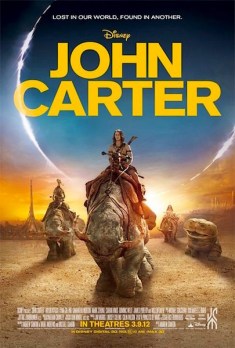 A box office flop (it made a once-astonishing $284 million worldwide, but that was off a $250 million production budget and a ginormous bungled marketing campaign), John Carter has gained something of a following among those who did enjoy it or caught it later — see
  not because it’s so famous (among Normal People, I don’t think it is), but because its influence means its imagery and concepts have already been plundered (
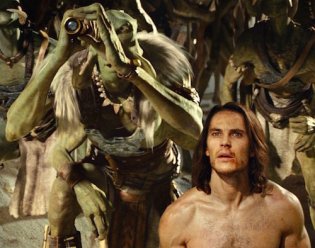 It doesn’t help that the film is structurally muddled at the offset. It begins on Mars, a voiceover detailing the conflict — an instant bombardment of names and concepts. I don’t mind things that challenge you to keep up, but it still feels a bit much. Then we jump to New York in the 1880s, where Carter is running away from someone in the streets. Then to his house, where his nephew has just turned up to be told he’s dead. You what? We just saw him in the telegraph office! And then we jump back to the 1860s, where he’s searching for gold and getting arrested (or something) by Bryan Cranston in a wig as some form of army officer. Then it gets a bit more straightforward. If being transported to Mars and meeting four-armed CG aliens who speak in subtitles is what you call “straightforward”, anyway.
 It feels a bit facile to criticise the quality of CGI these days, but that doesn’t stop John Carter from being over-ambitious in this regard. In fact, it’s not really the sometimes-half-assed green screen or occasional plastic-ness that’s the problem, but the design: those four-armed aliens are just a little too cartoony. Perhaps it’s a hangover from Stanton’s Pixar days, perhaps something just went a little awry during the process, but their design doesn’t look quite ‘real’ enough; a little like someone’s taken a real-life creature and then lightly caricatured it. I think it’s the eyes, which are perhaps a little too big and round and ‘cute’, but there’s something else indefinable there, or not there. These aliens aren’t just set dressing but proper motion-captured characters, played by the likes of Samantha Morton, Willem Dafoe, Thomas Haden Church and Polly Walker, so the lack of connection is regrettable.
 I was expecting, or perhaps hoping, to like it; to find a misunderstood old-style adventure full of entertainment value. It may be an old-style adventure, but that’s beside the point, because whatever it is, I just felt it wasn’t particularly well made: poorly constructed, weakly performed, lazily (and wrongly) assumptive of the audience’s familiarity with the material. Disappointing.
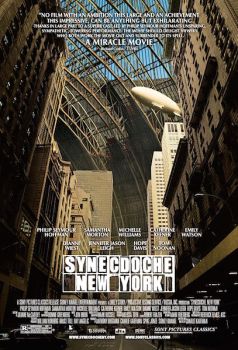 Despite its unpronounceable title, Synecdoche, New York starts out like a relatively normal comedy/drama… but then weird touches begin to creep in. A house that’s on fire when a character buys it and continues to be on fire for the next several decades, for instance. No one in the film bats an eyelid. Then the really weird bit arrives; the bit you all probably know; what the film’s about (except, of course, not what it’s About), as Philip Seymour Hoffman’s theatre director begins to construct a life-size New York within a warehouse.
 and I haven’t begun to care in the months since I watched it. It’s the kind of film where, as it gets on, you feel it’s a rich experience that you’ll have to ponder for a bit once it’s done, even if there’s something you quite fancy watching on the same channel immediately afterwards. But by the end it became the kind of film I was fed up with pondering, and I bloody well watched what was on the same channel immediately afterwards. Kaufman’s weirdness can wear you down to the point where characters who were interesting and ideas (both plausible and of Kaufman-logic) that had potential cease to be worth caring about; where you go from the point of “I’ll look up an explanation on the internet once it’s finished” to “…meh”.

 100Films.co.uk