
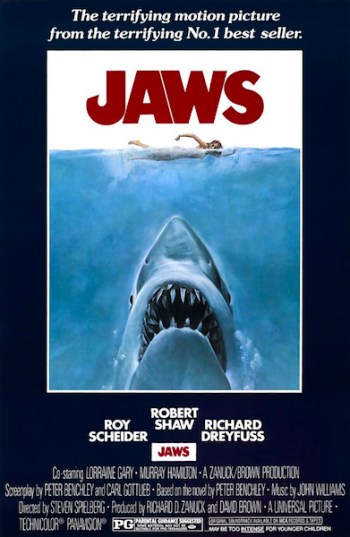
Country: USA
Language: English
Runtime: 124 minutes
BBFC: A (1975) | PG (1987) | 12A (2012)
MPAA: PG

Original Release: 20th June 1975 (USA)
UK Release: 26th December 1975
Budget: $7-12 million (sources vary)
Worldwide Gross: $470.6 million
Stars
Roy Scheider (The French Connection, All That Jazz)
Robert Shaw (From Russia with Love, The Sting)
Richard Dreyfuss (Close Encounters of the Third Kind, Poseidon)
Lorraine Gary (Jaws 2, 1941)
Director
Steven Spielberg (The Sugarland Express, E.T. the Extra-Terrestrial)
Screenwriters
Peter Benchley (The Deep, The Island)
Carl Gottlieb (Jaws 2, The Jerk)
Based on
Jaws, a novel by Peter Benchley.
The Story
As the seaside resort of Amity Island prepares for the lucrative 4th of July weekend, a series of violent shark attacks threaten the lives of residents and holidaymakers alike.
Our Heroes
Police chief Martin Brody is the one lumped with having to work out how to stop a man-eating shark, battling both small-town politics as well as the underwater predator. Eventually he’s aided by Matt Hooper, a young shark expert, and Quint, a salty old shark hunter.
Our Villain
A 25ft great white shark, with a taste for human flesh.
Best Supporting Character
Amity’s Mayor just wants what’s best for his town and its people — which, in this case, is having the beaches open for July 4th, whether people might get eaten or not.
Memorable Quote
“You’re gonna need a bigger boat.” — Brody
Memorable Scene
A group of young people sit on the beach at night drinking. The eyes of a boy and girl meet. They race off towards the sea, stripping as they go. She gets into the water first, while he’s too drunk to get his clothes off. She messes around in the ocean while he passes out on the sand. Then, she notices something underneath the water — something that grabs her — and… well, it doesn’t end well.
Memorable Music
John Williams’ famous, simple main theme is the definitive musical interpretation of approaching terror. When Spielberg first heard it, he thought it was a joke. Later, he said it was half of what made the film so successful.
Making of
Three mechanical sharks were built for the film, but no one thought to test them in water before taking them on location. They kept malfunctioning, causing a constant headache throughout production — because of them and other issues of shooting at sea, the film’s 55-day schedule ended up taking 159 days, and the $3.5 million budget ballooned to as much as $12 million. On the bright side, Spielberg had to work out how to shoot material around the unavailability of the sharks, which led to him taking a Hitchcockian approach of showing the ‘monster’ as little as possible, which was ultimately a benefit to the film’s effectiveness.
Next time…
Jaws was the highest grossing film of all time, so naturally there were a series of cash-grab sequels. As far as I was aware they were universally condemned, so I’d never paid them any heed, but I recently read a review that made me think I should give them a go. It said Jaws 2 wasn’t actually all that bad, Jaws 3-D was trashy fun, and Jaws: The Revenge… well, in for a penny, in for a pound, I guess. Incidentally, the last one is the film of which star Michael Caine famously said, “I have never seen it, but by all accounts it is terrible. However, I have seen the house that it built, and it is terrific.”
Awards
3 Oscars (Editing, Sound, Original Dramatic Score)
1 Oscar nomination (Picture)
1 BAFTA (Music (also for The Towering Inferno))
6 BAFTA nominations (Film, Director, Actor (Richard Dreyfuss), Screenplay, Editing, Sound)
1 Grammy (Original Score Written for a Motion Picture or Television Special)
It’s easy to start discussing Jaws in terms of it being the first summer blockbuster, or its troubled production, or the effect it had on audiences’ desire to go swimming. But divorced from all that, as a film in its own right, it’s a thrilling adventure movie — a man vs. a shark, when it comes down to it. It’s so packed with memorable shots and moments — be they horrific shark attacks, improvised one-liners, or precisely calibrated jump scares — that it’s no wonder it made Spielberg’s name. Personally, I feel the pace flags a bit once the three men get on a boat and go shark hunting, which slightly holds me back from completely loving it. Quibbles aside, it’s still a classic of suspense.

 Released the same year as
  Even with the undercurrents of grief and the difficulties of moving on, this is fundamentally a light, amiable romance.
 What About Bob is a comedy about mental health. As such, it feels primed for misunderstanding and inappropriateness. And it is indeed a little worrying early on: Bill Murray’s performance is, from the off, superbly believable, but it’s undercut by bad ‘this is a comedy’ music that suggests we’re meant to laugh at his impairments rather than feel sympathy. And maybe that’s what the screenplay, direction and performance were actually aiming at, but, personally, I don’t find laughing at the mentally disabled all that funny, even in a film nearly 20 years old. At one point, people clap as Bob gets off a bus he struggled to even get on — perhaps this is meant to indicate “thank God he got off!”, but I choose to take it as them celebrating his achievement, because, if not, it’s just attacking the disabled again.
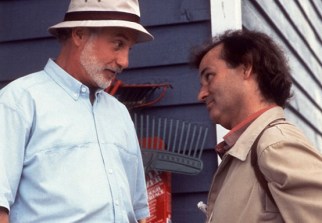 The film hinges entirely on Murray and Dreyfuss, and both are excellent in their respective roles. Murray portrays Bob’s mental health struggles early on in a way that would garner wider praise for accuracy if this were a drama, showing the potential he’s only unleashed in more recent years to play straight roles. But he’s equally good as the film becomes a clear-cut comedy: Bob doesn’t suddenly become a caricature, but is revealed as a good-natured, child-like, fun-loving person who, perhaps, just needs some care and love from others to help his conditions. Dreyfuss, meanwhile, is slickly believable as the uncaring fame-minded therapist, whose true nature — and problems — begin to unravel the more he’s confronted with Bob.
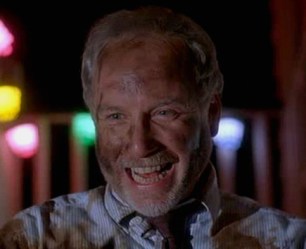 more about you as a person than it does about the film, the characters or the performances. It seems starkly obvious to me that Bob is the ‘good guy’, a nice but troubled chap who just wants to get by and have a good time, while Dr Marvin is a control freak with a raft of suppressed problems that are gradually unveiled throughout the film until they ultimately overwhelm him. He’s not a bad chap per se, but he is in the wrong.
 100Films.co.uk