
Although I only post my TV overviews once a month, I’m always looking ahead to what’s going to be included in them. That’s what made me realise edition #19, scheduled for July 20th, was going to be insanely busy: new episodes of Doctor Who, Game of Thrones, Preacher, Twin Peaks, and the entire latest season of The Americans — all things I typically review ‘in full’. Whew! So I’ve brought #19 forward a bit, and #20 will be in a fortnight anyway.
So, here’s what I’ve been watching in the past month three weeks (aka trisennight, a word that Google finds two other uses of ever. Cool.)

Doctor Who Series 10 Episodes 10-12
 History was made left, right and centre in the last three episodes of Doctor Who’s 36th-ever season. For starters, The Eaters of Light marked the first time someone who wrote for the classic series has written for the revived one. Rona Munro penned the last story of old Who, Survival, a personal favourite of mine and one that, stylistically and tonally, connects remarkably well with the first episode of nuWho, Rose, which is quite the coincidence. Anyway, The Eaters of Light was a solid episode with some very likeable parts, but it didn’t seem to quite gel entirely in the final mix. That’s been a recurring theme for the middle of this season, I feel, with every episode since Knock Knock featuring quality ideas and/or characters and/or scenes that aren’t fully developed into a final whole. Nonetheless, I’d certainly welcome Munro returning again in the future, but who knows what Chris Chibnall has planned.
And then we come to the two-part finale, written (of course) by departing showrunner Steven Moffat. The duology, which sadly is called neither Genesis of the Cybermen nor The Two Masters, continues his previously-stated aim of creating two-parters where each half is a distinctly different episode. The first part, World Enough and Time, is an immediate contender for an all-time great episode of the show. There’s a superb real-science setup with the time-dilated spaceship, plus a suitably eerie hospital in which we ‘unknowingly’ witness the birth of the Cybermen — my favourite Who monster, so perhaps I am a little biased.
 I put “unknowingly” in inverted commas there because that’s the episode’s biggest problem: thanks to the show’s own promotion, we knew the Cybermen were coming back, and we knew John Simm was returning as the Master. In truth, the former isn’t a problem. Sure, the existence of the Cybermen is played as something of a reveal at the end, but it also works as ‘just’ the reveal that Bill has been converted, and there’s dramatic irony in the viewer knowing what those cloth-headed patients are destined to become. The Master spoiler is more of a problem. The prosthetics turning Simm into Razor are impressive, and even fooled some people who knew he was back… for a bit. I’m sure most people must’ve guessed before the episode ended. It therefore becomes a distraction: what’s his plan? When will he reveal himself? And when the big reveal does come, it’s played as a twist, which it isn’t because we were told about Simm three months ago. Moffat has said before that it was entirely his decision to put Simm in the trailer, and it’s clear it was a misstep. Not a fatal one — World Enough and Time is strong enough to withstand it — but a shame. Can you imagine the reaction if we hadn’t known?
So with the Master finally revealed at episode’s end, he teams up with Missy for the first multi-Master story ever in the extended finale, The Doctor Falls. With a lot of business to attend to, this isn’t quite as striking as its first part. Nonetheless, there’s strong material here. Missy and the Master are a hoot, the pairing of Simm and Michelle Gomez working exactly as well as you’d hope. Their storyline comes to a very fitting conclusion, too. The way Moffat handles Bill being a Cyberman, how she feels inside and how people react to her, was an original use of a well-worn villain. Her possible-departure was fitting too, tying appropriately back to her debut episode. Moffat buried a way for her to return in the dialogue, which hopefully Chibnall will pick up because Bill has been absolutely fab. It would be a real shame if this is the last we see of her. 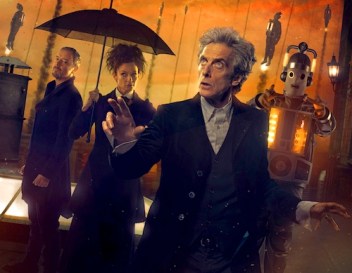 As for the other current Capaldi companion, there was an almost touching exit for Nardole, a character Matt Lucas has managed to imbue with much more likability than was promised in his initial appearance a couple of Christmases back. Finally, Peter Capaldi was in as fine fettle as ever, getting to deliver a few more of his iconic speeches, before going out with a heroic last stand.
Well, not quite going out, because we have that exciting cliffhanger to lead us into the Christmas special. With such a promising setup, let’s hope Moffat can stick the landing. We’ll find out on December 25th…
The Americans Season 5
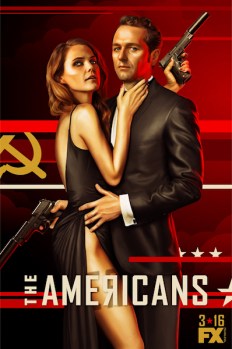
 “The best show on television” returns for its penultimate run. It’s currently mid-way through here in the UK (where it’s really, really buried on ITV Encore, more’s the pity — it deserves a bigger audience) so I’ll be extra careful to avoid big spoilers. It’s an interesting run of episodes, though: low-key, in their way; slow-paced, even by the standards of current high-quality TV. That’s not to say it’s without merit, but it’s rewarding of long-term investment more than ever. In truth, it may be the show’s weakest run, but that’s very much a relative assertion. There’s a lot of groundwork being laid here, probably the downside of them getting a two-season to-the-finish recommission — these are episodes 1 to 13 of 23, not 1 to 13 of 13.
Still, as I said, it’s most decidedly not without merit, it’s just that the drama is very much internalised into the characters. A lot of it is about Philip and Elizabeth becoming increasingly tired of their life — the toll that all the killing and lying takes. That’s not exactly something new for Philip, but is he reaching breaking point? And to see Elizabeth beginning to struggle too really rams home how tough it is. Indeed, the detrimental effects of this lifestyle are felt across all the storylines and returning characters, as people on both sides come to doubt the justification of their respective causes. Is someone going to snap and betray their country?
Although the season starts (and, in some cases, resolves) plot lines of its own, ultimately the big underlying thread is (picking up from last season) the debate about how, when, and if they can go home to Russia. The kids are a big factor: Paige is still being initiated into the realities of their cause, but Henry is off building a life of his own, now more than ever. At the same time, we’re shown how difficult it is for other people to adjust in similar circumstances, including Russians who’ve defected to America with their kid. These kind of storylines could be heavy-handed parallels on other shows, but The Americans unfurls them gradually and carefully and subtly enough that you come to see it for yourself rather than the show screaming at you to notice the mirroring.
Not the most dramatic run, then, but this deep in I think it’s earnt our trust that they’re going somewhere with it all. It’s also earnt our investment in the characters to the extent that it can base storylines about their internal struggles rather than just exciting espionage stuff. It’s clearly been a not-for-everyone season (reviews are largely positive still, but there are more dissenting voices) but there’s still quality in spades. And it’s still completely unpredictable how it’s all going to wind up next season.
Twin Peaks Season 3 Episodes 7-8
In its 7th episode, the new Twin Peaks suddenly delivered a surfeit of story, forging ahead with actual plot developments in several of its disparate storylines. It was almost bizarre. It was good. Heck, some of the scenes were incredible. Laura Dern is perfect here. So did this mark a turning point? Was the series finally getting stuck into the meat of the story? Well, as it turned out, no. Not at all. Indeed, perhaps David Lynch was just pre-trolling us, in his own way, because Part 8…
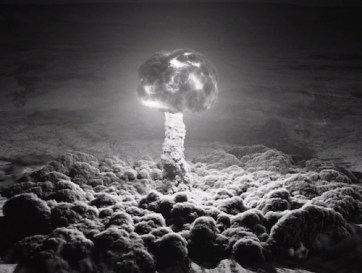 I don’t know if it was the reaction across the board, but on Twitter the reception the 8th episode received was adulatory to the nth degree. Having given us massive developments and beloved characters just one episode before, suddenly we were in a different era, in black and white, with mostly unknown characters, and a narrative conveyed through Lynchian visions rather than traditional storytelling. It made some kind of sense… some of it… in the end… but you certainly had to stick with it. Some of it was incredible — the tracking shot into the mushroom cloud is, somehow, almost inexplicably, one of the greatest shots of all time; an instant classic. But other bits… they did go on rather. I’m not one of those people who wishes the new Twin Peaks was a pure nostalgia fest, all repetition of famous lines and quirky goings on in the Double R over cherry pie and coffee, but I also think Lynch’s indulgence has run a little too rampant. Much of his surrealist imagery works if you’re prepared to engage with it, but I also think much of it doesn’t need to go on for as long as it does. There’s a difference between a slow pace and no pace.
So, I don’t really think Part 8 is a total revolution in television and one of the greatest episodes of all time, as some people do. For one thing, the opening stuff with Evil Cooper and the Nine Inch Nails performance felt like it belonged at the end of the previous episode but had to be moved for time. It was certainly an experience, though, I’ll give it that. I just hope it’s one that all makes sense in the end…
Preacher Season 2 Episodes 1-2
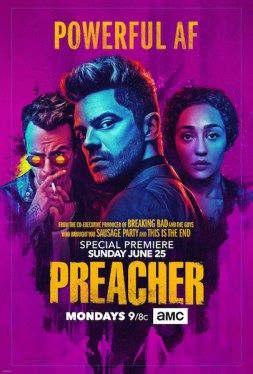 After a sometimes uncertain but ultimately promising first season that was, really, all prologue to the main story, Preacher returns with a confident bang, filled with unstoppable cowboys, exploding SUVs, Maced testicles, intestinal fuel syphons, baby foreskins, and Come On Eileen — and that was just the opening ten minutes. Shows like Legion, American Gods, and, especially, Twin Peaks may have been duking it out for the title of craziest series on television these past few months, but there’s nothing quite like Preacher.
With our trio of heroes — a Texan preacher with the power to make anyone do what he says, his badass girlfriend with a criminal past, and a rough but charming Irish vampire — now on the road, the series itself also feels free of the shackles of the first season’s small-town setting. We’re let loose into a world that can equal the barminess of the leads. A world where we meet a friend who keeps a girl locked in a cage in his garage (for good reason); where you can see a man cheat death nightly at the Mumbai Sky Tower Resort and Casino; where a drug-fuelled binge of pillow-fighting and reading Archie comics can solve your woes; where God goes to a strip joint for the jazz…
Sadly, you can’t really jump in here — too much was established in season one — but the ongoing unpredictable zaniness makes it worth the investment to reach this point, in my view. And with some fan-favourite characters just around the corner, hopefully it’s gonna be a helluva season.
Next fortnight… winter is here.
 As much as I love Game of Thrones, and think
 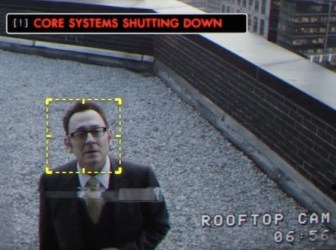 Watching this, it’s difficult to imagine anyone involved really believed they would get a sixth season — which is good, because (a) they stood very little chance, and (b) that means it wraps everything up to a nice, proper ending. My feelings on Jonah “brother of Christopher” Nolan’s cyber-thriller have oscillated over the years, and I’m a long way from agreeing with those who assert it’s actually one of the best sci-fi series ever; but for a show that started out as a fairly standard CBS procedural thriller, it did ultimately manage to play with and work around the network’s expectations to produce something superior. It’s a shame they clearly had to rush the final arc (marred further by having to hit a quota of ‘case of the week’ episodes, for some reason), but it still got to a good place. If you’ve not watched it but are interested, consider finding one of those “episodes you should definitely watch” guides (like
 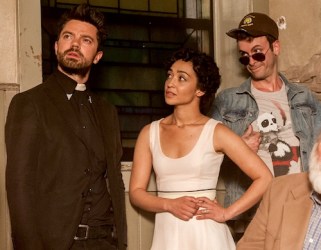 In the end, this turned out to be less of a TV prequel to the comic book series than an expanded and rejigged adaptation of the comic’s opening four-issue story arc (with some stuff from later thrown in for added fuel). As Seth Rogen explained on the post-finale chat show Talking Preacher, the books throw an awful lot of quite comic-book-y ideas at you very quickly, and TV viewers maybe needed a little longer to digest all of that. Plus extra space to develop and examine the characters, of course. It’ll be interesting to see how future seasons handle the issue of adaptation. By the end of season one, the characters are in a place to launch into something closer to the rest of the comic; but, at the same time, budget issues have already forced some reimagining, so what else will it be forced to compromise or reinvent? I think the bold, fearless barminess of the TV series has earned it the right to our attention, whether it goes further off piste or hews closer still to its roots.
 This month, I have mostly been missing… not that much, really. With the Olympics dominating the good TV channels and much of US drama on its summer hols, there doesn’t seem to have been much on. I haven’t gone crazy for Rio 2016 like I did for London 2012 (much to my surprise at the time, that was), though we’ve caught bits and pieces, not least Max Whitlock’s double gold (along with
 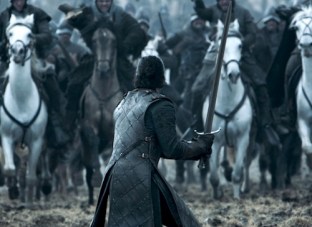 GoT produced two of its greatest-ever episodes to conclude this season. Actually, that’s arguably an understatement: based on IMDb votes, if nothing else, Thrones produced two of the best episodes of TV ever made. But what do IMDb voters know? Well, more than some people give them credit for. Obviously everyone has different tastes, but for the genres Thrones operates in — and, in some instances, even transcending those — these are incredible hours of TV. Episode 9, Battle of the Bastards, is surely one of the most thoroughly-realised medieval-style battles ever depicted on screen: the scale is epic, the strategy is clear, the feeling of what it’s like to be in the thick of that environment is palpable. How it turns out may have been predictable, but something being predictable is not the same as it being bad — not everything needs to be a twist.
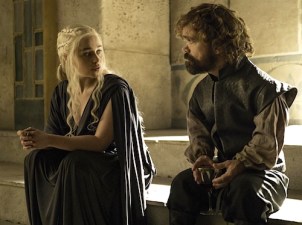 As for the forthcoming seventh season, it’s pretty clear we’re now entering the show’s endgame — though we’re going to have to wait even longer for it, with the next season set to have a later-than-normal premiere and the final end not coming until the season after that. It’s going to be an excruciating wait, but if they can maintain the form displayed throughout season six, it’ll be worth it.
 This is done and dusted Stateside now, but goodness knows when Channel 5 will choose to ‘officially’ air it over here, so I’m just getting on with it. I used to despise most of PoI’s arc plots and often wished it would stick to being just a pretty cool vigilante procedural; but at this point, it’s so invested in the epic Super-AI vs. Super-AI sci-fi storyline that any attempts at case-of-the-week episodes feel like a waste of time — especially when this truncated season is fast approaching the show’s final end. I really hope it comes to a proper conclusion, because there’s too much going on here to let it end forever on a cliffhanger. (Obviously that answer’s now out there, but naturally I’m avoiding spoilers.)
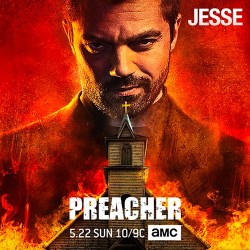 I’m a bit behind on this at the minute (the latest episode was the eighth), but, as of the halfway point, it’s definitely settled into its own skin — or maybe it was always settled there, but it’s taken time for viewers (or this viewer) to get past the expectations brought as a reader of the comic books. It’s still far from being a literally faithful adaptation, carving out its own path from some of the comic’s building blocks, which makes it an odd and hard-to-judge work if you have read any of the original. Still, it’s an entertaining series, and people involved keep talking about this season being something of a prequel to what we saw in the comic, so maybe the already-commissioned season two will feel more recognisable.
 This month, I have mostly been missing stuff I don’t even know I’m missing. By which I mean, I haven’t been paying enough attention to the TV schedules to know what I’ve missed. The BBC’s supernatural drama The Living and the Dead sounds kind of interesting; I know Mr Robot is back, not that I ever got round to season one; plus The Musketeers continues (though I hear it’s gone off the rails this season); and I keep hearing vaguely good things about Netflix’s new series, Stranger Things, like that it’s a cross between Steven Spielberg and Stephen King, or The Goonies mixed with The X Files… which just reminds me that I need to get round to seeing The Goonies someday.
 Finally done with most of these (still need to find time for the last two Legends of Tomorrows). One shouldn’t have that attitude to something one is choosing to watch, should one? I have a certain loyalty to Arrow, because they did a good job for seasons one and two, even if it’s waxed and waned since; but I’ve never really got on board with the adulation The Flash has received, and Legends of Tomorrow is mediocre to poor with regularity… though now and then they all exhibit flashes of worthwhileness. I rarely make the conscious choice to give up on a series (do it all the time by accident, though), but I’d consider abandoning a couple of these before the start of their next seasons… were it not for the ‘promise’ that they’re all about to be completely interconnected, at least for one almighty four-way crossover (with moving-to-the-same-network Supergirl).
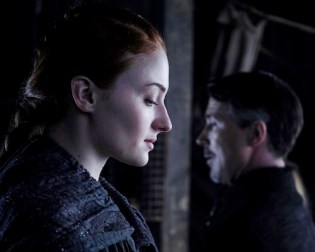 First up: The Door, surely one of Thrones’ best-ever episodes. That ending rather overshadows everything else (because wow, in so many ways), but before that there was Sansa being badass, proper development of Arya’s storyline, the hilarious play-within-a-play, a marvellous scene between Dany and Jorah, and a great moment for Varys, too. The week after’s Blood of My Blood was more about setting things up the second half of the season, which is an important role to fulfil but less dramatic in itself. A couple of surprise returns, though, including a big reveal for book readers (maybe).
 Sometimes it’s hard to separate what one might count as story development versus mere place-setting in Thrones, but at its best they can be one and the same, and episode seven managed that. Finally for now, No One did actually bring some storylines to a head, including some very long-awaited developments, particularly in Braavos. Throw in an equally-long-awaited reunion and a couple more unexpected returns, and you have a pretty satisfying episode.
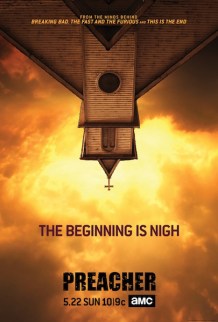 Sam Catlin of Breaking Bad and Seth Rogen & Evan Goldberg of… all those films Seth Rogen & Evan Goldberg have made (you know
  This month, I have mostly been missing anything I watch with my other half. It’s prime tennis season — eight weeks that starts with Geneva and flows through the French Open, Stuttgart, Nottingham, Birmingham, Queen’s, Eastbourne, and ends with the crowning jewel of all tennisdom, Wimbledon; all with near wall-to-wall coverage thanks to Eurosport, ITV4, and the BBC. It largely takes over the time we normally spend watching stuff together, so no room yet for the final seasons of Wallander or The Musketeers (not that we’ve watched season two yet, actually — oops), nor the just-finished fourth season of The Most Underrated Show On Television™, The Americans. Apparently it ended with “the Best Episode of TV So Far This Year”, according to one review’s headline (which obviously I can’t read because spoilers). Maybe in July.
 100Films.co.uk