Peter Jackson | 95 mins | TV (HD) | 1.85:1 | UK & New Zealand / English | 15

Commissioned by 14-18 NOW (the UK’s arts programme for the First World War centenary) and the Imperial War Museum to see what he could do to make their old World War One footage more engaging for a modern audience, director Peter “Lord of the Rings” Jackson’s initial tests at restoring the footage were so successful that the project was eventually worked up into this feature-length documentary. It tells the story of the Western Front from the point of view of ordinary Tommies living and fighting on the frontline, using only footage from the period (plus photos, posters, artwork, maps, and so on) and narration taken from interviews with men who were really there — no historians to provide context or analysis here.
This presents two distinct things to consider when looking at the film: not only its success as a documentary, but also the methods Jackson and co have undertaken to produce it. In terms of the latter, what Jackson and his computer wizards have done goes far beyond the normal realms of “restoration”. For starters, the original footage has been cleaned up (removing scratches and dirt, stabilising the image, etc) — so far, so normal. But that original footage was shot on hand-cranked cameras, giving it a frame rate of anywhere from 10 to 18fps (sometimes varying within one piece of film). So, computers have created additional frames to bring all the footage up to a standard, smoother 24fps. Then the footage has been painstakingly colourised, and also converted into 3D (if you see it at a 3D cinema screening, anyway. Maybe there’ll be a Blu-ray). The goal of all this is to make it seem more immediate and real; to try to connect modern viewers to these men in a more direct fashion, without the distancing effect of watching juddery, indistinct black & white film.
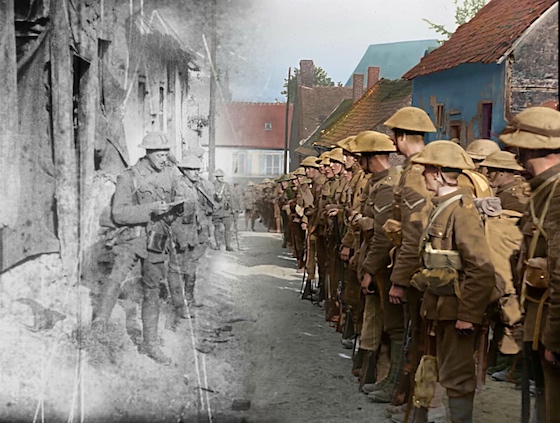
Calling the work Jackson and co did to old footage “restoration” has been controversial in some circles, because it goes beyond mere “restoration” and into the realm of revisionism, like the colourisation of old movies that came to prominence in the ’80s and was widely criticised (though it still occasionally rears its head today — try buying a Blu-ray of It’s a Wonderful Life without both black & white and colour copies of the film). Jackson has a different and specific aim with his work here, however. He’s not saying this is a better way to view old film footage fullstop, but rather is looking for a way to bring these past events to life for a modern viewer; to try to erase the past 100 years and put us in their shoes, to make us see how much these people, though separated by so much time, were really very similar to us. The effectiveness of the end result in achieving this goal — of bringing that long-gone war vividly to life — is undeniable.
Indeed, anecdotally, a lot of people do find the addition of colour to be revelatory — after the film’s screening on BBC Two last night, I saw many tweets talking about the “extraordinary”, “breathtaking”, “jaw dropping”, “spine tingling”, “astounding” moment when colour faded in. Personally, however, it rarely seemed like more than a special-effects veneer painted over the original footage. Well, that’s exactly what it is, in fact. It’s not necessarily a criticism, either — it may be for the best, even, because this isn’t a kind of ‘restoration’ we want to see applied across the board to old films. Either way, I do agree that it added a new perspective to see the war presented in this way; but the idea that it’s a perfect, genuinely lifelike ‘restoration’ didn’t quite wash with me. In fact, I thought one of the film’s most striking, identifiable moments came early on, before it had made the transition to colour: as the narrators talk about how young they were when they signed up, we’re shown closeups of soldiers’ faces, and you can really see how young they were — many of them literally just boys. I think it’s pretty common knowledge that, although the age to sign up was 19, lads as young as 14 lied to get in, but seeing it so clearly is another matter.
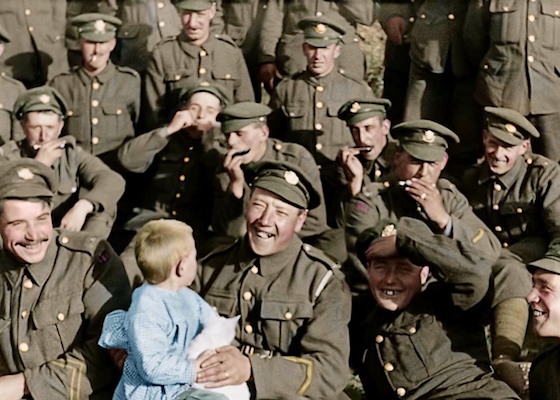
Moments like that prove that They Shall Not Grow Old’s success as a documentary doesn’t just lie with its “restored” footage. The film’s worth lies as much in the way the story is told — the voiceover narration taken from genuine soldiers’ testimonies, recorded by the BBC and IWM in the ’60s and ’70s; the editing of certain sequences — as it does in the “modernising” of old footage. The added colour and clarity do bring some bits to life and make them feel closer to today, as per Jackson’s stated goal, but a lot of the time the smeary, blurry quality of the colourisation makes it feel as much like a painting come to life as it does real footage. Nonetheless, the truthfulness of what we’re being told burns through that, and it’s the combination of visuals and audio that aids our understanding of what life was like for those men in that place at that time.
It’s quite a dense film too, packed with information, constantly surging forward with the images, an imagined soundtrack to match them, and almost non-stop narration. At times it becomes like a tone collage, where you almost absorb it more than process it, getting an impression of life on the front more than specific experiences. In this interview, Jackson says the film uses about 120 narrators, edited together to sound almost like they’re telling one story — the “common story” of the experience of a soldier on the Western Front, with extreme or uncommon anecdotes having been edited out. It means a lot of the war isn’t touched on (other fronts, other experiences, like the Navy or Air Force), but there were budgetary reasons for that as much as anything (they originally offered Jackson enough money for a film about 30 minutes long).

While those other stories are undoubtedly worth telling too, I think it was wise of Jackson to retain a degree of focus here. Rather than attempt to cram a wide-ranging account of a complex conflict into the brief running time of a single film, he’s instead painted a picture of what it was like to be an ordinary Tommy in the trenches of Europe. This is not the story of commanders and generals, of presidents and kings, but of ordinary blokes on the ground — the people most of us would’ve been, had we lived 100 years ago — and Jackson’s methods help make that story as real and relatable as it’s ever been.

They Shall Not Grow Old is available on iPlayer until Sunday 18th November. A documentary about the making of the film airs on BBC Four tonight at 7:30pm.


 Score:







 So says Peter Jackson in the special features accompanying this extended cut of his trilogy-closing saga-ending sixth Middle-earth movie, as
  Most obvious, and most discussed, is the dwarves’ war chariot action scene, whose bloody decapitations saw the film earn an R in the US and 15 over here. A seven-minute action sequence in the middle of the battle, it’s by far the largest single addition, and is mainly notable for all that blood and its use of the word “jambags”. Somewhat ironically, the sequence was a last-minute addition (the physical chariot was the last thing built for the films), which even as they’re shooting it Jackson acknowledges is an indulgence, and then of course it got bumped to the extended edition for being just that.
 Not a sausage, unless I missed something. It didn’t bother me too much because, quite frankly, I can’t quite remember what it was all about; but when I inevitably watch the extended trilogy back to back one day, it may do then. That said, I can’t imagine it’s a major fault, but again highlights the built-on-the-fly, ill-thought-through state of expanding The Hobbit 2 into The Hobbit 2 and 3.
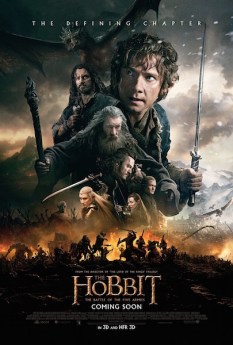 Peter Jackson’s epic Tolkien adaptation blunders its way to a conclusion with an instalment some have declared the trilogy’s best, presumably because they really enjoy watching someone else play video games. That’s what about half of this sextet-completing movie feels like, as it concludes the three-part Hobbit narrative with a CGI-riddled rendering of the titular battle. It’s the shortest film in Jackson’s Middle-earth magnum opus, though it comes to something when a film the best part of two-and-a-half hours long is described as “short”.
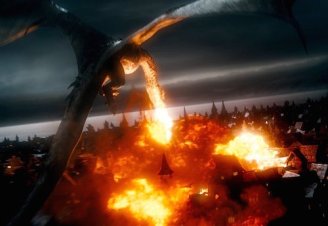 or he could have ended the second film with Smaug defeated and added more material to this third film to reach his desired running time. Or not even bothered adding stuff: if you lost the Smaug opener, The Battle of the Five Armies would still be over two hours long, which anywhere but Middle-earth is considered a decent length for a movie.
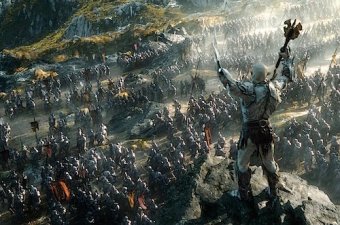 On the ground, the meat of the conflict only occurs when individual heroes are parcelled off into one-on-one duels. None of these particularly stand out, however, other than Legolas athletically jumping around a collapsing bridge that’s all so much CGI. This is where my earlier video game comparison really comes into play.
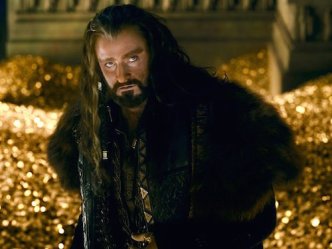 all of whom I’d thought would have more to do in the second and third parts of the trilogy. Turner, in particular, should have expected a bigger boost from Jackson’s decision to enrol him in an interracial romantic triangle, but it feels like they pulled back from that story thread a little after it proved unpopular in the previous film. It’s still obviously there, I just expected more of it.
 I was something of a defender of Jackson’s version of The Hobbit at first. I enjoyed An Unexpected Journey and stand by
  At the start of their audio commentary on The Desolation of Smaug, co-screenwriters Peter Jackson and Philippa Boyens note that, when the decision was made to extend the already-shot Hobbit duology to a trilogy, it wasn’t a third movie that need to be created but a second. That is to say, it was the middle instalment that required the most extra material, including a new prologue and climax. The
 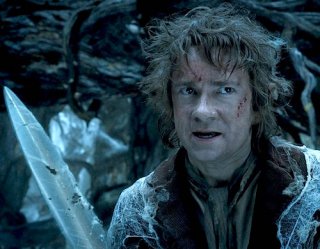 The extended cut amps him up even more, with an extra part in Mirkwood and a moment where he stands up for Thorin in Laketown. In fairness, he doesn’t have as much character development in this film as the first, while Thorin is on a definite arc and Gandalf is off on his own side-plot, but he’s undoubtedly a key character. I really don’t understand that complaint.
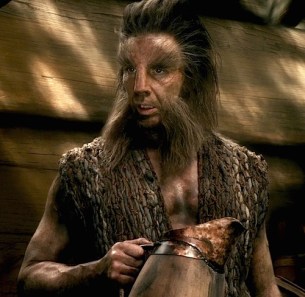 Even if some of the additions are worthless, on balance this is a better version of the film: more Beorn, more of the atmospheric Mirkwood, an additional character whose appearance will hopefully pay off in the extended
  1981: Steven Spielberg reads a French review of his movie
  Apparently some Tintin purists weren’t so keen on the actual adaptation — elements of The Crab with the Golden Claws have been mixed in to a plot primarily taken from The Secret of the Unicorn, the sequel/second half of which, Red Rackham’s Treasure, is reportedly used sparingly. Plus, in the original tale Sakharine is a minor character who wasn’t responsible for much, apparently. As someone who’s only read one of those three volumes, and even then not since I was young, such things didn’t trouble me. What superstar screenwriters Steven “
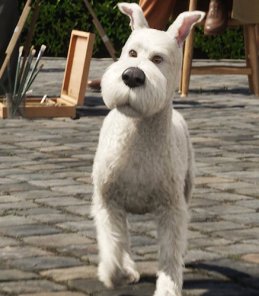 The slapstick is mainly hoisted by Simon Pegg and Nick Frost as the physically-identical Thomson and Thompson — a true advantage of animation, that. I imagine some find their parts tiresome because of their inherently comic role, but they’re likeable versions of the characters. Even more joyous is Snowy, though. Well, I would like him, wouldn’t I? His internal monologue, such a memorable part of Hergé’s books, is omitted (as it is from every film version to date, I believe), but he’s full of character nonetheless. Some of the best sequences involve Snowy running in to save the day. I don’t think they quite got the animation model right (the one glimpsed in test footage included in behind-the-scenes featurettes looks better, for my money), but his characterisation overcomes that.
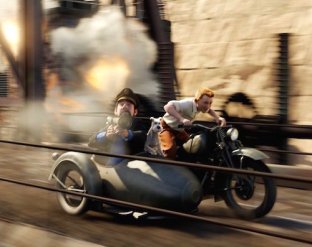 Of course, one very important person is neither British nor Belgian: Spielberg. The screenplay’s balance between peril and comedy is spotlessly enhanced by his peerless direction. In a world stuffed to the gills with lesser blockbusters that palely imitate the groundwork Spielberg and co laid in the ’70s and ’80s, work like this should remind people why he’s still the master of the form. The film is shot with an eye for realism (so much so that some viewers have been convinced it was filmed on real locations with real actors, with some CG augmentation for the cartoonish faces, of course), which helps lend a sense of plausibility and also genuine jeopardy. It’s easy to get carried away when working in CG animation, but often the most impressive works are ones that behave as if they’ve been shot largely within the limitations of real-world filmmaking technology.
 The tone on the whole is resolutely PG — actually, like many an action-adventure blockbuster used to be before everything went slightly darker and PG-13. So, for example, Tintin wields a gun on occasion, but never at another human being. The focus is on the story, which happens to lead to some adrenaline-pumping sequences, rather than a lightweight excuse to link together a bunch of punch-ups and chases. Ironically (though, for anyone who knows what they’re talking about, entirely expectedly) this makes the action all the more exciting. It also mean there’s a lighter touch than many current blockbusters offer; a greater presence for humour, including among the action. I guess that’s not fashionable these days, when everyone’s become so po-faced about their big-budget entertainment. However, with the likes of
  but some viewers would have seen it (even subconsciously) as more of a “real movie”.
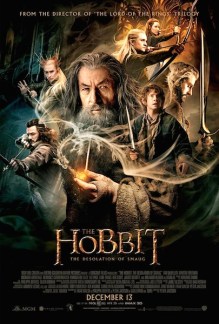 The Desolation of Smowg-not-Smorg begins in the same way
 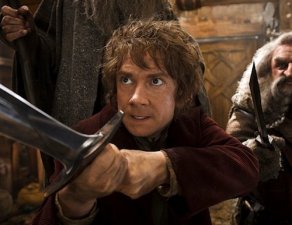 It’s my understanding that the originally-planned (and shot) two-part version of Jackson’s Hobbit adaptation was transformed into a trilogy by, essentially, taking what was to be film #2 and splitting it in half. That might explain why individual sections are allowed to go on so long here: to bulk up the running time to the kind of epic proportions audiences expect from a Middle-earth movie. Anything less than two-and-a-half hours isn’t going to cut it. But when your climax is a battle between a giant dragon (cool!) and a small army of dwarves (kick ass!) around a deserted underground city (hell yeah!), but my main thought afterwards is, “God that went on a bit”, then you’ve failed at something.
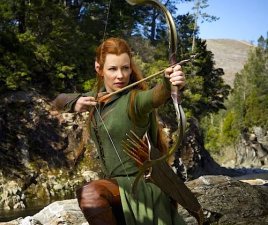 Meanwhile, Luke Evans’ Bard is as Welsh as the actor’s name suggests, which is a little bit of a surprise. But then the dwarves’ accents have all the rest of the UK covered, so why not. Benedict Cumberbatch sounds like Benedict Cumberbatch playing ‘big’ as Smowg-not-Smorg. It feels like this should be an iconic villain performance but, while good, I found it somehow lacking. Expectation may be scuppering him; maybe I’ll warm to it on future viewings.
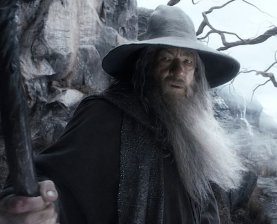 I haven’t picked apart everything that’s wrong with the film (what purpose is there switching from one made-up-for-the-film orc general to another?!), but then nor have I praised everything that works (there are some quality actors in amongst all that crashing and banging). It seems a fair few people liked this Hobbit instalment more than the first; the best explanation I can find is, “because it’s got more action”. Far be it from me to accuse other film viewers of being shallow, but… really? I genuinely enjoyed An Unexpected Journey as a return to the beloved realms and peoples of Middle-earth. The Desolation of Smowg-not-Smaug has some of that, and the charm of introducing us to new parts of the world too, but it’s drowned out by so much aimless noise. Here’s hoping it improves with repeat viewings and/or the inevitable extended edition, because this time I nearly slipped down to a lowly 3 stars.
 100Films.co.uk