
Wes Anderson | 89 mins | streaming (HD) | 2.35:1 | USA / English | 15 / R
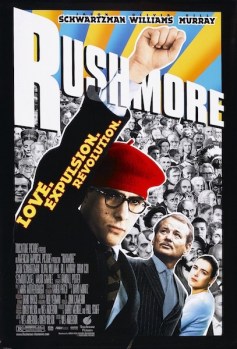 The breakthrough film of cult writer-director Wes Anderson, Rushmore is the story of high school student Max Fischer (Jason Schwartzman, making his debut, aged 18 but still looking like one of those twentysomethings-playing-highschoolers you so often see in US productions). He’s a prolific participator in extracurricular activities at the prestigious Rushmore Academy, but is put on notice for his failing academic standard. At the same time, he becomes infatuated with first grade teacher Miss Cross (Olivia Williams) and attempts to woo her by building an aquarium on school grounds. He enlists the support of local business magnate Herman Blume (Bill Murray), but soon Blume is falling for Miss Cross too, setting the men on a path of mutual enmity.
Having only seen Anderson’s three most recent films, it’s interesting to observe the early days of his distinctive style. The squared-off framing and blocking, the mannered acting, the interludes and asides, the not-quite-real / not-quite-fantasy quirkiness of it all… These things have only become more pronounced since, presumably as Anderson has become more confident in his own voice, or possibly as other behind-the-scenes forces have become more comfortable letting him do his thing. There might be an argument for newcomers to ease into Anderson’s unique world via something like this, but I kind of prefer the in-at-the-deep-end way I encountered him.
 Part of that is probably tied to Anderson’s own development. It’s not only his very personal touches that have flourished with further films, but I feel like his storytelling and depiction of character has become more sophisticated, too. That’s not to say Rushmore comes up short, but coming to it for the first time with that degree of hindsight, it feels very much like a formative work.
Maybe I’m being unfair to it — it’s amusing and delightfully unpredictable in its own right — but it didn’t excite me in the same way as the other Andersons I’ve seen. Perhaps if I revisit it once I’ve plugged the gap between this and his later work, I’ll be able to enjoy it for itself rather than playing “spot the directorial development”.

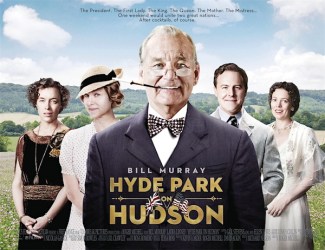 Wannabe-prestige picture Hyde Park on Hudson is like two films playing at once: the dramatic/romantic story of President FDR’s (Bill Murray) burgeoning affair with his distant cousin Daisy (Laura Linney), and the comedy-drama of his meeting with King George VI (aka “the one Colin Firth played in
  For what it’s worth, the film was born of the discovery of Daisy’s letters and diaries, which told of the relationship. Apparently the screenwriter was one of the people who found these, so I guess that’s where his interest lies. The film is a UK production from Film4, however, and made in the wake of the global success of The King’s Speech, so perhaps that explains the root of the royal involvement. While both stories have some potential, they aren’t made to gel, switching back and forth as if in some kind of narrative relay that enables the film to run a theatrical distance.
 with vibrant colours evoking a place of sunny happiness, but anything set at night is graded with a terribly extreme, not to mention awfully rote, case of teal-and-orange.
 The first manned mission to Mars is reaching the end of its six-month tour. As they count down the final hours, battling a dust storm and its attendant power outages and communications blackouts, one of the team secretly discovers bacterial life on the surface. Attempting to recover further samples, a sink hole opens beneath him. When the rest of the crew try to recover his body, it’s not there. Then he arrives back at base… only, he’s not quite himself anymore…
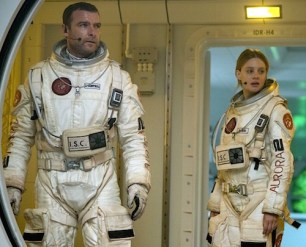 These faults persist despite the best efforts of a quality cast, particularly Romola Garai as (in functional terms) the capable sidekick, and Olivia Williams as the bitch whose heartless practicality becomes an asset when the going gets tough. First-time feature director Ruairí Robinson assembled his cast on the principle of “people who aren’t normally in sci-fi movies”, and that does feed in to the sense of realism. It also looks great, the production, costume and effects designs gelling to create a believable Mars mission, all in spite of a tiny budget (funded by the BFI and the Irish Film Board, it had about a tenth of Gravity’s budget, for example). Credit, too, to cinematographer Robbie Ryan for lensing the Martian surface convincingly (it’s actually the Jordanian desert). The editing may descend into fast-cut blurriness during action scenes — only emphasised by Max Richter’s predictably derivative horror movie score — but during calmer moments the film looks very good.
 and was more sure of its tone. There may be elements to commend The Last Days of Mars in this comparison (the much bigger budget pays off in the scope of the visuals, of course), but as a story and viewing experience, The Waters of Mars wins hands down.
 100Films.co.uk