
Christmas is properly over now: adults are back at work; kids are back at sch— wait, what? Another lockdown?
Well, the festive season is over either way, isn’t it? So it’s time for my annual look back at some of the TV highlights. Or what was on, anyway.

Doctor Who Revolution of the Daleks
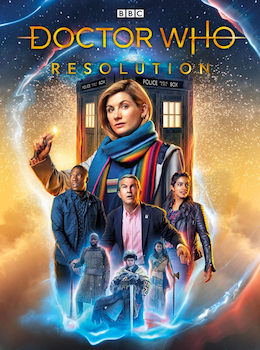
 This year’s Doctor Who special felt like a bid by showrunner Chris Chibnall to keep fans happy. Popular character Captain Jack Harkness is back, properly this time — after a cameo-ish appearance last season, this is his first major role in the show since 2008. And the proper Daleks are back, too — we got a sort-of-Dalek two years ago in the last special, but, after that’s used as the model for an army of “security drones”, the real Daleks turn up to exterminate them, with the 2005-style bronze Daleks making their first full appearance since 2015 (yes, it’s been that long).
Of course, the one thing most fans would really like Chibnall to do is bugger off and let someone better write the show. He hasn’t given us that gift yet, sadly, but at least this is one of his better episodes. It’s suitably romp-ish for a seasonal special, with plenty of running down corridors, exploding enemies, and the odd gag or two. There’s even some political satire, albeit fairly familiar, heavy-handed, and underdeveloped. Well, that’s Chibnall’s whole style, isn’t it? He can’t seem to escape it, or doesn’t want to (there are surely other writers or script editors he could employ to help point him in the right direction).
The other big news this episode is the departure of regulars Ryan (Tosin Cole) and Graham (Bradley Walsh). The latter has been one of the highlights of this era, but is given short shrift here. He barely has anything to do all episode — with a cast this big there’s no time for everyone to get emotional subplots (or what Chibnall thinks passes for them), and here they’re shared between the Doctor, Ryan, and Yaz… plus returning villain Robertson, of all people, who is arguably the episode’s main character. What a shitty way to write out two of your leads. And when it comes down to it, Graham only decides to leave the TARDIS because Ryan wants to go, and he wants to spend time with Ryan. Walsh is a fine actor when given the chance, and he deserved better. Ryan’s reasons for leaving aren’t quite as underwritten, but Cole does most of the heavy lifting, injecting a lot into unspoken moments to convey what Ryan’s feeling. A bit of screenwriting advice I once read asserted that, if you don’t bother to give your characters subtext, a good actor will invent their own regardless — it feels like that’s what’s happened here; or, at least, Cole has expanded well on the thin material Chibnall gave him.
In any other recent era, Revolution of the Daleks (an inaccurate title — it should’ve been called something like Purity of the Daleks, or even Security of the Daleks) would be a middle-of-the-road episode, at best. At present, it’s probably going to be remembered as of the highlights of the era. There are now rumours that Jodie Whittaker is planning to leave the show after her next run, having completed the more-or-less standard three series. Well, the wrong person is going: she’s a fine Doctor let down by poor writing, and we’d all be better off if Chibnall would go and let someone else have a crack at giving Whittaker the material she deserves.
Cinderella A Comic Relief Pantomime for Christmas
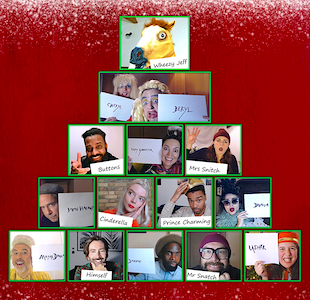 With theatres mostly shut this November and December due to Covid restrictions, the UK’s traditional pantomime season was a write-off. But where there’s a will there’s a way, and so an all-star bunch of actors and entertainers (including the likes of Olivia Colman, Helena Bonham Carter, Tom Hollander, and Anya Taylor-Joy, plus multiple surprise cameos) came together over Zoom to record this hour-long panto in aid of Comic Relief. (FYI, there are two versions available: a 60-minute one that aired on BBC Two, and a slightly extended 63-minute cut available on iPlayer.)
I imagine it would’ve been easier logistically to film everyone separately (and would we have been any the wiser?), but instead they seem to have wrangled all these stars together on the same Zoom call and performed it in more-or-less real-time. That ‘almost live’ aspect adds an element of unpredictability to proceedings — there’s the occasional tech issue, and a fair degree of corpsing and improvisation. Looking at other reviews, I guess this wasn’t to everyone’s taste (“a poor effort when better productions were hidden online”), but I thought it added to the do-it-yourself charm. It’s not a slick production by a bunch of pros, but has an air of fun similar to a bunch of mates doing their best and having a ball. The end result is very silly, of course, but all in the right spirit.
Roald & Beatrix: The Tail of the Curious Mouse
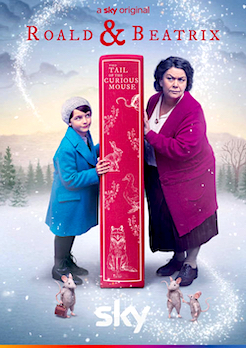 Sky’s big special this year was this based-on-a-true-story tale of when a young, bereaved Roald Dahl went on a trip to meet an ageing Beatrix Potter. Two of the great British children’s authors meeting up at very different points in their lives? It’s a wonder no one’s thought to film this before. Although, based on the evidence here, the meeting was fairly short and inconsequential — that they met is an interesting bit of trivia, not a defining moment in either’s life. To get this anecdote up to barely-feature-length (it’s just over an hour without ads), there’s a lot of expanded backstory on both sides. The Roald side feels like it must be broadly true — it’s all about him (and his mother) struggling to cope with the deaths of both his sister and father — but the Beatrix side feels dreamt up to balance it out — it’s just about her arguing with an agent about the contents of her latest book. Eventually, these threads converge on the eponymous pair’s brief meeting… and that’s the end. It’s a slight and gentle film, but it made for moderately charming Christmas Eve fare.
Comedy Specials
 As usual, the schedules were full of sitcoms and panel shows offering half-hour doses of festivals merriment. Highlights included a fourth Christmassy edition of The Goes Wrong Show, in which the accident-prone Cornley Polytechnic Drama Society turned their attention to The Nativity, with predictably disastrous — and hilarious — results. I get that Goes Wrong is too silly for some, but it hits just the right note for me. A more heartwarming tone was struck by the Ghosts special, in which Mike’s overbearing family coming to stay (clearly not set this Christmas, then). In keeping with the style of the recent second series, their presence prompted flashbacks to the life of horny MP Julian, which, via a series of kinky sex parties, delivered a message about appreciating your family while you can.
Meanwhile, Shakespearean sitcom Upstart Crow very much engaged with the current situation in an episode entitled Lockdown Christmas 1603, which imagined Will and his landlady Kate stuck at home during a plague-induced lockdown. Naturally this was a vehicle for observations about present-day life. It would be too kind to call it satire, but it was moderately amusing. After several years of Christmas specials, Not Going Out instead turned its attention to that other major end-of-December event: New Year. A show already fond of gathering its whole cast in a single location for basically a one-act play was perfect fodder for lockdown-constrained filming, and that’s what we get here: everyone gather for New Year’s Eve. Cue their inevitable sniping at one another — but when that gets too much, the assignation of New Year’s resolutions turns into some kind of group therapy session. It’s quite bold of a sitcom to deconstruct its characters’ defining foibles so explicitly, especially when there are more series on the way. One suspects the life lessons learnt won’t last…
Things to Catch Up On
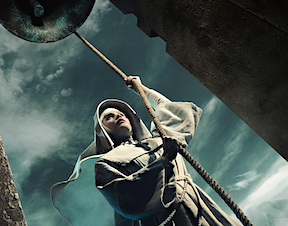 This Christmas, I have mostly been missing Black Narcissus, the BBC’s three-part re-adaptation of a novel most famous for being adapted into a film by Powell & Pressburger. It’s on iPlayer in UHD now, which is usually an incentive for me to catch it. Talking of three-part re-adaptations, I also didn’t watch Steven Knight’s version of A Christmas Carol — that was on last year, when I didn’t have time for it until after Christmas had passed. “Guess I’ll have to try to remember to watch it next year, then,” I said. Oops.
Next month… Perhaps Cobra Kai. After loving season one, I deliberately didn’t rush on to season two so that I didn’t burn through it too fast before season three. Then Netflix announced season three for early January, and then moved it forward to January 1st, and now instead of nicely spacing it out I just feel very far behind. Must resist the urge to burn through two seasons now instead…
 Now, that’s more like it! After the damp squib of alleged-finale
  Once upon a time it seemed implausible that anyone would ever try to play Poirot ever again, given how iconically (and thoroughly) David Suchet had embodied the Belgian detective during the 25-year series in which he starred. But I suppose it was inevitable that it would happen someday, and so following
  The BBC and Netflix teamed up for this £30 million CG animated adaption of Richard Adams’ children’s novel, perhaps most (in)famous for its 1978 film adaptation that is said to have traumatised all who saw it (I never have). I guess most of that money went on the all-star cast (seriously, the number of well-known names is mad — far too many to list here, so you can check out
  Normally I’d fold this into the comedy roundup (see below), but I enjoyed it so much I’m singling it out. As the title implies, this was a live edition of the long-running sitcom. What inspired that, I don’t know, but it paid off with the series’ best episode for years. The storyline didn’t necessitate the live-broadcast format in the same way as
 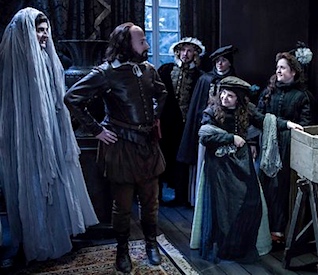 Also tickling my funny bone this season were a new Upstart Crow Christmas special, given a prime Christmas Day slot. It riffed off A Christmas Carol, which was unfortunate because I saw rather too many version of that this year (see below for another). I can’t say Crow’s take was particularly special, but I’m fond of the sitcom anyway so another episode is always welcome. The night before that (Christmas Eve, for those not keeping up), BBC One had one-off comedy-drama Click & Collect, with Stephen Merchant as a dad who must travel to the other end of the country to collect that year’s most-wanted toy for his daughter, accompanied by his irritatingly over-friendly neighbour. It’s the kind of fluff that would feel a bit too daft most of the time, but hits the right light-entertainment note at Christmas. A bit more cutting edge was Goodness Gracious Me: 20 Years Innit!, marking the 20th anniversary of the groundbreaking British-Asian sketch show with a special that used some of the series’ funniest sketches as examples to discuss what made the show so important. It was a subtly clever way to be both “greatest hits” clip show and retrospective documentary at once. Sadly, the repeat of an overlong old Christmas special that followed wasn’t quite as vintage. And, as I’m rounding things up, there were also seasonal editions of panel shows Mock the Week (the usual clips and outtakes), Have I Got News for You (more compiled clips), and Insert Name Here (actually a new edition! I’m fond of it and was happy to see back on our screens). Several others I’m yet to catch up on (Would I Lie to You, The Imitation Game), though I did see both new episodes of Mrs Brown’s Boys. I know I “should” hate it, but the Christmas Day one, at least, made me laugh.
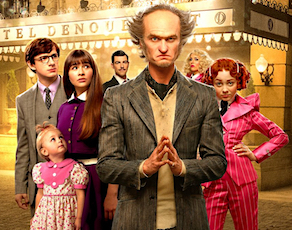 This Christmas, I have mostly been missing A Series of Unfortunate Events season three — the final one! Okay, it only came out yesterday, but I was with family and couldn’t watch it (ugh!) Not that I’d want to rush through it, anyway. By the time you’re reading this I’ll have made a start, and it’ll be reviewed next month. The same is true of Luther season four, which also started yesterday and which I’ll watch sometime later.
 The first screen adaptation of a novel by acclaimed British sci-fi/fantasy author China Miéville, The City & the City is a police procedural set in the unique location of twin cities Besźel and Ul Qoma, which occupy the same geographical space but inhabitants (and visitors) are forbidden from seeing the city they’re not in. When I first heard the pitch I assumed it was a Doctor Who-y sci-fi thing — that the cities were slightly out of step in time or something, and literally existed in the exact same space. Instead, they’re side by side, sometimes overlapping — there are places where the left-hand side of a road is in Besźel, the right-hand side in Ul Qoma. Residents are trained from birth not to see the other city. Apparently it’s partly an analogy for how we mentally block out unsavoury things in our own cities, but that doesn’t really come across in the screen adaptation, which is more focused on the murder mystery and its implications — it’s connected to a mythical third city, Orciny. In this respect it reminded me of Thomas Pynchon’s The Crying of Lot 49: our hero ends up investigating a very-secret, potentially dangerous organisation that may or may not exist, and whether or not they find it… well…
 The BBC’s latest Agatha Christie adaptation finally reached our screens after a delay for extensive reshoots (to remove a cast member accused of sexual misconduct, not on this production). It’s a grim tale of abuse and, of course, murder, but classy work by director Sandra Goldbacher kept it more in the tone of the Beeb’s excellent
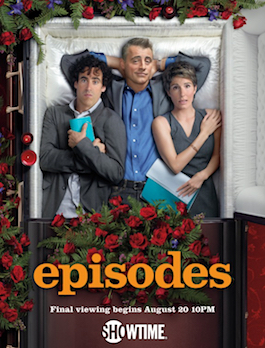 A whole seven months after its US airing (and nearly three years since we saw the last series), the final run of this UK-made UK/US-coproduced sitcom finally reached British screens (a far cry from the days when that took less than 24 hours). Originally about a pair of UK sitcom writers struggling to remake their successful British series for the US market, Episodes is fairly removed from that format at this point — it’s just about the characters now, and mainly their trials and tribulations with each other rather than the whims of the US network TV system.
 There was drama to spare at this year’s Eurovision. Firstly, China were banned from showing it due to messing around with the semi-final broadcast (they censored tattoos, homosexual dancing, and Pride flags); then, on the big night itself, the jury voting was neck-and-neck right to the final country… before being completely upended when the public votes were added.
 Cancellation season has been and, I think, gone in the US, and this year was a particularly bloody one. The big news as far as Twitter was concerned was Brooklyn Nine-Nine, which caused such a ruckus that multiple other networks were interested and it found a new home within 24 hours. Lucifer also caused a bit of a stir, though there’s no sign of hope for that yet. Similarly afflicted were Designated Survivor (which was decently addictive enough that I binged through
 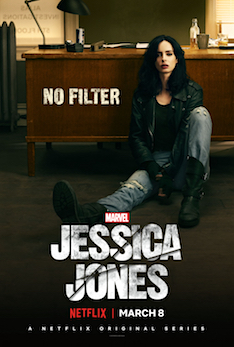 When the first season of Jessica Jones debuted 28 months ago it was practically a cultural phenomenon. Its fresh, unique take on the superhero genre marked it out as noteworthy even at a time when there are innumerable other films and series in that space. A large part of that was the intelligent and grounded way it engaged with some thorny issues, making it a critical darling and attracting audience admiration too. So I’ve been a little surprised that no one really seems to be talking about season two. Perhaps it’s just me and my little internet bubble, but since the flurry of pre-release reviews I’ve heard nary a whisper. I’m sure there must be reviews and recaps out there, which I wasn’t seeking out so as to avoid spoilers, but I didn’t stumble across any either.
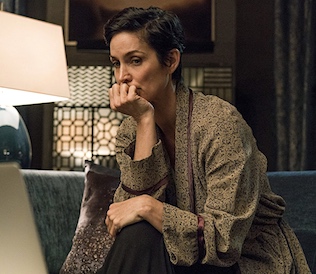 And that’s not to say these series never work in episodic form. For instance, events at the start of episode five, AKA The Octopus, see Jessica begin to force herself to be a better person. It’s one of the season’s strongest episodes, in part because of this burst of character development. Okay, it’s a bit blunt, in that she’s told she needs to improve and we see her consciously trying, but it pays off in a scene where she has to be empathetic to question a mentally-impaired witness. It’s not only Jessica who benefits from development: supporting cast members like Malcolm, Trish, and Jeri get meaty subplots to tuck into. Jeri’s is the best — indeed, her storyline might be the strongest bit of the entire season. There’s a fantastic, nuanced performance from Carrie Anne Moss — it feels like they’ve really worked to make use of her in a storyline that’s far more emotional and nuanced than what she’s had previously in these shows.
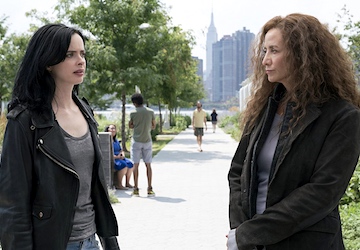 For me, it lost its way a bit again in the final pair of episodes — there are still really good bits, but others feel like a wearisome rehash of plot beats familiar from other superhero/thriller series. Eventually it comes to a good ending — there’s a surprising resolution to the plot, plus an epilogue that lays some intriguing hints for a third season (an inevitability, surely?) — but the faffery of episodes 12 and 13 to get us there… there were more streamlined ways to do this, I think. Or, considering the mandated episode count they have, more interesting ways to have spent the time. So it’s not perfect, but it’s still one of the best of the half-dozen Netflix/Marvel shows.
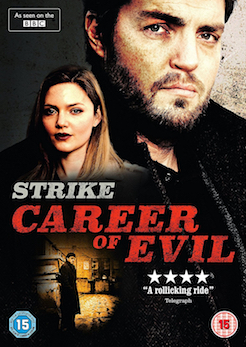 The latest Strike adaptation (and the last for at least a couple of years) was the best so far, I thought — a mysterious, reasonably complicated case, and plenty of character stuff for our likeable pair of heroes, too. The latter is certainly a big part of the series and its appeal, sometimes to the detriment of the actual investigation storyline, I suspect. By which I refer to the fact that some fans of the books have complained that the series isn’t devoting enough time to each adaptation, necessitating big cuts to the plot to fit into just two hours. I’ve not read them myself, and such editing didn’t feel noticeable during
 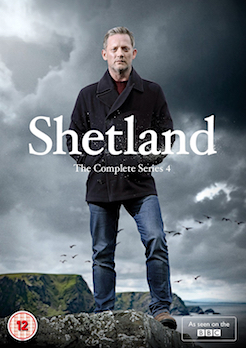 In almost the polar opposite to Strike, Shetland is no longer based on the books that inspired it (even though I believe there are one or two they’ve not adapted), and it takes a whole six episodes to tell its story. Actually, I feel a bit daft calling Strike’s case “complicated” now, because it’s as nothing to this series of Shetland, which sees DI Perez and his team struggling with both a 23-year-old cold case, which has resurfaced because the convicted murderer has just been awarded a mistrial, and a new murder with clear echoes of the first. If that wasn’t enough, the investigation leads them to Norway, where both the suspicious activities of an oil drilling firm and the plotting of a far right nationalist group come into play. Shetland has always had a bit of Scandi Noir about it (must be something to do with the cold northern environs), but it strays even further into that territory by, you know, actually going there.
 Not a reality show about manicurists (that’s what it sounds like, doesn’t it? If I was making a reality show about manicurists I’d be annoyed this took my title), but rather Netflix’s answer to The Great British Bake Off (possibly literally: they were miffed they didn’t get a chance to bid for it when it went to Channel 4). It’s not about super-skilled amateur bakers, though, but rather normal folk who attempt the kind of grand bakes you sometimes see online… and fail miserably. It’s like that bit of An Extra Slice where they look at viewers’ photos, only turned into a whole programme. It’s also very American — brash, loud, fast, unnuanced… It’s also the way it’s shot and edited, very much more like American reality series than British ones, but I shan’t bore you with a Media Studies-esque explanation of that.
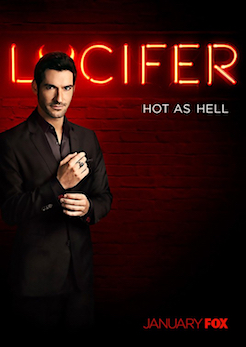 Having finally finished Castle last month, there was a gap in our viewing schedule for a light crime-of-the-week cop show. Lucifer seemed to fit the bill. For one thing, it’s been knocking around for a few years now, meaning there’s a nice backlog of episodes to get through. Loosely inspired by a DC comic, it’s about the actual Devil quitting Hell and setting up a life in Los Angeles, where — for one reason or another — he ends up helping the police investigate murders. Meanwhile, he enters therapy, and there’s an angel knocking around who wants to drag him back to Hell. The series nicely balances the bog-standard US-cop-show case-of-the-week stuff with the ongoing fantastical subplots, powered by a cast of engaging characters with conflicting motives. Best of all is the lead, Tom Ellis, giving a deliciously charming and slightly camp turn as the Prince of Darkness himself as he tries to become a better person. I’m not sure the series has really made any waves (especially on this side of the pond, what with it being an Amazon Prime exclusive here), but it’s really rather good. I mean, it’s not going to be challenging Quality TV for greatest-of-all-time status — it’s still a case-of-the-week buddy show when you boil it down — but it’s done well and a lot of fun.
 This month, I have mostly been missing The X Files season 11, which finished earlier this week in the US (and comes to the same end here in the UK with a double-bill on Monday). I watched (and reviewed, natch) its first episode
 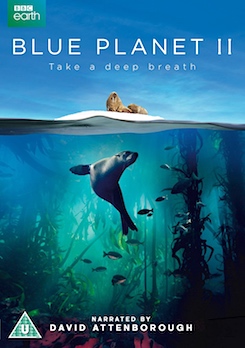 Despite the massive hype, I missed this when it aired. I say “missed” — I always intend to watch these big natural history shows, then never get round to them. I confess, it was new tech that persuaded me: after I saw it was all available in UHD on iPlayer, I had to give that a go. And…
 Now, I didn’t do a comparison to the regular HD stream, so I can’t really say how much better the UHD made things, but I do have a few observations. Related to it looking “more real”, after viewing I saw a good resolution photo taken for the series of one creature (
 As I mentioned
  This month, I have mostly been missing the BBC’s pair of big, grim January dramas, McMafia and Hard Sun. They both seem to have received a very mixed reaction (not that I’ve been following too closely because, y’know, spoilers), but both have intriguing setups: the former a drama about the global business of the Russian mafia inspired by a non-fiction book; the latter a pre-apocalyptic sci-fi/crime thriller from the creator of
  100Films.co.uk