
Yesterday I ranked the film series that have been a part of 100 Films down the years. The Sherlock Holmes films starring Basil Rathbone as the Great Detective and Nigel Bruce as his trusty sidekick Dr Watson may only have placed 6th on that list, but they have been a regular presence on my blog for most of its life as I slowly worked my way through all 14, from The Hound of the Baskervilles in Year 2 to Dressed to Kill as the record-breaking #200 in Year 9.
It seemed only fitting to include the series in my tenth birthday celebrations, therefore, so for today’s top ten I’ve gone back over all my reviews (and memories) and used them as a guide to rank my ten favourite instalments.

Sherlock Holmes and the Voice of Terror
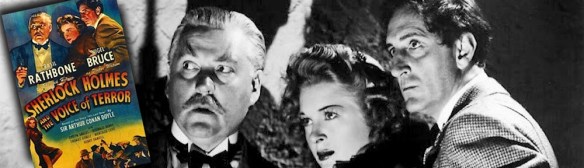
“The basic concept is a nice idea for a war-set spy-thriller, but not really for a Sherlock Holmes mystery. […] The consensus seems to be against me, but by the end I was quite enjoying Voice of Terror. It may be a Sherlock Holmes film in name only, but taken instead as a cheap spy thriller it makes for passable entertainment.” Full review.
The Hound of the Baskervilles
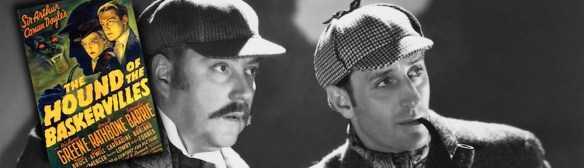
“One of the novel’s strong points is its occasional Gothic styling, and this is something the film version does very well. Dartmoor looks fantastic, like something Tim Burton would have created were he working in the ’30s. It’s clearly a set, but it’s dramatic and moody and completely effective.” Full review.
Terror by Night

“a contained, almost claustrophobic version of a Holmes tale. There are definite pros to this: it’s effectively a locked room mystery, with an element of howdunnit closely tied to the whodunnit. […] That it’s one of the series’ lesser instalments but still so enjoyable is simply testament to their overall quality.” Full review.
The Pearl of Death
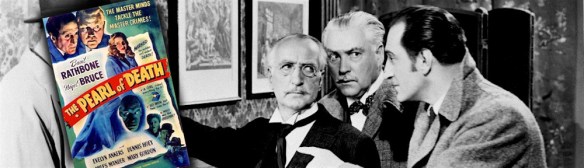
“Holmes first rescues the priceless Borgia Pearl, but then quite spectacularly loses it. The notion of Holmes being doubted, of having to prove himself to reassert his reputation, is a good one — one recently borrowed by avowed Rathbone fans Moffat & Gatiss for their modern-day Sherlock, in fact.” Full review.
Sherlock Holmes and the Secret Weapon

“The name’s Holmes, Sherlock Holmes, as Universal’s loose adaptations of Britain’s Greatest Detective deliver a low-key proto-Bond, 22 years before Goldfinger applied the same tricks to Britain’s Greatest Spy. […] As with Voice of Terror, I enjoyed a lot of Secret Weapon in spite of its distinct un-Holmes-ness — it’s another pacey, exciting World War Two spy thriller.” Full review.
Sherlock Holmes Faces Death
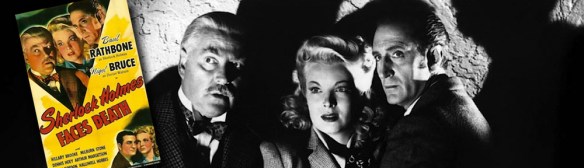
“Faces Death leaves behind the proto-Bond WW2 spying of the last three films (“it can almost be viewed as the starting point of a completely new Holmes series” asserts one review I’ve read) to involve Holmes in a genuine detective mystery […] packed with proper deduction, which is excellent.” Full review.
The Adventures of Sherlock Holmes

“There’s rain-lashed, fog-drenched Victorian London streets! Brutal murders by foul foreigners! Dastardly plots against the crown! Galloping carriages! Romantic subplots! A smattering of comedy! A song-and-dance number! (No, really, there is.) And a final shoot out… in the Tower of London! You can’t escape the joyous feeling that this was designed as pure entertainment, literally including something for everyone.” Full review.
The Woman in Green
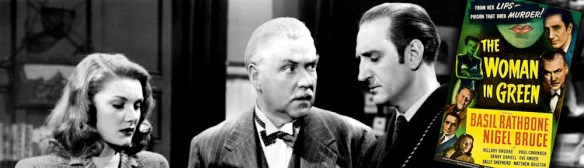
“Starting with a particularly vile series of murders that mask an even more detestable scheme and genuine peril for our hero, I can imagine some fans would find The Woman in Green to be too big a step outside the Rathbone Holmes comfort zone. For me, however, these elements mark it out as one of the series’ best instalments.” Full review.
The Spider Woman
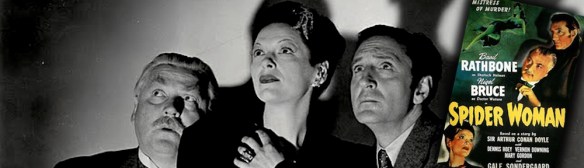
“Screenwriter Bertram Millhauser skillfully mixes elements from various Conan Doyle tales [including] The Sign of Four, The Final Problem, The Adventure of the Empty House, The Adventure of the Devil’s Foot and The Adventure of the Speckled Band. […] Several of these borrowed elements — the faked death and The Woman — lead to some delicious scenes, such as when Holmes reveals he’s alive to Dr Watson, offering one of those occasions where Bruce’s comedic rendition of the role actually works.” Full review.
The Scarlet Claw
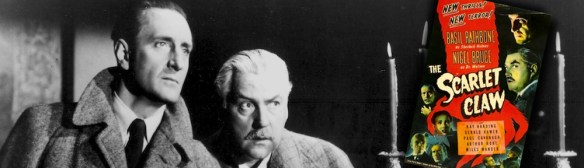
“[Roy William Neill’s] direction is incredibly atmospheric, from a wonderful mist-covered opening scene, replete with an incessantly tolling bell, to regular instances of shadow-drenched photography afterwards; not to mention various pleasing camera angles and moves. The story — in which townsfolk believe a mythical beast has returned to murder its residents — presents a well-constructed mystery all round, though as it moves into the second half some of its twists become all too guessable. [Such] little niggles may stop the film from being perfect but, like the similarities to The Hound of the Baskervilles, while they’re certainly there, they’re easy to overlook in the name of a rollicking good horror-mystery-adventure.” Full review.
Tomorrow: as seen on TV.
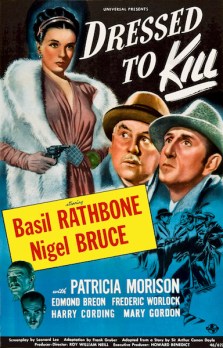 In the seven-and-a-bit years between 31st March 1939 and 7th June 1946, there were a total of 14 films released starring Basil Rathbone and Nigel Bruce as Sherlock Holmes and Dr Watson. By coincidence rather than design, I’ve spent nearly eight years viewing and reviewing them all for this blog — so yes, it’s taken me a little longer to watch them than it did to make them, which is ridiculous, but there you go.
 the story is explicitly referenced in the film, Watson having just had it published; then the film’s villainess turns up, played by Patricia Morison, functioning effectively as an Adler stand-in — and using some tricks she learnt from reading Watson’s story! The series hasn’t featured Adler before, so why not just name this character Irene Adler, have her devise those tricks from her own imagination, and be done with? Who knows.
 After the
  Perhaps it’s just because she’s clearly struggling with an atrocious variable accent, the quality of which makes it rather distracting whenever she opens her mouth. Having used Moriarty plenty, the series finally accepts that he’s dead and moves on to his right-hand man, Col. Sebastian Moran. Considering the identity of the conniving colonel is a mystery for most of the movie, however, his involvement is perhaps no great shakes.
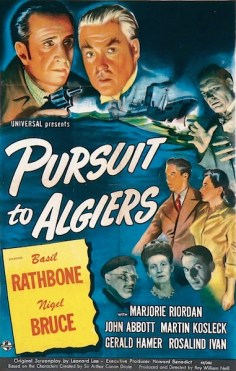 After a fun opening where Holmes and Watson have to solve the world’s most obvious riddle (naturally, Watson is completely oblivious to there even being a riddle), the original dynamic duo are tasked with escorting the heir to the throne of somewhere-or-other back to his homeland, thwarting assassination attempts as they go.
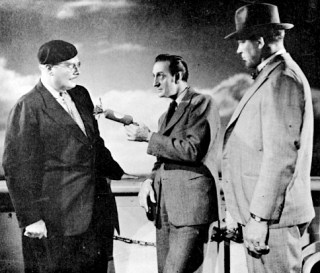 each of which he thwarts last-minute in sometimes amusing fashion. That’s not fundamentally a poor premise for an adventure comedy, I don’t think, but it doesn’t work for Sherlock Holmes. I mean, if you’re trying to prevent someone from being assassinated, why would you let the assassins carry on?! A last-minute twist reveals a sort of motivation, but it’s not a particularly convincing one in my book.
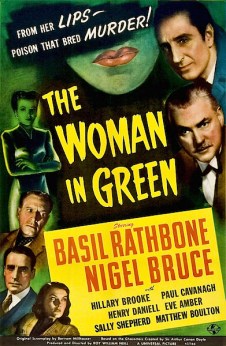 Basil Rathbone’s Sherlock Holmes starred in films which, although they typically involve murder, are best described as “adventures”. The series’ 11th film, The Woman in Green, is one of the few — perhaps the only one — that could genuinely be described as dark and grim.
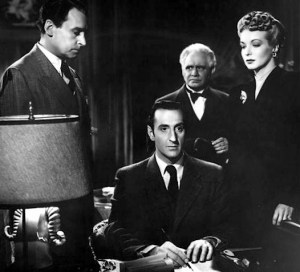 The evil is carried off with aplomb by Daniell. Reportedly a cold actor to work with, he chills on the screen too. This is a man you can believe would carry out such a scheme without a single twang to his conscience. His comeuppance, even with its surprising finality, is welcomed. The titular woman, played by Hillary Brooke, is one of Moriarty’s cohorts, posing as the ‘girlfriend’ of the aforementioned widower in order to set him up. The film is of course in black & white, so we can’t see what colour she’s wearing, and no one ever refers to it — even when they’re hunting for her based on looks alone. I guess someone thought it was an evocative title nonetheless.
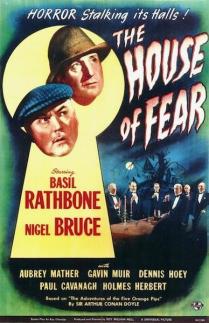 Adapted very loosely from the early Conan Doyle story The Five Orange Pips, this outing for Basil Rathbone’s Sherlock Holmes and Nigel Bruce’s Dr Watson sees them summoned to Scotland to investigate the suspicious deaths of the members of a club, where each killing is preceded by an ominous postal warning.
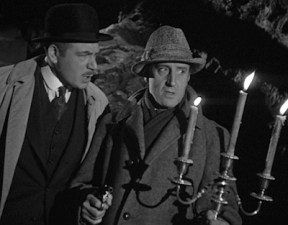 While the club having seven members does mean there’s a fair few suspects, it also means it takes a long time to get through them all being bumped off! It doesn’t sink so low as to be deemed repetitive, but does border it.
 100Films.co.uk