
Alfonso Gomez-Rejon | 101 mins | streaming (HD) | 2.35:1 | USA / English | 12 / PG-13

This is a film about a high school student who makes movie parodies for fun, who befriends a dying girl. It won the Audience Award at Sundance. I’m not sure there’s any other knowledge you need to judge if you’ll like this movie or not. Except normally that’d have me thinking “oh God, here we go,” but I liked it enough to put it in my Top 20 of last year.
So, I admit, I went into the film feeling pretty cynical about it. I was expecting to find a movie tailor-made to be an indie cinephile’s dream comedy-drama. There are elements of that about it, but I must also admit I ended up being won round and affected by the film, to the point of feeling quite emotional and often a little teary for, ooh, most of the second half. Was I just manipulated into feeling that way? Well, that question is a fallacy. All film is emotionally manipulative, because it has been constructed to achieve a purpose, and the people who complain about feeling manipulated by sappy dialogue or heavy-handed music or whatever have just seen behind the curtain, as it were. For these reasons it kind of annoys me when critics or ‘film fans’ get annoyed about a film being “manipulative”, but maybe that’s a rant for another time.

Anyway, as I was saying, I kind of didn’t want to like Me and Earl and the Dying Girl because I didn’t want to fall into the obvious trap of “this movie totally gets me because I love Criterion editions too!” But I thought it worked in spite of those pandering affectations. Or maybe I just couldn’t resist them on a subconscious level? In some respects it doesn’t matter how it achieved it: the film wanted to make me feel a certain way, and I did feel that way — success.
Perhaps another reason it worked for me was the positioning of Greg (the titular “Me”) as a high school “Everyman”, not affiliated with any of the school’s multitudinous social groups. I don’t think I’ve seen that in a film before. What movies (and TV) have taught us about American high schools is that they are chocka with rigid cliques, and everyone belongs in one group or another. Is that true? I have no idea — but as far as movies (and TV) are concerned, yes it is. I don’t think it’s the case out in the rest of the world (well, at least not in the UK); not so rigidly and antagonistically as it’s depicted as being in US high schools, anyway. Nonetheless, I could identify with Greg’s status as someone able to drift around groups being generally well-liked but also almost entirely unnoticed, which perhaps helped me buy into him and his emotional journey a little more, thereby explaining the film’s ultra-effective emotional manipulation effect.

A lot of what works lies in the performances. As “the dying girl”, Rachel, Olivia Cooke is fantastic. She’s got the showy role, but manages to play it with subtlety. Instead of the usual indie movie Manic Pixie Dream Girl, the lead character / narrator is the Quirky one and she’s a cynical girl who undercuts him, which is kinda fun. Nonetheless, as the film’s “Me”, Greg, Thomas Mann has a less obviously showcasing part, but the way he handles it — especially as the film moves away from the “he’s a Quirky film fan who’s uncomfortable in high school just like you” aspect — is essential to how the film’s relationships and emotions function.
Nowhere is this better exemplified than in a two-hander between the pair: achieved in a single static shot that lasts five minutes, they don’t look at each other while they argue and their friendship struggles. It’s a frankly stunning scene from all involved: kudos to Jesse Andrews (who wrote both the original novel and the screenplay) for the plausible and complex dialogue; kudos to Alfonso Gomez-Rejon for the confident blocking of both actors and camera; kudos to both of the actors for their layered, emotive, but not grandiose, performances.
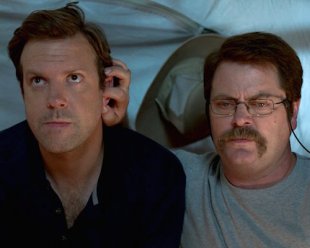
Several supporting cast members are also worthy of note: Jon Bernthal as a cool teacher; Molly Shannon as Rachel’s mom; and Nick Offerman for once again perfectly judging the level of funny his character needed to hit to be comic relief but also stay tonally consistent with the rest of the film.

A final stray thought before I wrap up this rather bitty review: I’ve read a few comments that make a point of mentioning this is not like all those other “teen death” movies, or that if you’re sick of all those then this one’s still good, and so on. I’m kind of aware these “teen death” movies exist and that there’ve been a few, but I’ve never bothered to watch one (because, frankly, they’ve all sounded rubbish), so I am immune to any overkill other viewers may experience. But if there’s a lesson here (and I’m not saying there is) it would be that you don’t have to watch every high-profile film that comes out (unless you’re a critic and being paid to do it).

Me and Earl and the Dying Girl placed 14th on my list of The 20 Best Films I Saw For the First Time in 2016, which can be read in full here.
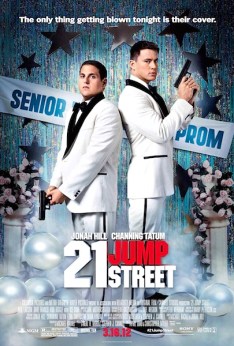 Having turned the unlikely-to-be-any-good story of a machine that makes it rain food into
  this leaves Hill hanging out with the cool kids — and being lured down the path of parties and their shallower friendship — while Tatum falls in with a gang of ultra-nerdy nerds and starts actually learning stuff. Distilled like that makes it sound pat, but in the film it works; in part because they don’t overplay the clichéd “friends fall out irretrievably… until it’s retrieved for the final act” story arc.
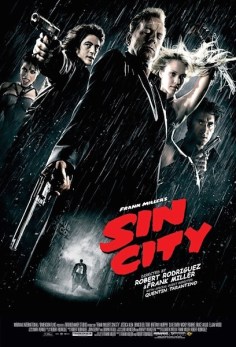 Adapted from a series of graphic novels by Frank Miller, Sin City is a noir homage, replete with high-contrast black-and-white cinematography, dialogue so hard boiled you couldn’t crack it with a sledgehammer, and all the requisite downtrodden heroes, corrupt authority figures, dangerous dames, etc. There’s also the very modern inclusion of shocking ultra-violence and nudity, but I guess a fair degree of that would’ve crept into classic noir if the mores of the time allowed — pretty much the point of the genre is the dark grubbiness of the world, after all.
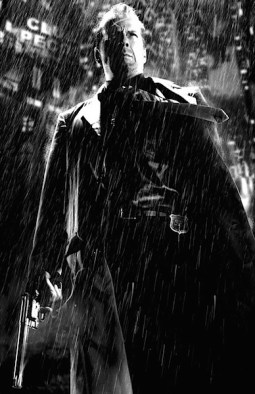 The DVD-premiering extended version, dubbed Recut & Extended (or, in the US, “Recut, Extended, Unrated”) is even more faithful to the comics than the theatrical version. Some of the books’ scenes that were excised are now included, and the structure has been rejigged to present each of the four stories one by one in their entirety (whereas the original version had a small amount of intercutting). The total running time is 17 minutes and 40 seconds longer, an increase of some 14.2%… which is a thoroughly misleading figure. As a presentational choice, each of the four stories is offered for individual viewing, plus option to “play all”. However, rather than that showing them as a single film, they play as four shorts back to back, with a full set of section-specific end credits rolling each time. The actual amount of new material in the film itself is
  For one, the second scene belongs more truly to The Big Fat Kill (the final story, starring Clive Owen’s Dwight and the whores of Old Town led by Rosaria Dawson). For another, because this recut purports to be in chronological order, The Customer is Always Right plays second. So we get 47 minutes of Bruce Willis protecting Jessica Alba from a paedophile in That Yellow Bastard, then we get a one-scene story that rightly belongs at the beginning (complete with title card, now 50 minutes into the ‘film’), then we get a scene that, actually, belongs in a completely different place. The next full story is The Hard Goodbye (the one with Mickey Rourke under a slab of prosthetics as Marv), followed by The Big Fat Kill — and it’s after this that the second scene with The Man belongs. Divorced of that context, the scene is robbed of almost all its meaning.
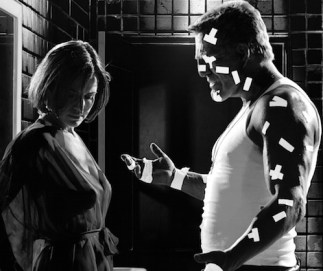 In the end, I enjoyed Sin City considerably less than I did nine years ago in the cinema. This is partly down to the restructure, but I’m not sure wholly so. I don’t think it’s aged particularly well, as things produced at the forefront of emerging technology are wont to do: some of the CGI looks dirt cheap, the shot compositions are often unimaginatively flat, and there’s an occasional internet-video style to the picture quality. It’s not just the visuals, sadly, with amateurish performances from reliable actors, possibly a result of the hurried filming schedule. Just because you can capture an entire part in a single day doesn’t mean you should. Then there’s Jessica Alba, who’s just awful here.
 None of the present additions are game-changing, and though some are good in their own way, there’s nothing noteworthy enough to compensate for the destruction of the original cut’s well-balanced structure. For the average punter — and certainly for the first-time viewer — the theatrical cut is unquestionably the way to go.
 The film that technically won
  Reviews for We’re the Millers are resoundingly average across the board, remarkably so (which is why I’m remarking on it). The funny thing is, some critics begrudgingly admit they liked it while giving it half marks, and others are very down on it… while still giving it half marks. It’s the same story for user reviews on
  100Films.co.uk