
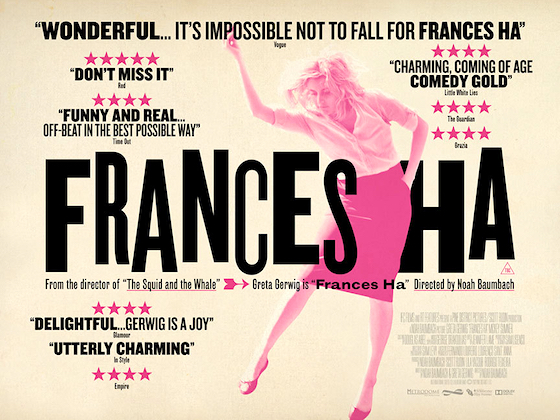
Being a ditzy twentysomething in New York, hanging out with friends and going to parties, having a job as a dancer and earning just enough to get by, and nothing quite going to plan but it all kinda being ok anyway — all in black & white? I see why some people love this film. It’s a kind of obvious fantasy life for certain Artsy people. Of course, there’s not much drama in that (not that that would stop some filmmakers), and so Frances’s messy life begins to get messier. It may stop being a fantasy, but it’s certainly relatable to any of us who’ve failed at the things we’d dreamed of doing.
While some viewers find the characters’ lives relatable or something to aim for, I’m not surprised to learn that other viewers just find them really annoying. The primary characters are all twentysomething art snobs, which is a definite phase some twentysomethings go through. Some grow out of it, some don’t. I don’t think the film is idolising them, which is part of what allowed me to enjoy it. If it had presented them as wonderful people living an ideal lifestyle, I might’ve hated them. Not that the film condemns them, but I think it takes them for what they are rather than outright celebrating it. That much is clear by how Frances ends up washing out of that lifestyle — it’s not even that she chooses to reject it; it’s that it’s unsustainable.
Having watched the film with the perspective of being older than Frances, where her life ultimately goes after she’s forced to reevaluate and make changes… well, I guess personal experience of whether your dreams were fulfilled, had to be tweaked, or were totally squandered is likely to colour whether you think the film ends up somewhere realistic or, in fact, with almost-stereotypical movieland optimism. As if that wording doesn’t give it away, I do err towards the latter.

To dig deeper into that, I find it hard to process my reaction to the ending, because it’s not that I want Frances to suffer — indeed, in many ways I found it a relief that she got her life on track and seemed happy. I can’t say I was super-invested in her as a character, but co-writer/director Noah Baumbach and co-writer/star Greta Gerwig got me invested enough that, when things were truly shitty, I did feel bad for her, and when she turned it around I was glad. But I also felt like she was lucky. She doesn’t get her dream, but she gets something comfortably adjacent to it. To people who want to make films and are making films (like, y’know, the people who made this film) that probably seems like a “compromised (therefore realistic) happy ending” (as opposed to an “everything turns out exactly as hoped (therefore unrealistic) happy ending”). But to those of us who’ve had to make even greater compromises — who’ve had to abandon dreams entirely and settle for what’s achievable — which, I’d wager, is the majority of human beings — Frances’s fate doesn’t seem hugely realistic.
I suspect the filmmakers believe they’ve created an ending in which Frances didn’t win, but nor did she lose; that she did ok. I’m sure I can’t be alone in seeing it as Frances still winning — not a 100% victory, but whatever she has (85% maybe?) is nothing to be sniffed at. So that’s why I’m conflicted: I’m glad Frances got her 85%; but if you want realism — and, as this is a black & white indie movie, not a glossy Hollywood dream factory, I kinda do — she should’ve got, like, 20%. By that I don’t mean end up living on the street or whatever, but maybe she had to move back to boring old Sacramento, move in with her parents for a bit, get a run-of-the-mill job in an office or whatever — something like that. Depressing, but truthful.
Anyway, it’s still a nice little fantasy for indie kids, so:





 Score:


 British Academy Film Awards 2016
 Adapted from Colm Tóibín’s award-winning 2009 novel by novelist-turned-screenwriter Nick Hornby and director John Crowley (
 Guiding us through this, the film’s heart in every respect, is Saoirse Ronan’s leading performance. I will watch Ronan in essentially anything at this point, both because she seems to choose good material and because, even when she doesn’t, she’s great in it. This is probably her first really mature performance, convincing as a somewhat shy young woman who makes her way out into the world, in the process realising all the confidence she should have in herself. It’s the kind of character and performance that works by accumulation; it’s about the journey, not heavy-handed emoting in a scene or two.
 John Crowley’s direction is largely unobtrusive, but that is a very different kettle of fish to lacking quality. The subtle changes in framing, lighting, and colour palette as the film moves through its locations and stages helps emphasise how Eilis is changing, and how the world changes in her perceptions, too. It makes the story’s times and places look beautiful without quite slipping into picture-postcard rose-tinted-memories territory.
 Hugh Dancy (of
  than some of her movie choices would have you believe, and roles like this prove that. Bonus points to the writing here for Beth not just accepting everything Adam does — that’s much more realistic than him happening across an endlessly understanding saint of a woman. But boo to the critics who didn’t buy that a privileged “daddy’s girl”-type could ever possibly fall for someone with autism — how judgemental are you?
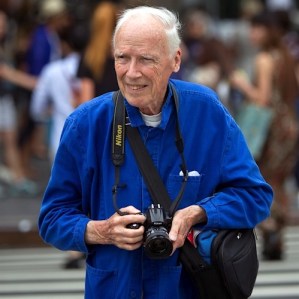 Bill was 87 years old — “a good innings”, as we say, and consequently not the most tragic newsworthy death to have happened in this year of perpetual bitterness. Nonetheless, as I wrote in my review, Bill seemed “a fascinating, unusual, but likeable, and certainly unique, individual”. That’s why the film is so interesting, and why his loss is particularly sad.


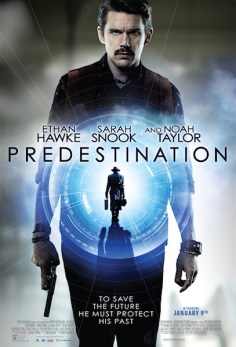 A man walks into a bar in ’70s New York. The bartender strikes up a conversation, which leads to a wager: if the man’s story is the most incredible the bartender has ever heard, he’ll give him a free bottle of whiskey. It had better be pretty good, because what we know that the man doesn’t is that the bartender, played by Ethan Hawke, is an agent for the Temporal Agency, travelling through time to stop crime before it happens; and he’s just had his face burnt off and completely rebuilt while failing to stop a notorious terrorist known as the Fizzle Bomber. Beat that.
 I don’t know how many people will remember, but the pair got a bit of attention back in the early ’00s with their debut feature
 100Films.co.uk