
Darren Aronofsky | 108 mins | Blu-ray | 2.40:1 | USA / English | 15 / R

 2011 Academy Awards
5 nominations — 1 win
Nominated: Best Picture, Best Director, Best Cinematography, Best Film Editing.
Described by director Darren Aronofsky as “a psychological thriller horror film”, Black Swan straddles the divide between classy Cinema and genre Movies as artfully as, say, a Hitchcock thriller. It’s the story of ballet dancer Nina (Natalie Portman) who’s desperate to be the lead in her company’s production of Swan Lake. She’s suited to the White Swan but struggles as its black counterpart, a role newly-arrived rival Lily (Mila Kunis) seems perfect for. As Nina pursues perfection with a monomaniacal focus, she’s pressured by the lascivious director (Vincent Cassel) and her overbearing mother (Barbara Hershey), to the point where her sanity is beginning to crack…
Shot handheld on a mix of 16mm and video-capable HD DSLRs, Black Swan has a documentary look, often emphasised by its editing — at times it could almost pass for a fly-on-the-wall look behind the scenes of a ballet company. That’s not to say the visuals lack artistry, however. In particular, the constant presence and use of mirrors is fantastic — both thematically relevant and visually rich. Nonetheless, the documentary-ish look serves to make the film’s unsettling parts all the more effective, especially as they take a while to emerge and continue to sidle up on you as the film goes on. The final act is where everything really kicks off — the point of the rest is to build up to that; to establish and put in place and explain everything we need for a shocking, thrilling, somewhat unguessable climax. If that sounds like a criticism, it’s not, because the movie leading up to that point certainly has worth.
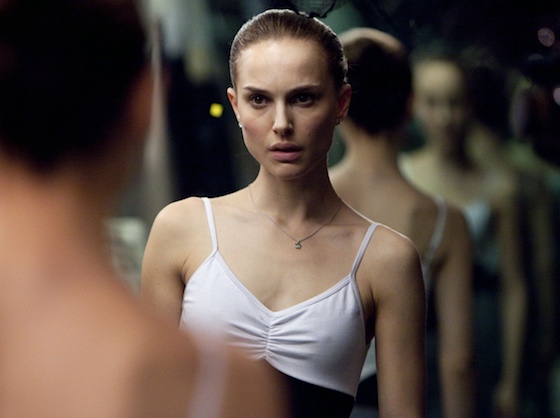
I’m not particularly familiar with Swan Lake, but it would seem Black Swan’s story echoes it — to the point, even, that all the cast are credited with both their character in the film and their equivalent in the ballet (and I don’t just mean the dancers who also play that role in the ballet-within-the-film — Hershey, for example, is billed as Erica Sayers / The Queen”). This extends outwards in other ways, like how the music of Tchaikovsky is repurposed by the film to its own magnificent effect. That’s as well as featuring a typically striking score from Clint Mansell.
Natalie Portman is brilliant as the conflicted Nina. She’s introverted and sheltered but has chosen (or been railroaded into) a career that requires she perform publicly; she’s fragile and under-confident but in a profession that invites criticism from all sides; she’s been left repressed, uptight, and virginal, which clashes with her perfectionism when trying to embody a role that is none of those things. It’s a complex role with many subtle facets that Portman negotiates skilfully. It feels like a departure from who she is — proper acting, if you like — which makes the performance all the more striking. Conversely, Mila Kunis feels more in her comfort zone as Lily, the free-spirited, lively but imperfect, almost a bit of a bitch, company dancer that Nina is inexplicably drawn to. She holds her own against Portman when required, but it’s not exactly a role of equatable complexity.
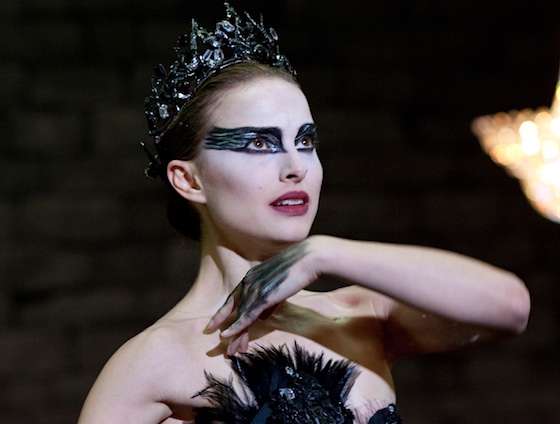
Depending how you want to see it, Aronofsky’s film is an arty movie about ballet and the psychological effects of perfectionism, or a slow-burn horror-thriller with almost as many jump scares as instances of introspection. Best of all, it can be both those things.

Black Swan was viewed as part of my What Do You Mean You Haven’t Seen…? 2017 project, which you can read more about here.
Darren Aronofsky’s latest dark mind-bender, mother!, is released on UK DVD and Blu-ray tomorrow.
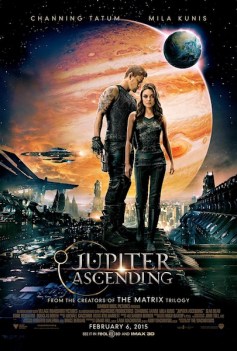 Ah, the Wachowskis. They made
  The plot… oh, do I have to explain the plot? It’s some rubbish about a cleaner (Mila Kunis) getting attacked by aliens and some alien crossbreed in magic flying shoes (Channing Tatum) coming to her rescue, and taking her to a half-bee man (Sean Bean — there has to be a “Sean Bee-n” joke here…), and then into space, because she’s… nope, not the Chosen One (makes a change, at least) but a reincarnation of someone important, and her surviving family members (Douglas Booth, Tuppence Middleton, Eddie Redmayne) have a vested interest in her — which may or not be that they want her dead (again).
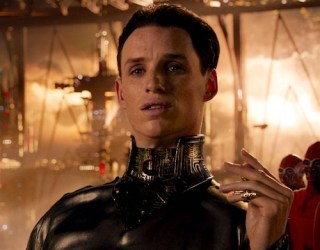 I guess it works for some people, but while it’s not bad, it also didn’t do much for me. And every time something almost works, something else undermines it, like Tatum’s make-up, or his flying boots, or Redmayne’s bizarre, affected performance. Though, to be honest, I think he’s so bad he’s good, a phrase you often hear bandied around but rarely see actually happen.
 The directors of
  The music is by Atticus Ross, which was interesting because I’d thought it was reminiscent of
 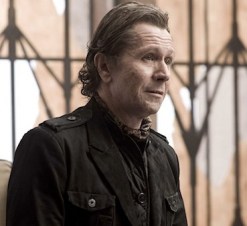 Late on the film pulls out surprise appearances from Michael Gambon and Frances de la Tour. Their roles aren’t even close to needing thesps of such calibre though — they appear fleetingly, the actors underused. Particularly Gambon, who really has nothing to do except fire a gun. I know it’s usually a joke to comment that a usually-better cast member must have needed the money, but that’s the only reason I can imagine he’s here.
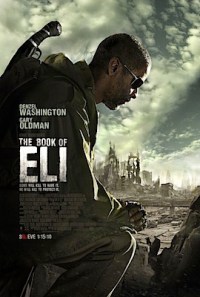
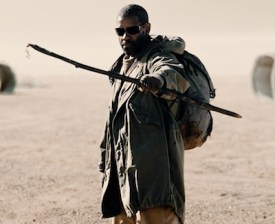
 Newman concludes that “you can’t help feel you were invited to a party with fizzy pop and cream cake and got suckered into a sermon instead.” I couldn’t have put it better. Eli starts off with the potential for an arty 5; slips slightly to a solid 4 when the standard post-apocalyptic trope of a gang fighting for local power comes in to play; unsteadies that 4 with an increasingly atonal second half; and quite frankly borders a 1 with its sickening ending.
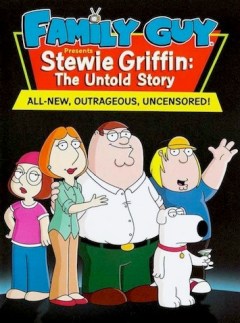 Following Family Guy’s cancellation after three seasons, it somehow found a new lease of life on DVD, posting surprising sales in what was, I suppose, the early years of the format’s mass take-off. This led to a rethink by Fox and a belated (as in, several years later) renewal for the animated sitcom. This story was originally intended to form a three-part opener to the first season back, but Fox wanted a direct-to-DVD movie too — presumably to capitalise financially on that previous success — and so those three episodes were retooled into a feature.
 and the need for it ultimately to be split back up (it was broadcast, censored, as a three-parter at the end of the comeback season). With subplots that begin and end within each half-hour(-ish) segment, it plays about as well as watching a three-parter back to back… which is more than can be said for that Star Wars film. Consequently, it also feels just like regular Family Guy — the same level of humour, basically — though it seemed to me like there were more scatological jokes than normal, some of them going on too long as well. If you’re not a regular viewer of the series, references to running jokes will pass you by; equally, the nature of its humour, often based in cultural references, means that some bits that are obviously jokes will elicit no more than bafflement from a non-versed viewer. Still, there’s plenty of more universal humour too. It relies on the usual style of numerous non sequitur flashbacks and asides. Which, again, is fine — that’s their style; it would be wrong to be anything else.
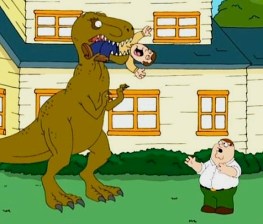 the same as the series normally is, shows how arbitrary US regulations are. It feels like there are a few more jokes that are slightly dirtier than normal and there are a few extra swear words, but they consciously didn’t go OTT with them and, thankfully, it shows. But actually, most of the stuff that’s cut (as detailed on the commentary or in full
  And if you’ve always been curious but never given it a go, don’t start here — I don’t think it would be incomprehensible to first-time viewers, but I don’t think it’s the best introduction to the series either, and it probably makes more sense if you know the characters a bit.
 100Films.co.uk