
Mikhail Kalatozov | 97 mins | Blu-ray | 1.37:1 | Soviet Union / Russian | 12
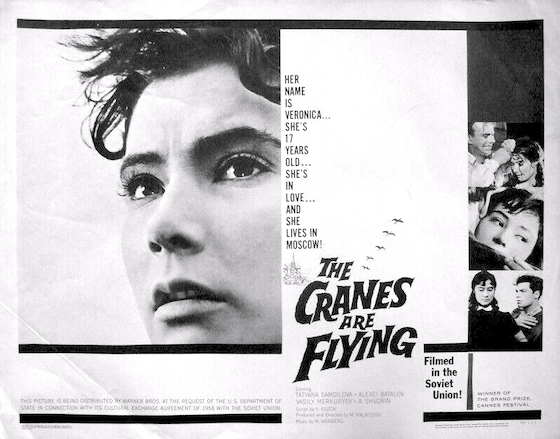
The Russians seem to excel at making a certain kind of war movie; one that befits our stereotype of their national temperament. It might be most succinctly described as “grim as fuck”. The Cranes Are Flying is no Come and See in that regard, but it’s also a million miles away from the gung-ho, celebratory kind of World War II pictures being produced by the US and UK during the same era. No exciting commemorations of the heroic deeds of our brave boys here. Instead, this is a clear-eyed condemnation of the futility of sending the young off to war, and the devastation wreaked on those back at home.
Yet, for all of that, the film is underpinned by what feels like a broadly standard “wartime romance” storyline. Veronika (Tatiana Samoilova) and Boris (Aleksey Batalov) are young and in love, in that all-consuming do-or-die way only young people can be, when war is declared. He does some kind of important job so should be safe from the draft, but — spoiler alert! — he volunteers anyway. Will they survive the war so and be reunited? What other calamities will fate throw at them to prevent happiness? Yes, as if war weren’t enough, other Bad Shit goes down too. I suppose that’s part of what helps the film overcome what could have been a boilerplate plot: that it’s not just about Veronika pining away at home while Boris tries not to get killed on the front line. Indeed, the film is more focused on Veronika’s struggles than on Boris fighting the actual war, and it benefits immensely from a strong performance by Samoilova as Veronika navigates her own personal battles.
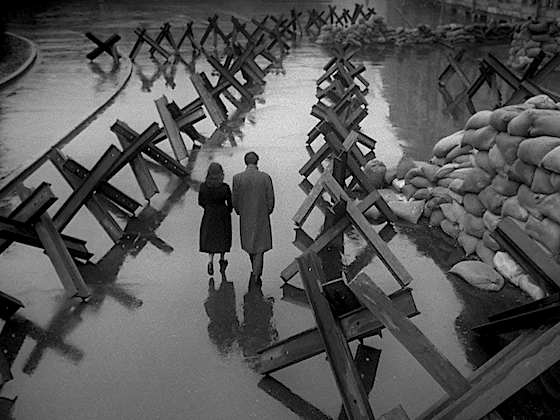
Nonetheless, what really elevates and defines the film is the truly remarkable camerawork by cinematographer Sergey Urusevskiy. Appropriately, his then-groundbreaking use of handheld cameras was a filming technique he had learned as a military cameraman during the war. But its effectiveness goes far beyond the mere fact the camera isn’t mounted. ‘Handheld’ tends to conjure an idea of rough, on-the-fly, documentary-esque filmmaking, but that’s not the impression you get here. The shots are still carefully composed, it’s just that they’re also often extraordinarily and innovatively designed, in a way that remains striking seven decades later. The very way the camera moves is sometimes part of the storytelling itself; at others, it cleverly imparts new information mid-shot, or reveals the scale of events. As an inherently visual success, there’s little point in trying to describe it — “just watch it” has rarely been more apt. (That said, Chris Fujiwara’s essay for the Criterion Collection neatly describes several of the film’s most memorable shots.)
The Cranes Are Flying was a huge success on its release, both at home in the Soviet Union — where it was a breath of fresh air for a nation used to positive propaganda pictures — and abroad, becoming the first (and last) Soviet film to win the Palme d’Or. (For our part, it was nominated for two BAFTAs, although it won neither: it was one of several still-acclaimed movies that lost Best Film from Any Source to a British film (Room at the Top) that also won Best British Film (do I smell bias?), and Samoilova lost Best Foreign Actress to the lead from that same film (hmm…) Next time someone tries to claim awards have become meaningless, maybe suggest they always have been.) They also don’t really matter, this many years later, when we can easily appreciate this film’s successes — both for the impact it had at the time, and the one it continues to have today.

The Cranes Are Flying is the 91st film in my 100 Films in a Year Challenge 2024. It was viewed as part of Blindspot 2024. It was my Favourite Film of the Month in November 2024.
 100Films.co.uk