
Tom Ford | 117 mins | streaming (HD) | 2.35:1 | USA / English | 15 / R
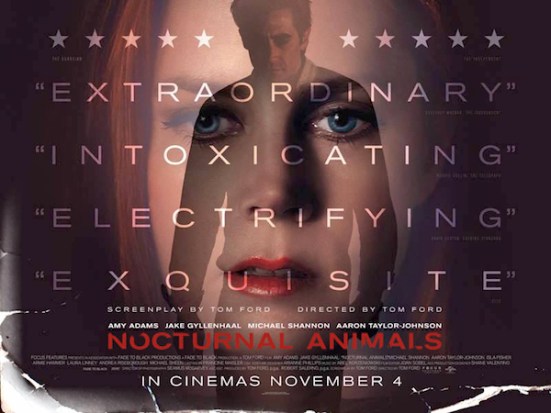
In her second Oscar-worthy role of 2016 that didn’t even get nominated, Amy Adams plays rich art gallery owner Susan, who out of the blue receives a package from her ex-lover Edward (Jake Gyllenhaal) containing an advance copy of his debut novel, which he’s dedicated to her. With the weekend alone to herself, Susan reads the novel — in which the family of Tony (Gyllenhaal again), wife Laura (Isla Fisher) and their daughter India (Ellie Bamber) are terrorised by a gang led by Ray (Aaron Taylor-Johnson), before copper Bobby Andes (Michael Shannon) helps them seek justice/revenge — in the process reliving memories of her tumultuous former relationship.
At first the plot of Edward’s novel seems more interesting than the framing narrative that contains it — after all, you’re pitching a tense thriller against a woman reading a book while she remembers falling for a guy. But as it becomes clear that the novel is just a pulpy thriller, and as the flashbacks to Susan and Edward’s history reveal a mystery of their own, the balance begins to shift. The question is not really “why is the book dedicated to Susan”, because she clearly knows that from very early on. Instead, the quandary for the viewer is: what exactly did she do that merits this lurid tale being her… what? Punishment, maybe?
Although the story is black as night, it’s a beautifully constructed film — as you might expect from someone with a background in design like writer-director Tom Ford. It’s not just the visually appealing work of cinematographer Seamus McGarvey or the film’s various designers that is so striking, though. The three narrative strands are expertly handled. There’s never any doubt about which is which, even when Ford at times intercuts between all three in one sequence, but he hasn’t resorted to simplistic tricks (like vastly different colour grading, say) to pull that off. It’s subtler, and more effective, than that.

To guide the characters through his sombre narratives, Ford has put together a helluva cast. Of course there’s the primaries — Adams, Gyllenhaal, Shannon, and Taylor-Johnson are all superb — but turning up for just a scene or two are the likes of Isla Fisher, Armie Hammer, Laura Linney, Michael Sheen, Andrea Riseborough, and Jena Malone, any of whom could be leads in their own right. It does make it slightly disconcerting when you assume someone that recognisable will turn up again later and then they don’t, but I suppose that just sits with the generally unsettling tone of the film.
Taking its artfulness to heart, some people have dismissed the film as being no more than an artily-dressed-up simplistic revenge story. Personally, I think the point of the story-within-the-story is to be simplistic. I don’t think Edward is meant to be a very good writer, and that’s why he’s produced a very pulpy novel. What matters is the effect this bluntly allegorical piece of trash storytelling has on the person it’s primarily aimed at — i.e. Susan. And there’s still ambiguity for the audience in just what Susan is interpreting from the novel. I mean, Edward is Tony, that’s obvious; and maybe he’s Bobby, too; and Susan must be Laura… but who is Ray? Is Ray just the concept of what happened between them made flesh? Or maybe Susan is actually Ray? Or perhaps Edward is Ray too? Or perhaps it’s something else entirely, I don’t know.
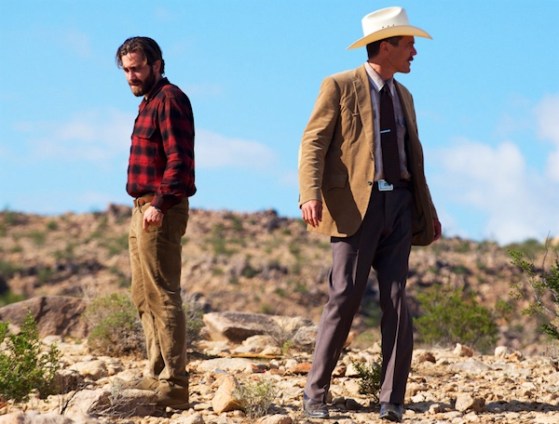
Equally ambiguous is the ending to the present-day framing narrative, but I’m not sure I have much to add to that other than what you can easily find online, so no spoilers here. Other than to say I think the main plot points are all solved (the story-within-the-story wraps up, and how it mirrors the characters’ history has been revealed), but there are some open-ended points that the viewer can choose how to read as they see fit.
Nocturnal Animals has been a pretty divisive film. Lots of people compare it to last year’s even more controversial The Neon Demon, in one way or another — I’ve seen both “at least it’s better than…” and “it would make a good double bill with…” Well, I really ought to get round to that, then, because I admired Nocturnal Animals very much. It’s a beautiful movie about ugly deeds and ugly thoughts.

Nocturnal Animals is available on Sky Cinema from today.
 I’m not sure I’d even heard the name Jeff Nichols before Midnight Special came along, at which point most of the gushing reviews that followed seemed to mention him with cult-like reverence. He’s the writer and director, by the way, for anyone still in the dark, and unbeknownst to me (and, I rather suspect, most people outside certain cinephile circles) he’d amassed something of a following over his first three movies (
 straight-up Spielberg rehashes we’ve seen over the past four decades; conversely, a strand of wilful obscurity means it may be ultimately less satisfying. Again, some people derive satisfaction explicitly from that lack of resolution or explanation, while others will find it damagingly frustrating. Even more than Spielberg, I felt the thing most evoked by this structure was
  I thought they perfectly conveyed what they were intending to convey — usually, just a kind of otherworldly light. It’s not like it’s even over-stretching its means, like so many network TV series or
 Between the mega-hits of
  The problem with the last point is that, in real life, Sam is still over there, still doing the same thing, while conflicts rage on. But this is a film — you need to find some kind of conclusion. The makers have tried, but its an incredibly half-arsed climax; less a resolution to the entire story and more Sam having learnt one lesson from something that went wrong a little earlier.
 mashed together with a polemical charity documentary about Africa, and then with some
 100Films.co.uk