
Matthew Vaughn | 132 mins | cinema/Blu-ray | 2.35:1 | USA / English | 12A / PG-13
Superhero films have been a significant regular part of the summer movie season for over a decade now, but this year really looks like it’s going to take the biscuit: The Avengers obliterated box office records Stateside last weekend, and has spent most of the week knocking down more worldwide; there’s a Batman sequel/finale to look forward to, which everyone has been expecting to do the same; and sandwiched somewhere between the two is a Spider-Man reboot that, provided it doesn’t get dwarfed by the other two and/or poor reviews, is likely to make a pretty penny. (If I recall correctly, the initial Raimi Spidey film was the first movie ever to make over $100m in its opening weekend; and now, 10 years later, The Avengers is the first to beat $200m — how neat.)
But that’s all still to come (I haven’t even seen The Avengers yet myself, and I won’t now until at least sometime next week, for various reasons. Grr.) Instead, here’s a review of my personal favourite from last year’s crop of comic book adaptations — indeed, I ranked it the second best film I saw all year.
 I made sure to see First Class soon after its cinema release back in June 2011 — an increasingly-rare cinema trip for me (previous one before this was Inception in July 2010), and even rarer to go so quickly, but it earnt it as probably my most anticipated movie of the summer. I’ve been a fan of the X-Men since the ’90s animated series was a defining part of my childhood; Matthew Vaughn has become one of my favourite filmmakers thanks to Stardust and Kick-Ass, both of which earnt 5 stars and spots on my end-of-year top 10s (and Layer Cake was 4-star-ly entertaining too); and the idea of doing a superhero film that was definitively set in a specific point in the past (namely the early ’60s), rather than the perpetual Now of every other entry in the sub-genre, is the kind of thing creative fans long for but risk-averse studios rarely greenlight. Plus the trailers looked brilliant.
So my long-held high anticipation (unlike many whingy comic-continuity-obsessed inexplicably-Vaughn-dubious internet fanboys, who needed the trailer to even consider thinking the film might be good) led me to the cinema quickly. Why so long to post a review, then? Because I’ve been waiting for Blu-ray to see it properly.*
As “Film fans”, rather than “movie consumers”, we’re supposed to believe 35mm cinema projection is the best way to view a film, rather than the cold hard digital realm that’s taking over, or the home cinema that is increasingly the viewing location of choice as people seek to avoid inflated ticket prices and noisy crowds, and gain a huge degree of convenience in the process. Well, sod that. I saw X-Men on 35mm. 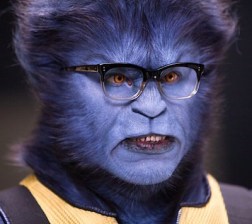 It was blurry, the sound was muffly. I saw a clip in a summer movies trailer just a few days later when I saw Pirates 4 in 3D (i.e. digitally projected), and had a genuine moment of, “oh, that’s how it’s meant to look”. So thank God for Blu-ray — never mind prices, crowds or watching when I want, the real advantage is seeing it as sharp as a pin and being able to hear everything the characters are saying. I can enjoy the cinema experience, but at the end of the day it’s about the film, and if the only way to see, hear and appreciate it properly is to watch it 5+ months later on a much smaller screen from a digital source, so be it. The fact that it’s usually cheaper to buy the Blu-ray to own forever than take two people to see it just once doesn’t hurt either.
But I digress massively. X-Men: First Class takes us back to the origins of the X-Men (at least, the movie-universe X-Men): it’s the 1960s, mutants aren’t widely known about yet, Charles Xavier is uncovering some interesting ideas at Oxford, and Erik Lehnsherr is travelling the world taking revenge for Nazi atrocities. But when some Evil People are plotting to do Something Nasty, the US government winds up bringing them together, and the road to establishing the X-Men begins…
I should give up on plot summaries again, I never write good ones. There’s so much more to First Class than that might suggest. Firstly, it’s very much a prequel to the other X-Men films, rather than a reboot. So no Cyclops and co in the original team-up, which really annoys some fanboys, but pfft, it doesn’t matter. It’s fair to say the characters who make up the eventual first X-Men team aren’t as iconic or memorable,  but that’s fine because here they’re just supporting characters. This is the story of two other young men, Xavier and Lehnsherr, aka Professor X and Magneto.
You need some pretty fine talent to replace two of our greatest actors — Ian McKellen and Patrick Stewart, of course — and in Michael Fassbender and James McAvoy you certainly have that. Fassbender carries much of the emotional weight of the film, and certainly received much of the praise from critics, but it’s thanks to McAvoy’s support that the film is lifted to a higher level. He provides calm, humour and fundamental decency to balance Fassbender’s rage and emotion. What’s fascinating about them as characters is that they are half-formed people. That is to say, while they are Wise Old Men by the time of X-Men, here they are still flawed and finding their way; witness Charles’ insensitivity toward Raven, for instance. That’s quite aside from all the little character-building touches. It all builds to the fantastic, heartbreaking climax on the beach. I’d also say it adds weight to the relationship between McKellen and Stewart in the original X films. Not significantly, perhaps, because those films are about other things, but I think you can feel their shared history more keenly.
The rest of the cast is suitably well equipped. There’s 2011 Best Actress Oscar nominee Jennifer Lawrence as Raven, aka Mystique. Little more than a henchman designed to bring sex appeal in the trilogy, here she’s given a significant degree of backstory that makes her an important piece of the overall series. Indeed, she comes across as woefully underused if you watch X-Men after this — 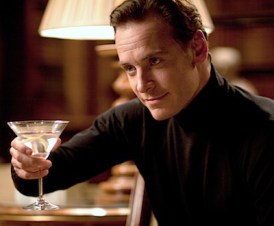 the flipside to the Xavier-Lehnsherr relationship working better, if you will. There’s also Kevin Bacon, playing his second superhero villain in as many years, who does sterling work as a former Nazi seeking world domination — remember the ’60s, when world domination was a valid aim for a villain? There’s more than a little Bond in the mix here.
Rounding out, we have the likes of Vaughn regular and perpetual “I’m only doing it for the money”-er Jason Flemyng, in an almost dialogue-free part that, while visually striking, doesn’t fare much better than his Kick-Ass ‘cameo’ in terms of screen time. There’s also a very flat (in every way apart from her frequently highlighted chest) turn from January Jones as a villainous sidekick, feeling every bit like the last-minute casting she was (after various other actresses walked away — considering the small size of both the role and costume, I can see why). Plus Rose Byrne, who’s always worth mentioning.
Much was made in some circles of a rushed production schedule leading to some of the film’s flaws. I think that’s only an issue because people know it could be one, because (on second viewing especially) I noted no such problems. The earlier parts are probably the film’s best — with Lehnsherr and Moira being all Bond-y, and Kevin Bacon’s Shaw being very much a Bond villain, making it feel more like a big ’60s spy thriller than a superhero movie in many ways — and when it tries to introduce an X-Men team made up of second-string leftover characters it loses its way slightly. But balance is everything with ensemble casts like this, and watching the film again gives a better perspective on its pace and its actual balance. First time through these things are distorted because you don’t know how far through the story you are, how long’s left, how long each scene will last, and so on; a second time, with an idea of where it’s going and so forth, you can better appreciate how it’s all actually weighed up, and I think First Class achieves a balance better than most have given it credit for.
Also worthy of a mention is Henry Jackman’s score. He gives us brilliant driving, menacing action themes, alongside some evocative ’60s stuff too, especially when they’re on the hunt for mutants for instance. I love a good blockbuster movie score, and this is definitely one of those.
Perhaps the thing that most impressed me about First Class, however, was its genuine sense of spectacle. The climax features master-of-magnetism Magneto hoisting a submarine out of the ocean with his powers. That’s not a spoiler, it’s in the trailers — so we’d all seen it going in. And we’re in an era of anything-goes CGI — nothing looks impressive any more because we know not only that it can be done, but how it was done too (greenscreen and pixels, essentially). But that’s not what happens, at least for me, especially on the big screen.

Between Vaughn’s direction, Jackman’s score, Fassbender and McAvoy’s performances, plus those of other supporting cast members, and sterling work by the visual effects team(s), the moment when that submarine floats dripping into the sky is hair-raising. It played to me as a moment of genuine cinematic spectacle; the kind of thing you used to get when big stunts had to be done for real somehow. It’s not a feeling I expected to get from a new film ever again.
I’ve mentioned a couple of times how it ties in to the earlier (set later) films in the series, and how some complained about it messing up X-Men comics lore. But this is an adaptation — it’s not beholden to what’s established in the comics. And it’s working around fitting into the world of the later films, so of course they’re not going to have Cyclops in a ’60s X-team, and so on.  It’s a complete non-issue for non-fans, and the same for any open-minded fans who realise they’re not trying to faithfully bring the X-Men canon to the big screen. Earlier films should already have shattered that illusion anyway.
As to the former, it largely fits well with the earlier films. There might be some questions about ages and events not lining up precisely (especially with the flashbacks in The Last Stand), but these are minor points that I think we can overlook for the overall quality of the film. Largely, a use of certain effects, call-forwards, cameos and little touches here and there really tie it in to the existing films. You don’t need to have seen them to get this — indeed, I imagine the ultimate way to experience it would be with no foreknowledge whatsoever of where Charles & Erik’s relationship is going — but for all those of us who have, it works very nicely.
Yet despite these links, and the 40(-ish)-year gap between the end of this story and the start of X-Men, if First Class never received a follow-up it would work perfectly as a standalone ’60s X-Men film. But I’m ever so glad we’re getting more, because I want to see this crew and this cast tell us more stories of the X-Men.
 After seeing First Class in the cinema I thought to myself that, while I would dearly love to give it a full five stars, in all good conscience I couldn’t; for whatever reason, it didn’t quite come together enough. Watching it again on Blu-ray, however, I’ve completely changed my mind: I wouldn’t change a thing. All my anticipation is more than paid off — I love this movie.

X-Men: First Class placed 2nd on my list of The Ten Best Films I Saw For the First Time in 2011, which can be read in full here.
* That was released back in October 2011, I know. The rest is general tardiness. ^
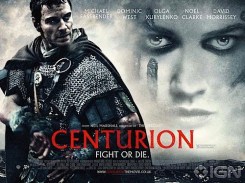 The fourth feature from writer/director Neil Marshall (despite owning his first three on DVD, this BD rental is the first I’ve actually watched — story of my life) is a bit of a departure: where the first three were horror (or at least horror-leaning) flicks, Centurion is an action-adventure crossed with something a little more artsy. Only a little, mind. Think
  Regular readers may know that I have an ever-growing dislike for films that begin at or near the end for no good reason (and most of those that do have no good reason to do so). Centurion’s opening line notes that “this is neither the beginning nor the end” of the lead character’s story. Oh dear, thought I; though perhaps “nor the end” signifies we might reach this point suitably distant from the credits, maybe. Not meaning to spoil it, but we’re there just 10 minutes later. Nice work Mr Marshall.
 The cast is packed with people who, even if you don’t know their names, there’s a fair chance you’ll know the faces (assuming you watch your share of British drama): in addition to Fassbender and Morrissey there’s Dominic West, JJ Field, Lee Ross, Paul Freeman, Liam Cunningham, Noel Clarke, Riz Ahmed, Imogen Poots, Rachael Stirling, Peter Guinness… not to mention Film Star Olga Kurylenko. Recognisability doesn’t guarantee quality, of course, but that’s a pretty good list.
 I really enjoyed Centurion, appreciating its mix between brutally real action and stunning scenery, with a slightly more thoughtful side emerging in the final act. It’s also always pleasant to see a film that runs the length it wants to at a reasonable speed, rather than padding itself to reach two or even two-and-a-half hours. Splendid.
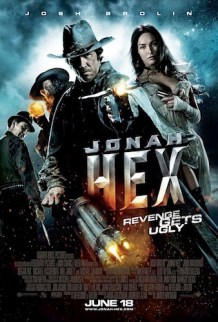 Jonah Hex is not a good film. Let’s just establish that, before I start being nice about it.
 Much of the film rattles on in this way. And rattle it does: 73 minutes before credits. As blockbuster running times spiral out of control, such brevity is almost welcome. It doesn’t feel exceptionally short, mind, except for when the plot occasionally jumps forward.
 — usually improbably — or generally be a female. By “female” I mean “cleavage delivery device”. Considering her acting ability, her lack of presence is no real shame.
 Watching almost any film a second time can affect your opinion of it. It could reveal deeper levels of character or theme; it could allow you to see how the writer(s) subtly foreshadowed events, or built up to the big twist; it could be you spot jokes you were too busy laughing during last time; it could let you look at the imagery now you don’t have to concentrate so hard on the subtitles. Or it could reveal shallowness, that there’s nothing to be gleaned that you didn’t get the first time; or highlight the holes in a plot that seemed so well constructed before; or jokes that were hilarious fall flat when heard more than once; or the action sequences aren’t exciting when robbed of their freshness. A second viewing can reveal that you were too young to get it the first time, or that you’re now too grown up to enjoy it; it can reveal a bad movie isn’t so bad, or that without the hype it’s actually quite good; it can raise a favourite even higher in your estimations, or it can tear it down. And even if a second viewing just reaffirms exactly what you felt the first time, well, when there’s such a chance for change and it doesn’t occur, that’s an effect in itself.
 — and, today, a year since its UK release —, having watched it a second time to refresh my memory. But has it changed my opinion?
 only instead of being one thing once he does it again and again, with any trick he fancies, throughout the film.
 The ending (and skip this paragraph if you haven’t seen the film) is the key to that, as I’m sure you either noticed or have read in other coverage. The power of cinema literally destroys the Nazis, changing the course of the war. Killing Hitler — and the rest — is one of those barmy notions that at first seems wrong, and then seems completely right. “If my characters had existed, this is what would have happened” is one of those genius notions that seems so inescapably obvious you wonder why no one’s done it sooner. Why do you necessarily need to obey history if the rest of your story is fiction anyway?
 (I believe more of the film is subtitled than in English), did little to endear it to the complaining masses who thought they were getting “
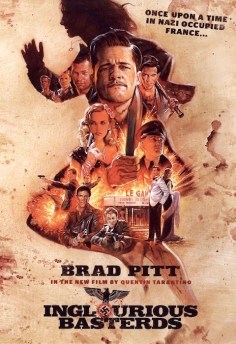
 And for all those constantly-introduced characters, the acting is top notch. Christoph Waltz easily deserved the huge pile of awards he garnered, his quirky persona following in a long tradition of calm psychopaths in movies. You always know his pleasantries hide something far nastier; every scene he appears in is instantly tense. Mélanie Laurent is an instant one-to-watch as the film’s real central character, Shosanna, though she seems to have been sadly sidelined by all the praise heaped on Waltz. It doesn’t hurt that she’s the kind of woman you’d happily decorate a whole review with pictures of (though you’ll note I resisted). Michael Fassbender is the very definition of Englishness, without quite slipping into an irritating stereotype. It’s difficult to imagine the originally-cast Simon Pegg in the role, though I’m sure he would’ve brought something… shall we say, different… to it. Brad Pitt’s much-criticised heavily-accented performance is fine. While not as memorable as the others mentioned, I don’t see why some have had such a problem with it.
 Til Schweiger’s vicious German basterd; Diane Kruger’s glamorous, calm actress-spy; Daniel Brühl’s apparently sweet accidental hero and movie star-to-be; Martin Wuttke’s raving loony Hitler; and others too. Perhaps the only duff note for me was Mike Myers as an English General. I liked the
  every once in a while, but it also proves they work, that he was right to employ them.
 care-free deployment of an abundance of film-specific techniques, and, both through this and also directly in its narrative, its love of film as a medium — Inglourious Basterds isn’t just “a Quentin Tarantino film”, it is Quentin Tarantino. His choice of final line — “You know something, Ultivich? I think this just might be my masterpiece” — is clearly about more than Aldo Raine’s swastika-carving abilities.
 100Films.co.uk