
Alfonso Cuarón | 135 mins | streaming (UHD) | 2.39:1 | Mexico & USA / Spanish & Mixtec | 15 / R

 2019 Academy Awards
10 nominations
Drawn from writer-director Alfonso Cuarón’s memories of growing up in the Colonia Roma neighbourhood of Mexico City, Roma is the story of what happens to a middle-class family’s housemaid, Cleo (played by newcomer Yalitza Aparicio), over the course of ten months in 1970 and 1971. It’s also one of the best-reviewed films of the year, winner of BAFTA’s Best Film award (amongst others), and a frontrunner for the same at tonight’s Oscars. No pressure, then.
Roma has already attracted a reputation for being slow and difficult to engage with for ordinary viewers — the very definition of an arthouse movie; and it’s in black and white with subtitles, just to compound the stereotype. There’s no doubting it has a measured pace, and the viewer needs to be prepared for that. It sets its stall with the opening credits, which fade in and out slowly over a static shot of paved flooring being washed by soapy water that flows across it like waves on a shore — and that’s all we see, for several minutes. From there, much of the move unfurls in wide shots, with slow pans or no movement at all, inviting the viewer to search the frame for details and significance. Note that it’s not nominated for Best Editing…

At first it’s difficult to see the point of all this, which is where accusations of it being boring stem from. Nothing seems to be happening, just people going about their lives and jobs; a “slice of life” narrative taken to the extreme. What’s missing from that view is context, and as the film goes on we get that — looking back at earlier scenes with the knowledge of what happens later, it’s more possible to see what Cuarón was going for. For example, there are two scenes side-by-side which are barely notable in themselves and certainly have no immediate connection — the father of the family going away on a business trip, and Cleo going to the cinema with the guy she’s been seeing — but when you know what happens later, these scenes are clearly back-to-back for a reason, with a clear connection. One might say juxtaposed, but they’re less being contrasted, more mirrored. There’s quite a lot of that kind of subtle, often exclusively visual mirroring throughout the film — it’s no coincidence the opening shot looks like waves.
This is a film that rewards perseverance, then. It doesn’t work for everyone, but for some the way it slowly inducts us into this family’s life builds to great emotional payoffs come the events of the final act. After a whole lot of very little, it suddenly gets very dramatic and heart-wrenching. You’d have to be pretty cold not to feel anything for the characters given some of the things that transpire, but how much of a connection is developed between them and the viewer is, I think, very much a matter of personal experience. Based on online comments, some find the finale emotionally cathartic, and end up sobbing their heart out; others find Cleo’s silence to be distancing, making her true character and feelings inaccessible, and by turn neutering the film. I find myself sympathetic to both points of view. The film, and the characters, are certainly understated, but I don’t think they’re wholly shut off. Put another way, I wasn’t in tears by the end, but I felt I understood something of these people and their reactions to what had occurred.

One thing I wasn’t prepared for by anything else I’ve read about the film (which, admittedly, wasn’t much) was how much… slightly odd stuff there was. Not full-blown Lynchian weirdness, just things you don’t really expect to see. A surprising focus on dog shit, for example. A martial arts display with some very, er, jiggly full frontal male nudity. A Norwegian New Year’s Eve song performed in front of a blazing forest fire. Walls of pet dogs’ heads mounted like hunting trophies in a macabre display of affection, but with the sheer disturbingness of that seeming to go uncommented on. Cuarón has said 90% of the movie comes from his own childhood memories, so I guess he had an interesting time of it…
At the very least, Roma is a technical masterpiece. Shot by Cuarón himself (because Chivo was unavailable), it looks thoroughly gorgeous — crisp, textured, always perfectly lit, be that by the nighttime glow of a city or misty morning air, with some shots that look like molten silver caressing the screen. Cuarón is the frontrunner for the cinematography Oscar, marking the first time it will have gone to a director lensing his own film (assuming he does win, of course), and it seems to be very much deserved (in fairness, I’ve not yet seen any of the other nominees to compare).
But while everyone talks about the photography, very few people seem to mention the immersive sound design, and I think that’s just as worthy of attention. Roma is also nominated tonight for Sound Mixing and Sound Editing, categories that are often dominated by blockbuster-type films due to their energetic soundscapes — its competitors include the likes of Black Panther, Bohemian Rhapsody, First Man, and (somewhat ironically) A Quiet Place. I doubt Roma will overcome their bombast, but in its own way it’s just as effective, generating a world around you with its enveloping audio. I guess this is partly the problem of it going direct to Netflix, though — most people who see the film will listen to it through TV speakers, or, at best, a stereo sound bar. However, it’s proof that surround sound isn’t just for action movies, and that it’s worth having a system in your home, if you can.

On the whole, Roma exudes the feel of a quality piece of Art, with a capital ‘A’ — it’s beautiful to look at, slow and heavy and opaque in its storytelling, with (perhaps) some deep message about human experience that’s left for the viewer to discern. Is it the best picture of 2018? Well, I mean, if you like that kind of thing… Should it win tonight? That depends what you think the Oscars should be rewarding, I guess. It’s not an unworthy champion in an artistic sense, but is something else — something artistic in a different way, and also more accessible — even more deserving of being crowned The Best? That’s always the tug-of-war when it comes to Best Picture, I suppose. It’s certainly not my favourite movie from last year (and I wouldn’t necessarily expect it to make 2019’s list either), but I still admire much of it.

The 91st Academy Awards are handed out this evening. In the UK, they’re on Sky Cinema Oscars from 12:30am, with highlights on Sky One tomorrow at 9pm.

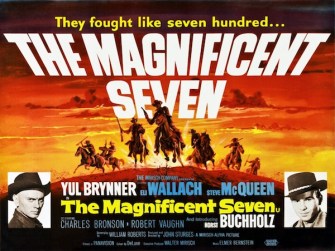 Described in the booklet accompanying the Ultimate Edition DVD release as “the last great American western before Sergio Leone reinvented the genre,” The Magnificent Seven doesn’t feel as dated as that might make it sound. Famously, it’s a remake of Akira Kurosawa’s
 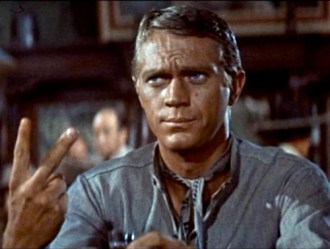 With even less screen time to go round than in Kurosawa’s original, the cast only get to provide thumbnail sketches of their characters. However, bearing that in mind, only Vaughn really feels shortchanged on time, while McQueen manages to steal every scene he’s in, even when he was supposed to just be in the background — much to Brynner’s annoyance. One reason this works is because the seven represent more or less the same things thematically, in some respects functioning as one hero character with seven parts. They are all unsettled drifters, good at killing but not at settling down; they have nothing to do but win and so be damned to go find another cause, or die trying. This is taken from Kurosawa’s film too, of course, but it fits just as well in its new setting, and the main scene where the seven discuss it is a definite highpoint of the movie.
 That’s not something that bothered me, but where I did find it suffering was in comparison to Kurosawa. While it has obviously been rejigged for its new setting, it’s not just borrowed the basic concept of seven violence-skilled loners defending a needy village, but rather retained all the bones of the samurai original. As with most remakes, it falters by not doing the same thing quite as well, for one reason or another. Still, if it is a faded copy then at least it’s of one of the greatest films ever made, which leaves it a mighty fine Western in its own right.
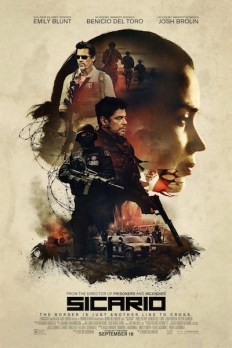 Fighting a losing war against Mexican drug cartels in Arizona, FBI agent Kate Macer (Emily Blunt) is keen to be enlisted to an interagency task force run by Department of Defense consultant Matt Graver (Josh Brolin). Taken along for the ride but kept in the dark, Macer becomes increasingly concerned that all is not as it seems — especially when it comes to Alejandro (Benicio Del Toro), a mysterious task force member whose motives seem to be a big secret…
 Arguably, the film loses its way a little when it does reach that point. Answers are forthcoming eventually, and the third act occasionally abandons the conflicted and complex world that came before it for more straightforward and satisfying turns of events. Fortunately, the film survives such wobbles thanks to the strengths it’s already established, and with an even deeper dive into moral greyness even while it seems to be offering a simplistically fulfilling climax.
 Brolin may be a headline lead alongside those two, but his character is given little to work with beyond being a son-of-a-bitch who keeps Macer onside with (deceitful) charm. He’s fine but unremarkable in that role. Perhaps
 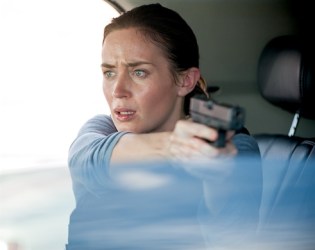 Tension is definitely the name of the game when it comes Jóhann Jóhannsson’s score, which was also Oscar nominated. Dominated by elongated, heavy strings and pacey, heartbeat-emulating percussion, it makes the threats lurking in every corner feel tangible; makes the sense that everything is doomed and liable to go south at any moment palpable. It’s a major contributor to the film’s mood.

 Score:



 The film that technically won
 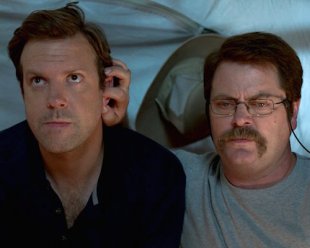 Reviews for We’re the Millers are resoundingly average across the board, remarkably so (which is why I’m remarking on it). The funny thing is, some critics begrudgingly admit they liked it while giving it half marks, and others are very down on it… while still giving it half marks. It’s the same story for user reviews on
  100Films.co.uk