

Did you know The Exorcist was based on a true story? I didn’t, until I watched some of the special features on the Blu-ray release. “Based on” is a bit of a stretch, to be honest. “Inspired by” would be more accurate. But you get the sense from author and screenwriter William Peter Blatty that he believes all this stuff so much that he thinks “based on” would be fine.
The Exorcist does start out very plausibly. It’s about Regan MacNeil (Linda Blair), a sweet 12-year-old kid living with her mother Chris (Ellen Burstyn) in Washington, D.C. But one day Regan begins to act oddly: delivering insults and soiling herself at a party; yelling obscenities; slapping her beloved mother; somehow causing her bed to shake uncontrollably… Doctors run tests, but they reveal nothing. The only suggestion they’ve left to give is that Regan may believe she’s possessed by an evil spirit, and that she might be tricked into believing she’s cured if the church will perform a little-known procedure called an exorcism.
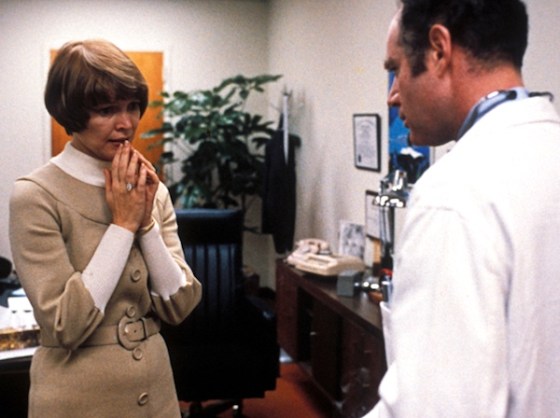
Everyone’s so busy talking about The Scary Stuff when it comes to The Exorcist, no one ever tells you how low-key and grounded a lot of it is. Okay, the talking in voices and spinning heads and vomiting green gunk and bloody crucifix masturbation are pretty memorable, so fair enough. Before that, though, it’s more of a character drama, about a single mother struggling to handle what appears to be her daughter’s out-of-control mental health problems. Meanwhile, a priest, Father Karras (Jason Miller), struggles with a crisis of faith brought on in part by his ailing mother. Naturally these two threads align when Chris calls on Karras to investigate Regan’s condition.
Another thing I’ve never heard about The Exorcist is how good Miller is. This is his film debut, before which he was a stage actor, but he delivers a very naturalistic performance as a man of the cloth who also has his head screwed on — his training in psychology keeps him suitably skeptical of what’s going on with Regan. Events conspire to challenge his point of view, of course. Karras has the clearest arc of anyone in the film, giving Miller the most scope to develop his role. I’d venture he’s the film’s most interesting character.
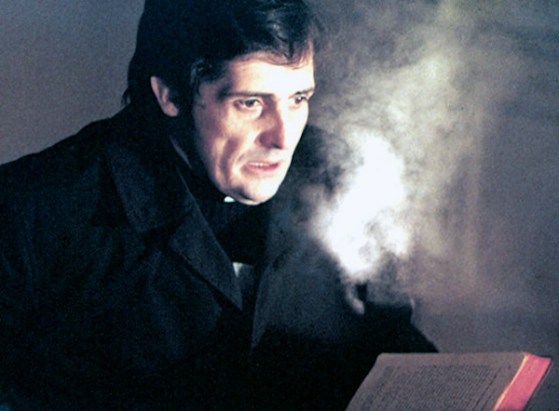
That’s not to dismiss Burstyn, who’s also excellent as the very together mom who begins to crack under the increasing strain of her daughter’s worsening, inexplicable condition. As said daughter, Blair’s performance is certainly memorable, though the potency of Regan is aided by special effects and voice work from another actress. Although second billed, Max von Sydow only pops in at the beginning and end in the titular role of Father Merrin. It’s no wonder someone later thought Merrin’s past was ripe for a prequel, because there’s a backstory there that’s only hinted at.
And no one ever says how little Tubular Bells is in it, either.
The thing people do say about The Exorcist is how scary it is. Tales of audiences fainting and running out during its initial theatrical run are the stuff of movie legend. Today its releases are branded as “the scariest film ever made”, with the justification of several polls that have named it thus. I can well believe that, in the early ’70s, it was indeed the most shocking film most people had ever seen, certainly from a major studio. The extreme bad language, the gruesome special effects, the morally depraved acts, and all of it happening to a child…
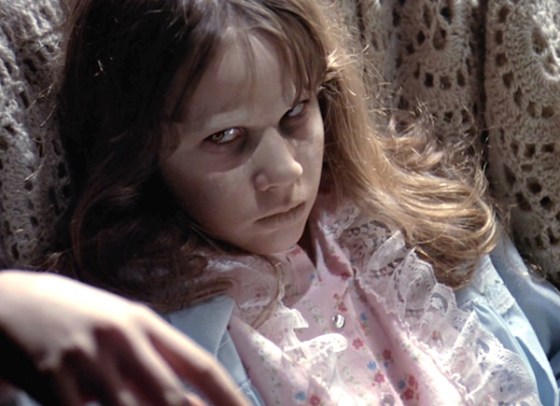
It was surely an element of sensibilities being offended (especially in America), as much as it was actual horror, that provoked such radical reactions from audiences back in the day. Nowadays we’re a bit more deadened to those things — the last 40+ years have served up plenty of elaborate gore, and potty-mouthed pre-teen girls are more likely to be found in comedies (Hit-Girl is even younger than Regan when she utters the C word in Kick-Ass, for example). I also thought it frequently undermined its own intensity by cutting away from the scary scenes to more mundane stuff. Maybe the goal was to never give those scenes an ‘out’ — we always seem to leave them when supernatural stuff is still going on — but for me it killed the momentum that was building.
That’s not to say the horrific and shocking stuff is no longer powerful. What really works in its favour is how long the film spends being grounded and plausible — most of the first hour is a ’70s social drama about a child with a mental health problem. That level of realism helps the later horror scenes be all the more effective. They quite quickly transcend the realms of the plausible (unless you’re some kind of religious fanatic, I guess), but the grounded setup lends weight to them nonetheless. The climax in particular — the actual exorcism — might just be silly without the realistic world it’s been placed in. Instead, it’s a suitably tense climax.
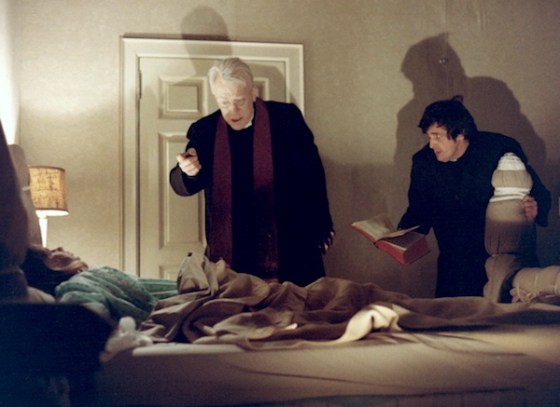
Obviously it was the extreme stuff that caught people’s attention and earnt The Exorcist a reputation that it still trades off to this day. However, I’d say it’s best regarded, not as a fright-fest, but as a film about characters: the mother who’ll do anything for her child; the priest battling with a crisis of faith. It’s a drama about real people in extreme circumstances, it’s just that these extreme circumstances happen to be horror movie fodder. In this respect it’s such a film of the ‘70s, which I mean in the best possible way.

The Exorcist was viewed as part of my Blindspot 2017 project, which you can read more about here.
* IMDb lists half a dozen other languages, but Arabic’s the only one I remember being significant enough to earn subtitles. ^

 Score:



 2016 Academy Awards
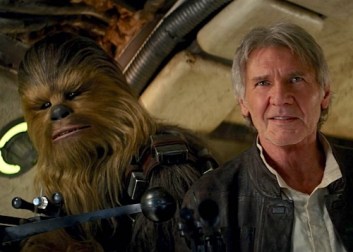
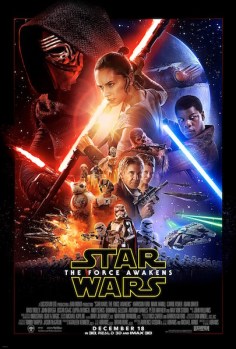 Star Wars: The Force Awakens is not the best film of 2015. Not according to the Academy of Motion Picture Arts and Sciences, anyway, who didn’t see fit to nominate it for Best Picture at tomorrow’s Oscars. Many fans disagree, some vociferously, but was it really a surprise? The Force Awakens is a blockbuster entertainment of the kind the Academy rarely recognise. Okay, sci-fi actioner
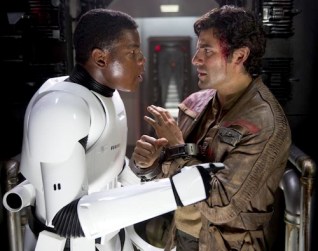
  I too could talk about the likeable new heroes; the triumphant return of old favourites; the underuse of other old favourites; Daisy Ridley’s performance; John Boyega’s performance; the relationship between Rey and Finn; the relationship between Finn and Poe; the success of Kylo Ren and General Hux as villains (well, I thought they were good); the terrible CGI of Supreme Leader Snoke; the ridiculous overreaction to the alleged underuse of Captain Phasma; that awesome fight between the stormtrooper with that lightning stick thing and Finn with the lightsaber; the mystery of Rey’s parentage; the mystery of who Max von Sydow was meant to be (and if we’ll ever find out); some elaborate theory about why Ben wasn’t called Jacen (there must be one — elaborate theories that will never be canon are what fandoms are good for); the way it accurately emulates the classic trilogy’s tone; the way it’s basically a remake of
 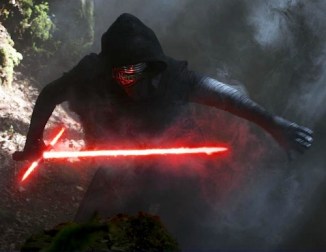 J.J. Abrams seems to have tricked some people into thinking he’s a great director with The Force Awakens (rather than just a helmer of workmanlike adequacy (when he’s not indulging his lens flare obsession, at which point he’s not workmanlike but is inadequate)), and I think that’s partly because it’s quite classically made. Yeah, it’s in 3D, but the style of shots used and — of most relevance right now — the pace of the editing help it feel in line with the previous Star Wars movies. Some of the more outrageous shots (often during action sequences) stand out precisely because they’re outside this norm. Perhaps we take for granted that Abrams delivered a movie in keeping with the rest of the series, because that’s The Right Thing To Do, but that doesn’t mean he had to do it. And the transitional wipes are there too, of course.
 No one knows what the difference is between these two categories. I’m not even sure that people who work in the industry know. As a layperson, it’s also the kind of thing you tend to only notice when it’s been done badly. The Force Awakens’ sound was not bad. It all sounded suitably Star Wars-y, as far as I could tell. That’s about all I could say for it. It feels like these are categories that get won either, a) on a sweep, or b) on a whim, so who knows who’ll take them on the night?
 “restraint […] applying the basic filmmaking lessons of the first trilogy,” according to
  those elements aren’t gone about in an awards-grabbing fashion anyway. In the name of blockbuster entertainment, however, they’re all highly accomplished.
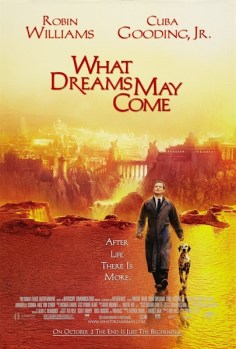 When What Dreams May Come first came out, the reviews seemed to conclude that it was rubbish, but at least visually splendid. Back in 1998, that put me off — “it’s not meant to be very good” was the takeaway thought there. As the years have gone on, for some reason those reviews (or possibly just one I extrapolated into a consensus, who knows?) stuck with me; and as my temperament as a film fan grew, that it was visually extraordinary (even if nothing else) began to seem reason enough to watch it. It lingered in the back of my mind, never quite becoming a “must see”, especially as the opportunity rarely (if ever) presented itself. So that’s more or less how I come to it now, 17 years since its release and those reviews — a long-awaited scratch of a long-lingering itch. (Perhaps this gives some insight into why/how it takes me so long to get round to watching recommendations/things I’m quite keen to see/etc.)
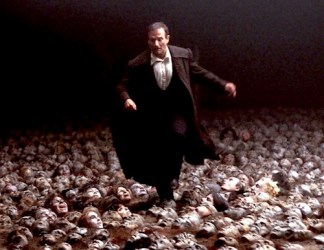 Hell, incidentally, also looks incredible, as do the various locales visited by Chris and his companions (played by Cuba Gooding Jr and Max von Sydow) on their way there. Director Vincent Ward and his team have created a rich, engrossing visual space here. It’s not just the Oscar-winning visual effects either, which create Chris’ initial realisation of Heaven as a kind of living painting, but also the locations, their decorations, and some fantastic sets. The design work is brilliant, and the vast majority of it still holds up today. Even the CGI doesn’t look glaringly like 17-year-old graphics, and in many cases what I presume is a mix of live action, models and some CGI is far more effective than the all-CG look it would likely have if made today.
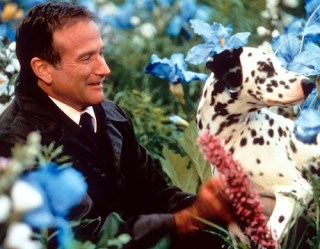 Nonetheless, some will identify with the sentimental “love transcends death”-type message more than others, and there’s a chance those who like (or don’t mind) their films to be at the soppier end of the spectrum will genuinely love it. For the rest of us — for anyone who likes visual splendour in their movies, anyway — it does indeed merit a look for the imagery alone.
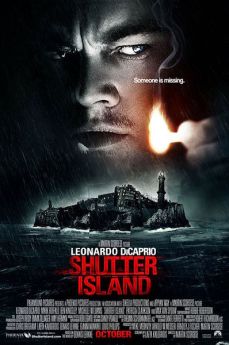 Adapted from a novel by Dennis Lehane (whose work also inspired
 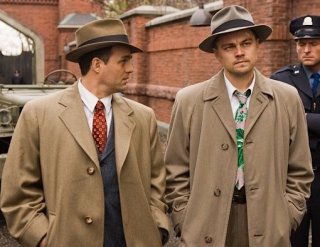 Besides, the film has other delights beyond being an elaborate guessing game. One of the things Lehane set out to do in his novel was write “a gothic”, and Scorsese and co have taken that ball and run with it. It’s overflowing with a fantastic atmosphere: unsettling, creepy, chilling, horror-movie scary when needed (some sequences are properly hair-raising); truly gothic-feeling. Every aspect of filmmaking — the direction, the photography, the editing, the sets and locations, the music — work in harmony to create a coherent mood.
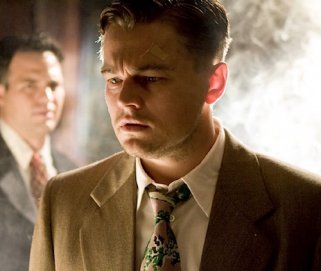 And then, after Scorsese and co have done their best to shred your nerves, in the final half-hour the pathos is immense. Quite without realising it had brought me to that point, I had a tear in my eye. This is in part thanks to some great performances, though you do need to reach the twist to fully appreciate them. Everyone reveals more levels once you know it, and indeed it’s clear a great amount of effort went into ensuring re-watchability — that if you view it again knowing the answers, you can spot things; not clues, per se, but elements in the performance, the design, the staging, that tie in to the reveal.
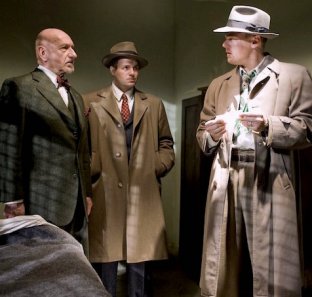 I think the more you let Shutter Island percolate after it’s over, the better it becomes. Solving the mystery and guessing at the twists occupies so much of your time on a first viewing that you almost miss the details in the characters and the world, but they build up nonetheless. There’s layers and depth here, and a plausibly realistic depiction (even according to an expert) of something that’s incredibly hard to depict in fiction. You can view Shutter Island as just an atmospheric gothic mystery chiller, and as that it’s a quality piece of work, but it’s the extra depth that mark it out as, actually, a great movie.
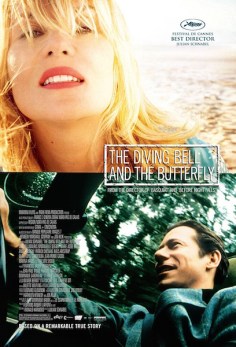 Le Scaphandre et le Papillon, as it’s titled in its original French, has until now been on my (unwritten) ‘List of Films to Avoid’, alongside the likes of
 100Films.co.uk