
Anthony & Joe Russo | 149 mins | cinema | 2.39:1 | USA / English | 12A / PG-13
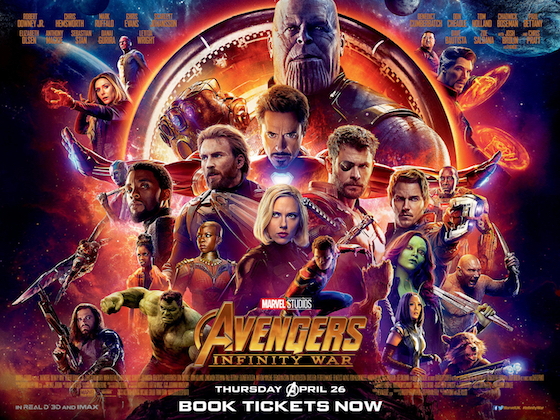
People are incredibly wary of Infinity Wars spoilers right now — understandably — so here’s the deal: this review starts off completely spoiler-free, until a clearly-marked move into spoiler territory. Then the last paragraph (after the picture of Thanos and right above my star rating) is everyone-friendly again. Get it? Got it? Good.
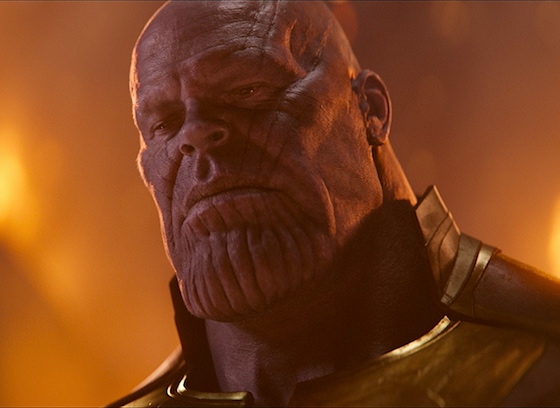
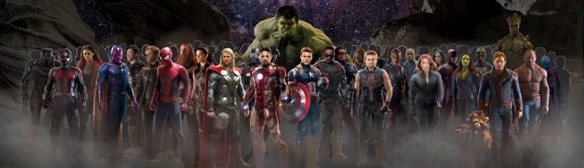
Ironically, it’s actually quite easy to give a fair summary of the plot without spoiling anything that’s not already been teased in previous films: alien warlord Thanos (mocapped and voiced by Josh Brolin) is out to collect the six Infinity Stones, crystals from the birth of the universe with unique powers, which when amassed together will grant him ultimate power. Out to stop him is pretty much every hero introduced in the previous 18 MCU films.
I confess, I was all prepared for Infinity War to fail to live up to the hype and hyperbole of the reviews that have swarmed over the internet in the past few days, just like happened for me with Avengers Assemble six years ago. In this case, there’s so much going on, the experience is such a huge rush, that it’s almost hard to get your head around what to think of it. I don’t believe there’s ever been another movie quite like it — so many disparate primary heroes, all needing time, and facing a single huge villain, who also gets plenty of focus… Setting aside any of the usual quantifiable elements, reviewing the film comes down (as it really always should) to one simple question: did I enjoy it? Yes, I did.

Like the first Avengers, it’s certainly a great event of a movie — but more so, natch. It trades off that event status too: the stakes are huge, the pace and size relentless. It could’ve been like a Transformers movie — “a beginning, then AHHHHH! for another two hours or so”, as someone once described them — but thankfully it’s not so one note: as well as big action, there’s room for humour (plenty of that, it being a Marvel movie, but never ill-placed) and emotion (some affecting dramatic scenes, most of them too spoilersome to mention here).
It’s impressive to join together so many different sub-franchises and manage to create a consistent tone. In some respects it does feel like they’ve chopped up bits from the characters’ individual movies and spliced them together. The most striking for this is the entrance of the Guardians of the Galaxy, when the Russos cut so abruptly into those films’ style that it initially feels misjudged… though I guess a lot of people won’t mind because, hey, everyone loves the Guardians (my audience practically cheered with recognition — not at seeing the characters on screen, but at the very obvious stylistic shift just before they appear). But, across the movie as a whole, it gels well. I suppose some would counter this with “all Marvel films have the same formula and tone so obviously it works”, but that’s not wholly fair — The Winter Soldier and Thor: Ragnarok are hardly the same, are they?
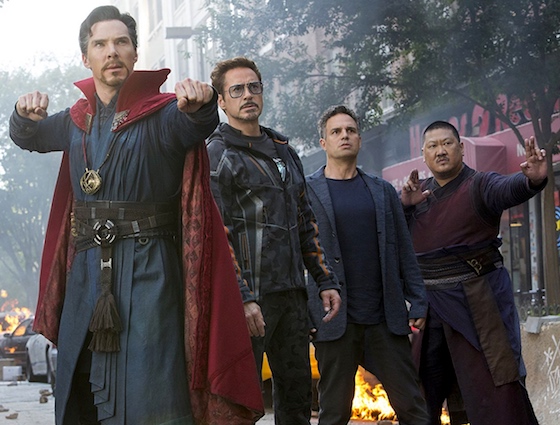
Whatever the cause, the big plus is that none of the characters ever feel inconsistent — you’ve not got funny people suddenly being serious, or serious people suddenly cracking one-liners, just to make it all fit together. On one level that’s just good character writing, but it’s also good story structure: which characters get teamed up together, because each group has a good mix to butt against each other in the right ways. That doesn’t mean every set has one Funny One, one Serious One, etc, because sometimes the film needs to be able to cut from The Serious Group to The Funny Group. Several reviews I’ve read talked about the film’s “surprising team-ups”. Well, maybe… if you haven’t watched any trailers or seen any posters. Whatever, they mostly work very well. Some characters are better served than others, which is inevitable in a film of this scope, but pretty much everyone gets at least a line or a moment. Who your personal favourites are might dictate whether you think the screen time was fairly allocated or not.
(Spoilers follow.)
Talking of other reviews, I read one that said that, while the film may be entertaining, it’s ultimately hollow because it has no major thematic throughline to explore. I disagree. It leans quite heavily into the question of “at what cost?” What is everyone prepared to sacrifice to achieve their end goal? Both the heroes and Thanos are presented with this question, again and again. Heck, it’s not only a major test for Thanos, it’s part of his origin story too! Now, you can argue about how well the film expounds on this theme, as you can with any work of art (In this case: several of our heroes make that ultimate sacrifice, only for it to be undone by plot necessity), but to say the theme isn’t there feels disingenuous.
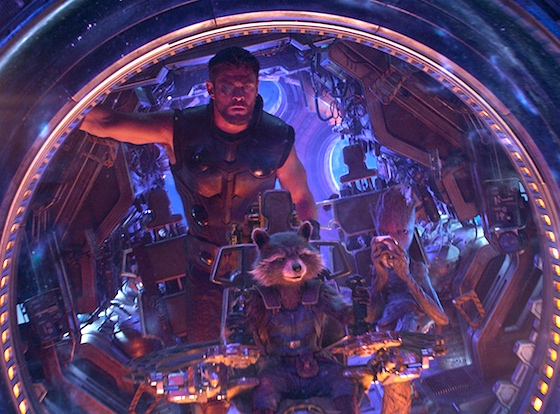
With all of that accounted for, I don’t know what more could be asked of the movie, in some respects. That said, two fairly specific things bothered me. The bigger one was that we only witness Thanos collecting five of the six stones. Why not show us the lot? How he acquires his second stone makes for an effective opening scene — immediately killing off two well-liked characters, as well as defeating two of the MCU’s main heroes, quickly establishes Thanos’ power — but then how he got the first stone is just revealed in some exposition dialogue later on? C’mon, you can do better than that! The other was the random reappearance of the Red Skull, not seen since Phase One. I guess they felt in need of some kind of reveal at that point, but I’m not sure why. Does him being there even make sense? I don’t see how, but then I’ve not watched The First Avenger in the last six years so maybe I’ve just forgotten. They even had to get a sound-alike to do the voice, so clearly they felt it was vitally important!
Something I’ve previously written about being bothered by in movie franchises are two-part films. As a rule I prefer that, even when a pair of films are connected, they should function as finite units — think Back to the Future Part II and Part III, for example, or the link between The Empire Strikes Back and Return of the Jedi. Avengers 3 and 4 have an interesting history in this regard: originally announced as Parts 1 and 2, this was later changed to them having individual titles, to indicate they were two separate stories… but still connected, because the two films were shot back to back, and Avengers 4’s final title hasn’t been announced presumably because it’s an Infinity War spoiler. Nonetheless, some people seemed to interpret all this as meaning the two films would be completely standalone from each other, and are now annoyed at Marvel because, surprise surprise, there’s a cliffhanger.

(I know I already gave a spoiler warning, but just in case you read on regardless: the paragraphs between now and the next photo give away, like, everything.)
So, here’s my take: obviously Infinity War is not entirely isolated from Avengers 4, but I don’t think this is a Kill Bill one-film-split-in-two situation either. Fans who now think the original Part 1 and 2 titles would’ve been apt are maybe taking too simplistic a view of story structure. I mean, look at it this way: it’s only half a movie to us because we know the Avengers are going to come back and win somehow; but if you’re Thanos — the film’s real protagonist, remember — then the story’s over: he did what he set out to do, the end. Maybe this is an academic distinction, but I do think it’s fair enough to have ditched the subtitles that implied it was one movie in two halves. This film tells a whole story (of Thanos trying to wipe out half the universe) and the next film will tell a new story set after it (presumably, how the Avengers try to undo that).
Either way, the film ends on a cliffhanger — a bloody huge one! But I have to wonder: is it actually too much? By that I mean: it has to be undone. Yes, obviously we know the heroes will win in the end, but none of those final deaths can stick. Even if you took Benedict Cumberbatch at his word that Doctor Strange 2 isn’t confirmed, and James Gunn at his that Guardians Vol.3 might feature a changed line-up, we know they need Peter back for Homecoming 2, T’Challa back for Black Panther 2, and so on. So if it has to be undone — if there have to be resurrections — well, why not also resurrect Loki, and Heimdall, and Gamora, and Vision, and anyone else who genuinely died earlier in the story? In fairness, in this I may be getting too far ahead — how the resurrections occur is absolutely a question for next time, after all. But it’ll have to be a very specific solution — one that undoes Thanos’ final act, but doesn’t undo all the ones that led up to it — to not just seem like a stereotypical death-doesn’t-matter superhero cop-out.
A final point on these deaths. I’m not sure I can actually remember everyone who lived and died during the wipe-out-half-the-universe finale (there were so many!), but I’m fairly certain they were mostly Phase Two and Three characters. I remember that Iron Man, Thor, Hulk, and Cap all definitely made it, anyway. My point is this: things are now set for Avengers 4 to really cap off the first 11 years and 22 films of the MCU by placing at its core the heroes who started it all. That’s quite neat, isn’t it? You’ve got to assume that’s deliberate.
Avengers: Infinity War is like a massive comic book crossover rendered in live-action. You might think “of course it is”, but it’s not that long ago that this wouldn’t even have been possible (the CGI required is phenomenal), and even less time since it would’ve been considered profitable (remember when all superhero movies had to be “grounded”?) As much as it’s a familiar epic sci-fi action blockbuster, it’s also a new kind of thing to the big screen. There are pros and cons to turning that kind of narrative into a movie, but Infinity War is heavy on the former and relatively light on the latter. When it comes down to it, it’s just marvellous entertainment.

Avengers: Infinity War is in cinemas everywhere (except Russia and China) now.
The fourth Avengers movie will be released this time next year.
Avengers: Infinity War placed 6th on my list of The 26 Best Films I Saw For the First Time in 2018.

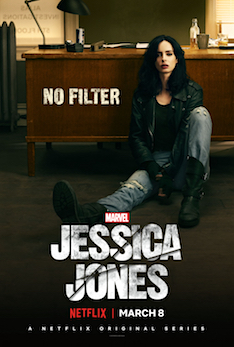 When the first season of Jessica Jones debuted 28 months ago it was practically a cultural phenomenon. Its fresh, unique take on the superhero genre marked it out as noteworthy even at a time when there are innumerable other films and series in that space. A large part of that was the intelligent and grounded way it engaged with some thorny issues, making it a critical darling and attracting audience admiration too. So I’ve been a little surprised that no one really seems to be talking about season two. Perhaps it’s just me and my little internet bubble, but since the flurry of pre-release reviews I’ve heard nary a whisper. I’m sure there must be reviews and recaps out there, which I wasn’t seeking out so as to avoid spoilers, but I didn’t stumble across any either.
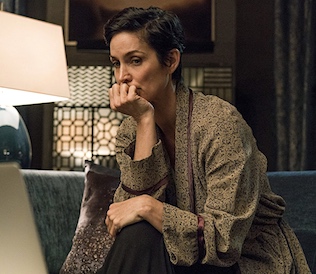 And that’s not to say these series never work in episodic form. For instance, events at the start of episode five, AKA The Octopus, see Jessica begin to force herself to be a better person. It’s one of the season’s strongest episodes, in part because of this burst of character development. Okay, it’s a bit blunt, in that she’s told she needs to improve and we see her consciously trying, but it pays off in a scene where she has to be empathetic to question a mentally-impaired witness. It’s not only Jessica who benefits from development: supporting cast members like Malcolm, Trish, and Jeri get meaty subplots to tuck into. Jeri’s is the best — indeed, her storyline might be the strongest bit of the entire season. There’s a fantastic, nuanced performance from Carrie Anne Moss — it feels like they’ve really worked to make use of her in a storyline that’s far more emotional and nuanced than what she’s had previously in these shows.
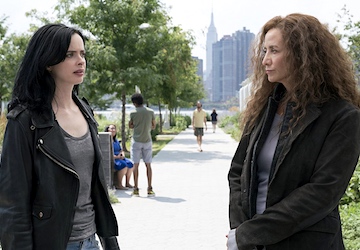 For me, it lost its way a bit again in the final pair of episodes — there are still really good bits, but others feel like a wearisome rehash of plot beats familiar from other superhero/thriller series. Eventually it comes to a good ending — there’s a surprising resolution to the plot, plus an epilogue that lays some intriguing hints for a third season (an inevitability, surely?) — but the faffery of episodes 12 and 13 to get us there… there were more streamlined ways to do this, I think. Or, considering the mandated episode count they have, more interesting ways to have spent the time. So it’s not perfect, but it’s still one of the best of the half-dozen Netflix/Marvel shows.
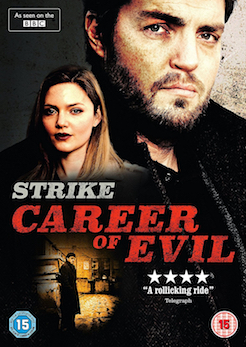 The latest Strike adaptation (and the last for at least a couple of years) was the best so far, I thought — a mysterious, reasonably complicated case, and plenty of character stuff for our likeable pair of heroes, too. The latter is certainly a big part of the series and its appeal, sometimes to the detriment of the actual investigation storyline, I suspect. By which I refer to the fact that some fans of the books have complained that the series isn’t devoting enough time to each adaptation, necessitating big cuts to the plot to fit into just two hours. I’ve not read them myself, and such editing didn’t feel noticeable during
 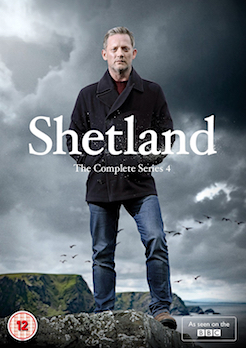 In almost the polar opposite to Strike, Shetland is no longer based on the books that inspired it (even though I believe there are one or two they’ve not adapted), and it takes a whole six episodes to tell its story. Actually, I feel a bit daft calling Strike’s case “complicated” now, because it’s as nothing to this series of Shetland, which sees DI Perez and his team struggling with both a 23-year-old cold case, which has resurfaced because the convicted murderer has just been awarded a mistrial, and a new murder with clear echoes of the first. If that wasn’t enough, the investigation leads them to Norway, where both the suspicious activities of an oil drilling firm and the plotting of a far right nationalist group come into play. Shetland has always had a bit of Scandi Noir about it (must be something to do with the cold northern environs), but it strays even further into that territory by, you know, actually going there.
 Not a reality show about manicurists (that’s what it sounds like, doesn’t it? If I was making a reality show about manicurists I’d be annoyed this took my title), but rather Netflix’s answer to The Great British Bake Off (possibly literally: they were miffed they didn’t get a chance to bid for it when it went to Channel 4). It’s not about super-skilled amateur bakers, though, but rather normal folk who attempt the kind of grand bakes you sometimes see online… and fail miserably. It’s like that bit of An Extra Slice where they look at viewers’ photos, only turned into a whole programme. It’s also very American — brash, loud, fast, unnuanced… It’s also the way it’s shot and edited, very much more like American reality series than British ones, but I shan’t bore you with a Media Studies-esque explanation of that.
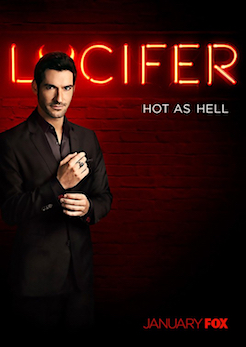 Having finally finished Castle last month, there was a gap in our viewing schedule for a light crime-of-the-week cop show. Lucifer seemed to fit the bill. For one thing, it’s been knocking around for a few years now, meaning there’s a nice backlog of episodes to get through. Loosely inspired by a DC comic, it’s about the actual Devil quitting Hell and setting up a life in Los Angeles, where — for one reason or another — he ends up helping the police investigate murders. Meanwhile, he enters therapy, and there’s an angel knocking around who wants to drag him back to Hell. The series nicely balances the bog-standard US-cop-show case-of-the-week stuff with the ongoing fantastical subplots, powered by a cast of engaging characters with conflicting motives. Best of all is the lead, Tom Ellis, giving a deliciously charming and slightly camp turn as the Prince of Darkness himself as he tries to become a better person. I’m not sure the series has really made any waves (especially on this side of the pond, what with it being an Amazon Prime exclusive here), but it’s really rather good. I mean, it’s not going to be challenging Quality TV for greatest-of-all-time status — it’s still a case-of-the-week buddy show when you boil it down — but it’s done well and a lot of fun.
 This month, I have mostly been missing The X Files season 11, which finished earlier this week in the US (and comes to the same end here in the UK with a double-bill on Monday). I watched (and reviewed, natch) its first episode
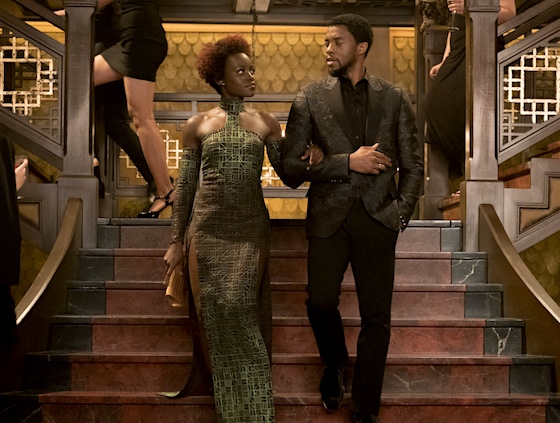
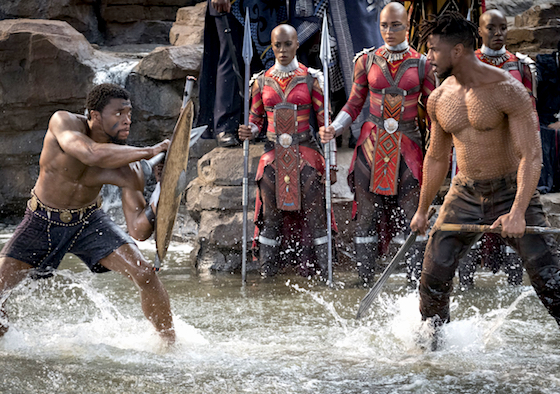
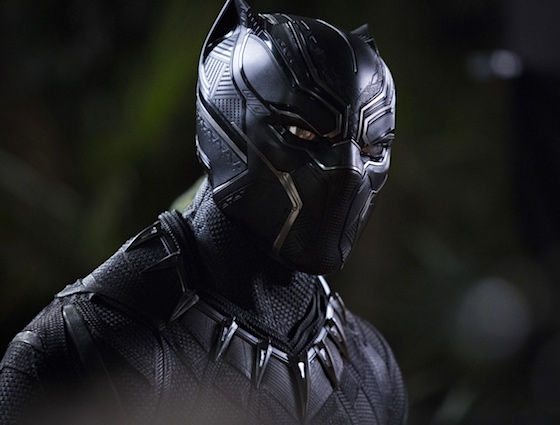
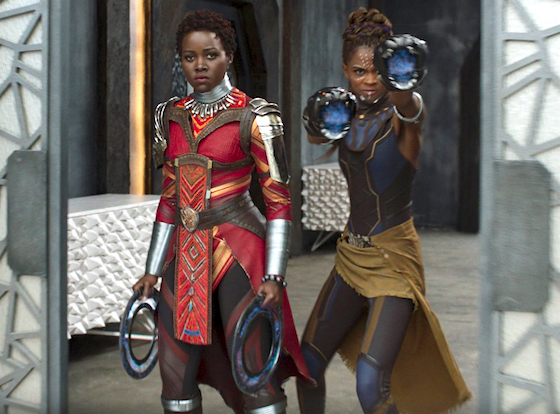







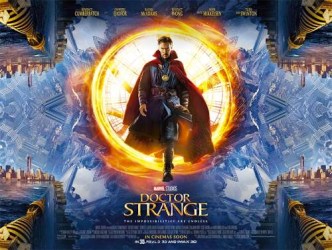 The latest from Marvel (or Marvel Studios, as they’re now branded, presumably in a bid to differentiate themselves from the properties owned by other studios that have been only too keen to use the Marvel logo and blur the line for the casual moviegoer) opens the door on a new facet of their shared cinematic universe, though does so in a movie whose plot follows the familiar “superhero origin story” rulebook. On the bright side, Doctor Strange has several other qualities to recommend it.
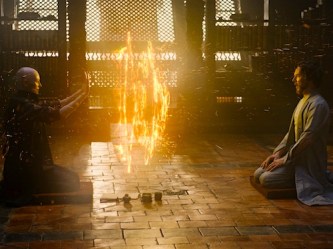 where the incredible effects are half the point — seemed dead in an era where every movie has CGI and every blockbuster has its share of once-impossible visuals. Strange demonstrates the form can be alive and well. The way the effects are created — with green screen and pixels — is the same as any other movie, but the designs and the visual imagination are exciting.
 Then there’s the cast. Obviously keen to avoid being typecast after playing an arrogant British genius in both
 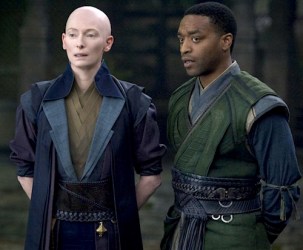 Besides, one of the film’s best characters is of Asian ethnicity, so it kinda balances out. That’s Benedict Wong as the sorcerers’ librarian, who’s likely to emerge as the film’s most popular character. It helps that viewers aren’t likely to expect much of him. Conversely, Chiwetel Ejiofor and Rachel McAdams are seriously underserved, perhaps hoping for more meat in the no-doubt-intended sequel(s).
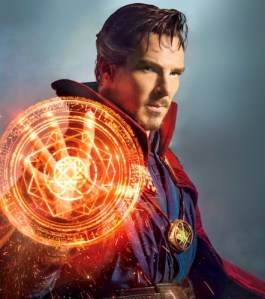 a teaser for another Marvel film, the other relates to the plot of the movie we’ve just seen. The former is first (and about 10% of my screening walked out before it came on) and the latter is, obviously, second (by which time about 90% had left). Those percentages ‘matter’ because, a) how do people not know Marvel’s rep for these scenes by this point?, and b) I think the scene related to the film you’ve just watched is the one that should be more attached to it, with the ‘teaser trailer’ being a fun bonus for those dedicated to stick around to the bitter end. But maybe that’s just me.
 We’re now on to the 13th film in the Marvel Cinematic Universe, and while you don’t need to have seen all 12 preceding movies to follow the events of Civil War, you do need at least four — and, to get everything, a further four or five beyond that. (Don’t worry about the four TV series — it’s increasingly clear that they’re only notionally connected to the movies.) So the Marvel model for a “shared universe” is not discrete stories that take place in the same world, but a series of ever-more-connected narratives. It’s working for them, though, as the continually stellar box office totals prove.
 As complicated as the plot sounds once you start trying to succinctly summarise it, Civil War is easy to follow as it unfurls. In fact, it’s to its credit that it can’t be readily summarised in any more detail than “Cap and Iron Man disagree; fight” without really getting into it. Screenwriters Christopher Markus and Stephen McFeely have followed up the political thriller of Winter Soldier with another global thriller storyline, again bringing different genre textures to the superheroics that are nonetheless present and correct. The film’s style mixes in just the right amount of realism — no one’s pretending this isn’t a comic book movie, with some elements of comic book logic and a casual acceptance of people having world-changing powers; but if such people did exist, this is the kind of way they would be handled by the authorities.
 Well, maybe. But the debate is partially stalled by the fact this is a Captain America movie rather than an Avengers one. Yeah, you can side with Tony Stark & co, but you know Cap’s going to come out to the good, one way or another. As it pans out, it’s not a total victory (Team Cap are all now fugitives, presumably until
  On that visceral level, there are a couple of stunning action sequences. The car/foot chase between Cap, Bucky and Black Panther is fantastic, casually throwing in cool moments like the way Bucky steals a motorbike. The climactic two-on-one fight is also a sight, throwing in strong choreography and seamless effects work to create a battle that has a real ebb and flow, a back and forth over who has the upper hand. And the centrepiece of it all, of course, is the two teams facing off at the airport. For fans of superheroes, this is pretty much the ultimate expression of the genre yet brought to live-action moviemaking. For my money, the antics of Ant-Man — and Giant-Man — are by and large (pun very much intended) the best bit of it, but maybe I’m just
  “hey, remember that foreign prince who was Black Panther? He lives in a foreign country… where he’s Black Panther!” Other than that, it’s kinda important to answer the question of “hey, what happened to Bucky?” next time Cap turns up. So why isn’t the scene just in the film? Well, it is in the film — just after a few of the credits — so what does it matter, right?
 In the end, Civil War leaves plenty open for future Marvel movies. Well, of course it does — half the time MCU movies are feature-length trailers for the next MCU movie. Where Civil War is really clever, however, is that it does that stage-setting while also feeling conclusory. As the third part in the Captain America trilogy, it actually makes a pretty satisfying end to that narrative. As the third part in the “trilogy in five parts” that is The Avengers trilogy, well, it’s clearly not the end, but it’s a fairly discrete segment.
 It’s certainly the summer of good-guy-on-good-guy dust-ups in the superhero subgenre this year, with Batman v Superman
  I’m a little surprised I’m still with this “Sherlock Holmes in modern day America with a female Dr Watson” series, because it was never a particularly good version of Sherlock Holmes and it still isn’t. What it has turned out to be is a decent show in its own right (for a US network procedural, anyway), with sometimes-interesting characters who happen to share the names and the odd characteristic of Sir Arthur Conan Doyle’s famed creations. It’s so much its own show that it’s never really bothered adapting the canon, so it was very odd when episode 16, Hounded, didn’t just use a few names from The Hound of the Baskervilles (as the series has in the past), but actually had a passable swing at modernising the entire plot. It doesn’t seem to have gone down too well with critics and viewers, though for my money it did a much better job than
  A lavish, all-star, ultra-hyped John le Carré adaptation that, thank goodness, lives up to its reputation. Although it wrapped up in the UK a couple of weeks ago, it only started in the US last night, and I recommend any America-based readers who enjoy a good thriller to get on board tout suite. The Night Manager doesn’t have a
  This month, I have mostly been missing season four of The Americans, aka the most underrated drama on television. Well, apart from with critics, that is, who’ve given this run
 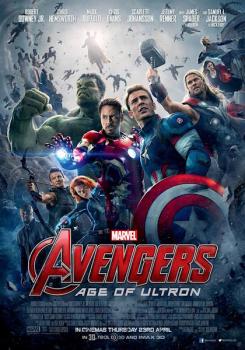 It feels kind of pointless reviewing Avengers: Age of Ultron, the written-and-directed-by Joss Whedon (and, infamously, reshaped-in-the-edit-by committee) follow-up to 2012’s “third most successful film of all time” mega-hit
 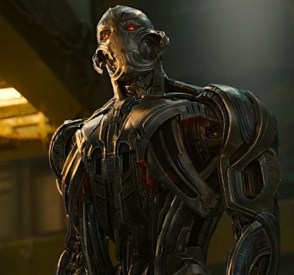 Even though the first half of that is still three years away, we’re still very much on the road to it. Heck, we have been practically since the MCU began, thanks to those frickin’ stones (if you don’t know already, don’t expect me to explain it to you), but now it’s overt as well as laid in fan-friendly easter eggs. The titular threat may rise and be put down within the confines of Age of Ultron’s near-two-and-a-half-hour running time, but no such kindness is afforded to the myriad subplots.
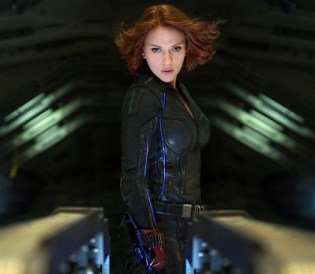 (not just obvious stuff like the Hulk, but digital set extensions, fake location work, even modifying Stark’s normal Audi on a normal road because it was a future model that wasn’t physically built when filming) that stuff they genuinely did for real looks computer generated too. All that time, all that effort, all that epic logistical nightmare stuff like shutting down a capital city’s major roads for several days… and everyone’s going to assume some tech guys did it in an office, because that’s what it looks like. If you’re going to go to so much trouble to do it for real, make sure it still looks real by the time you get to the final cut. I’ll give you one specific example: Black Widow weaving through traffic on a motorbike in Seoul. I thought it was one of the film’s less-polished effects shots. Nope — done for real, and at great difficulty because it’s tough to pull off a fast-moving bike speeding through fast-moving cars. What a waste of effort!
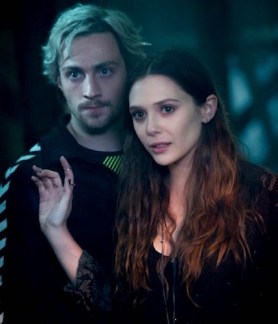 The really daft thing is, Whedon specifically added Scarlet Witch and Quicksilver… wait, are Marvel allowed to call them that? I forget. Anyway, Whedon added the Maximoff twins because, as he said himself, “their powers are very visually interesting. One of the problems I had on the first one was everybody basically had punchy powers.” I know Hawkeye’s power is more shoot-y than punchy, and we all know
  At the end of the day, what does it matter? Age of Ultron isn’t so remarkably good — nor did it go down so remarkably poorly — that it deserves a reevaluation someday. It just is what it is: an overstuffed superhero epic, which has too much to do to be able to compete with its comparatively-simple contributing films on quality grounds, but is entertaining enough as fast-food cinema. Blockbusterdom certainly has worse experiences to offer.
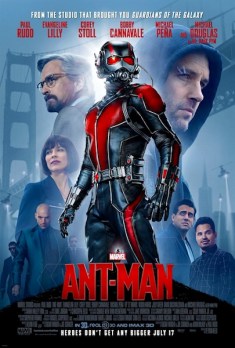 The final film in ‘Phase Two’ of the Marvel Cinematic Universe is perhaps the most fun Marvel movie since
 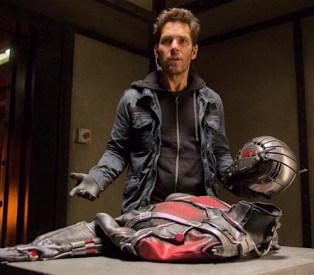 Nonetheless, some have criticised the film for not being especially original. I mean, originality’s good ‘n’ all, but c’mon, what do you expect when you sit down to a superhero movie from the primary purveyor of superhero movies? Ant-Man may blend elements from a few other genres into the superhero mix, but, yeah, it’s a superhero movie that, at times, plays like a superhero movie — just like everything else Marvel Studios has produced (with the possible exception of
  It remains tough to talk about Ant-Man without referencing The Edgar Wright Situation. I mean, you could ignore it, but then it becomes the elephant in the room. If you somehow missed it: writer-director Edgar Wright pitched Ant-Man to Marvel as a movie before Marvel Studios even existed, back in 2003, and had been developing it on and off ever since. The ideas he brought to the table — an action-adventure-comedy style, being a special effects extravaganza but with a lighthearted tone — influenced how the studio approached Iron Man and, consequently, the whole MCU. Nonetheless, Ant-Man wound up positioned as the 12th film in the studio’s slate, finally going into production after a decade of prep. Wright had a script almost finalised, he’d cast the film, a release date was set… and then he left due to “creative differences”. And the internet was on his side because Edgar Wright has made
 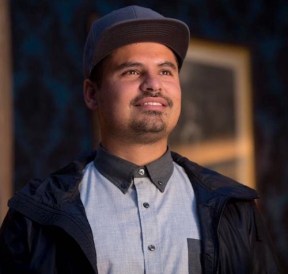 After Wright left, the screenplay was rewritten by a host of scribes (far more than the two extra writers ultimately credited). Other things they’re responsible for include bulking up the supporting characters, especially Hope, which works pretty well, and Lang’s friend Luis (Michael Peña), which we should all be thankful for: Peña’s Luis is one of the best things in the movie, an enthusiastic motormouth who’s consistently entertaining whenever he’s on screen. He’s the standout from an ensemble that is generally strong, with Rudd proving a likeable lead and Douglas committing to the material in a way you wouldn’t necessarily expect an older actor to with ‘just a comic book movie’.
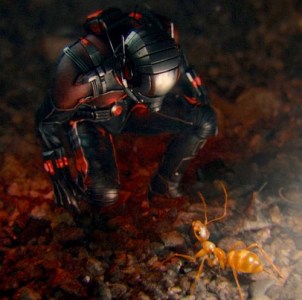 That doesn’t mean it’s a story that doesn’t have stakes, they’re just different stakes. It’s a refreshing change of pace at this point. It’s also pretty much standalone, with nice nods to the shared universe but without being dependent on other films (either before or to come) for its story. Guardians of the Galaxy did that too, but how many other recent Marvel movies is it true of? Even the highly-praised
  100Films.co.uk