
The title’s pretty self-explanatory, isn’t it?
Those films were:
(2016)
Martin Scorsese | 161 mins | streaming (HD) | 2.35:1 | USA, Taiwan & Mexico / English, Japanese & Latin | 15 / R

A re-adaptation of Shūsaku Endō’s novel (previously filmed in 1971), Silence is gorgeously produced but torturously dull Christian propaganda. The plot is about two priests travelling to anti-Christian Japan to find their mentor, who’s rumoured to have renounced the Church, but really it’s about faith and the testing of it.
The foremost of the two priests is Rodrigues (Andrew Garfield), the kind of Christian who lets others die for his faith even as he doubts it. Like many a preacher before him, Rodrigues’ sin is pride — too proud of his faith, his culture, his rightness, his superiority, to consider another point of view; to bend to help others. Conversely, his accusers and persecutors lack compassion or fairness, torturing and killing from exactly the same position as Rodrigues: that their beliefs are correct, all others be damned. Well, of such things are all religious wars made, I guess. At least the Horrible Japanese are better than the Christians’ own Inquisition was: if people renounce Christianity the Japanese sometimes set them free; the Inquisition just used it as another reason to murder them. God, religious people can be shits.
There are no good people here. The Christians are colonialists with a monomaniacal belief in their own faith. The Japanese are so set against it that they’ll torture and murder their own people just to get back at the Christians. It’s a world full of hatred. So much for the love of God. All this intolerance is as pointless then as it ever was before or has been since. If we just let others go on how they want to go on — live and let live — then the world would be such a nicer place.
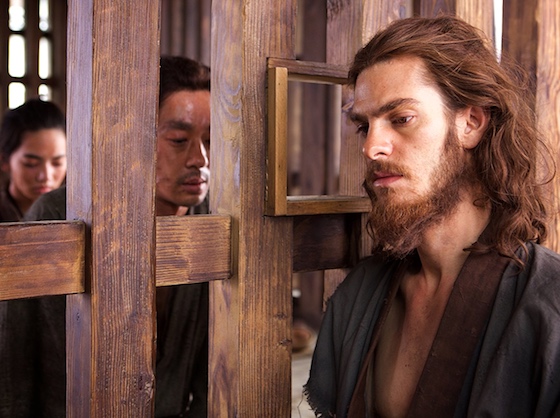
For all the violent torture depicted on screen, the hardest thing to take is the film’s slow, slow, slow pace. It does have some theological points to make, but they’re thin gruel for the time it takes to make them — or, rather, the time it wastes before it really starts to consider them. If the first hour was a lot shorter it would improve the whole film; indeed, it would’ve made me better disposed to the rest. It does improve, but by the time it improved I was already bored and annoyed with it. Its best qualities by far are visual: as well as stunning cinematography by Rodrigo Prieto, the whole production is beautifully mounted — the locations, sets, costumes, make-up, and so on, are all very well realised.
To say Silence was not a box office success is an understatement: off a budget of $46 million, it took just $23.7 million worldwide, and only $7.1 million of that in America. I think it must’ve been promoted badly — I’m sure it’d appeal to the Bible Belt crowds who flock to that niche Christian shit that’s always turning up nowadays. And if you’re in any doubt that it’s meant to be a pro-Christian film: the premiere was held at the Vatican and it was screened early for 400 priests.

(1995)
Martin Scorsese | 178 mins | download (HD) | 2.35:1 | USA & France / English | 18 / R
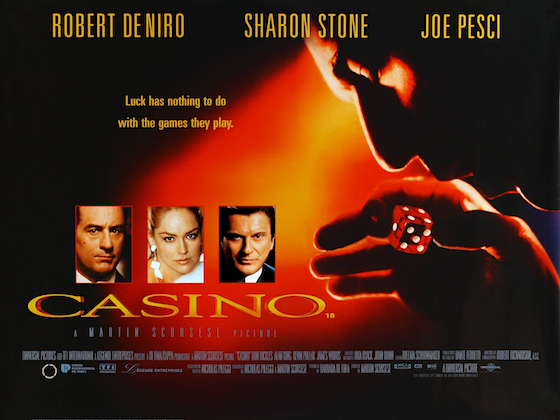
“A fictional story with fictional characters adapted from a true story,” as the film’s own credits describe it, Casino tells of the rise of Sam ‘Ace’ Rothstein (Robert De Niro, of course) in Mob-controlled Las Vegas, whose life is made awkward by his loose-cannon Mob-enforcer best friend Nicky Santoro (Joe Pesci, of course) and his tumultuous marriage to hustler Ginger (Sharon Stone).
“There’s no plot at all”, says Martin Scorsese in an interview included on Casino’s Blu-ray (per IMDb). “It’s three hours, no plot. […] There’s a lot of action, a lot of story, but no plot.” Well, er, he’s not wrong. Casino seems to skip around at random, devoid of a throughline to guide its narrative. It flies off on so many different tangents, it takes a while to get a handle on what it’s about — if it’s about anything. Or possibly it’s about too much. For example, there’s a lot of “how the casino business works” stuff early on, which is quite interesting in itself but only some of it has any relevance later on; and eventually the film gets sidetracked wholesale into De Niro and Stone’s marriage woes, which are at best a subplot earlier on. Whatever it was supposed to be, I was never hooked and never engaged.

Part of this is the film’s storytelling style — I didn’t know Scorsese was in the business of making visuals to accompany audiobooks. Well, that’s what Casino felt like. Naturally there’s skill on display (they’re very, very good visuals to accompany an audiobook), but the voiceover-driven style really alienated me. It makes the characters feel at arm’s length: despite De Niro and Pesci constantly taking directly to us, I didn’t feel like I was getting to know or connect with them, I was just being told about them. The endless narration constantly skims through events too, making it feel like a summary rather than an actual story. You might think that would give it pace, but it does the opposite: the first hour drags and drags, and then drags some more, and eventually this three-hour film feels every minute of it.
I read one review of Casino that concluded, “I don’t feel like watching it again, but it certainly made me want to watch Goodfellas again.” I know the feeling.

Casino was viewed as part of my What Do You Mean You Haven’t Seen…? 2018 project.
(1977)
Martin Scorsese | 156 mins | DVD | 16:9 | USA / English | PG / PG
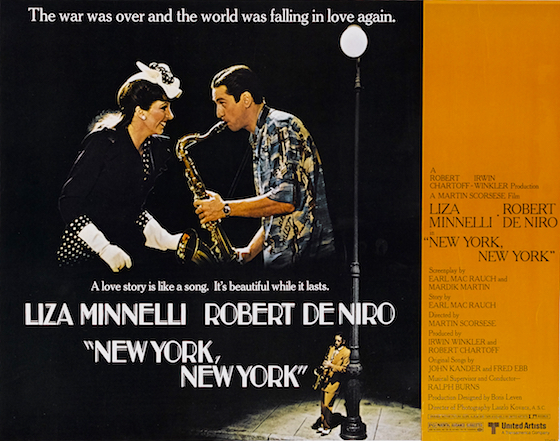
Once again, this is a lengthy Martin Scorsese movie that seemed terribly unfocused for so long that it lost me ages before it found what it wanted to be about. (Well, it predates the other two, but whichever order you put them in it’s looking like a definite pattern.)
Starting on VJ Day in New York, it stars Robert De Niro as a wannabe musician and Liza Minnelli as a wannabe singer who wind up in a romance and co-dependent career, until one outshines the other. De Niro is playing an angry young man who has talent but whose temperamental nature may well get in the way of success — yes, it’s Any Robert De Niro Movie. But, wow, his character is annoying, and I imagine his actions are only getting more distasteful with time — the way he badgers and cajoles Liza into going out with him (something she eventually agrees to) is the kind of behaviour that gets regularly criticised nowadays (rightly). Well, I don’t think he’s meant to be a nice guy — the film seems to be about their tempestuous relationship and how that helps and hinders their careers — but I wasn’t sure the film knew how unlikeable he was.
I wasn’t sure the film knew much of anything, really. Apparently much of the dialogue was improvised, which in turn made it a nightmare to edit into a coherent narrative, which would explain the messiness — everything feels overlong, unfocused, and increasingly dull. Consequently there have been several cuts of the film, with this being the longest “director’s cut” released in 1981. It has some good bits, foremost being the extended Happy Endings musical interlude, which at one point was ditched to create one of the shorter versions. I like the idea of this film being less long, but don’t lose the only really good bit!
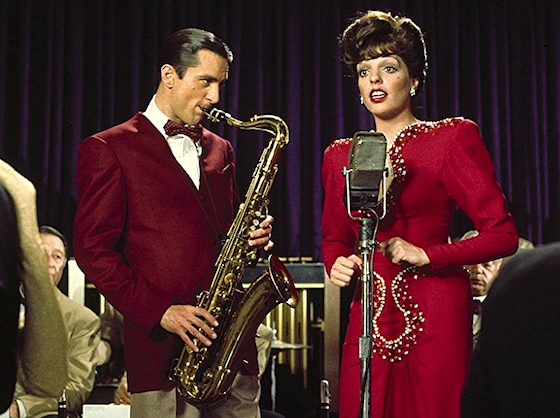
Just to wind me up further, the content has fundamentally nothing to do with the title. I mean, it begins in New York, and when the characters go on tour they’d like to get back there, and eventually they do and so some more of it’s set there, and occasionally they’re writing the titular song (which, I confess, I was unaware hailed from this film — I assumed the movie was named after the famous standard, not that it spawned it), and in the epilogue Liza performs said song (post-2016 observation: said epilogue is gosh-darn similar to La La Land’s!) Anyway, my point is: this film could’ve been set almost anywhere and not affected anything much, so why the title?


 Score:



 Scorsese tells the story of Jesus in this controversial epic adapted from Nikos Kazantzakis’ novel. I have no idea how much is actually rooted in scripture — a disclaimer is keen to establish the film isn’t based on the Gospels, but obviously that’s just to appease the devout.
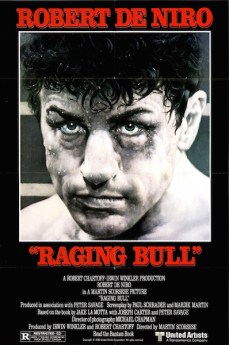 It would be boring if we all liked the same stuff, wouldn’t it? I’m sure there’s at least one ‘universally’-loved classic that we each dislike. Heck, tends to be every ‘universally’-loved classic has at least one Proper Critic that dislikes it. The flip side of this is that, in my opinion, if you don’t like something that everyone else does, there’s a fair chance it’s you who’s missing something. That’s a rule I apply to others, naturally, but I also try to bear it in mind myself (and, at the risk of sounding terribly arrogant, I think a few more people could do with thinking the same).
 The aforementioned fights, on the other hand, are full-on Cinema, and glorious for it. The make-up is also very good. Relatedly, De Niro’s physical transformation, from lithe boxer to washed-up fatso, is remarkable. Decades before the likes of Christian Bale and his
 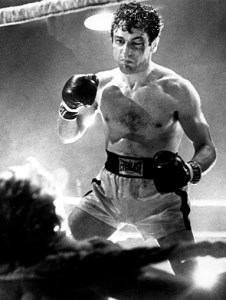 Based on where we find him at the end, I guess LaMotta would appreciate a Shakespeare quotation. For all the film’s “greatest of all time” acclaimedness, this is the one that came to my mind:
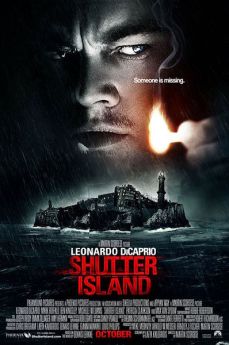 Adapted from a novel by Dennis Lehane (whose work also inspired
 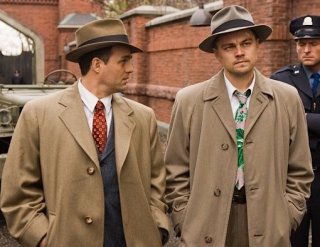 Besides, the film has other delights beyond being an elaborate guessing game. One of the things Lehane set out to do in his novel was write “a gothic”, and Scorsese and co have taken that ball and run with it. It’s overflowing with a fantastic atmosphere: unsettling, creepy, chilling, horror-movie scary when needed (some sequences are properly hair-raising); truly gothic-feeling. Every aspect of filmmaking — the direction, the photography, the editing, the sets and locations, the music — work in harmony to create a coherent mood.
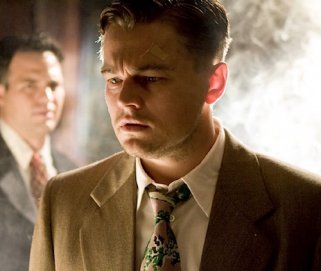 And then, after Scorsese and co have done their best to shred your nerves, in the final half-hour the pathos is immense. Quite without realising it had brought me to that point, I had a tear in my eye. This is in part thanks to some great performances, though you do need to reach the twist to fully appreciate them. Everyone reveals more levels once you know it, and indeed it’s clear a great amount of effort went into ensuring re-watchability — that if you view it again knowing the answers, you can spot things; not clues, per se, but elements in the performance, the design, the staging, that tie in to the reveal.
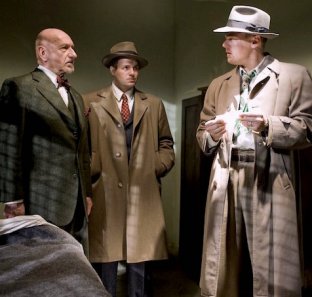 I think the more you let Shutter Island percolate after it’s over, the better it becomes. Solving the mystery and guessing at the twists occupies so much of your time on a first viewing that you almost miss the details in the characters and the world, but they build up nonetheless. There’s layers and depth here, and a plausibly realistic depiction (even according to an expert) of something that’s incredibly hard to depict in fiction. You can view Shutter Island as just an atmospheric gothic mystery chiller, and as that it’s a quality piece of work, but it’s the extra depth that mark it out as, actually, a great movie.
 2014 Academy Awards
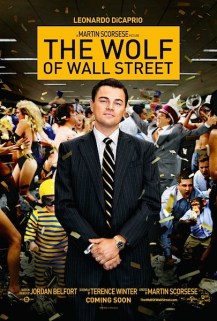 When someone says “100-million-dollar epic”, you probably don’t imagine a film about a swindling stockbroker; but, with a three-hour running time and a nine-figure budget, that’s exactly what Martin Scorsese’s black comedy biopic is.
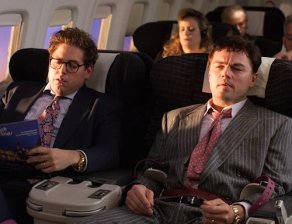 and the closing shot clearly shows how many people have already judged them to represent something desirable, regardless of what position the film might take. Some people want this lifestyle, in spite of all the problems it wrought, and even if the film had clearly condemned it that wouldn’t change. In the end, to say Scorsese approves of it purely because he doesn’t lambast it is too simplistic a reading.
 but almost every supporting character gets a memorable line or scene, a moment where they shine brighter than everyone else; and even when the smaller roles aren’t dominating a scene, they’re part of a first-rate ensemble that functions like a well-oiled machine. My personal favourite was P.J. Byrne’s ‘Rugrat’, but yours may well be someone else.
 As one of
 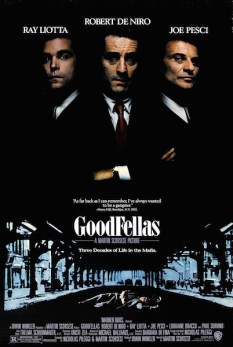 These days perhaps even more praised than
  Much praised, discussed and quoted, Taxi Driver needs little introduction. The weight of expectation also makes it hard to judge when first viewed.
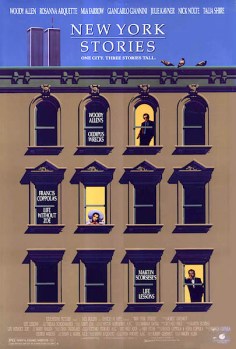 Anthology of three shorts, connected only by the New York setting (which, incidentally, may as well be anywhere in all but the last segment).
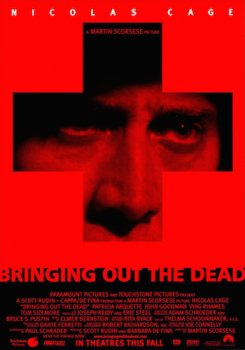 It’s hard to know what to make of this, because by the end it all seems a little pointless. The storyline, which follows Nicolas Cage’s paramedic across three nights in New York, is a mixture of short episodic medical incidents with longer threads that continue throughout. These connect and fall apart, feeling as episodic as the rest, and most of them don’t really lead anywhere.
 100Films.co.uk