A new year means the monthly update format is… exactly the same as last year, because it works. (Well, I think it does.)
For any newcomers, or people in need of a refresher, here you’ll find: everything I watched in January 2016, with some observations and analysis too; all the reviews and 100 Favourites entries I posted last month; and The Arbies, my monthly awards. Plus, this month, a few snippets of site news.
Without further ado:

 #1 Sherlock: The Abominable Bride (2016)
#2 Snatch. (2000)
#3 12 Years a Slave (2013)
#4 Funny Games (1997)
#5 Lady of Burlesque (1943)
#6 The 36th Chamber of Shaolin (1978), aka Shao Lin san shi liu fang
 #7 Super 8 (2011)
#8 The Man from U.N.C.L.E. (2015)
#9 The Five Venoms (1978), aka Five Deadly Venoms
#10 Hercules (Extended Cut) (2014)
#11 White God (2014), aka Fehér Isten
#12 King Boxer (1972), aka Five Fingers of Death
#13 Return to the 36th Chamber (1980), aka Shao Lin da peng da shi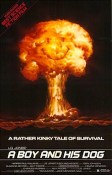
#14 Starman (1984)
#15 The Two Faces of January (2014)
#16 Amistad (1997)
#17 The Last Temptation of Christ (1988)
#18 47 Ronin (2013)
#19 A Boy and His Dog (1975)
#20 Adam (2009)

- For the first time, I’ve opened up my What Do You Mean You Haven’t Seen selections beyond my DVD and Blu-ray collection to include stuff I have access to on streaming services, etc. Due to my inattentiveness, I included a film that was to be removed the day after I posted that list. Fortunately I did notice, and 12 Years a Slave was squeezed in on its last evening on Amazon Prime.
- I also caught Snatch before I cancelled my Netflix subscription (I hadn’t meant to keep it so long, what with also having Amazon Prime, but golly, there’s so much to watch!) That’s two checked off already, meaning WDYMYHS 2016 is off to a flying start. Considering I usually end up playing catch up (and, two times out of three, failing), that’s a Good Thing.
- A few other instances of pairs and repetitions this month:
- 2x Guy Ritchie movies. As mentioned, one was the first check off WDYMYHS 2016; the other was the first check off my list of 50 Unseen from 2015.
- 2x slavery-related movies. The aforementioned 12 Years a Slave, and Steven Spielberg’s Amistad. Both feature Chiwetel Ejiofor, donchaknow.
- Lots of kung fu movies! Two reasons: Film4’s first Martial Arts Gold season (there’s another in March/April), and that loads are available on Netflix UK, including several well-regarded ones.

January is always the most awkward month to analyse. In so many ways the start of a new year is a false new start — it’s an arbitrary marker imposed on Time by humanity, not any kind of empirical new beginning. (Sorry to get glumly philosophical.) A goal like watching 100 films is different though, because January bumps you right back to #1; and this year, that was from the lofty heights of #200. My point being: here, January is a new beginning, not just “the next month”, and can set a tone or pace for the year to come.
Probably not this year though, because — in spite of my stated aim to watch fewer films in 2016 — I made it to 20 in January. That makes it only the fourth month to pass into the 20s, and also my fourth-highest month ever — and as I’ve been doing this for 109 months now, being fourth is (in relative terms) an achievement. It’s the best January ever too, exceeding last year’s tally of 16, and the 20th month in a row with a double-figure total. That is something I aim to maintain this year. If I achieve it, it will see me reach 10+ films per month for two consecutive years, and a total of 31 consecutive months. Just 11 months to go…
So what else can we forecast for 2016? If I keep this up, it’s looking at another record-obliterating final total, this time of 240. I won’t keep it up, though. Historically, January averages 8.08% of a year’s final tally (the actual percentages ranging from 2008’s 5% to 2011’s 12%), which would peg 2016’s total at an even higher level: 248. Which, I say again, it won’t be. What it should be, though, is over 130 — which would still position it as my third best year ever. Considering I intend to spend February and/or March getting value-for-money out of a streaming service or two (as I did in January), besting 2014’s 136 is certainly not out of the question.


A new series for 2016, tracking my 100 favourite movies (that I saw before starting 100 Films). This month: a fuller introduction than that one-sentence summary (though that is the gist of it) and the first seven entries. The full list of all 100 will continue to be updated here throughout the year.
 The 8th Monthly Arbitrary Awards
 Favourite Film of the Month
Looking back over this month’s viewing, it feels a bit “good but not great” — a lot of films I liked very much, but nothing that really jumps out at me as a dead-cert contender for this category. While it’s more of a Quality movie than a favourite per se, then, the best film this month was its only five-stars-er, 12 Years a Slave.
Least Favourite Film of the Month
Conversely, not many films I didn’t enjoy this month either. However, for disappointment value — expecting the greatest martial arts movie ever made and getting a mess — the loser is The Five Venoms.
Best Opening Sequence of the Month
If you haven’t seen White God then it can be a tough experience (especially for dog lovers), but the opening is fantastic: our young heroine cycles through deserted city streets, percussion-heavy classical music dramatic on the soundtrack, pursued by a pack of hundreds of dogs. There’s a reason they used it for the poster.
Most Surprising #1 at the Chinese Box Office
 I know I’m meant to choose these awards, rather than let the Chinese public do it for me, but surely it’s worthy of note that the cinema release of Sherlock: The Abominable Bride saw it top the box office in China, as well as post strong figures in South Korea and other countries. No, really. And that was just the start of it: according to Box Office Mojo, it wound up taking $20.5 million in China and $7.5 million in South Korea, where it bested The Force Awakens (seriously), while other reports peg it as earning $2.7 million in the US. Full figures aren’t easy to come by, but it seems to have a worldwide gross somewhere north of $34 million. Not bad for a TV episode produced for a couple of million quid.
The Audience Award for Most-Viewed New Post of the Month
Outpacing popular posts from just inside the New Year, like Sherlock and my statisticstastic 2015 list, was fun backstage murder mystery — and, significant to its success in this category, blogathon entry — Lady of Burlesque.

Normally I refresh my directors page header image somewhere around August to October, but I was busy watching a shedload of films back then, so it’s been pushed to now. January’s a better time for it anyway, after a full year of film viewing — and next January could make a big change, with my 100 Favourites factored in. The header features the 20 directors who have the most films reviewed on here, and some will get multiple additions thanks to that favourites list. For now, it’s based on how things were on January 1st. I completely rebuilt it, so it’s all spiffy.
Also, I’ve modified the “list of reviews” header. I think that’s the first time I’ve changed it since it went live a couple of years ago. Of the 27 pictures, ten were replaced and four refreshed with higher-quality versions, so it looks a lot spiffier too.
Finally, I decided to re-write the “About” page, for the first time in 3½ years. I re-read the old one and found myself intensely irritating, so hopefully the new version is… less bad.

My viewing selections will be mainly dictated by “what’s on Sky Movies”, in the run up to the Oscars…

 Con man Gordon Liu poses as San Te (Liu’s character from the first film) to help his oppressed friends at the dye factory. When his ruse is rumbled, he heads to the Shaolin Temple to learn kung fu… and spends a year constructing scaffolding and learning to wash his hair with a rock. Of course, he may’ve accidentally learnt a few other things too…
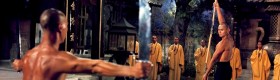
















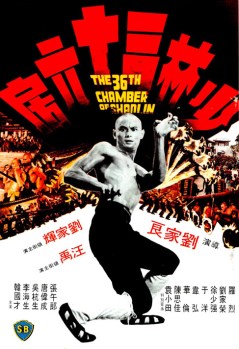 Widely regard as one of (if not the) greatest kung fu movies ever made, The 36th Chamber of Shaolin introduces us to San Te (Gordon Liu), a student whose hometown is oppressed by forces of the ruling Qing dynasty. He and his classmates join the underground resistance run by his teacher, only to wind up witnessing his friends and mentors be hunted, tortured, and killed. Faced with a similar fate, San Te escapes to the Shaolin Temple, widely known for being home to the best kung fu around. The temple’s monks refuse to teach martial arts to normal folk, nor help by joining the fight — they’re Buddhists, after all. Nonetheless, San Te manages to inveigle his way in to their company, and years of training begin.
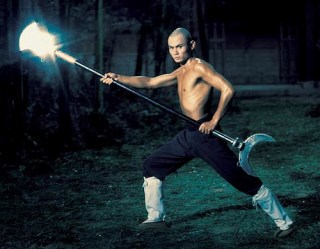 San Te is eventually learning how to use weapons, and when he finally graduates from the 35th chamber he has to prove himself in combat, first against the temple’s justice, then when he returns to the outside world and seeks vengeance. Fights both with and without weapons are imaginatively choreographed and executed with the customary speed and precision.
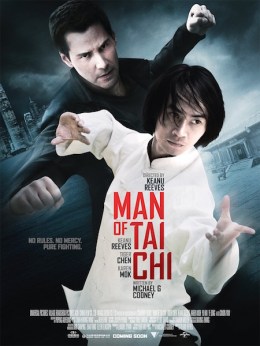
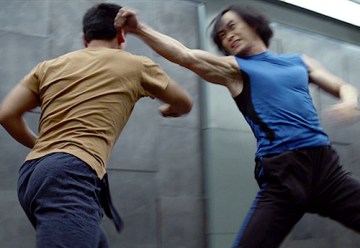 Some have opined that it’s over-edited. Early on I thought it was a mite too chopped up (during a plain old dialogue scene, funnily enough), but for most of the film it’s fine. Fast at times, sure, but so’s the fighting. There’s a style and rhythm to it all — some near-montage-like sequences are surely meant to be exactly that — and the fighting is never needlessly obscured, because (unlike in so many Hollywood action movies) these guys can actually do it and Reeves wants to show us that. He really focuses on them, too. These aren’t fights as part of elaborate chase sequences, or action interludes whose drama is reliant on the sheer volume of competitors being offed. Nearly every bout is one-on-one (there’s a single instance of two-on-one), all executed in nondescript rooms or arenas. It’s the straight-up fight choreography that does the talking here.
 A mention also for the score by Kwong Wing Chan. Apparently it’s made up of “Techno-styled, bass-heavy beats” or something (I got that from another review). Not the kind of music I normally listen to for pleasure, but its pounding electronic rhythms fit here, making their presence felt while never crossing into the over-dominance that kind of music is wont to do.
 100Films.co.uk