

Unless you’re a dyed-in-the-wool fan, keeping up with the MCU is beginning to feel more like a chore than entertainment. There’s just so much of it! No wonder it can feel like its fans never watch anything else, because getting through the myriad TV series and movies could conceivably fill most of your free time. That said, it’s obviously not doing the movies any harm (yet) based on the spectacular box office performances of No Way Home ($1.89 billion, the 6th highest grossing film of all time) and Doctor Strange 2 ($935.3 million and counting). And getting round to everything does have its benefits, because occasionally you find a diamond, and it’s not always one the critics or other viewers have flagged up. I mean, most of what I heard about the first Doctor Strange was that it was just the standard superhero origin story over again, but it’s one of my favourite films from the studio’s output, primarily thanks to the stunning visuals and a few other clever developments. Being another iteration of something isn’t always bad, especially if you’ve iterated closer to perfection.
Shang-Chi is the latest Marvel movie to fall into that camp for me. It is, again, a superhero origin story; but, again, one that’s been refined to a place where the hints of familiarity don’t really matter. It’s about Shaun (Simu Liu), an ordinary guy working as a valet in San Francisco… who it turns out isn’t such an ordinary guy, but is really Shang-Chi, the son of the magically-powered leader of a global crime syndicate known as the Ten Rings. Of course, events conspire to bring Shang back into contact with his estranged family, where he must choose whether to stand against his father’s evil plans.
The MCU publicity claim that any given film is “not just a superhero movie, it’s a [1970s conspiracy thriller / John Hughes comedy / whatever]” has, rightly, become a bit of a laughing stock. But I think Shang-Chi might be the first time it’s actually true. Yeah, it’s undeniably set in the MCU and, as such, plays by some of those rules (there are Blip references from early on, with the requisite cameos and mid-credit teaser scenes to follow), but the bulk of the movie itself is not really a superhero film as we normally think of them. Rather, it’s a martial arts fantasy-actioner. Now, maybe those are in the same ballpark — people with impossible abilities fighting each other — but I’d argue the style of it in Shang-Chi feels closer to something like Detective Dee or 47 Ronin (except good) than Iron Man or Captain America, or even the other fantasy/magic-based MCU sub-series like Thor or Doctor Strange.

And for that, I loved it. Unfortunately, where it’s most like the MCU is in an ‘epic’ battle finale that, a few show-off moments aside, is mostly realised through CGI that looks like swirling mud. If it weren’t for that disappointment (and, to be clear, it’s not a disaster, just a bit of a let down), I might have given the film an even higher score.
I was also glad I bothered to track down the 3D version (only released on disc in Japan, I believe. I also believe Japanese imports are expensive. I wouldn’t know from experience, I’ve never bought one). I’m aware that 3D is an ever-dwindling format and that’s why major labels aren’t bothering with disc releases anymore (though it must be worth it at theatrical level, because they’re still shelling out for these post-conversions that cost millions of dollars a pop), but it’s a shame for those of us who enjoy it and still have the kit, because it’s as enjoyable as it ever was when done well. Shang-Chi may not be the height of the format, but lots of it looked nice with the extra dimension. Sadly, unlike many previous Marvel 3D releases, it didn’t have the bonus benefit of a shifting IMAX ratio. There is an “IMAX Enhanced” version of the film (it’s on Disney+), but, like the last two Avengers movies, it presents the entire film in IMAX’s 1.9:1 ratio, so no luck for us 3D fans there (or anyone bar Disney+ viewers, because it’s not included on the film’s 2K or 4K Blu-ray releases either).



 In this lesser sequel to

 Score:


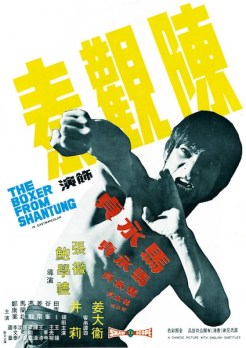 The problem with watching so many Shaw Brothers movies so close together, as I have this year, is they begin to blur into one. There’s definitely a house style to the stories, the photography, the sets — everything, really. Even the particularly good ones can fail to lodge in the memory as discrete units.
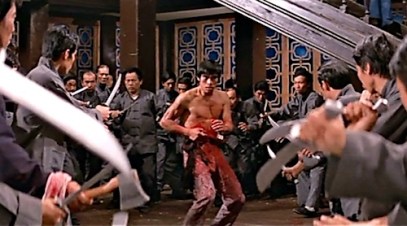 At the end of the day, tightly choreographed and expertly performed action sequences such as this are why we come to these movies; and, at the end of the day, The Boxer from Shantung doesn’t disappoint.
 Donnie Yen returns as the eponymous kung fu master, who’s most famous for training Bruce Lee, to complete a trilogy of biographically-dubious but broadly entertaining actioners.
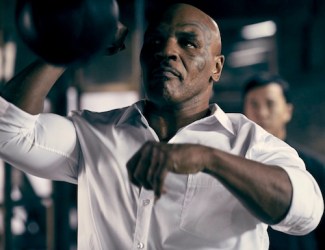 the less said about the film’s attitude to foreigners the better (though I guess Hong Kong’s British occupiers weren’t exactly above reproach).
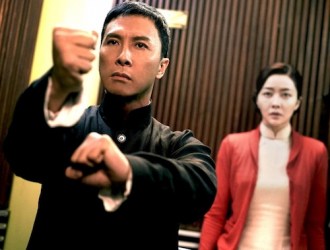 After an awkward first half, Ip Man 3 gradually transitions into a rewarding set of circumstances, on both the action and emotional fronts. The lack of consistency may mean it doesn’t satisfy fans as much as the first film did, but I’d say it’s a step up from the second, and definitely worth a look for fans of the old punching-and-kicking-and-hitting-each-other-with-poles-and-knives.
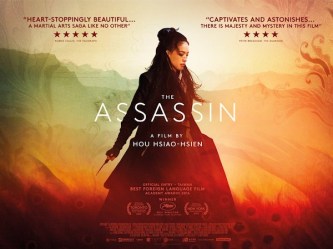 The Assassin is a martial arts drama about Nie Yinniang (Shu Qi), a woman trained since childhood to be a highly-skilled assassin. When her emotions lead her to renege on a mission, her master sets a difficult task for Yinniang to prove herself: she must return to her homeland and assassinate its leader, Tian Ji’an (Chang Chen) — her cousin, to whom she was once betrothed.
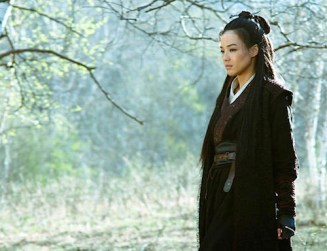 So little happens at times that it’s very easy to become disconnected from it. At one point my mind wandered to other films it reminded me of.
 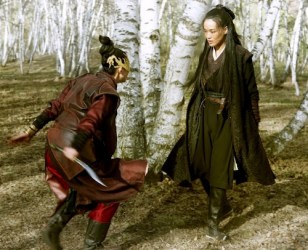 For all that, there is some action, but director Hou Hsiao-Hsien has said he’s more concerned about the before and after of a fight than the process itself — it’s about the mood, the tension, the ultimate outcome of winning or losing, rather than the choreography of the combat — so there’s a lot of build-up for very brief bursts of action. That’s certainly not an invalid way to handle it — it’s Leone-esque, in its way — but it does mean anyone looking for the detailed swordplay or fisticuffs you expect of a martial arts film will come away disappointed.
 When a warrior family are betrayed and killed, the surviving siblings seek vengeance.
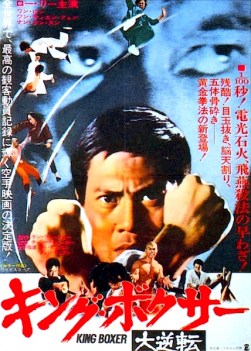 Released in the US as Five Fingers of Death, this popularised kung fu Stateside… before
  Some say The Five Venoms is
 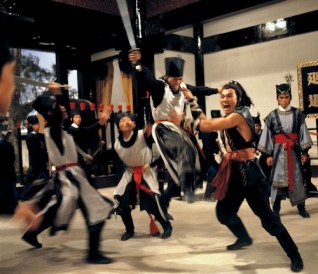 I keep reading things like “the concept of the five Venom styles is simply amazing”, or that “the mythology alone is exquisite”, but I just don’t buy it. There’s nothing wrong with it — it’s a decent setup — but to call it a “mythology” is bordering on grandiose. And whether it’s a full-blown mythology or just a high-concept setup, either way it’s not that incredibly mind-blowing a concept.
 100Films.co.uk