
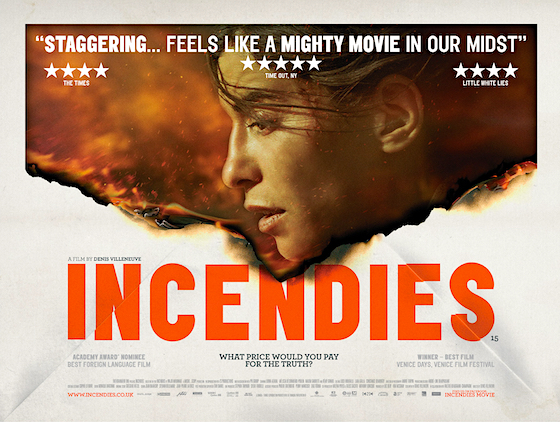
The Best Foreign Language Film category at the 2011 Oscars is, in retrospect, a pretty impressive year. Alejandro González Iñárritu was already well established before his nominated film, Biutiful, but his fellow nominees included Yorgos Lanthimos for only his third feature, Dogtooth, and Denis Villeneuve for this, his second after his career re-start. And yet the winner was In a Better World. Remember that? Me neither. (I don’t even recall it ever being mentioned in the last near-decade-and-a-half; although its director was Susanne Bier, who’s gone on to the likes of The Night Manager and Bird Box, so that’s something). It seems like an odd choice for victor with the power of hindsight, but that’s hindsight for you. On the other hand, watching Incendies, it’s hard to see how anyone could ever have missed its incredible power. (Or maybe In a Better World is even better. I struggle to believe that possibility, but you never know… and probably never will, because who’s still watching it nowadays? It’s certainly not getting a Collector’s Edition-style 4K UHD release from a boutique label — unlike, say, Incendies.)
Incendies is, on the surface, one of those films that can sound off-puttingly heavy: it’s about generational trauma caused by a long-running war in the Middle East. Sure, that kind of thing can be Worthy and Great filmmaking, but egads, hard going. But while Incendies is all those things, it’s also a compelling mystery, which leads to twists worthy of a great thriller. The first of those comes in the film’s setup: Nawal, the mother of a pair of grownup twins has died, and it’s only from her will they learn, first, that their thought-dead father is still alive and, second, that they have an older brother they didn’t know existed. They are tasked with finding both men, and only then will they receive the final letter she has left for them. To do this, they must travel to their mother’s homeland, an unnamed Middle Eastern country (heavily inspired by Lebanon) where the aforementioned war is over, but the scars still linger. As they investigate their mother’s previous life, we see it play out in flashbacks.
While the film at first seems to be about the twins, it’s really most about Nawal. That’s in part thanks to the incredible performance by Lubna Azabal. She has to portray this woman across decades, from a relative innocent to someone changed and hardened by all she’s been through, and charting every step of that journey, too. Plus, she’s left to convey almost all of that silently. Not that she’s mute, but she’s rarely allowed the shortcut of dialogue that discusses or exposes her emotions and motivations. That we still gain so much understanding of the how and why of Nawal is remarkable, really; a performance that, under different circumstances (let’s be honest: if it were in English) would surely have contended for every major award going.

The film is not about a specific conflict — that’s part of the reason playwright Wajdi Mouawad didn’t explicitly set his original work in Lebanon, and why Villeneuve ultimately didn’t change that when adapting it. Rather, as Villeneuve says, it’s “about the cycle of anger, the heritage of anger in a family, where in a conscious and subconscious way anger is traveling among family members, and among a society”. The point is not “what happened in Lebanon”, but what happens when families are torn apart, emotionally just as much as physically; what the fallout from that is, and how healing can be found — if, indeed, it can.
Oh dear, it’s all sounding a bit heavy again, isn’t it? And yes, there is an element of Incendies that is like that. It’s the kind of film that uses Radiohead on its soundtrack multiple times. (That said, this is how I feel that band’s dirge-like ambient-noise style of music functions best: as background mood-creating film score, rather than as, y’know, songs.) But, as I said before, this is also a film that plays as an effective mystery. What, exactly, happened to Nawal? Who and where is their father? Who and where is their older brother? Why was this a secret Nawal took to her grave? Why did she feel the need to reveal it posthumously? Any and all of these are questions your stereotypical “art house” movie would leave unanswered, providing vague prompts for you to consider after the film ends — or, inevitably, provoke you to Google “Incendies ending explained”. But Incendies isn’t actually like that — all of those questions are answered, because they’re essential to what the film is about. That they can also be gasp-inducing all-timer reveals is another bonus.
Within that, Villeneuve also shows off the expert filmmaking that has since elevated him to Christopher Nolan-adjacent levels of big-budget auteurist blockbuster-making. There’s a sequence on a bus in the middle of the film that is as tense as any suspense movie, as scary as any horror movie, and as emotionally devastating as any hard-hitting drama. There’s a reason it’s the inspiration for almost every poster and key art piece related to the film. (The exception is the original American theatrical poster, which shows… a woman standing by some sand. Great marketing, folks. Maybe that’s why it didn’t win the Oscar.) It’s an event of such horror that — especially when combined with the shocking revelations later in the film (which, obviously, I’m not going to spoil) — I imagine this is the kind of movie some people swear off ever watching again, like Requiem for a Dream; a big comparison, maybe, but one Incendies is up to.

Incendies is the 68th film in my 100 Films in a Year Challenge 2024. It was viewed as part of “What Do You Mean You Haven’t Seen All of the IMDb Top 250?”. At time of posting, it was ranked 101st on that list. It was my Favourite Film of the Month in September 2024. It placed 4th on my list of The Best Films I Saw in 2024.
 100Films.co.uk