
Michael Bay | 145 mins | streaming (HD) | 2.35:1 | USA / English | 12 / PG-13
 Sometimes you have to wait to see a film because it’s not accessible for some reason (no one’s put it out yet, or it’s out of print and costs a fortune, or whatever). Other times… maybe it’s just me, but there are some films that I wait years to watch for no particular reason. Not wait in the sense of “drumming my fingers waiting for the chance”, but in the sense that I’ll get to it someday, it’s just not a priority, for whatever reason. And then one day, with nothing apparently having changed, the time comes when it’s that movie’s turn.
So it was for me with Armageddon, Michael Bay’s 1998 sci-fi disaster epic. It’s a film I’ve been aware of since it came out (how could you not be?) but never cared enough to actually watch, other than a general feeling I’d get round to it one day because (a) it’s the kind of movie everyone else has seen, and (b) when Michael Bay’s good, he is good (at what he does), so it’s at least worth a look. It’s a pretty readily available film — the kind of thing I regularly see in TV listings or on streaming services and consider watching and end up deciding “nah, not today” — so quite what made me finally watch it now — what made me see it in a list and go “actually, yes, today” — I’m not sure. Such are the mysteries of life. Or of my brain, at any rate.
For the few people who haven’t seen it, then, it’s about a giant asteroid heading towards Earth, where its impact will cause an extinction-level event, and NASA deciding the only way to stop it is to send up a couple of spaceships to land on the asteroid, drop nukes inside, and blow it up (it’s a Michael Bay movie, of course the solution is “blow it up”). To learn about the kind of deep drilling this would require, they bring in the best driller around, Bruce Willis, to train the astronauts. But drilling isn’t something you can learn in a couple of weeks — unlike “how to be an astronaut”, apparently, because it’s decided it will be easier to train drillers to be astronauts than train astronauts to use a drill.
 If you’re a reader from outside the UK, I guess you’ve probably not heard of Tim Peake. He’s (quite rightly) been big news here for the last year or so because he was our first (official) astronaut. That it’s taken until now for there to be a British astronaut seems remarkable, but there you go. I guess we always let other people do the initial exploring, then come along later to own the place — I mean, that Columbus fella was Italian, and is Italian the official language of America? No it is not. Anyway, Peake is a qualified helicopter pilot and instructor, has a degree in Flight Dynamics and Evaluation, was selected to be an astronaut in a process that involved academic tests, fitness assessments, and several interviews, and then received six years of training, including a mission as an aquanaut, before he went into space. But no, you can totally train a group of drillers to do that in a fortnight.
Many Hollywood blockbusters have ludicrous concepts, but Armageddon feels designed to plow new furrows of ridiculousness. Apparently NASA show the film to new managers and ask them to spot the errors. There are at least 168. It only takes a few minutes before it’s already so OTT that it seems like a spoof of Bay — I mean, the title card explodes for crying out loud. When the president makes a speech just before the launch, the quaint shots of the world listening in make it look like the film’s set in the 1950s. Despite being a full two-and-a-half hours long, Bay manages to make the whole film feel like a plot-summarising montage. The average shot length must be Moulin Rouge-level crazy, though where that film weighs super-fast-cut scenes against more measured ones, I think Armageddon is out-of-control-freight-train fast for every last second. Bay is so impatient, the credits start rolling before the film has even finished! And why the fuck does the drilling vehicle have a fucking great machine gun on it?!
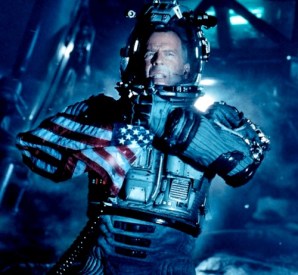 Apparently Michael Bay thinks it’s his worst film. In 2013, he said, “I will apologise for Armageddon, because we had to do the whole movie in 16 weeks. It was a massive undertaking. That was not fair to the movie. I would redo the entire third act if I could.” The problems stretch further than that, Michael.
Believe it or not, it’s not all bad. The bit where Bruce Willis’ life flashes before his eyes is actually really good — ten seconds of artistic moviemaking in a 150-minute movie! Visually it looks great throughout, meaning DoP John Schwartzman is possibly the only person who comes out of the whole thing entirely unscathed. The special effects are excellent for 1998. I thought Independence Day’s were still effective when I re-watched it earlier this year, but Armageddon’s feel much less dated, and it was only made two years later. As an effects showcase, it absolutely still holds up today. That said, the top of the Chrysler building falling off, complete with plummeting screaming people, is considerably less palatable since 9/11. And just a minute later there’s a shot of the World Trade Center with burning holes in it. It’s a wonder it hasn’t been re-edited to remove those shots, especially as it’s a Disney-owned movie and they have a history of self-censoring stuff that is no longer considered acceptable.
Armageddon was, famously, released the same year as Deep Impact, which I watched many years ago but remember as a character-driven drama about an asteroid threatening the end of the world. Armageddon’s action-packed bluster was more successful at the box office, of course, but Deep Impact was the more mature movie. 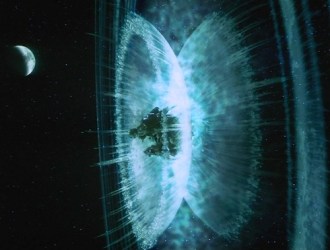 Maybe I’m wrong — it has a lower rating on IMDb. But then, that is IMDb. I should probably watch it again, but even without doing that I feel pretty confident saying it’s the better film.
If Michael Bay knew he was making a comedy, Armageddon might be a great movie. But he didn’t. While it’s definitely bad, I did kind of enjoy it… but mainly to laugh at. Make of that what you will.

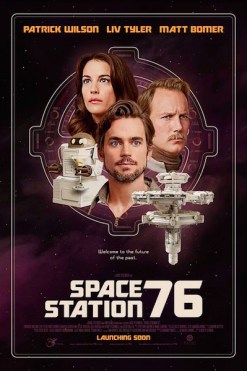 Liv Tyler is the new first officer on a space station commanded by Patrick Wilson in this retro-future-styled film, which is both a spoof of/riff on ’70s genre movies, and a character drama about people’s relationships. No, really.
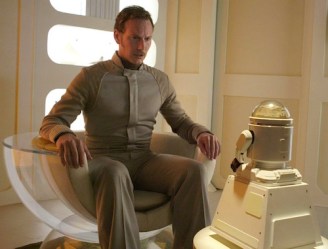 used to feed into the humour, that’s simply what makes it, a) a period movie (just a period movie set in the future), and b) a comedy-drama (as opposed to a drama). I think this is the real reason for its lowly regard on sites like IMDb: those expecting Anchorman in Space are going to be disappointed; but you can’t blame anyone for such expectations when that’s more-or-less how it’s trailed.
 The characters and their relations are well enough drawn to make it passably engrossing, even if not a stand-out contribution to any such genre, while the comedy pays off handsomely at times.
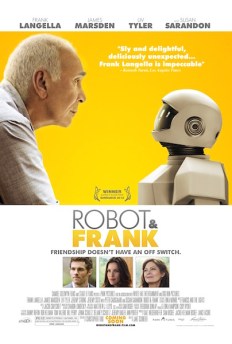 In “the near future”, Frank (Frank Langella) is an ageing jewel thief in denial about his dementia, contenting himself with visits to the local library, which is being taken over by a bunch of yuppies to turn into “the library experience”, and shoplifting from the beauty store that used to be his favourite restaurant. Concerned for his wellbeing, his son (James Marsden) gets him some home help in the form of a humanoid robot (voiced by Peter Sarsgaard). Initially reluctant to accept its presence, when the robot attempts to help by also shoplifting from the beauty store, Frank senses an opportunity…
 (part of a half-realised almost-subplot about robot rights, or something), we not only feel Frank’s (temporary) loss of his friend, but also urge the film to turn the robot back on and get back to what’s really making the movie work. The event serves a purpose (it’s the point Frank realises he’s stopped just putting up with the damn robot and actually come to appreciate its presence), but still.
 Equally, this is of a branch of science-fiction we see all too rarely on the big screen, but which is fertile ground for those wishing to explore it: using fantastical concepts to explore and enlighten our own world. Even if you learn nothing revelatory about old age and the rigours of dementia, the friendship between the robot and Frank is reason enough to enjoy.
 If
If 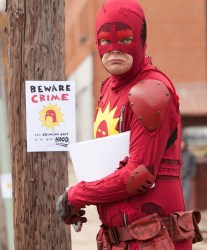 which moves fairly swiftly into the fantasy of being a successful superhero, Super stays quite grounded. The ending allows itself to be a little more triumphantly heroic, but not far beyond the bounds of realism (unlike Kick-Ass).
 really, they are deciding something is right and something else is wrong”. The psychology of superheroes has been a factor to one degree or another for decades now, not least the Batman films making the parallel between the hero and his villains, but the difference in Super is it’s not a parallel — it’s primarily the heroes who are messed up. The villains are criminals and quite nasty at times, but they’re mostly quite normal. They may deserve their comeuppance, but wisely — and interestingly — they’re not over-written or over-played to heighten them to the level of the psycho-hero. The Crimson Bolt is a sledgehammer to crack a nut, even more so than Batman in
 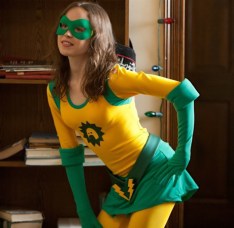 Super is about a troubled human being and his relationship with faith, morality and what he perceives as his calling… I think that is part of why we gave him Ellen Page as a sidekick — because her character, Boltie, actually is insane. The Crimson Bolt is not doing what he does because he enjoys hurting people but Boltie is and that is the difference between the two of them. It starts to become a concern when you enjoy the violence.”
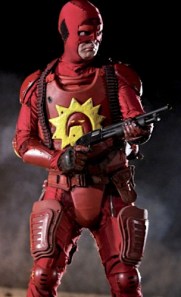 For all its grounded reality, Super lets loose in the final fifteen minutes, creating a punch-packing sequence that’s the rival of any comic book movie. It’s emotionally-charged action, all the more powerful for its semi-amateur-ness and realistic brutality. It climaxes in a face-to-face between our hero and the villain which is as good as any you’ll find in such a film. Is it revelling in the extremity of its violence? You might argue it is, but I don’t think it’s celebrating its gore so much as the triumph of its hero. And that’s followed by a neat epilogue, which I won’t reveal details of but is a kind of ending I’ve been wanting to see for a while.
 a decade-old track by Sweden’s 2007 Eurovision entry (they came 18th of 24. Don’t laugh — we were joint 22nd). And, despite the low budget, there’s great special effects. The tentacles are the rival of any big-budget movie; the blood and guts are all gruesomely realistic, not filmicly censored or reduced or cheaply fake; handdrawn-style Batman “kapow”s (etc) are very effective. The title sequence, in a similar style as the latter, but with a dance routine, is also a ton of fun.
 “I think that so many movies today try to be everything to all people and I’m a little sick of it. Super is not for everyone. It is for some people.” And for the people it’s for, I think it’s exceptional. If you were to compile a list of the greatest superhero movies, I believe Super’s unique style and perspective — plus its excellent climax — would earn itself a place right near the top.
 100Films.co.uk