
Francis Lawrence | 137 mins | Blu-ray | 2.40:1 | USA & Germany / English | 12 / PG-13
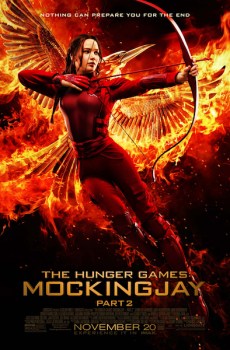 The artificially-extended Hunger Games trilogy-turned-tetralogy climaxes here. Presumably you’ve seen the first three and so know what you’re into by this point — either you’re invested or you’ve given up. Unless you want to know “does it end well?” before embarking on the whole thing, of course. While Mockingjay Part 2 is not the series’ finest instalment, it brings things to a decent head… eventually.
In my review of Mockingjay Part 1, a film much criticised for feeling like half of a whole — or, rather, half of a part of a whole — I argued it does actually function as a film in its own right. I mean, all of these films are part of one long narrative, so that’s par for the course, and I didn’t feel like Mockingjay Part 1 was any less a ‘standalone’ chunk of that narrative than the two films that preceded it. Specifically, I asserted that “the focus on using Katniss as no more than a propaganda figurehead… has been fully explored — and so I think this instalment will feel much more like a fully-fledged film in its own right if they just move on. I hope the final film give us new themes, new subplots, new arcs to follow”.
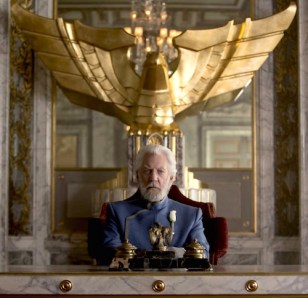
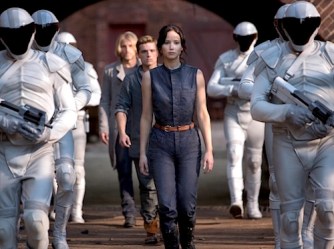
With that in mind, Part 2 begins with a degree of disappointment, as it tackles some propaganda-related holdovers from the last movie. Maybe I was putting too much stock in the idea of them moving on from that theme and establishing something new, though — especially as it does soon do that anyway. What develops is a “men on a mission” war movie, as Katniss and a small band of soldiers make their way through the deserted-but-boobytrapped Capitol on a mission to assassinate President Snow.
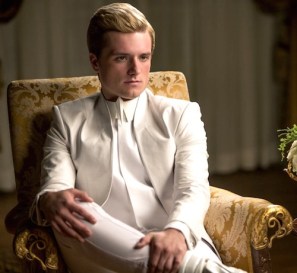
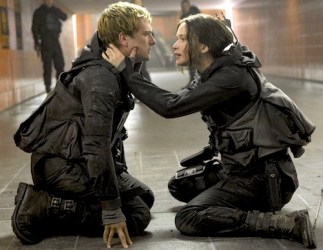 What follows isn’t perfect — in particular, the storyline could’ve done with tightening up — but it does have a lot going for it. There’s strong characterisation: Katniss is as confused, conflicted, and incapable of engaging with her emotions as ever, while Peeta’s PTSD is well-handled, with an effective device where he repeatedly makes a statement before asking, “real or not real?” There are other nicely developed thematic points too, like expanding further on the rebels not being perfect good guys (as initiated in Part 1), which plays a central role in the denouement. The action sequences are well staged and occasionally inventive, but best of all is that the climax doesn’t lean on being the biggest fight scene yet — it’s driven by the story, and the characters and their decisions, rather than being a ginormous shoot-out.
Speaking of the film’s finale, complaints that the endings go on too long bug me, just as they bug me when people bring it up about Lord of the Rings. In both cases, you’re getting a capstone to a 9+ hour saga, not the 2- to 3-hour section of it you just watched. Rings’ endings feel completely suitable if you watch all 12 hours of the extended editions in one sitting, and I’d wager Hunger Games’ do too. Rush it and you end up with something like Harry Potter’s finale, which comes to a crushing thud of an ending as soon as the battle is won. What both Rings and Hunger Games are doing, actually, is showing that these characters are people who exist outside of the context of their war. They’re not just combatants, who evaporate into thin air once the battle’s lost or won; they’re people who have to either return to their old lives or establish new ones.* It’s a richer, more realistic, more human way to end a story than “plot’s over, action sequences are finished — we’re done here!”
 Mockingjay Part 2 is not the best instalment of the Hunger Games, a series whose second half didn’t quite live up to the developed potential of the excellent Catching Fire. That said, I think it largely works as a whole, with conflicted and complicated characters living in a world that initially seems straightforwardly dystopic but develops many moral greys. That’s particularly welcome from a Young Adult series, a sort-of-genre where some of the most famous examples are lacking in intellectual — or (considering the target audience) educational — heft. In fact, based on the scores and comments I’ve seen on some websites, Mockingjay Part 2 may yet turn out to be the most underrated of the Hunger Games films.

The Hunger Games: Mockingjay – Part 2 is available on Netflix UK as of this week. Mockingjay Part 1 is also on there; the first two films are not.
* Potter does do the “back to a life” thing, but the details of it are found in ancillary texts. ^
 If you’re not au fait with the
  as both sides attempt to rally ordinary people to their cause through the power of the media. It’s a tale that’s as timely as ever, surely.
 I must say that (as someone who hasn’t read the book) it didn’t feel overly like the first half of something longer to me. Of course there’s a cliffhanger and stuff, but there was at the end of the last film as well. This is no worse than that. If anything, I felt Mockingjay Part 1 built to its ending more successfully — I was quite surprised when
  it may be your favourite instalment so far (and you wouldn’t be alone in that view). For me, Catching Fire is the best of the three because it crystallises both of those constituent elements; and if the first film was purely the action side (with a bit of the politics), then here we find its mirror image: purely politics (with a bit of action). Either way, perhaps the ultimate fate of all these films rests on how well
  Jennifer Lawrence (who, depending on your mileage, is either “the most charming young movie star in, like, forever” or “actually kind of a little bit irritating”) returns as the totally-plausibly-named Katniss Everdeen in this super-successful follow-up to the super-successful
 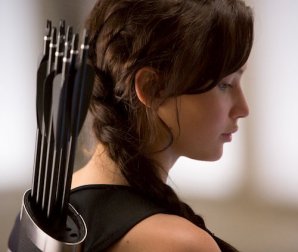 Tonally, however, it’s more similar to
 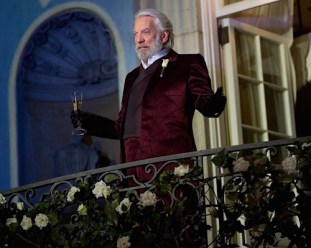 Of course, to an extent the tone of this ending comes from it being an adaptation: the filmmakers haven’t looked at the history of movie cliffhangers and chosen which to emulate, but instead brought someone else’s ending to the screen. Adapting doesn’t mean you have to take the original work faithfully, mind — you could go the
  which seems richer, more detailed, despite no genuine increase in resolution. I guess it’s true what they say: if you start with a higher quality source, it filters all the way down. The “bigger screen” effect probably wouldn’t work for a film entirely shot on IMAX — it’d just fill your TV from the start — but, after an hour-or-so of black bars, it really feels like the screen has grown.
 Seen by some as a
  100Films.co.uk