
Jon Favreau | 97 mins | streaming (HD) | 1.85:1 | USA / English | PG / PG
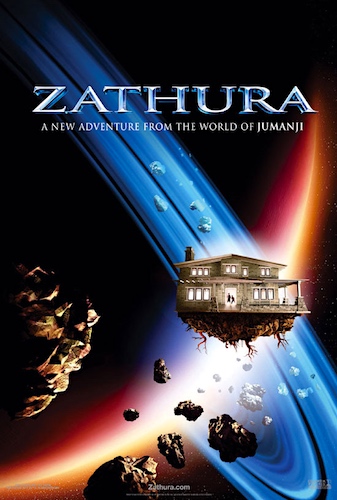
Before Jumanji: Welcome to the Jungle there was Zathura, which is sort of a sequel to Jumanji… but more of a spin-off, I guess… well, really it’s a completely unrelated movie with the exact same plot. Inspired by another book by the same author, it sees two kids (Jonah Bobo and a very baby-faced Josh Hutcherson) discover an old board game that comes to life with terrifying consequences, and the only way to make it stop is to finish the game. But this game is about space, so it’s completely different, obviously.
Unsurprisingly, it’s difficult to avoid assessing the film’s quality in comparison it to its predecessor. The thing that struck me most was it feels less consequential than Jumanji, somehow. In the previous film the stakes feel high — you worry they won’t beat the game or make it out alive. Perhaps that’s because of Robin Williams’ character getting trapped in the game at the start, which makes you believe things can go wrong. Whereas here, it just feels like crazy shit will keep happening until they finish. It may also be because you can infer ‘rules’ in Jumanji — we know monkeys are going to be mischievous, tigers might eat you, etc — whereas in Zathura, because it’s sci-fi, it’s all made up. And it feels made up as it goes along, too — because it’s not based on real life or an existing brand, we don’t know the characters, the monsters, etc.
Similarly, the characters benefit from way too much luck. The kids keep not reacting fast enough to stop or save things, but then something fortunate happens so things go their way. Maybe you could sell this as a deliberate thing — like, the game wants to be finished — but that’s not how it plays out. They just keep getting lucky, in a not-great-screenwriting way. Perhaps I’m projecting problems where there are none in these observations, but it’s just another factor towards not feeling jeopardy like I did in Jumanji. Overall, Zathura was just more… pleasant.
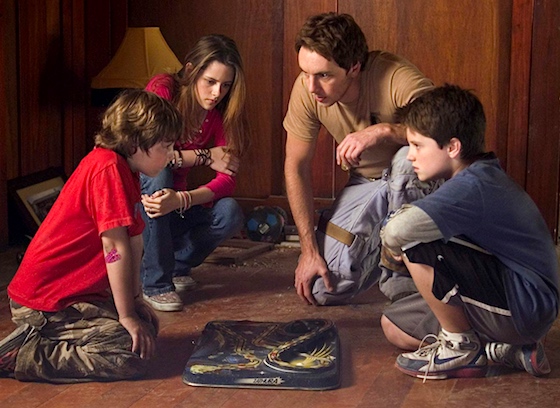
That said, I had some more specific niggles. For a film that should’ve been trying to avoid accusations of being a rip-off, they invite it further by (spoiler alert!) giving one character a backstory that’s a riff on Robin Williams’ from the first movie. Zathura comes at it from a different angle, at least, but that’s a mixed blessing: it doesn’t have the same emotional effect because we only learn about it belatedly, but at least that means it isn’t ripping off Jumanji’s entire narrative structure, and also allows for a neat twist later on. There’s some time travel stuff that doesn’t wholly hang together, but then does it ever?
Equally, you can clearly tell they weren’t paying enough attention to every aspect of the screenplay: the older sister (played by a pre-fame Kristen Stewart, by-the-by) gets put in hibernation for five turns, but it takes eight turns before she wakes up. How no one noticed that is baffling — did they not think to just count it in the script? Even if they somehow missed it until post-production, all it would’ve taken is a dubbed line or two. “Five turns” sounds like a lot of gameplay to miss, so maybe they just thought “eight turns” would sound too ridiculous, but did they not think someone would spot it?!
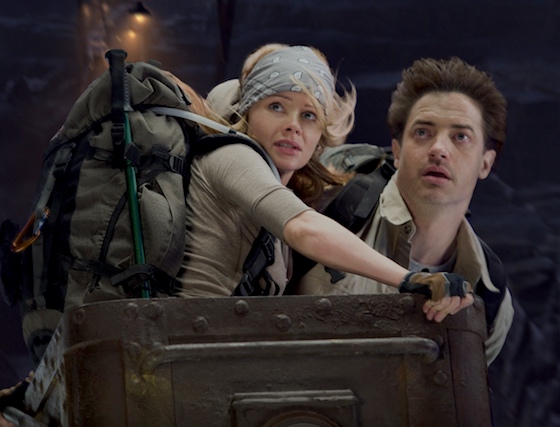
Plot logic aside, at least the film has some great effects and design work. Jumanji has aged badly in that respect (the CGI is pretty ropey), whereas Zathura still looks great, in part because there’s actually a lot of props and models involved. The performances are pretty decent, too. Director Jon Favreau clearly has a talent for working with kids — the pair here; Mowgli in his Jungle Book; Robert Downey Jr… But in all seriousness, he gets really good performances out of these children.

Also worth noting is that the UK version was originally cut to get a PG… and remains cut, because the uncut rating wouldn’t just be a 12, it’d be a 15! That’s because of “imitable techniques”, which in this case means using an aerosol as a blowtorch to set fire to a sofa. The main thing I find interesting about this is that presumably the original cut shows the Astronaut setting fire to the sofa, whereas in the UK version it just suddenly cuts to him stood beside a sofa on fire, which is so much funnier. Hurrah for censorship, I guess.
And so we come to the score. Zathura is one of those films I find a little awkward to rate, because I did enjoy it — in some respects, more than I enjoyed Jumanji when I rewatched that recently — but it also doesn’t feel as polished and complete as its predecessor in terms of story and characters. Even as I had fun, I saw many things I felt could’ve been sharpened up. For that reason, I’ve erred towards a lower rating.



 If you’re not au fait with the
  as both sides attempt to rally ordinary people to their cause through the power of the media. It’s a tale that’s as timely as ever, surely.
 I must say that (as someone who hasn’t read the book) it didn’t feel overly like the first half of something longer to me. Of course there’s a cliffhanger and stuff, but there was at the end of the last film as well. This is no worse than that. If anything, I felt Mockingjay Part 1 built to its ending more successfully — I was quite surprised when
  it may be your favourite instalment so far (and you wouldn’t be alone in that view). For me, Catching Fire is the best of the three because it crystallises both of those constituent elements; and if the first film was purely the action side (with a bit of the politics), then here we find its mirror image: purely politics (with a bit of action). Either way, perhaps the ultimate fate of all these films rests on how well
 Jennifer Lawrence (who, depending on your mileage, is either “the most charming young movie star in, like, forever” or “actually kind of a little bit irritating”) returns as the totally-plausibly-named Katniss Everdeen in this super-successful follow-up to the super-successful
  Tonally, however, it’s more similar to
  Of course, to an extent the tone of this ending comes from it being an adaptation: the filmmakers haven’t looked at the history of movie cliffhangers and chosen which to emulate, but instead brought someone else’s ending to the screen. Adapting doesn’t mean you have to take the original work faithfully, mind — you could go the
  which seems richer, more detailed, despite no genuine increase in resolution. I guess it’s true what they say: if you start with a higher quality source, it filters all the way down. The “bigger screen” effect probably wouldn’t work for a film entirely shot on IMAX — it’d just fill your TV from the start — but, after an hour-or-so of black bars, it really feels like the screen has grown.
 100Films.co.uk