
Phil Lord & Christopher Miller | 112 mins | Blu-ray | 2.40:1 | USA / English | 15 / R

After the genuinely surprising success (both critically and financially) of the 21 Jump Street movie, a sequel was inevitable. This is that sequel — and it won’t let you forget it.
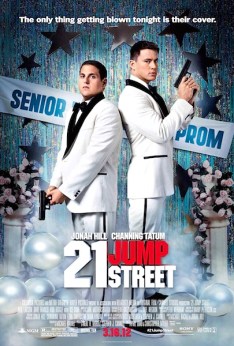
In the first movie, best-buddy cops Jenko (Channing Tatum) and Schmidt (Jonah Hill) went undercover in a high school to unearth a drug ring. Now, they go undercover in a college to unearth a drug ring. Sequels, eh? But it’s okay because the film makes a running joke out of how it’s just rehashing what worked in the first movie. I say “it’s okay” — some people seem to fundamentally object to this, saying that acknowledging that it’s a copy doesn’t stop it being a copy. Personally, I give the film a bit more credit than that. It’s a copy because it’s funny when it’s a copy, not because it has absolutely no new ideas.
In part, it knows when to improve on itself: they’ve taken one of the most memorable and likeable bits of the first movie — the meta-jokes at the expense of the film itself — and ramped them up to 11. And it works. Or, at least, it did for me. Is this the most meta comedy ever? I dunno, but I can’t think of another that so relentlessly riffs off both the expected tropes of its genre and its own status as a sequel. It broadens the remits to movies in general, too — when it finally paid off, the meticulously over-constructed ‘meet cute’ gag elicited one of the biggest laughs I’ve had at a film in a long time. I’m almost loathe to mention it, because it works best when you have no idea that’s where it’s going, but oh well. Similarly, the widely-discussed end credits must’ve been a real hoot when they were a total surprise. Fortunately, they’re still a ton of fun even if you’ve had the joke ruined. (As I’ve already half-spoiled one moment, and the credits were pretty widely covered back when the film first came out, I shall say no more.)

The one shame in all this is that it rehashes the last movie’s relationship arc for the leads. Gags about it being exactly the same movie are funny when they’re overt, like with the main drug investigation plot, but it’s like no one in production noticed that they’d reheated the character arcs. It does kind of go somewhere new with it, but only in the sense that it’s inverted which of the pair soars and which feels left out. Nonetheless, it stills leads to some funny scenes, like the “break up” and a counselling session, so at least it’s not a complete loss.
When a movie nobody expected anything good of becomes a hit and they rush to produce a sequel, you’d expect nothing more than a lazy rehash. 22 Jump Street takes that ball and runs with it, turning its lazy rehashery into meta-humour that makes the movie more-or-less the equal of its predecessor.
It’s a shame the threequel seems to have become lost down the dead-end of making it a Men in Black crossover because I wouldn’t mind seeing trilogies given the Jump Street treatment. But you never know, maybe that’ll become the silver lining to the Han Solo fiasco.

Channing Tatum stars in another spoof cop series, Comrade Detective, available on Amazon Prime from today.
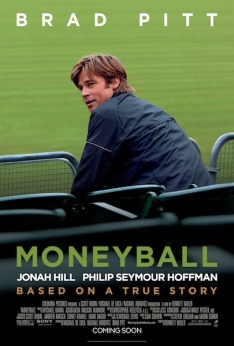 Based on a true story, Moneyball concerns the management of baseball team Oakland Athletics during the 2002 season. General manager Billy Beane (Brad Pitt) struggles to put a squad together due to a comparatively low budget for players, which has seen all his best ones drift off to richer contracts elsewhere. Fed up with the traditional scouting system, he recruits Peter Brand (Jonah Hill) to use statistical analysis to select a cheap team of quality players. The rest of his staff despair, including coach Art Howe (Philip Seymour Hoffman), who refuses to play the team as Beane and Brand suggest, which unsurprisingly leads to self-vindicating failure — until they force his hand…
 Problems extend beyond the sporting specifics. It’s quite some way into the movie before it gets stuck into the meat of the plan working, and before that it often throws in asides that meander around through Beane’s earlier playing career and current family life. The former has some bearing on the plot, though feels inadequately integrated — as one flashback it might work, but as a series of them it’s not enough to constitute a parallel story. The latter, his family life, provides character texture, but it’s slight, uninformative, and ultimately unnecessary. You could cut it and the film would lose nothing.
 and didn’t need any work, which probably explains why it’s not so Sorkin-y. Zaillian is not a bad writer — his credits include
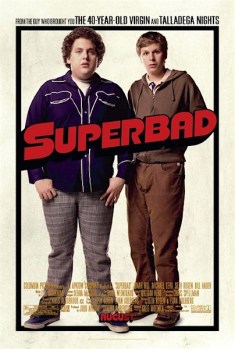 Seth Rogen and Evan Goldberg’s semi-autobiographical comedy sets Seth (Jonah Hill) and Evan (Michael Cera) (see what they did there?) on a quest to obtain booze for a party where they hope to copulate. Or, “every American teen comedy.”
 Four years ago, DreamWorks’
  Tonally, DeBlois has been productively inspired by
  If there’s a flaw, it’s in some of the new characters. The primary villain is underused, introduced too late in the game to become a palpable threat. More time spent building him up, seeing his evil on screen rather than just being told about it, would’ve been appreciated. So too for the mysterious vigilante dragon-rider, who turns out to have a very significant role. The deleted scenes include a prologue that would have introduced the character at the start, which would have better established the mystery and import of their role. It’s clear why it was deleted (to focus on Berk and keep the initial tone light), but I still think it would’ve worked better in the film. In the final cut, the vigilante is mentioned all of once, then turns up and is unmasked about two minutes later. Really, though, these are niggles — even for them, the cumulative consistency is certainly better than, say, its Oscar conquerer
  Having turned the unlikely-to-be-any-good story of a machine that makes it rain food into
  this leaves Hill hanging out with the cool kids — and being lured down the path of parties and their shallower friendship — while Tatum falls in with a gang of ultra-nerdy nerds and starts actually learning stuff. Distilled like that makes it sound pat, but in the film it works; in part because they don’t overplay the clichéd “friends fall out irretrievably… until it’s retrieved for the final act” story arc.
 2014 Academy Awards
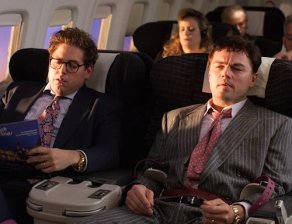
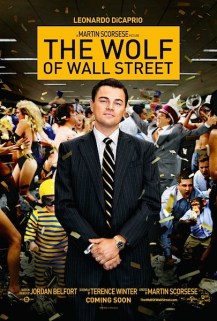 When someone says “100-million-dollar epic”, you probably don’t imagine a film about a swindling stockbroker; but, with a three-hour running time and a nine-figure budget, that’s exactly what Martin Scorsese’s black comedy biopic is.
 and the closing shot clearly shows how many people have already judged them to represent something desirable, regardless of what position the film might take. Some people want this lifestyle, in spite of all the problems it wrought, and even if the film had clearly condemned it that wouldn’t change. In the end, to say Scorsese approves of it purely because he doesn’t lambast it is too simplistic a reading.
 but almost every supporting character gets a memorable line or scene, a moment where they shine brighter than everyone else; and even when the smaller roles aren’t dominating a scene, they’re part of a first-rate ensemble that functions like a well-oiled machine. My personal favourite was P.J. Byrne’s ‘Rugrat’, but yours may well be someone else.
 As one of
  100Films.co.uk