Country: USA
Language: English
Runtime: 90 minutes
BBFC: U
MPAA: PG

Original Release: 16th May 2001 (USA)
UK Release: 29th June 2001
Budget: $60 million
Worldwide Gross: $484.4 million
Stars
Mike Myers (Austin Powers: International Man of Mystery, The Cat in the Hat)
Eddie Murphy (Coming to America, Dreamgirls)
Cameron Diaz (There’s Something About Mary, Gangs of New York)
John Lithgow (Cliffhanger, Rise of the Planet of the Apes)
Directors
Andrew Adamson (The Chronicles of Narnia: The Lion, the Witch and the Wardrobe , Cirque du Soleil: Worlds Away)
Vicky Jenson (Shark Tale, Post Grad)
Screenwriters
Ted Elliott (Aladdin, Pirates of the Caribbean: The Curse of the Black Pearl)
Terry Rossio (The Mask of Zorro, Pirates of the Caribbean: Dead Man’s Chest)
Joe Stillman (Beavis and Butt-Head Do America, Gulliver’s Travels)
Roger S.H. Schulman (Balto, Mulan II)
Based on
Shrek!, a picture book by William Steig.
The Story
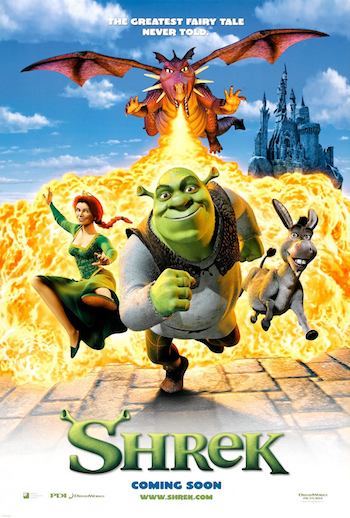
When his swamp is overrun with fairytale creatures, ogre Shrek sets off to confront the man responsible, Lord Farquaad. To get his land back, Shrek must rescue the Princess Fiona from her dragon-guarded castle, so that Farquaad can marry her. But all is not as it appears…
Our Hero
Shrek is a grumpy Scottish-accented ogre who just wants to be left alone in his swamp, but events conspire to get in his way. Of course, as things transpire, he really has a heart of gold.
Our Villain
Men of his stature are in short supply, though there are those who think little of him — it’s Lord Farquaad, who wants Fiona to be his bride primarily so he can become king.
Best Supporting Character
Shrek’s new best friend (whether he likes it or not), wise-cracking ass Donkey, gets many of the best lines.
Memorable Quote
Gingerbread Man: “Do you know… the Muffin Man?”
Lord Farquaad: “The Muffin Man?”
Gingerbread Man: “The Muffin Man.”
Lord Farquaad: “Yes, I know the Muffin Man. Who lives on Drury Lane?”
Gingerbread Man: “Well, she’s married to the Muffin Man…”
Lord Farquaad: “The Muffin Man?”
Gingerbread Man: “The Muffin Man!”
Lord Farquaad: “She’s married to the Muffin Man…”
Memorable Scene
As Shrek, Fiona, and Donkey travel back to Lord Farquaad, they’re jumped upon by Robin Hood (who, for no apparent reason, has a French accent) and his Merry Men, attempting to rescue Fiona by, in part, singing a merry song. But she doesn’t want rescuing and so goes all Matrix on their merry arses.
Memorable Music
As part of its generally irreverent take on myths and fairytales, Shrek is laden with contemporary popular music. It was all very modern at the time, but, 17 years on, it’s obviously dated itself, sounding distinctly early-millennium-y now.
Technical Wizardry
The overall animation quality may be looking a bit dated now, but Shrek hails from the era when every major new computer-animated movie was breaking ground in the field, in one way or another. In Shrek‘s case, it was the ability to realistically animate hair and grass.
Next time…
To date there have been three sequel movies, a spin-off movie (which then has its own world of attendant spin-offs, including a six-season TV series), a 4D theme park attraction (which was included in 3D on some DVD releases of the film), plus numerous TV specials and the like, as well as a stage musical version. There are constant rumours of the franchise getting a big-screen continuation, too.
Awards
1 Oscar (Animated Feature)
1 Oscar nomination (Adapted Screenplay)
1 BAFTA (Adapted Screenplay)
5 BAFTA nominations (Film, Supporting Actor (Eddie Murphy), Music, Sound, Special Visual Effects)
1 BAFTA Children’s Award (Film)
1 Saturn Award (DVD Special Edition)
4 Saturn Award nominations (Fantasy Film, Supporting Actor (Eddie Murphy), Writing, Music)
8 Annie Awards (Animated Theatrical Feature, Individual Achievement for Directing in an Animated Feature, Individual Achievement for Writing in an Animated Feature, Voice Acting by a Male Performer in an Animated Feature (Eddie Murphy), Individual Achievement for Effects Animation, Individual Achievement for Music Score an Animated Feature, Individual Achievement for Production Design in an Animated Feature, Individual Achievement for Storyboarding in an Animated Feature)
4 Annie Award nominations (Individual Achievement for Character Animation (x3), Individual Achievement for Production Design in an Animated Feature)
Nominated for the Hugo for Best Dramatic Presentation
Nominated for the Palme d’Or (seriously)
DreamWorks’ irreverent riff on fairytale animations was a breath of fresh air back in 2001, allowing them to net the first Best Animated Feature Oscar ahead of Disney or Pixar. A decade and a half of imitators have taken the shine off that somewhat, as have advances in technology (old CGI ages worse than old cel animation), but it remains an amusing and quotable film, with a surprisingly strong moral message at its heart.




 Nine months on from its theatrical debut, I’ve managed to remain remarkably spoiler-free about Interstellar, the ninth feature from director Christopher Nolan. “Matthew McConaughey lives on a farm and somehow ends up in space with Anne Hathaway,” is about all I knew going in. That and the somewhat divisive critical reception it had received, leaving what many had assumed could be an Oscar favourite with a disappointing tally of nominations (and its studio to have backed the wrong horse, resulting in
  More plot happens. Interstellar is the kind of film where you could get an awful long way through the story just trying to explain the setup. That’s a certain style of storytelling, and in its own way a positive one — a plot that is constantly moving and updating, rather than one that presents a basic setup, runs on the spot with it for a while, then wraps it up. The latter is how most narratives unfold, which is why reviews can so often summarise said setup and that’s fine. Nonetheless, Interstellar’s first act goes on too long, and could do with a good trim. (For an alternative view on why the first act is in some respects the best part of the film and needed more development, read
  Based on a skim through online reaction, some viewers would indeed love even more, while others would despise it. One thing I find interesting about this apparently diverse reaction is that you can find an abundance of negative/semi-negative comments and reviews by people who write such things, but nonetheless the average user scores on the likes of
 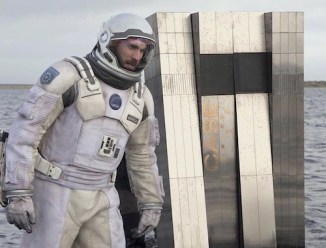 From a filmmaking perspective, there is surely nothing to fault. The visuals are incredible. As you’d expect, the IMAX footage looks absolutely stunning. Every time the Blu-ray reverted back to 2.40:1 I was a little disappointed. A sneaky part of me thinks Warner deliberately make these sequences look less good to ramp up the quality of the IMAX footage (I felt the same about
 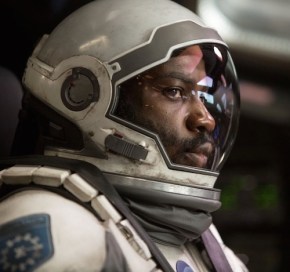 Anne Hathaway is largely understated, but slivers of emotion seep through when appropriate; and Michael Caine actually gets to do a bit of Acting in a Nolan film for a change, rather than just turning up as a wise old dispenser of exposition — though don’t worry, he does that too. One of the stand-outs for me was David Gyasi, getting a role that was subtly stronger and more thought-provoking than several of his more famous colleagues, and executing it with aplomb too. Similarly, the voices of semi-sentient robots TARS and CASE — Bill Irwin and Josh “he’ll always be ‘that guy from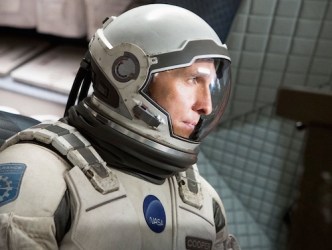

 100Films.co.uk