
Terrence Malick | 139 mins | Blu-ray | 1.85:1 | USA / English | 12 / PG-13

Writer-director Terrence Malick made just five films in the first 38 years of his directorial career, this being the fifth. In the seven years since it came out, he’s made five more. Why the long gaps before, or the sudden increase now? Who knows — Malick is notoriously interview-shy. But the answer may indeed lie with this film, sitting as it does at the fulcrum of his career. It was a project Malick had on his mind for decades (he shot material for it as far back as the ’70s), which for various reasons — primarily funding and technology, I think — it took him until this decade to achieve. Many think it was worth the wait: lots of people love it, including the Cannes jury, who awarded it the Palme d’Or. Many others… don’t: plenty of people regard it as pretentious, or at least too abstruse to care about. It’s a film that, I think, can only elicit an entirely personal reaction. So here’s mine.
The Tree of Life is about… um… oh dear, we’ve hit a snag already. Well, once it settles down (which takes the best part of an hour), what it’s literally about is a family living in Waco, Texas, in the 1950s — dad (Brad Pitt), mom (Jessica Chastain), and their three sons, Jack (Hunter McCracken), R.L. (Laramie Eppler), and Steve (Tye Sheridan). The kids play around doing the kind of thing young lads did in the ’50s — running around in the woods, swimming in rivers, throwing stones through windows, murdering frogs — while being torn between the influences of their parents: their kind, gentle, caring mother, and their strict, authoritative, borderline abusive (or just straight abusive?) father.
But the film also occasionally shows us Sean Penn as grown-up Jack, working some high-level job in a present-day city. And it also shows us an extended sequence about the birth of the universe and the evolution of life on Earth. And that’s to say nothing of the epilogue… Or, indeed, the prologue, which introduces a massive event in the family’s life that is then, arguably, unreferenced by the rest of the movie.
So… yeah.

Much of The Tree of Life is more like visual poetry than a traditional narrative film. Beautiful images glide before our eyes, some with obvious meaning, others less so. Some of the images resonate or rhyme with each other, urging us to infer our own interpretation of what we’re seeing, and why, and what it signifies. This is mostly true of the opening chunk — which lasts a good 45 to 60 minutes — and the ending. In between, more of a narrative is discernible — the stuff about the young family — although it’s constructed in a poetic fashion, with minimal dialogue, lots of vignettes, fragments of day-to-day life that don’t necessarily have an immediate significance.
To me, it felt like we were watching someone’s dreams or memories, presented as we really remember things: random fragments from our lives. If you think about your memories of childhood, they don’t take the form of a neat narrative in concise scenes with all the important landmarks accounted for. We do remember big events, of course, but also many small things; and some things we remember extensively, but others only fragmentarily. If you could view a person’s memories, they’d create, not a biopic, but an impressionistic collage or our lives — and this film is that, I think.
But that can still leave the viewer to question what it’s all about, especially given the extended sequence of space gases, forming planets, burgeoning microscopic lifeforms, and dinosaurs. Yes, in arguably the film’s most baffling sequence (there are many contenders), we see an event in the life of some dinosaurs. Actually, I say it’s the most baffling, but only if you stick to the film itself: of all the confusing things herein, that’s the one with the most concrete explanation, thanks to visual effects supervisor Michael L. Fink having a little chat with critic Jim Emerson about Malick’s intentions for the scene. Not everyone likes firm answers to this kind of stuff, so I’ll just link to where you can read it if you want to.

That said, some of the stuff I’ve already mentioned in passing I only know definitively thanks to extra-textual sources. Well, if you count the film’s end credits as extra-textual, which I suppose they’re not. But it’s only thanks to those that I know for certain which of the boys Penn was supposed to be, or that the creation-of-the-universe stuff is indeed meant to be that (based on genuine science, donchaknow), and that these scenes show us the “astrophysical realm”, because there are effects credits for that. And more still can be learnt from, of all places, the Blu-ray’s chapter menu: the long creation sequence is indeed called “creation”, in case you weren’t sure. The ending is “eternity”, followed by “was it a dream?” Others include “grief”, “innocence”, “mother”, “father”, “I do what I hate” — all showing us the way towards important themes… maybe. Or perhaps they’re just convenient chapter points…
Praise for the film’s imagery is due not only to Malick, but also cinematographer Emmanuel “Chivo” Lubezki. And it’s not even the guy’s best work — I’d argue for consistent beauty he’s surpassed it with some of the stunning, Oscar-winning stuff he’s done since — but you can see how he got from here to there: the very best shots in The Tree of Life are kind of what he does all the time in films like The Revenant. As for constructing those images into a meaningful flow, I’m never sure how much is down to an editor’s own creativity and how much is them operating machinery under the director’s instruction — I guess, like most things in the movies, it’s a collaborative mix of both. Anyway, the film has five credited editors — Hank Corwin, Jay Rabinowitz, Daniel Rezende, Billy Weber, and Mark Yoshikawa — who I’m sure must’ve been vital to the process. (Relatedly, here’s a fun anecdote from IMDb: “an Italian cinema showed the film for a week with the first two reels switched. Even though the film starts with production logos, no one in the theater noticed and thought it was all part of Terrence Malick’s ‘crazy editing style’.”)

There’s a lot of really great music and sound design as well — something Malick clearly considered important to a Lynchian degree, given that before the film plays the Blu-ray flashes up a notice advising you to “play it loud”. Alexandre Desplat is credited for the music, but a very, very long list of sourced tracks too hints at what actually happened: most of his music went unused in the final cut, with only a few minutes making it in. I imagine that feels quite unedifying, to have your work sidelined; but maybe it’s better than being ditched entirely in favour of a new score, as has happened to plenty of other composers in the past.
It’s easy to get hung up on all this filmmaking when thinking about The Tree of Life, because that’s where its own focus seems to be, as opposed to the usual things a reviewer might think to discuss first, like the screenplay or performances. But there are still actors here, and good ones at that. The movie is really centred around Hunter McCracken, and he’s very good. The casting directors saw thousands of Texan school kids while trying to cast the boys, and the effort paid off; though McCracken hasn’t done anything else since, so maybe not for him personally. The other two brothers don’t have so much to do; in fact, I kept almost forgetting one of the trio existed, so little is he on screen or relevant to events. Ironically, he’s the only one of the three who’s gone on to have a career: it’s Tye Sheridan, most recently seen as the lead in Ready Player One.
As for the adults, Sean Penn is one of the many lead actors in a Malick film whose performances have wound up on the cutting room floor. According to Lubezki, there’s enough deleted footage to make a whole movie focused on Penn’s character. Yep, sounds like Malick! Obviously such a movie would be completely different to this one, but I’d be curious to see it. More screen time is devoted to Jessica Chastain and Brad Pitt, who both achieve a lot with comparatively little. Chastain is the focus early on, but it later becomes apparent that Pitt has a showier role, in a way, because of his character’s arc. There’s a pullquote on the back of the UK Blu-ray that calls it “the strongest performance of his career”, but considering his performances in the likes of Se7en and The Assassination of Jesse James, or that he’s been Oscar-nominated for his turns in Twelve Monkeys, Benjamin Button, and Moneyball, I thought that was a bit of an outlandish claim to make. To each their own, though.

Anyhow, all this is “technical” stuff quite apart from what The Tree of Life is really about. Not that I’m totally clear on what that is, still. I guess maybe it’s there for us to infer what we like from it, be that religious, scientific, humanistic, or, for many a viewer, just boredom. Whether you love it or hate it — and there are certainly plenty of perfectly reasonable people at both extremes — it’s definitely an Experience; one every person who considers themselves serious about film appreciation needs to have.

A new edition of The Tree of Life, which includes a different cut that’s 50 minutes longer (but, intriguingly, is not an extended cut), is released by Criterion in the US tomorrow and in the UK on November 19th.
 2016 Academy Awards
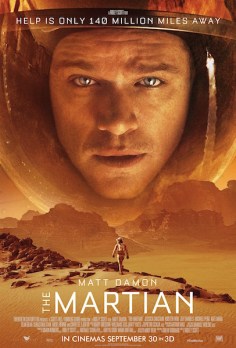 Ridley Scott’s latest arrives on Blu-ray in the UK today, with a disappointing dearth of special features (disliked
  Whether that’s appropriate or not is another matter. A well-argued
 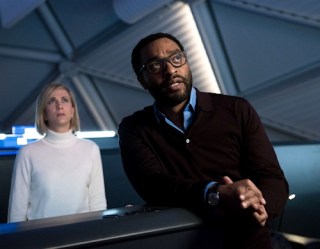 While Damon is stuck on Mars by himself, a starry supporting cast actually get to interact with each other. This is a quality ensemble and, short of writing an epic essay of a review where I just praise them all one by one, there’s little to do but list their names. That said, Jessica Chastain gets the most brazenly emotional beats as the commander who chose to leave Watney behind and has to face the consequences of her decision; Jeff Daniels treads a line between being an evil bureaucrat and just a regular bureaucrat (apparently consideration was given to turning him into a full-blown villain; thank goodness they swerved that bullet); Chiwetel Ejiofor brings easy gravitas to NASA’s director of Mars missions; Michael Peña provides some additional comic relief, if not as strikingly as he did in
  I’ve read at least one review that described The Martian as “an instant sci-fi classic”, and at least one other that described it as “no sci-fi classic”. I’m going to sit on the fence of that debate for the time being. What I will say is that it is undoubtedly an accomplished piece of entertainment. For a film that primarily concerns itself with a man applying scientific principles to tasks like “growing potatoes”, that’s surely some kind of achievement. In our current climate (both in society in general and in the “more explosions less talking, please” state of blockbuster cinema), to make space travel — and science in general — seem fun and appealing to the masses is no bad thing whatsoever.
 Nine months on from its theatrical debut, I’ve managed to remain remarkably spoiler-free about Interstellar, the ninth feature from director Christopher Nolan. “Matthew McConaughey lives on a farm and somehow ends up in space with Anne Hathaway,” is about all I knew going in. That and the somewhat divisive critical reception it had received, leaving what many had assumed could be an Oscar favourite with a disappointing tally of nominations (and its studio to have backed the wrong horse, resulting in
  More plot happens. Interstellar is the kind of film where you could get an awful long way through the story just trying to explain the setup. That’s a certain style of storytelling, and in its own way a positive one — a plot that is constantly moving and updating, rather than one that presents a basic setup, runs on the spot with it for a while, then wraps it up. The latter is how most narratives unfold, which is why reviews can so often summarise said setup and that’s fine. Nonetheless, Interstellar’s first act goes on too long, and could do with a good trim. (For an alternative view on why the first act is in some respects the best part of the film and needed more development, read
  Based on a skim through online reaction, some viewers would indeed love even more, while others would despise it. One thing I find interesting about this apparently diverse reaction is that you can find an abundance of negative/semi-negative comments and reviews by people who write such things, but nonetheless the average user scores on the likes of
 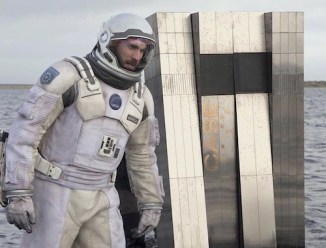 From a filmmaking perspective, there is surely nothing to fault. The visuals are incredible. As you’d expect, the IMAX footage looks absolutely stunning. Every time the Blu-ray reverted back to 2.40:1 I was a little disappointed. A sneaky part of me thinks Warner deliberately make these sequences look less good to ramp up the quality of the IMAX footage (I felt the same about
 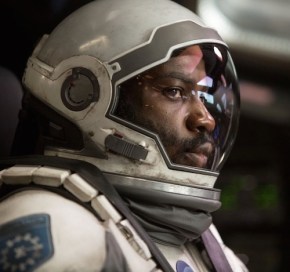 Anne Hathaway is largely understated, but slivers of emotion seep through when appropriate; and Michael Caine actually gets to do a bit of Acting in a Nolan film for a change, rather than just turning up as a wise old dispenser of exposition — though don’t worry, he does that too. One of the stand-outs for me was David Gyasi, getting a role that was subtly stronger and more thought-provoking than several of his more famous colleagues, and executing it with aplomb too. Similarly, the voices of semi-sentient robots TARS and CASE — Bill Irwin and Josh “he’ll always be ‘that guy from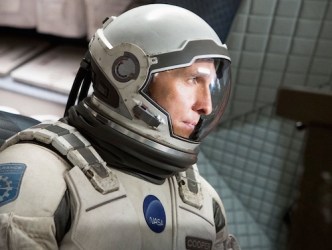
 100Films.co.uk