
Denis Villeneuve | 116 mins | cinema | 2.35:1 | USA / English & Heptapod | 12A / PG-13
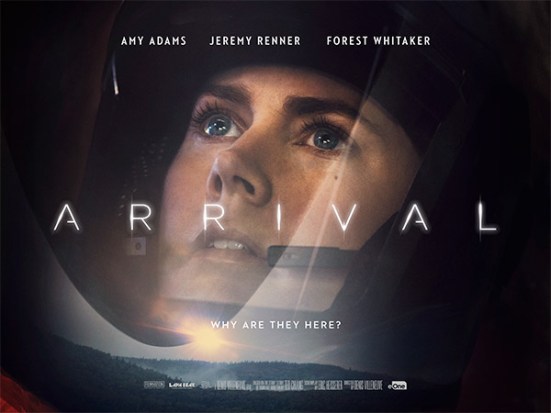
An intelligent sci-fi movie released by a major studio?* What madness is this? A good kind of madness, because Arrival is one of the best — and, importantly, most humane — science fiction movies for years.
For one thing, it takes an unusual, but completely pragmatic, approach to alien first contact: how would we communicate with them? Most sci-fi movies gloss over this — either we don’t because they’re just killing us, or the aliens are sufficiently advanced that they already speak our language. Here, however, the focus is on Amy Adams’ linguist. The problem is approached as it would be in real life — the production sought advice from real linguists, and the only tech used is stuff we have access to today. Far removed from the usual glossy high-tech sheen of most sci-fi movies, the most important pieces of kit here are things like whiteboards and scissor lifts. It’s very mundane, and that’s the point — it’s grounded in a world we know. Apart from the aliens, of course. But while the process Adams’ character undertakes may be factual, as she begins to work on the aliens’ language its unique properties begin to have a surprising effect on her…
At the risk of sounding like one of those people who boasts about guessing a twist, I did develop a fair idea of where the film was going. (Not completely — at one point (massive pseudo-spoiler here) I thought it might be that Jeremy Renner’s character was the future-father of Adams’ past-child, in some wibbly-wobbly timey-wimey all-things-happen-at-once way that I was curious how they’d explain.) But whether you work it out in advance or not doesn’t matter, because Arrival is not a middling M. Night Shyamalan film, dependent on its twist. That it’s a revelation to the characters is enough. The emotional journey they go on is what’s more significant, and Arrival is a powerfully emotional movie. This is all carried by Amy Adams in a subtle, understated performance; one that quite possibly deserved to win the Oscar but, bafflingly, wasn’t even nominated.
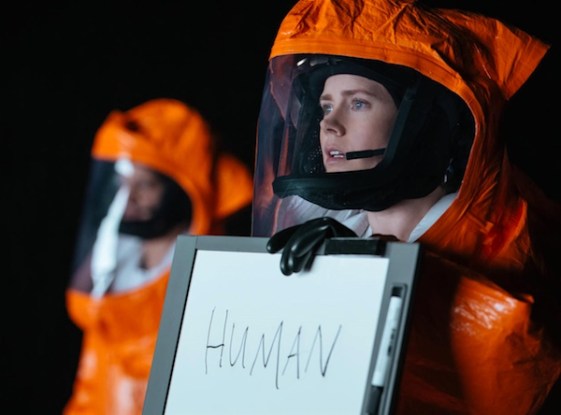
Despite the high-concept setup, Arrival is really a character-driven emotional drama that just happens to be about first contact with aliens. Because of that, it’s not a Sci-Fi Movie in the sense that it needs to explain why the aliens are here — despite what some commenters on the (now defunct) IMDb message boards (and similar places) seemed to think. If you’ve seen the film and are thinking “but it does explain why they’re here?”, you’re right, but apparently we need to know more specifics, otherwise the film hasn’t achieved its “stated objectives”. Yes, I agree, people who say that are talking utter bollocks.
Part of what makes Arrival so good is the way it does work on multiple levels. Despite what I just said, you can enjoy it as a pure science fiction movie, about both the logistics of first contact and some big theoretical ideas that I won’t mention because of spoilers. A lot of effort was put into the concepts underpinning the film, both the scientific theories and the functions of linguistics (the Heptapod language was developed for real; the software used to translate it is a functioning program), so it’s got a dedication to detail that rewards those interested in that aspect. It’s also, again as I said, an emotional drama; effectively a dramatisation of Tennyson’s famous adage “better to have loved and lost than never to have loved at all” through a unique lens. The author of the original story, Ted Chiang, started from more or less that place and then found a sci-fi concept he could use to explore it.

In addition to both of those, it’s also got a timely message about the state of humanity and global politics. This factor is even more pertinent now than when the film came out almost a year ago, mainly thanks to Trump. Just look at the recent willy-waggling between the US’s President You’ve-Been-Tango’d and North Korea’s Supreme Leader It’s-My-Party-And-I’ll-Blow-You-All-Up-If-I-Want-To — it’s the very stupidity that Arrival is warning against. In the film, some soldiers who watch too much nutty television and swivel-eyed internet rants almost fuck things up, while level-headed scientists and experts save the day. If only we could take some of the morons in power these days, and the even-worse people who voted for them, and strap them to a chair in front of this movie until they got the point…
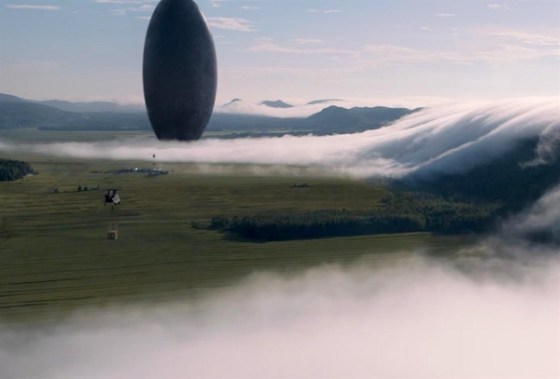
While its greatest power lies in these analogies and emotional beats, it’s also a beautifully made film. Bradford Young’s photography is a little on the gloomy side at times, but it creates a clear mood — director Denis Villeneuve refers to it as “dirty sci-fi”, by which he means “the feeling that this was happening on a bad Tuesday morning”. It’s a pretty accurate description. That doesn’t preclude the film from generating some fabulous imagery, however. The sequence when they first arrive at the spacecraft by helicopter — which follows the choppers over amassed civilians queuing to see the ship, then transitions to a long oner that flies over the makeshift army base towards the giant, unusual alien craft, as clouds roll in over the hills, before continuing on down to the landing site — is majestic, and indicative of the entire film’s attitude to pace. It’s measured, not slow, and all the more effective and awe-inspiring because of it. That’s emphasised by Jóhann Jóhannsson’s atmospheric score, which almost lurks in the background, his work supplemented by Max Richter’s On the Nature of Daylight during the emotional bookends. (The latter is such an important piece to the soundtrack’s effect that Jóhannsson’s work was deemed ineligible for nomination at the Oscars, which is a shame but I can kind of see their point.)
Arrival is a multifaceted film, which works well as both a sci-fi mystery and a reflection of current sociopolitical quandaries, but has its greatest power in the very human story that lies at its heart. The mystery and the twist are almost a distraction from this, actually — I watched the film again last night before finishing this review and enjoyed it even more than the first time. That it’s a movie best appreciated when you can see it in totality, watching it with an awareness of how it will end from when it begins, is only appropriate.

Arrival is available on Amazon Prime Video UK from today.
It placed 6th on my list of The 20 Best Films I Saw For the First Time in 2016, which can be read in full here, and also featured on my list of favourite movies from the past decade, which you can read about here.
* Only in the US, mind, which presumably means they just bought it after someone else made it, so let’s not give them too much credit. ^
 It feels kind of pointless reviewing Avengers: Age of Ultron, the written-and-directed-by Joss Whedon (and, infamously, reshaped-in-the-edit-by committee) follow-up to 2012’s “third most successful film of all time” mega-hit
 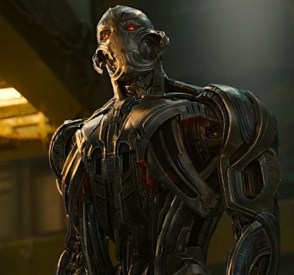 Even though the first half of that is still three years away, we’re still very much on the road to it. Heck, we have been practically since the MCU began, thanks to those frickin’ stones (if you don’t know already, don’t expect me to explain it to you), but now it’s overt as well as laid in fan-friendly easter eggs. The titular threat may rise and be put down within the confines of Age of Ultron’s near-two-and-a-half-hour running time, but no such kindness is afforded to the myriad subplots.
 (not just obvious stuff like the Hulk, but digital set extensions, fake location work, even modifying Stark’s normal Audi on a normal road because it was a future model that wasn’t physically built when filming) that stuff they genuinely did for real looks computer generated too. All that time, all that effort, all that epic logistical nightmare stuff like shutting down a capital city’s major roads for several days… and everyone’s going to assume some tech guys did it in an office, because that’s what it looks like. If you’re going to go to so much trouble to do it for real, make sure it still looks real by the time you get to the final cut. I’ll give you one specific example: Black Widow weaving through traffic on a motorbike in Seoul. I thought it was one of the film’s less-polished effects shots. Nope — done for real, and at great difficulty because it’s tough to pull off a fast-moving bike speeding through fast-moving cars. What a waste of effort!
 The really daft thing is, Whedon specifically added Scarlet Witch and Quicksilver… wait, are Marvel allowed to call them that? I forget. Anyway, Whedon added the Maximoff twins because, as he said himself, “their powers are very visually interesting. One of the problems I had on the first one was everybody basically had punchy powers.” I know Hawkeye’s power is more shoot-y than punchy, and we all know
  At the end of the day, what does it matter? Age of Ultron isn’t so remarkably good — nor did it go down so remarkably poorly — that it deserves a reevaluation someday. It just is what it is: an overstuffed superhero epic, which has too much to do to be able to compete with its comparatively-simple contributing films on quality grounds, but is entertaining enough as fast-food cinema. Blockbusterdom certainly has worse experiences to offer.
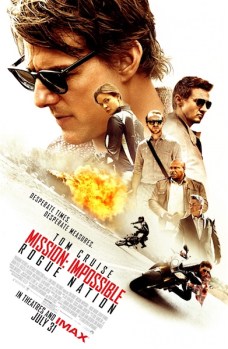 It’s an overcrowded year for spies on the big screen (as
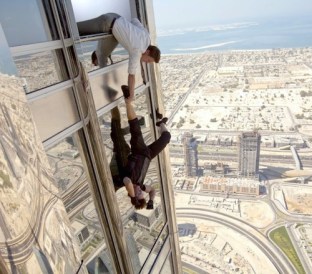
 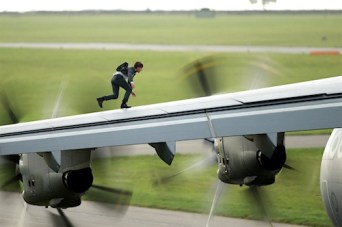 Obviously this uncertainty is also thanks to the story constructed by writer-director Christopher McQuarrie. Some automatically dismiss the plots of the Mission films, saying they’re just an excuse to link some death-defying stunts performed by Mr Cruise. Although there may be an element of truth to that, I don’t think this is a bad storyline by any means. As I said, it’s fairly straightforward (there’s no mole in IMF! Hurrah!), but the intricacies keep it engrossing and keep you guessing. And anyway, the action sequences it ties together are first-rate. You’ve pretty much seen the opening plane stunt in the trailer — heck, you’ve seen it on
 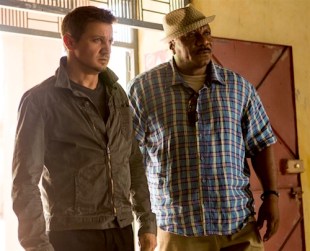 As alluded to above, this is probably the most globetrotting Mission film yet: it starts in Belarus, before taking in Washington D.C., Cuba, Paris, Vienna, Casablanca, and London. It’s things like this that lead me to describe it as a James Bond film. There’s also the balance of a serious plot line with plenty of humour, the use of outlandish just-ahead-of-reality gadgets, and the fact that the series can’t retain a female cast member for more than one film (though that last one isn’t a positive). For all the effort Spectre made to bring classical Bond elements back into the fold, Rogue Nation arguably feels more like a classically-styled Bond movie. It’s not a faultless like-for-like comparison — one of Rogue Nation’s best points as a Mission movie is that the whole team are necessary to complete the mission, a defining factor of the TV series that many felt went awry in the movies, with their focus on Cruise — but the almost-indefinable sensation of this experience is Bondian. It’s not stealing that style, though: considering Ghost Protocol had it too, and Craig-era Bond has abandoned it for a ‘classier’ action-thriller mode, it’s something the M:I series has come to own.
 So on the one hand the recent news that McQ (as current regular collaborator Cruise calls him) is returning to write and direct the sixth Mission is a shame, because it breaks a twenty-year rule; but on the other, I’m not sure it matters. Plus, by taking on the dual role of sole writer and director, you could argue McQ’s Missions are the most auteur-y of the lot, even in spite of the lack of a terribly unique visual style. Which is all a very long-winded way of saying that I was a little disappointed when it was announced there wouldn’t be a sixth director for the sixth film, because I always thought that was a neat idea; but as the idea hasn’t actually had much effect, who better to ask back than the man who wrote and directed arguably the best Mission: Impossible film of them all?
 The cast are liable to get lost among all the grandiose goings-on in a film like this, so its a testament to the skilled team that’s been assembled over the past few movies that they absolutely do not. Cruise is Cruise — surely by now you know whether you like him or not. I always feel like I should dislike him, especially given his crazy real-life religious views, but on screen I find him very entertaining. Rogue Nation is no different. Hunt is on the back foot for a lot of the film, and Cruise is at his best when he’s playing someone who’s almost the underdog. He’s also a more talented comic actor than he’s normally given credit for, and that glimpses through here too. Most of the time comedic duty is handled by Pegg, of course, who provides a good foil as Hunt’s sidekick for much of the film. More surprising, perhaps, is the amount of humour Jeremy Renner brings. It’s much less obvious, dryer and more sarcastic, so the contrasting tone is fun. He’s paired with Ving Rhames for a long stretch, who returns wholesale after sitting out Ghost Protocol but for a cameo. The pairing may come up just short of feeling inspired, but nonetheless makes for an entertaining change. Elsewhere, Baldwin offers a neat, not-too-clichéd turn as the CIA ‘villain’, while Tom Hollander pops in for a funny cameo-level turn as the British Prime Minister.
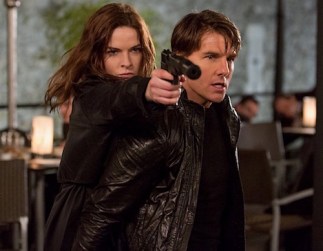 As the fifth film in a franchise that has always carried a slight “pretender to the throne” air, Rogue Nation should feel played out and tired. Instead it seems fresh and invigorated, with a spot-on tone, likeable and fun characters, a real sense of jeopardy and menace (missing in so many modern action films), and some of 2015’s very best action scenes — and in the year of Fury Road, that’s really saying something. McQuarrie has
 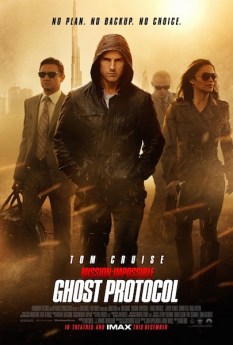 With Bond going “real world” and gadget-free in the Daniel Craig era, and the Bourne series having blazed a trail of “we shot it all handheld and shaky and grainy so it must be real” veracity, it seems the task of providing audiences with a contemporary version of the spy action, just-ahead-of-reality gadgets, and larger-than-life spectacle that the Bond movies specialised in during the ’60s and ’70s, has fallen upon the Mission: Impossible franchise. For my money, it’s taken the baton with aplomb.
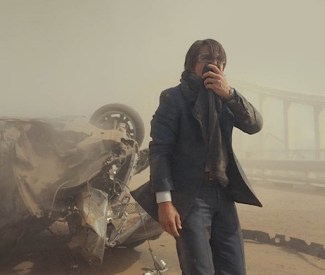 Somewhat unfortunately for pacing, they come halfway through. The climax is a mano-a-mano fight in an automated car park. It’s good, but feels underwhelming by comparison, with Michael “
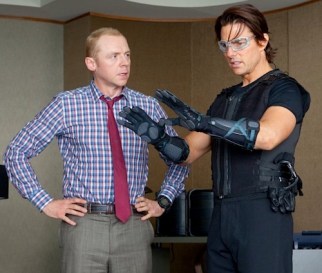 There’s a host of other gadgets to be going on with, though. It may be a side effect of having the writer-director of
  Still, that’s a fault of the home entertainment release, not the film itself. In all other respects, Bird’s work is first-rate. I like that the series consciously changes director with each new film to provide new ideas and voices, but if they were going to break the pattern then Bird would’ve been a good guy to allow back (certainly a superior pick than the third film’s J.J. Abrams, anyway, who was originally slated to tackle this sequel too).
 2014 Academy Awards
 “Don’t put metal in the science oven!”
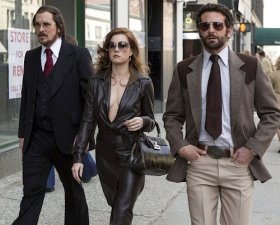 I never connected with the characters, so consequently never felt their predicaments, either romantic or professional. A halting chronologically-challenged start gives way to a middle that ultimately drags, before a “gotcha!” ending whose straightforwardness means it lacks the memorable punch of the best con movies.
 As Jason Bourne flits around London and New York making trouble for what’s left of Treadstone, a group of shady men go about safeguarding their own secretive activities. When Bourne exposes Treadstone, a series of convoluted join-the-dots links means it could bring them down too, so they set about destroying their risky initiatives, including killing a bunch of medically-enhanced operatives. What they didn’t count on was one surviving…
 For my money,
  Perhaps also, after four films, he’s too close. Clearly that has advantages for remembering the intricacies of the timeline and continuity, especially with the trilogy’s increasingly complex web of conspiracies and conspirators; but maybe Gilroy has become too deeply embroiled in that. After all, he thinks it’s OK to spend the first half hour of the film connecting up the dots between the previous story and his new plot — who really wants that? That’s for geeky fans to do later.
 At the end, the two films come together, adding a few seconds more story to what we saw at the end of IV, and ready to move on with unified purpose (well, sort of) in
  is wasted staring at monitors; Albert Finney is literally wasted, his one meaningful moment relegated to the Blu-ray’s deleted scenes section; Zeljko Ivanek gets a pivotal character but is underdeveloped and so his talents are wasted; and some actors from previous Bourne movies appear to be credited merely for use of their photos, until they turn up for ten-second cameos near the end that you’d rather weren’t there because it means someone is planning on a Bourne 5.
 100Films.co.uk