
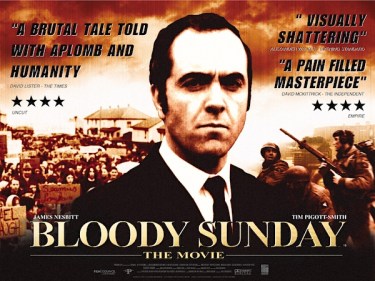
a day written in history
a day when innocence died
when truth was sacrificed
and lives were changed forever
Country: UK & Ireland
Language: English
Runtime: 110 minutes
BBFC: 15
MPAA: R

Original Release: 20th January 2002 (UK)
First Seen: TV, 20th January 2002
Stars
James Nesbitt (Millions, The Hobbit: An Unexpected Journey)
Tim Pigott-Smith (The Remains of the Day, V for Vendetta)
Nicholas Farrell (Chariots of Fire, Hamlet)
Kathy Kiera Clarke (The Most Fertile Man in Ireland, Cherrybomb)
Director
Paul Greengrass (United 93, Captain Phillips)
Screenwriter
Paul Greengrass (The Murder of Stephen Lawrence, United 93)
The Story
Derry, Northern Ireland, 30th January 1972: MP Ivan Cooper leads a peaceful march to protest internment. British paratroopers observing the march, geed up after previous conflicts, respond to minor rioting by shooting into the unarmed crowd and at fleeing civilians.
Our Hero
James Nesbitt stars as MP and civil rights activist Ivan Cooper, a Protestant who was elected in a mostly Catholic constituency, and the organiser of what was supposed to be a peaceful protest march.
Our Villains
The British Army don’t come across in the best light, with Tim Piggot-Smith’s Major General Robert Ford issuing hostile orders, and the troops eager for a fight. The depiction is tempered by Nicholas Farrell as Brigadier Patrick MacLellan, battling his conscious even as he must carry out his orders.
Memorable Quote
“I just want to say this to the British Government. You know what you’ve just done, don’t you? You’ve destroyed the civil rights movement, and you’ve given the IRA the biggest victory it will ever have. All over this city tonight, young men — boys — will be joining the IRA, and you will reap a whirlwind.” — Ivan Cooper
Memorable Scene
After the day is done, Ivan Cooper delivers the above statement at a press conference. Intercut, at inconspicuous locations and under the cover of dark, young men queue up to join the IRA.
Technical Wizardry
Shot handheld on 16mm by cinematographer Ivan Strasburg, Bloody Sunday looks like news footage. It’s not trying to pass itself off as documentary, but rather it places the viewer in the heart of events. Clever shot selection and Clare Douglas’ editing mean that, even though a sense of confusion is evoked, the chronology and geography of events is maintained.
Making of
“Making the film Bloody Sunday was important for me, not only as an actor but for my understanding of myself as an Ulsterman. It helped me realise that this episode was the watershed, and that the ensuing 30 years of conflict in Northern Ireland were in large part due to what happened that day in 1972. For it was on that night that young men all over the country joined up with the IRA in a sense of rage and injustice at what had happened.” — James Nesbitt, The Independent
Awards
1 BAFTA TV Award (Photography and Lighting)
4 BAFTA TV Award nominations (Actor (James Nesbitt), Single Drama, Editing, Sound)
2 British Independent Film Awards (Actor (James Nesbitt), Director)
3 British Independent Film Award nominations (Best British Independent Film, Screenplay, Technical Achievement (Cinematography))
4 Irish Film and Television Awards (Feature Film, Director, Script, Sound)
4 Irish Film and Television Award nominations (Actor (James Nesbitt), Actress (Kathy Kiera Clarke), Photography, Editing)
Won the Golden Bear at the Berlin International Film Festival (tied with Spirited Away).
What the Critics Said
“you have to remind yourself at moments that you’re not looking at a documentary. […] Filmed in 16mm, with a hand-held camera that seems to be breathlessly attempting to keep up with the chaotic events, the movie has a stunning immediacy. It doesn’t feel as if Greengrass has staged the events, but that his camera (in the expert hands of cinematographer Ivan Strasburg) happened to be there when the tragedy occurred, a witness to the British officers’ planning, to the marchers’ anger and panic, to the soldiers’ gung-ho macho and to the cover-up that followed.” — David Ansen, Newsweek
 Score:
 92%
92%What the Public Say
“The film has been criticized by some as focusing too much on the Cooper character, encouraging a “great man” view of history. This criticism seems overblown when one considers the breadth of Bloody Sunday, but Greengrass does acknowledge an interest in placing Cooper at the fore as a kind of “man between worlds,” being a Protestant politician campaigning for peace across Northern Ireland and for civil rights denied to his Catholic countrymen.” — spinenumbered, Make Mine Criterion!
(Be advised, the Criterion Collection edition of the film described in this article is wishful thinking rather than a genuine release.)

Bloody Sunday is a tough film to write about in a somewhat frivolous format like this one. It’s a film about a terrible moment in history, a shameful day for the British Army and a tragic one for the people of Northern Ireland, which it presents with documentary realism and an objective perspective, more concerned with presenting the facts as best it can than with apportioning blame. Even given that, it’s an inescapably emotional and affecting film. Powerful moviemaking.

#15 will be… extreme ways.
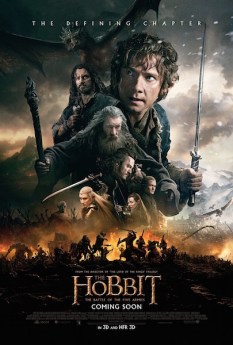 Peter Jackson’s epic Tolkien adaptation blunders its way to a conclusion with an instalment some have declared the trilogy’s best, presumably because they really enjoy watching someone else play video games. That’s what about half of this sextet-completing movie feels like, as it concludes the three-part Hobbit narrative with a CGI-riddled rendering of the titular battle. It’s the shortest film in Jackson’s Middle-earth magnum opus, though it comes to something when a film the best part of two-and-a-half hours long is described as “short”.
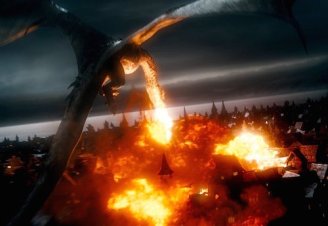 or he could have ended the second film with Smaug defeated and added more material to this third film to reach his desired running time. Or not even bothered adding stuff: if you lost the Smaug opener, The Battle of the Five Armies would still be over two hours long, which anywhere but Middle-earth is considered a decent length for a movie.
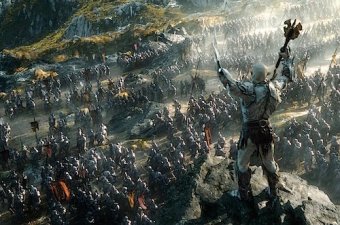 On the ground, the meat of the conflict only occurs when individual heroes are parcelled off into one-on-one duels. None of these particularly stand out, however, other than Legolas athletically jumping around a collapsing bridge that’s all so much CGI. This is where my earlier video game comparison really comes into play.
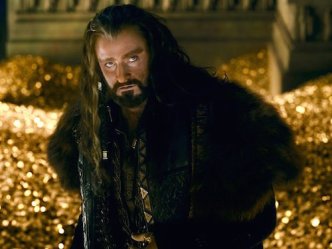 all of whom I’d thought would have more to do in the second and third parts of the trilogy. Turner, in particular, should have expected a bigger boost from Jackson’s decision to enrol him in an interracial romantic triangle, but it feels like they pulled back from that story thread a little after it proved unpopular in the previous film. It’s still obviously there, I just expected more of it.
 I was something of a defender of Jackson’s version of The Hobbit at first. I enjoyed An Unexpected Journey and stand by
 100Films.co.uk