
Tim Miller | 128 mins | Blu-ray (UHD) | 2.35:1 | USA, China, Spain & Hungary / English & Spanish | 15 / R
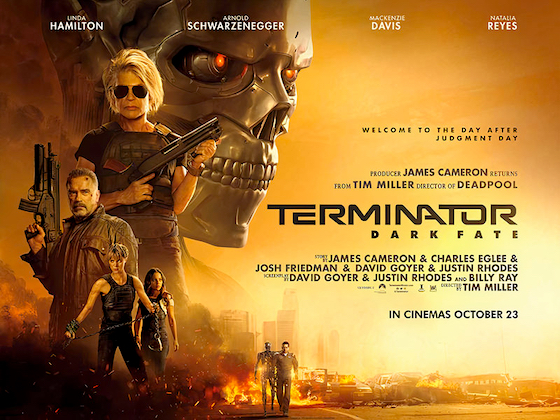
“I’ll be back,” the Terminator famously said in The Terminator, and he has been proven right — again and again. And again. This may be a franchise about time travel, but it’s us who seem to be stuck in some kind of time loop, because this is now the third attempt at creating a direct sequel to Terminator 2. For those keeping score, the first was literally titled Terminator 3; then there was TV series The Sarah Connor Chronicles, which picked up from T2 (pretending T3 didn’t exist); and now this ignores them both. It also ignores the other attempts to keep the Terminator franchise alive: Salvation, which actually continued the storyline on from T3 (albeit with an entirely new cast); and Genisys, which attempted to be both a sequel and a reboot.
As well as being the third Terminator 3, Dark Fate is also the third attempt to start a new trilogy (Salvation and Genisys both arrived with such lofty plans), and is now the third to see those plans aborted after poor box office. Salvation made just $125.3 million at the US box office and $371.4 million worldwide — big numbers, but not when your movie cost $200 million. Hence starting again with Genisys — but that was an even bigger flop at the US box office, taking just $89.8 million. Worldwide, it took a respectable $440.6 million (more than Terminator 3, even), which, off a lower budget of $155 million, is pretty good. But US studios continue to struggle to see beyond their own borders, and so that trilogy was abandoned too.
Both of those movies tried something new for the franchise. Salvation took us into the Skynet-ruled future, something the previous movies had only had as a threat to be averted. Genisys played more with the idea of time travel, taking us back into the timeline of the first movie, but different. Now, Dark Fate explicitly wipes out previous continuity, beginning with a flashback that directly follows on from T2 but sets us on a new path, introducing new heroes and villains, alongside the return of the original Sarah Connor, Linda Hamilton (who was written out of T3 and recast in Chronicles and Genisys). Surely that would solve the box office problem? No: it took $62.3 million in the US and just $261.1 million worldwide, the worst yet by any measure.

Box office is not indicative of quality, of course, but audience reception of Dark Fate hasn’t been any better than previous attempts to continue Terminating: if you look at IMDb scores, Dark Fate has 6.2 to Genisys’s 6.3, while Salvation has 6.5. None of them are stellar, but all are solid; and, with hindsight, suggest the producers should’ve just stuck it out with one of the previous versions. Indeed, I think trying to sell Dark Fate as “another restart” probably just put more people off. The Terminator franchise has become such a tangle of forgettable messes, aborted plans, and “this is a sequel to X but not Y”-type ventures that, for your average cinema-goer, it’s easier to just ignore it than engage with what counts and what doesn’t.
All of which is to review the film’s box office performance rather than the movie itself. But I’m more or less with IMDb voters on this one: the behind-the-scenes story is almost more interesting than the film itself. Not that it’s a bad movie, but it’s little more than a serviceable sci-fi action-adventure flick, hobbled somewhat by a palpable sense of desperation to emulate the cultural impact and success of Terminator 2. That’s the real reason none of these continuations have been allowed to stick: because none of them equalled T2. Such a goal is a hiding to nothing; a fight you stand almost no chance of winning. T2 is regarded as a Great Movie; a seminal entry in the sci-fi and action genres; influential and beloved. Thinking you can equal that is like making a gangster movie with the view that “if this isn’t regarded as at least equal to The Godfather, I have failed.” You’re setting yourself up to lose. In Terminator’s case, they’ve had that loss three times in a row, with ever-diminishing financial returns, to the point where anyone setting out to make Terminator 7 is going to be looked on as mad. What do you do with it now? You can’t reboot it again! But nor can you reasonably make a sequel to any previous version. They have, literally, killed the franchise. (Well, they probably haven’t — someone will almost inevitably continue it someday — but it’s going to be harder than ever to persuade anyone to finance that.)

Perhaps some form of spin-off will be seen as the next thing to try, but — spoilers! — that’s basically what Dark Fate tries to kickstart. Sure, Schwarzenegger and Hamilton are here, and the events of T2 are directly referenced and continued; but Skynet is no more and there’s a new war to fight. On the bright side, with a new future, a new threat, and an apparent aim to transition from old characters to new ones, it doesn’t feel stuck on the merry-go-round like the previous sequels did. It’s at least trying to move on in a (slightly) new direction, rather than just rehash the familiar. The problem (and it has been a big problem for some fans) is that by abandoning certain key tenets of the franchise (John Connor being the ‘Chosen One’; Skynet), it doesn’t feel so much like Terminator 3 as Terminator: The Next Generation. But, hey, that worked for Star Trek! After so many sequels that tried to find new angles to rework familiar bits and bobs, isn’t it about time someone tried something new, even if it’s in a very similar mould to what came before?
Well, it’s a moot point now, because Dark Fate Part 2 ain’t happening. We can only take some small measure of solace in the fact that it isn’t as open-ended as Genisys was; and that, whatever any other filmmaker tries and fails to achieve with this franchise, we’ll always have Terminator and T2.

Terminator: Dark Fate is available on Sky Cinema and Now TV from this weekend.





 I liked
  Now, a good idea doesn’t guarantee a good execution, and here is where we begin to encounter Genisys’ problems. Time travel is a tricksy thing to engage with in fiction, and is highly prone to creating plot holes — something blockbusters regularly struggle with anyway. Genisys has at least one glaring one. Then there’s the general level of quality — the screenplay, acting, effects, and so on. In this regard, I suspect the reason so many people reacted so badly to it is that it follows, and riffs off of, two of the greatest sci-fi/action movies ever made. In and of itself, Genisys is no worse than any of the other half-dozen-or-so middle-of-the-road $150-million-plus-budgeted blockbusters we’re routinely served every year now. If you instead compare it to its iconic forebears, however, it comes up much shorter.
 And yet the man who was responsible for those remarkable pictures, James Cameron, was impressed by it. He’s interviewed among the film’s special features, where he explains, “can I guarantee that you’ll enjoy it? No. I just know that I enjoyed the film, you know. But I strongly suspect that… you’re gonna love this movie.” Well, he was way wrong there! You almost feel a bit sorry for everyone in those special features, actually. They’re all so confident that Genisys is a great, well-made movie that everyone’s going to love, and they have big plans for a trilogy which they keep talking up. I would love to see their reactions after the reviews and box office figures came in…
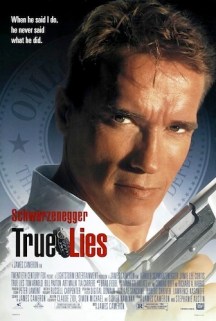 Quite how I’ve not got round to seeing True Lies until now is a little beyond me. Perhaps — no, definitely — if they’d re-released a better edition on DVD I’d’ve bought it and seen it then; but they never did, and so it’s taken ’til now to reach the top of my rental queue (not that my rental service works that way) and ‘force my hand’, as it were (because it’s certainly been on TV enough over the years).
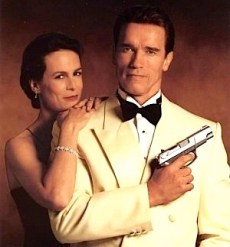 audacious things that might get laughed out in a straight actioner. The demise of the villain, for instance, is a great idea and great fun, but would be a step too far normally; but here that’s OK, because it’s allowed to be funny as well as cool.
 to do everything themselves (and even if they don’t their face gets CG’d on).
 So many consumers hold off for the DVD these days, especially with the added quality offered by Blu-ray, that the old answer of “what was released in the cinema” doesn’t necessarily hold true any more. Filmmakers know some will be waiting for the DVD, so are less concerned with releasing a studio-mandated, shorter, mass audience friendly cut into cinemas when their fuller vision can be found on DVD. Equally, the PR people know that “longer cut!” and “not seen in cinemas!” and other such slogans can help sell DVDs, and so may be forcing needless and unwelcome extensions onto filmmakers. Then there’s all those older directors who think they’re doing a good thing finally getting to tamper with their film 30 years on, who may well be misguided.
 There remains one argument for clarity, I think. How does one guarantee that, in the future, the ‘correct’ version remains accessible? With new formats always coming along, there’s no assurance that every cut of a film will be released; with TV showings, there’s no assurance the preferred version will always be the one shown (though there’s another argument for how much the latter matters considering they already mess around with aspect ratios and edits for violence/swearing/sex/etc.) But then, even if a filmmaker makes it clear that their preferred version is the one that only came out on DVD/Blu-ray, what chance is there that unscrupulous disc / download / unknown-future-format producers or TV schedulers won’t just revert to the theatrical version by default?
 100Films.co.uk