
Martin Scorsese | 124 mins | DVD | 1.85:1 | USA / English | 18 / R
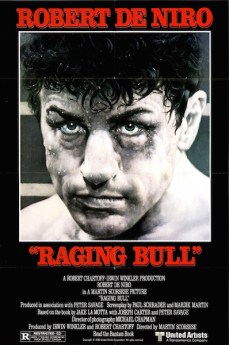 It would be boring if we all liked the same stuff, wouldn’t it? I’m sure there’s at least one ‘universally’-loved classic that we each dislike. Heck, tends to be every ‘universally’-loved classic has at least one Proper Critic that dislikes it. The flip side of this is that, in my opinion, if you don’t like something that everyone else does, there’s a fair chance it’s you who’s missing something. That’s a rule I apply to others, naturally, but I also try to bear it in mind myself (and, at the risk of sounding terribly arrogant, I think a few more people could do with thinking the same).
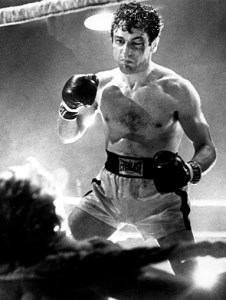
Given that introduction, I guess it’ll come as no surprise that I didn’t get on very well with Raging Bull. We’ve established before that I don’t like boxing (see: Million Dollar Baby, which (I’ll say now) I didn’t like more than Raging Bull, but has a higher score because I was softer back then), but I don’t think that precludes me from enjoying a film set in that world. Anyhow, I wouldn’t say Scorsese’s biopic pitches the sport as an aspirational one full of honour and wonder or something. And indeed, the boxing scenes were some of the bits I liked the most — they’re very well done; immensely effective. Unfortunately, they make up barely ten minutes of the running time, and it was the rest I didn’t care for.
Robert De Niro stars as wannabe-a-contender boxer Jake LaMotta, as he grows in stature — both his reputation and physically — and also grows ridiculously paranoid, which is probably the kind of thing that happens when you spend years being repeatedly punched in the head. This arc seems to unfold through interminable scenes of people mumbling semi-unintelligibly at each other, realised with a style of camerawork, editing, and acting that seems to be aiming for documentary-like realism, which has both pros (realism) and cons (s’boring).
 The aforementioned fights, on the other hand, are full-on Cinema, and glorious for it. The make-up is also very good. Relatedly, De Niro’s physical transformation, from lithe boxer to washed-up fatso, is remarkable. Decades before the likes of Christian Bale and his Machinist/Batman Begins flip-flop, De Niro gained a then-record-setting 60lbs.
Mixed technical success aside, I was never sure what the film was really meant to be about. Things turn up and go nowhere — like, what happened with that 14-year-old girl in his club? One second he’s been arrested, then it’s a couple of years later and he’s slumming it as a stand-up in New York; then, just as fast, he’s doing some kind of literature recital to a packed house. I mean, what? I would say that this is a film only of interest to people who are already fans of LaMotta and want to see some of his life on screen, but clearly that’s not the case. That’s certainly how it felt to me, though; and it’s what I would believe too, were it not for 35 years of widespread appreciation that demonstrates I’d be wrong.
 Based on where we find him at the end, I guess LaMotta would appreciate a Shakespeare quotation. For all the film’s “greatest of all time” acclaimedness, this is the one that came to my mind:
Life’s but a walking shadow, a poor player
That struts and frets his hour upon the stage
And then is heard no more. It is a tale
Told by an idiot, full of sound and fury
Signifying nothing.
You can’t win ’em all, right?

Raging Bull was meant to be viewed as part of my What Do You Mean You Haven’t Seen…? 12 for 2013 project, but I missed it. I’ve righted that as part of my What Do You Mean You Haven’t Seen…? 2015 project, which you can read more about here.
 100Films.co.uk