
Jean-Luc Godard | 103 mins | DVD | 2.35:1 | France & Italy / French, English, German & Italian* | 15
 Le Mépris establishes its two main themes with its two opening shots. First, a static shot of the film’s cinematographer, Raoul Coutard, filming a scene from the film, over which writer-director Jean-Luc Godard reads out the credits, which never appear on screen. This is a movie about moviemaking, and its inherent artifice. Second, a shot of Brigitte Bardot’s naked bottom. This is a movie about a man being in love with Bardot (well, the character she plays), and another man lusting after her, and what happens when the first man pats a different bottom. Maybe.
The first man is Michel Piccoli, playing a playwright turned screenwriter who is only in it for the money, to buy a flat to share with Bardot to keep her happy. But she doesn’t want it. Or she does. Or maybe she doesn’t. The second man is Jack Palance, playing an American studio executive who’s paying the writer, but who seems to covet Bardot. It’s his assistant/translator whose bottom gets patted, in a relatively innocent matter. As innocently as an attractive Frenchman in Italy in the ’60s ever pats a woman’s bottom, anyway. The film is being directed by Fritz Lang, playing Fritz Lang, who comes out with some words of wisdom but mainly is present to represent the art of cinema. The playwright doesn’t see it as art, because it’s not a play. The producer doesn’t want it to be art, because he wants to make money.
All of this plays out over a day or two in some very long scenes. Indeed, the centrepiece is a 34-minute quiet, passive-aggressive argument between the playwright and Bardot in the aforementioned flat. 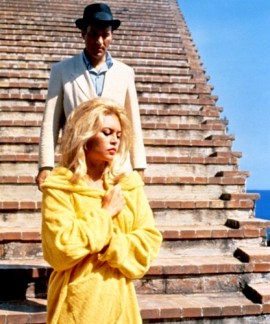 They go round in circles about staying together or being apart. The point? Your guess is as good as mine. Perhaps it’s the unknowableness of the other gender (whichever gender you are). Perhaps it’s just the unknowableness of other people fullstop. Perhaps it’s the unknowableness of our own emotions — eventually Bardot decides she does want to leave the playwright to run off with the producer, but no one seems to know why.
Apparently it’s somewhat autobiographical. Maybe that explains everything.
There are attractive performances from all concerned, and gorgeous saturated cinematography by Coutard. The location manager has also done superlative work, from the run-down mostly-deserted Cinecittà studio the film opens in, to the stunning and unusual holiday home in Capri where it comes to a head. Even if you’re left a little baffled by the exact point of what you’re watching, at least it’s pretty to look at.

Le Mépris was viewed as part of my What Do You Mean You Haven’t Seen…? 2015 project, which you can read more about here.
This review is part of the 100 Films Advent Calendar 2015. Read more here.
* All 4 languages are prominently spoken at times, but it’s mainly French, with a big dose of English from Jack Palance. On the Criterion DVD, the German and Italian parts aren’t even unsubtitled. ^
 Jack Palance is an actor wanting out of his studio contract in this stagey film noir.
 Partially driven by a seeming twist that’s obvious from the outset (which, in fairness, the film reveals only 40 minutes in), the story never quite comes alive. Palance and Corey make parts worth watching, but at other times it’s a bit of a slog, not helped by an awful score that chimes in now and then, loudly. Expansive cinematography (so much headroom — was it shot to be cropped for widescreen? Perhaps it was) combats any feeling of claustrophobia the single location and oppressive moral situation might have leant it.
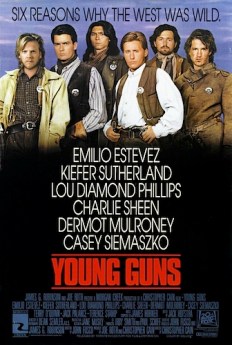 Way back in March, the ever-excellent Colin at
 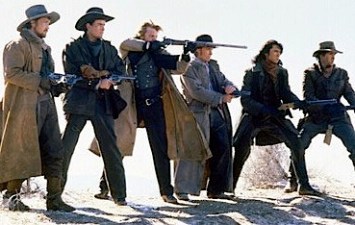 Though if someone was planning to use Young Guns to research the real-life facts of these events, more fool them in the first place. Wikipedia says (without citation) that “historian Dr. Paul Hutton has called Young Guns the most historically accurate of all prior Billy the Kid films”. We’ll leave it at that for now.
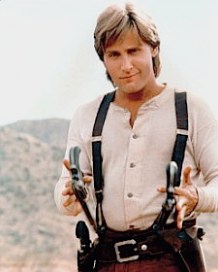 And that’s without mentioning the overuse of dated slow-motion that descends upon its eventual climax.
 Young Guns is not a particularly likeable film, managing to miss both its potential target audiences: it’s not serious-minded enough for Western enthusiasts, let down by the Brat Pack cast and (it seems) historical accuracy; but it’s surely not fun or modernised enough to appeal to a younger (or younger-minded) crowd. Though clearly it did well enough as it spawned a sequel two years later. I didn’t hate it, I just didn’t particularly like it.
 100Films.co.uk