
When Andy Williams sang “it’s the most wonderful time of the year”, he was on about Christmastime; but ’round these parts, the real most wonderful time of the year comes a little later: in early January, with the annual statistics post. And, friends, that time is here again.
Before the onslaught of numbers and graphs begin, a couple of quick reminders. Primarily: these stats cover my first-time feature film watches from 2024, as listed here. Shorts and rewatches are only factored in when expressly mentioned.
Secondly, and finally: as a Letterboxd Patron member, I get a yearly stats page there too, which can be found here. The numbers will look a bit different, because I also log whatever TV I can, plus it factors in shorts and rewatches more thoroughly, but that’s part of what makes it interesting as an addition/alternative to this post. It also breaks down some interesting things not covered here, like my most-watched and highest-rated stars and directors.
Now, without further ado, here’s what you came for…
I watched 131 feature films for the first time in 2024. That puts it right in the middle of the history of 100 Films: out of 18 years, it ranks ninth largest (or tenth smallest).
Of those 131 films, 85 counted towards my 100 Films in a Year Challenge. Alongside 15 rewatches, that means I finally reached all 100 films for my Challenge for the first time in its new form. More thoughts about that in the Final Standing and December review posts.
Outside of the Challenge, I rewatched only two further films for a total of 17 rewatches. That’s my lowest number since 2016, which was the last year before I started to make a concerted effort to up my rewatches (first with the Rewatchathon from 2017 to 2020, then by including them as a category in my Challenge). Any number going down is a shame, but there are always going to be compromises somewhere — if I’d rewatched more, I likely would’ve watched fewer new films.
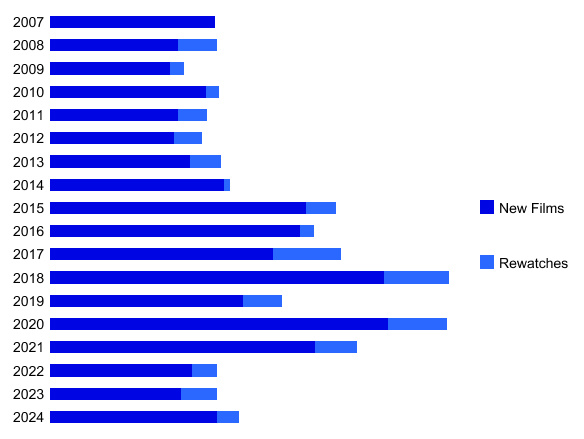
NB: I have no rewatch data for 2007 and only incomplete numbers for 2008.
Here’s how that viewing played out across the year, month by month. The dark blue line is my first-time watches and the pale blue is rewatches. Both lines are much flatter than normal (I mean, look at 2023’s), which is because I was consistently hitting my “ten films per month minimum” goal but rarely managing to exceed it (the spikes in April and December being notable exceptions).

I also watched 16 short films. That might not sound like a lot, but it’s actually my third highest total ever, behind only 2019’s 20 and 2020’s 65 (which was so high thanks to watching many for film festivals I was working on), and just ahead of last year’s 15. On the other hand, only 11 were ones I’d never seen before, down marginally from 12 last year. (For some reason I didn’t make that distinction in last year’s stats, but it does affect the total running time, because only the new ones count.)
The total running time of my first-watch features was 229 hours and 3 minutes. That’s my highest since I revamped the site for 2022, but only ninth overall. The same ranking as for the film count? It’s almost as if there’s a correlation! I jest, but what it does suggest is that I rarely, if ever, watch a disproportionate number of especially-short or especially-long films. Talking of short things, add in the (new) short films and that total rises by only just over an hour to 230 hours and 14 minutes. (The additional bit is labelled as “other” on the graph because it would also include any alternate cuts of features that I watched for the first time, but there weren’t any this year. In fact, it’s been five years since there were.)

Formats next, and after disappearing last year, TV is back! Okay, it’s only got one film to its name (thanks to the BBC for premiering a new Wallace & Gromit feature on Christmas Day), but it’s something, I guess. Unless there’s another similar must-watch-live event in 2025 (doubtful), I imagine it will drop off again next year.

It will come as no surprise that the year’s most prolific viewing format was digital with 85 films. At 64.9% of my viewing, it’s an increase on last year, though still below the peak of 2020–2022. It was below 50% in 2019, and I’d like to get it back down there in favour of Blu-rays.

“Digital” encompasses a multitude of different platforms and viewing methods, and this year it was downloads that topped them with 20 films (23.5% of digital). Of the streamers, it was actually NOW that emerged victorious for the first time, with 18 films (21.2%), knocking Netflix and Amazon Prime into shared third place with 16 films (18.8%) each. Surging slightly ahead of the “also ran”s, iPlayer accounted for eight films (9.4%), while bringing up the rear were Apple TV+ on three (3.5), Disney+ and MUBI each on two (2.4%), and newcomer Crunchyroll with one (1.2%). Crunchyroll is all about TV and has hardly any films (I think I found a grand total of four), so don’t expect to see them return (although it’s not an impossibility).
Back to the main ranking, Blu-ray did come second with 38 films (29.0%), a raise in number but drop in percentage from last year.
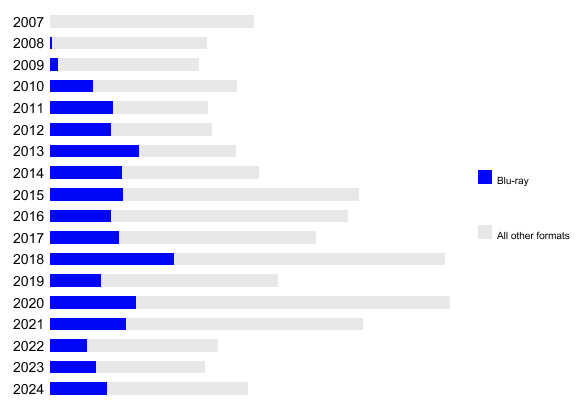
Last year I noted that the addition of a Physical Media category to my Challenge hadn’t actually done much to boost the number of DVDs I watched. This year I took that category away, and DVD did drop slightly, down to six (4.6%); but, considered over a longer timescale, it’s held pretty steady — just look at the graph:
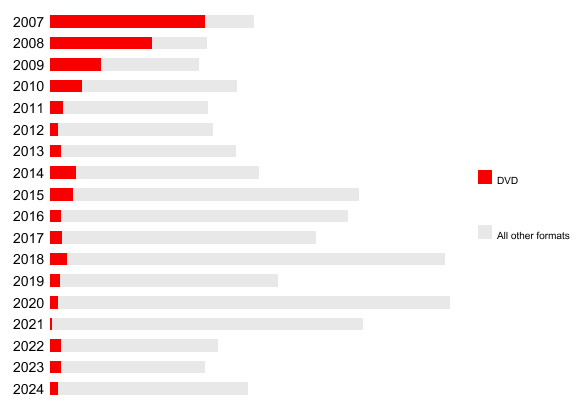
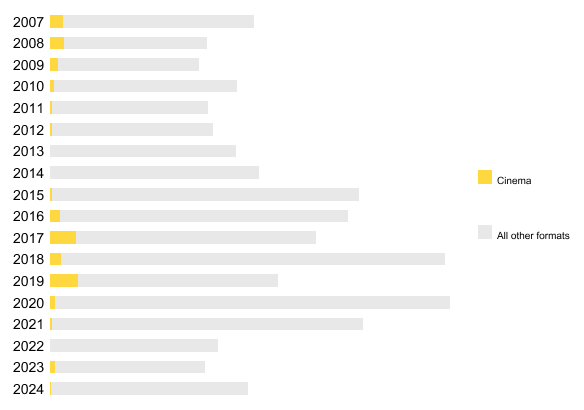
Finally, I made just one trip to the cinema this year (for Dune: Part Two). Other things piqued my interest, but nothing else panned out. Will 2025 fare any better? Well, I’ll be sure to catch the next Mission: Impossible, at least. Hey, one is still better than I managed some years (2013, 2014, and 2022, I’m looking at you).
Looking at formats from a different angle, now. First: in 2024, I watched as many new films in 3D as I did in 2021–2023 combined. Okay, that was still only four, but it’s an improvement. Looking at my Blu-ray collection, I own 63 films in 3D that I’ve never seen (plus about the same again that I’ve seen but not in 3D), so this number should be significantly higher. Maybe I’ll finally boost it up in 2025. (The first number to beat is 2020’s 13. The best ever is 2018’s 18.)
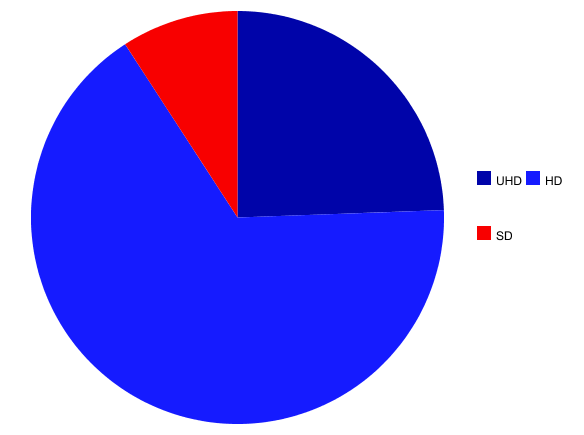
Next, the format du jour, 4K Ultra HD (it still feels pretty new to me, though 4K discs are about to hit their 9th anniversary). I watched 32 films in UHD in 2024, which is a numerical increase from 2023’s 27, but a percentage drop: 24.4% vs last year’s 26.2%. Still, it’s my second best percentage ever, so that’s not nothing. 1080p HD remains the standard, of course, representing a sliver under two-thirds of my viewing at 66.4%. Meanwhile, SD lingers on with 12 films — a hold from last year, but a percentage drop to 9.2%, only the second year it’s been under 10%. Will it ever go away entirely? It would be nice, but there remain plenty of films without even a DVD-quality SD copy out there, never mind all the DVDs that have never received an HD release.
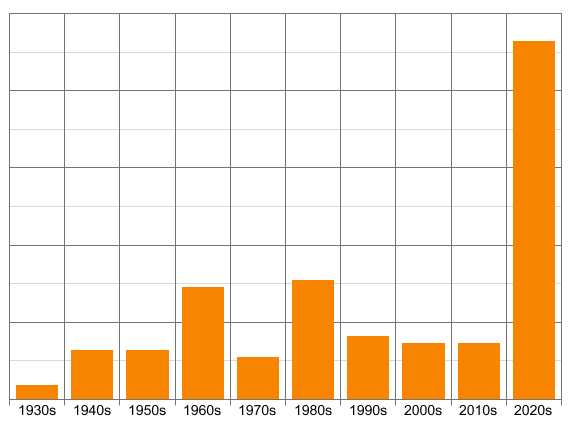
Some people would think that the fact I’m watching so many films in high quality means I’m mostly watching new stuff, but those people are misinformed. Okay, so the the 2020s remains my top decade with 51 films (38.9%), its highest total yet; but other recent decades fare less well, with the 2000s and the 2010s in joint fifth with just eight films (6.1%) each. That’s the third year in a row that my top two decades haven’t been the most recent two; before that, it only happened in 2010 (understandably) and 2019.
The decade that actually landed second place was the 1980s with 17 films (12.98%), closely followed by the ’60s on 16 (12.2%), while the ’90s took fourth with on nine (6.9%). After the first two decades of this century, we come to another tie: the ’40s and the ’50s on seven (5.3%) each. Things are rounded out by the ’70s on six (4.6%) and the ’30s on two (1.5%). No features from before 1932 this year, although I did watch two shorts from the 1920s, five from the 1900s, and even one from the 1890s.
You might think no films from before 1932 would mean no silent films, but there was actually one. At this point I think we’re all aware they still make technically-silent films sometimes, and this year the qualifier was Robot Dreams. I still need to watch more genuine silents from the actual era though, and (minor spoiler alert!) some are almost guaranteed to feature in 2025.
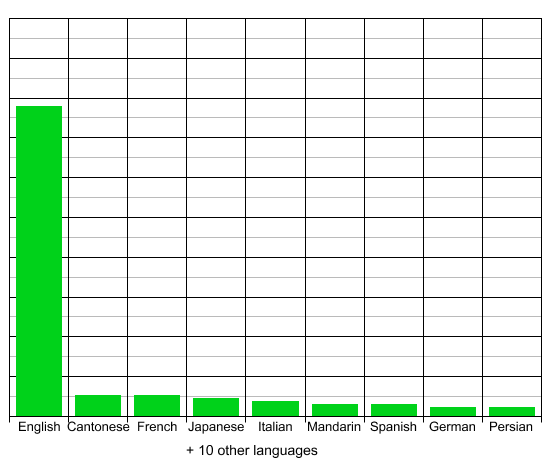
As for spoken languages, English dominated as always, with 102 films wholly or significantly in my mother tongue. At 77.9%, it’s a couple of points up on last year, but still below any previous year. Nonetheless, second place is a distant tie between French and Cantonese in seven films (5.3%) each. They’re closely followed by Japanese in six (4.6%), Italian in five (3.8%), Mandarin and Spanish each in four (3.1%) each, and German and Persian in three (2.3%) apiece. In total, 19 languages were spoken in 2024’s viewing, including Czech and Telugu for the first time on record, and Swedish for the first time since 2020. That tally is better than 2022 or 2023, but still below 2015–2021.
In terms of countries of production, the USA drops below 50% for the first time ever, its 64 films accounting for just 48.85%. Meanwhile, the UK reaches a new percentage high, with 43 films coming out at 32.8%. Lest you think I’m going to brag about being worldly, I’ll note that only 29.0% of films didn’t feature either the US or UK among their listed production countries. Still, there were 31 countries in total in 2024, which is among the better years since I started recording this stat (the highest is 2020’s 40). France were third for the fourth year in a row with 17 films (12.98%), followed by Japan with 11 (8.4%), Hong Kong with nine (6.9%), Italy with eight (6.1%), then a three-way tie between Australia, Canada, and Germany each with five (3.8%).

A total of 114 directors plus eight directing partnerships helmed the feature films I watched in 2024, with a further six directors and four partnerships behind my short film viewing. For the second year in a row, no one was responsible for more than two features, but those with a duo on the list were Abbas Kiarostami, Denis Villeneuve, Joseph Kuo, Joseph L. Mankiewicz, Oliver Parker (not to be confused with Ol Parker, who also had one), Robert Tronson, Sammo Hung, W.S. Van Dyke, and Wellson Chin. Plus I watched three shorts credited to British cinema pioneer Cecil Hepworth.
This is my tenth year charting the number of female directors whose work I’ve watched each year. I’d love to say the number and percentage of women-directed films I watch has steadily grown in that time, but it’s actually fluctuated wildly. The low point was 2016, at just 1.66%; the high was 2020, at a still-measly 11.4%; last year, it was 11.2%. In 2024, I watched 10 films with a female director, though two of those were a shared credit (one as part of a duo, one a trio). Counting those shared credits as the appropriate fractions means those 10 films represent 6.74% of my viewing. As terrible as that sounds, it’s still my third best year — so, even worse, then. As I’ve said before, I neither avoid nor especially seek out female directors — arguably I should do more of the latter, but the fact I just watch what I watch and this is how low the percentage is suggests that it’s the industry who really need to do more. That said, as revealed earlier, I watch a relatively high percentage of older films, and you can’t change the past. I hope this graph will improve further in the future, but I doubt it will ever come close to 50/50.

Every year, I track my progress at completing the IMDb Top 250, but this year it’s a bit special because I made it a whole category in my 2024 Challenge. When I made that decision, it wasn’t guaranteed I’d finish the Top 250: the category only required 12 films to complete it and I had a few more than that left on the list. My thinking was: at the very least it will be significant progress; at best, maybe I’d watch a couple more than the prescribed 12 and get the list close to done. Well, I didn’t specifically watch any ‘extra’ films, but titles do come and go (Godzilla Minus One was on the list when I announced my plans in January, but was gone by the time I watched it in September) so maaaybe… but no, I’m still 10 films away from completing it. Goddammit. Comings and goings aside, at the time of writing this article there were 13 films from my 2024 viewing still on the Top 250 — the 12 I watched for the Challenge (listed here) plus Dune: Part Two. Their current positions range from 41st (Spider-Man: Across the Spider-Verse) to 237th (My Father and My Son). Well, there’s always next year…

As I’m sure you’re aware, at the end of every year I publish a list of 50 notable films I missed from that year’s new releases, which I call my “50 Unseen”. I’ve tracked my progress at watching those ‘misses’ down the years — progress that has been very variable: I didn’t watch too many of them at the start, then went through a period of several years where I made serious inroads, but recently I’ve dropped off again. Put in more practical terms: I hit a high of 68 watched from all previous lists during 2018, but only watched 10 during 2023. There’s a nice bounce in 2024, doubling to 20 films across all 17 lists, although it’s still one of my weaker years (only four were worse). That’s dominated by 12 from 2023’s 50 — a big improvement on the six from 2022 I watched last year, but still my fourth-worst ‘first year’ (historically, I’ve watched the most from any given list in its first year of existence).

In total, I’ve now seen 543 out of 850 ‘missed’ movies. That’s 63.9%, a further drop from last year, though still a little above 2017 (2018 was the first year I got it above 70%). I’d like to get it above 70% again, but to do it by the end of 2025 I’d have to watch 87 films, which is almost double the number I watched in 2022 to 2024 combined. To even hold the percentage steady I’d have to watch 32 films, which is still more than 2023 and 2024 combined, so it’s not looking great. (As usual, 2024’s 50 will be listed in my “best of” post.)
And so we reach the finale of every review; a fitting climax to these statistics: the scores.
For the avoidance of doubt, this stat factors in every new film I watched in 2024, including those I’ve not yet reviewed (this year, that’s 92% of them — an improvement on last year’s 95%, albeit not by much). That does mean there are some where I’m still flexible on my final score; usually films I’ve awarded 3.5 or 4.5 on Letterboxd, but which I insist on rounding to a whole star here. For the sake of completing these stats, I’ve assigned a whole-star rating to every film, but I reserve the right to change my mind when I eventually post a review (it’s happened before). It only applies to a small handful of films, so hopefully this section will remain broadly accurate.
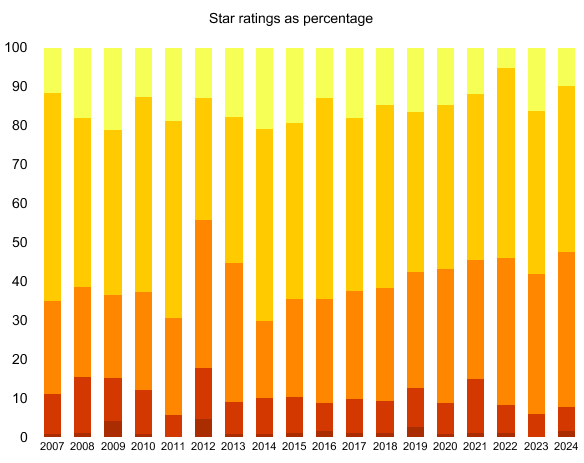
At the top end of the scale, in 2024 I awarded 13 five-star ratings (9.92% of my viewing). That’s down slightly from last year, though not close to as low as 2022. (I’d make comparisons to all other years, but that’s only down fairly as a percentage and I don’t have that to hand. I should compile a list of them, really.) At the scale’s other end, I gave two one-star ratings (1.53%), which is more or less normal for me — indeed, my all-time average is 1.94 per year. Even when I watch more films, it doesn’t change much, because I avoid giving it to all but the most terrible rubbish, and I try to avoid watching such things, on the whole.
The largest group this year was four-stars, given to 56 films (42.75%). Three-stars has only been the majority awarded once (in 2012), but it came pretty close this year, as there were 52 three-star films (39.69%). Finally, there were only eight two-star films (6.11%), which is roughly in-keeping with the last couple of years (before that there were a lot more, but then I watched a lot more in general. I really ought to get those percentages ready for comparison…)
And so to the big final number: the average score for 2024. Oo-ooh! The short version is 3.5 out of 5 — down from last year, but the same as the two years before that. To get more precise (for the sake of comparison, as all of my years fall within a spread of 0.4), at three decimal places the score is 3.534 — that’s above 2021 and 2022, then, but the only other year it bests is 2012 (a real outlier, as you can see on the below chart). As my fourth lowest-scoring year, it’s almost the antithesis to last year, which was fifth highest.
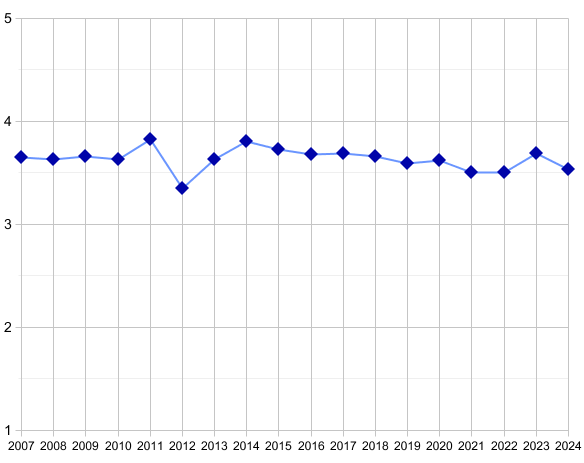
What can we conclude from all that? Nothing much, really. The fact that line is pretty flat (a few oddities aside) suggests both my film choosing and my scoring have remained consistent over the years, for good or ill. Should I choose better films? Should I score more leniently? Or more harshly? To be honest, I don’t really think about such questions. I take these stats as an indication of what’s happened, not as a learning exercise in what I should or shouldn’t change.

Talking of scores and finales, next up is the finale of the 2024 review: my pick of the best from my 131 first-time watches.
 100Films.co.uk