
Gabriele Salvatores | 89 mins | TV | R
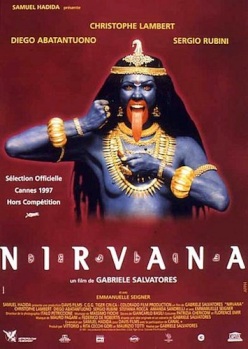 The Radio Times film section may be steadily going down the drain, but when anyone describes something as “one of the best science-fiction films ever made” it’s worth paying attention. “Yet few people outside Italy have seen it,” they add. Indeed, despite screening at Cannes (albeit out of competition), this Italian movie has never been classified by the BBFC, so I presume it’s never been released here (though this was its third showing on the BBC). It’s been released in America though… by Miramax. They did their usual foreign film job, chopping out 17 minutes, changing the music and adding an English dub. This is the version shown by the BBC (at the time of posting, also available on iPlayer) and reviewed here.
Most sci-fi we see is of the American variety — partly due to the fact most of any cinema and the vast majority of imported TV we get is from there, partly due to that being where the money is for special effects and what have you — and that tends to mean tonnes of CGI, a fast pace and action sequences up to the eyeballs. Nirvana is more stereotypically European, however: it’s clearly a Deep and Meaningful film, though unlike many examples of Thoughtful cinema it at least has a slightly thriller-ish plot and a hefty dose of cyberpunk styling for us plebs to pick up on.
Sometime in the future (I read 2005 in one review, but best to ignore that now), Christopher Lambert is a computer game designer working on a new title for Christmas. Somehow a virus invades his system, in the process making his lead character, Solo, fully sentient. Unable to escape the game, Solo wishes to be deleted, but Lambert can’t because the final software is owned by some giant corporation and will be released in just three days… so he has just three days to get into their computer system and delete the file, before Solo is condemned to never-ending life stuck in the game.
 The most obvious point of reference for Nirvana is Blade Runner, which I’d wager was a hefty inspiration. Writer/director Salvatores introduces themes of what it means to be human and a lead character one might like to decide isn’t after all, and sets it in a perma-night, dystopian, multi-cultural future. It doesn’t quite have Ridley Scott’s consistency of vision, though: while he just rendered an Asian-American future L.A., Salvatores takes globalisation to the max, running us through locations named after Marrakech and Bombay City, which may or may not be part of the same sprawling metropolis, and which all exhibit appropriately specific cultural stylings. These aren’t just pretty backgrounds, but in some ways reflect the film’s use of video games — in which you can, of course, constantly re-spawn your character — as a metaphor for reincarnation.
In aid of this, while Lambert is collecting the plot pieces needed to attack that corporation — at the same time as following a subplot about a missing girlfriend — we get to witness Solo’s experiences inside the game, frequently dying and re-living the same story with a group of characters who aren’t aware in the way he is. To be blunt, the in-game stuff is a bit odd. It doesn’t really go anywhere, and builds to a lacklustre climax — indeed, the word climax is a bit strong. But perhaps this is part of the point: as the only character in the game capable of independent thought, Solo is stuck in a loop of story and fellow characters who just re-enact what they were programmed to re-enact. Literally, he can’t go anywhere.
This part of the film calls to mind eXistenZ, David Cronenberg’s film about a virtual reality game that blurs the line between reality and the game. It’s rather a surface similarity though — Lambert barely spends any time in his game,  interacting with Solo merely though a series of screens on his journeys (and, one presumes, a series of microphones too). Cronenberg’s film was made a couple of years after this, so commending it for not doing the same thing would obviously be a bit rich. It is to be commended for not descending into a needlessly twist-strewn third act though, which I had thought was coming — there’s plenty of bits along the way that could be used to build a ‘surprise’ or two. There’s some ambiguity in the ending, but not too blatantly (unlike later versions of Blade Runner, for instance), and Emmanuelle Seigner’s ex-girlfriend character is never quite used in the way I expected.
For all its intellectualising, Nirvana can still be a fun film, and not just because Lambert’s accent is always set to provoke a giggle. That sounds horribly xenophobic written down, but it’s all Highlander’s fault: there’s no reason he shouldn’t sound European here (and he has dubbed himself), but the memory of that accent supposedly being Scottish does linger. (And, just so we’re clear, I love Highlander.) But no, there are proper dashes of humour, scattered here and there to provide some subtle texture. And there are action sequences too, and dated ’90s music (presumably thanks to Miramax), and even some boobies. To be honest, though, if you just want humour, action, dated music and boobies, there are dozens of films that will serve you better. At least they stop it becoming too dry, and give you a chance to let what’s going on sink in, helping prevent total confusion every time the film threatens to become incomprehensible (maybe it’s just me, but it took a little while to work out what Lambert was actually getting up to in the main plot).
I’d quite like to see the original version. Who knows what changes Miramax have wrought with their fiddling (that woman on the poster certainly isn’t in this version, at least),  and I imagine subtitles could be easier to follow than this dubbed version, in which everyone’s covered by either the original actors straining with English (based on the accents) or the typically bad voice actors employed for such dubs. The Italian DVD is reportedly English-friendly and very good quality, so perhaps I’ll get hold of that (expect another review if/when I do… well, eventually).
Apparently Nirvana “has achieved something of a cult status, especially in Europe”, and I think I can see why: there’s a few themes that might be worth a ponder, and enough splashes of style and action to keep one’s attention… most of the time. It might not be as stylistically delineated as either of the films it brought to mind, but then Blade Runner is perhaps the pinnacle of screen SF and eXistenZ… well, now I really want to see that again. I don’t know if this is “one of the best science-fiction films ever made” — especially not in this Americanised version — but it certainly has a few things going for it.

Nirvana is available to UK viewers on the BBC iPlayer until 3AM on Saturday 3rd September (i.e. Friday night).
 A Good Woman adapts Oscar Wilde’s 1892 play Lady Windermere’s Fan, switching the setting to the Amalfi Coast in 1930. If one didn’t know better, one would believe that’s when and where it was always set.
 So it seems one’s perception of the film lies in what it is compared to. Compared to Wilde’s original, it may indeed be a pale imitation, relocated to an inappropriate country and period, with lacklustre performances and incongruous Wilde-penned lines crowbarred in. Taken without the context of the work it’s adapted from, however, I thought it was a flawed but, more importantly, highly amusing film.
 I can’t help but wonder if, back in 1985, there was any audience confusion between A Room with a View and
  100Films.co.uk