
reviewed in haiku form. (And
you thought drabbles short!)
I can’t even remember what gave me the idea, but the other day I started writing haiku-sized reviews of films I’d watched, and before I knew it had written one for every film from August. So, in what may or may not become a new regular feature, I’m going to share them with you. You lucky, lucky people.
Technically a haiku is more than just the 5-7-5 syllable structure most people know: it should be about nature, and (to quote Wikipedia) “the essence of haiku is ‘cutting’… often represented by the juxtaposition of two images or ideas and a kireji (‘cutting word’) between them.” Obviously these haiku have nothing to do with the first of those conditions; as to the second, well, it comes and goes. At times, I’ve tried; others, less so. Hopefully none are just 17-syllable sentences split in three. Nonetheless, I don’t promise poetic quality with these.
 Contagion
Gwyneth Paltrow eats,
whole world at risk of grim death.
Scares ’cause it could be.
 End of Watch
Cops film selves, sort of.
Inconsistent P.O.V.
undermines reel-ism.
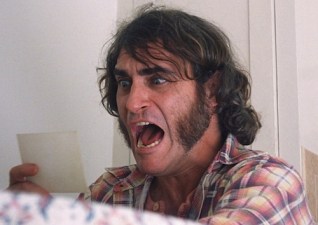
 Inherent Vice [review]
Pynchon’s comedy
filmed by P.T. Anderson.
Laughs for weed users.
 Interstellar [review]
Two-Thousand-And-One,
A Space-Time Anomaly.
Mainly, spectacle.
 Justice League: The New Frontier
Uncommon premise
raises expectations, but
promise is squandered.
 Life of Pi [review]
Tiger on a boat:
CG extravaganza!
Better than the truth.
 Monsters: Dark Continent [review]
Genre transplanted,
but soldiers pose same quand’ry:
aren’t we the monsters?
 Seeking a Friend for the End of the World
This: way the world ends —
not with a bang or whimper,
but a love story.
 Shallow Grave
Danny Boyle’s debut.
Cold cash leads friends to distrust
and dismemberment.
 Sherlock Holmes (1922) [review]
Moriarty v.
Barrymore. Gillette-derived
slight Sherlock silent.
 Shivers
Amateur work by:
biologist, kills neighbours;
Cronenberg, upsets.
 Space Station 76 [review]
Groovy future fun,
undercut by theme of frac-
tured relationships.
 The Story of Film: An Odyssey
Epic history,
too personalised for some.
Piqued insight abounds.
 Stranger by the Lake
French gays have the sex
with a killer in their midst.
A slow-burn beauty.
 The Theory of Everything [review]
Eddie Redmayne won
awards, but the film’s heart is
Felicity Jones.
 The Thing (2011) [review]
Under prequel’s guise,
computers doodle a mere
Carpenter rehash.
 Paul Thomas Anderson — the fêted writer-director of
  Anderson chooses to realise the movie mostly in long, unbroken takes, which not only lets the photography shine, but also allows his cast free rein to construct their own performances. I’m not sure how much that pays off, but it’s certainly not a hindrance. Turns from the likes of Josh Brolin and Martin Short border on the memorable, though your mileage will vary on if anyone truly achieves it, with the possible exception of Katherine Waterston, who surely deserves more — and more prominent — roles. Other recognisable faces (Jena Malone, Eric Roberts, Reese Witherspoon) are wasted in one- or two-scene appearances, which I suppose we could kindly call cameos.
 I am in neither of those groups, however. The aforementioned fleeting aspects of quality weren’t enough to swing it for me either. Sadly, I’ll be chalking this up alongside
 100Films.co.uk