

The action-man with the second most quotable line about being back is, er, back — again — for the third chapter in the ongoing saga of what happens if you kill a man’s dog. Basically, lots of people die. Quite right too.
Chapter 3 begins exactly where Chapter 2 left off: John Wick (Keanu Reeves) has been made “excommunicado” from the organisation that controls the criminal underworld, the High Table, and he has just an hour’s grace before every assassin in the world will be out to claim his life. He’s just one man, with a $14 million bounty on his head, in a New York City where about 50% of the population seem to be highly trained killers — as Winston (Ian McShane) says, his odds are “about even”.
And so the first half-hour is basically nonstop action, first as Wick desperately tries to prepare for the all-out assault coming his way, and then as he faces it. The series’ reputation is built on its lengthy, stylish, inventive action sequences, and Chapter 3 does not disappoint, with some of its best material coming right out the gate. I feel like they could’ve expanded this first half-hour into an entire movie (i.e. John on the run, fighting endless assassins, until he finds some way out of his bind) and I’d’ve been happy with that — it would’ve mirrored the simplicity of the first one. But the previous film’s cliffhanger is not so simply resolved, because what John did to earn his excommunicado status cuts deep into the mythology of this world — oh so very deep — and the fallout of his actions, well, that’s the plot of the movie. And not just for John himself, because a High Table Adjudicator (Asia Kate Dillon) rocks up to decide the fate of any person or organisation who might’ve given John a helping hand when they really shouldn’t, including Winston, the Bowery King (Laurence Fishburne), and the Director (Anjelica Houston).
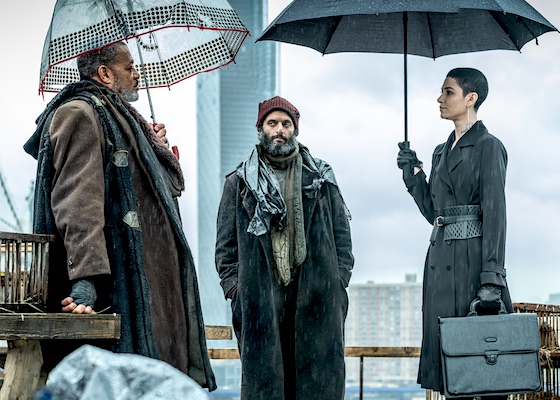
The first John Wick had a bit of fun introducing us to a rule-driven shadow-world of assassins. The first sequel put a lot of stock in extending that mythology. Now, the third chapter thrives on it. The first film’s plot was a straightforward revenge thriller with some extravagant flourishes; for the third, we’re (to borrow a phrase from Reeves’ other major action franchise) right down the rabbit hole. Just like the famed action sequences, if you’re onboard with it then there’s a ton of fun to be had; but if that kind of thing bores you, there’s little respite from it. Extravagant brutal action and gradually-unveiled ever-deepening mythology: these are John Wick’s twin raisons d’être.
Half the fun of how the films present their mythology lies in the way every character seems to be completely aware of all the rules. No one ever needs a symbolic coin or a judgement’s motivation explained to them; they inherently understand its significance or reasoning, the status and power that’s conferred. But we don’t know what any of it means, of course, because this is a fictional world that we’re being inducted into as and when parts of it become relevant to the narrative; and so we’re led along on a magical mystery tour of what these arcane rituals might mean and where they might lead us. As I said, it’s quite a particular kind of storytelling, and if it doesn’t engage you then that’s that, but if you do find it enjoyable then the John Wick films are spinning it into a fine art.

Naturally, nowhere is the film’s sense of artistry more on display than in the fights. For all the mythology, director Chad Stahelski and the small team of screenwriters never forget what really made people love John Wick in the first place: the gonzo action. There’s a lot of competition in that arena (not just its own preceding instalments, but the past decade’s acclaimed imports like The Raid and its sequel, The Villainess, The Night Comes for Us, et al), but Chapter 3 is up to the challenge, boasting continual inventiveness among the slickly choreographed and expertly performed carnage. One innovation includes dogs getting involved in the action — appropriate for a series all about the love of pooches. The mutts in question are commanded by an old acquaintance of Wick’s, played by Halle Berry, who trained with the dogs so she could actually control them during takes. It’s that level of dedication that marks out the action here.
It all looks great as well, with the camerawork boasting precise movement and impressively long takes to celebrate the action and how well it’s been achieved. The actual phototography is fantastic too, the light looking gorgeous whether in the neon glow of New York or the sand-orange Moroccan desert (I watched it in UHD, where it’s a real showcase for why HDR is a bigger benefit than pure resolution; though that’s not to discredit the film’s crispness). It’s complemented further by the design work, in particular a glass-house set where several key scenes take place, which reportedly cost $4 million. On any technical merit you care to name, Chapter 3 is exceptional.

That said, while there’s fun to be had throughout, by the end I felt like the story was the film’s real problem. Not the tone and style that I praised earlier (though it’s easily the most fantastical of the series so far, which might turn some off), but its significance: it ultimately feels like merely a dot-join between Chapter 2 and the already-announced Chapter 4. The film’s Latin subtitle, Parabellum, translates as “prepare for war”, and that’s apt: this film is a preparation for the next. But maybe I’m being unfair. Maybe, when this series is all said and done, we’ll see that Chapter 3’s contribution to the overarching narrative is equivalent to the other films. However, at first blush, it feels to me like this is either a kind of linking passage, or maybe Chapter 3 Part 1. I guess only time — specifically, the time until after we’ve seen the fourth chapter (currently slated for May 2021) — will tell.
In the meantime, let’s not get too distracted from storyline niggles in a film that’s really about style over substance, in a good way. Chapter 3 certainly knows what boxes it should tick, and it ticks every last one of them with considerable flair. (Can you tick a box with flair? I bet John Wick could. After all, we know how skilled he is with a pencil…)

John Wick: Chapter 3 – Parabellum is released on DVD and Blu-ray in the UK today.
* The film’s primary language is undoubtedly English, but IMDb also lists seven more. Each only pops up briefly, in short lines or exchanges here and there, which is why I haven’t cluttered the top of this post by listing them. But for the record, they are: Mandarin, Latin, Russian, Japanese, Italian, Arabic, and Indonesian. ^

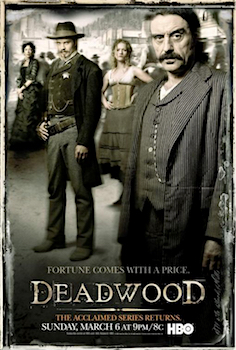 One of the early touchstones of the “peak TV” era we’re now right in the midst of, Deadwood is a kind of revisionist Western — revisionist in that it treats the West not as a time of myths and legends, as most movies still do, but as a real historical period like any other, populated by realistic people (more or less — I’ll come to that). The titular town began as a camp in Native American territory, established by gold prospectors. When they found success, more gold hunters followed, plus all the amenities they might require: supplies, tools, food, gambling, whores… Plus, the town was outside the jurisdiction of most law enforcement, thereby attracting a different class of person again. Naturally, illicit activity followed. At one point Deadwood averaged a murder a day — and those are just the ones that were recorded.
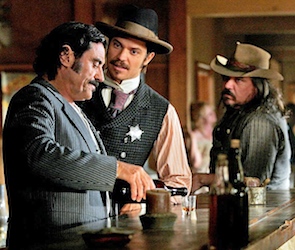 They’re aided by the extraordinary storytelling. It’s often said to be Shakespearean, but that’s not an empty epithet. The dialogue may be littered with expletives (not as shocking today as it was back in 2004, but still not for the faint of heart) and tailored for the understanding of modern ears, but there are still speeches and exchanges that you could put anonymously alongside writings of the Bard and laypeople would struggle to identify which was which. It’s a structural thing, too — I mean, there are characters who deliver soliloquies! How often do you see genuine soliloquies outside of classical theatre? Plus there’s the way that, again, it’s using personal conflicts to touch on bigger themes and points about human nature and society.
 Season two is a little more like the latter, and suffers for it. A major death about two-thirds of the way through comes to overshadow the rest of the season; while it doesn’t completely stall it, things begin to take longer to get anywhere. There’s also an early plot in season two designed to ‘depower’ Swearengen — he’d become such a dominating force in season one, Milch felt it necessary to take some of that away, if only for a while. A justifiable aim, but taking him out of play due to incapacity and recovery makes parts of the second season somewhat less fun. There’s a lot of entertainment value in Al’s scheming and swearing.
 Until a couple of years ago, my experience of The Twilight Zone was limited to the Tower of Terror ride at various Disney theme parks (and recognising the theme that everyone knows, of course). Then in 2017 I watched
 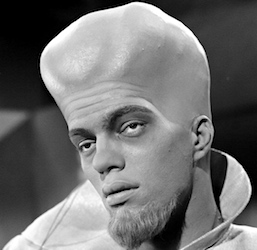 Secondly, IMDb user’s pick: season three’s To Serve Man (ranked 7th by Screen Crush and cited by Peele). This is, essentially, an entire half-hour story based around reaching a neat twist that’s staring you in the face the whole time, like a well-executed punchline on a dark joke. That’s the kind of thing The Twilight Zone is renowned for, so it feels very apposite as a “best ever episode”. That said, while the punchline attracts our focus, the story that gets us there does have some commentary about the nature of mankind. There’s no explanation for why the aliens spend most of the episode wearing such a dopey expression, though.
 This month, I have mostly been missing the back ends of the series I mentioned were starting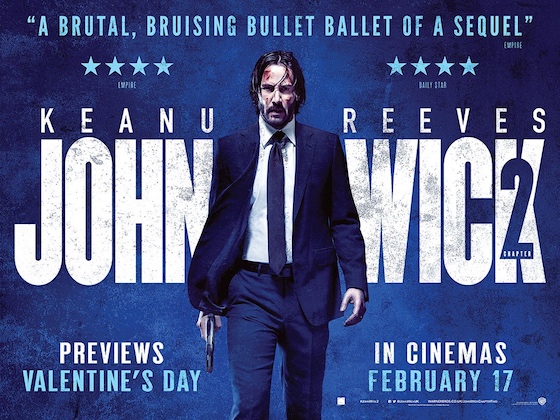


 The answer to the question, “Hey, remember Brett Ratner? Whatever happened to him?”,
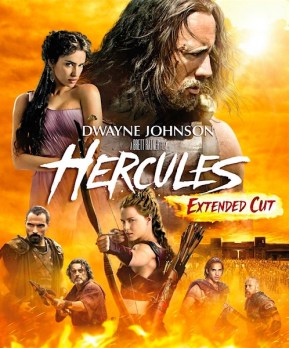
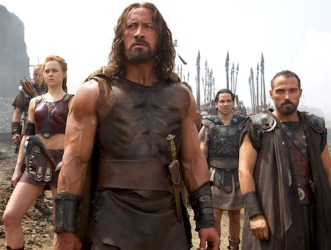 This extended cut wasn’t included on the UK Blu-ray, so no BBFC rating (it’s about a 15), but it is available on Netflix over here (it’s not listed as the extended cut, but it is). It’s no great shakes, though, adding only a couple of minutes. That’s made up of three short scenes, another half-a-dozen additional lines of dialogue, a couple of extra seconds of action, and some blink-and-you’ll-miss-it CG blood (full details
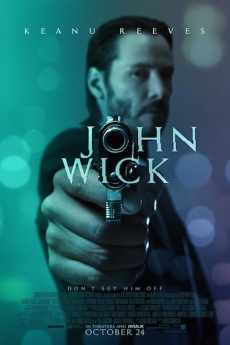 Keanu Reeves is John Wick, a nice guy whose wife sadly died. Now he lives alone with a puppy. Then he accidentally annoys a thug (
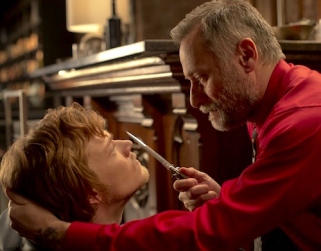 A decade and a half on from
 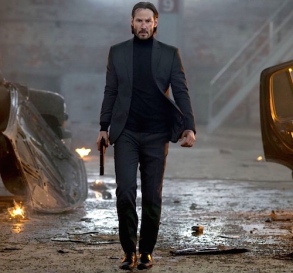 Combine that with the exciting, innovative, technically faultless action sequences and you have a distinctive, memorable movie. It seems to have gone down a storm with action movie fans, anyhow, and so those hoped-for sequels and/or spin-offs are most definitely in development. It’ll be interesting to see if it does what-I-call “a Bourne”, spiralling from a well-liked almost-sleeper-hit first film into an everyone-knows-it major franchise, or, well, not.
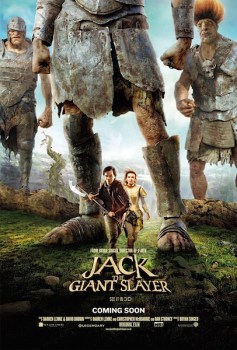 The influence of Peter Jackson’s
 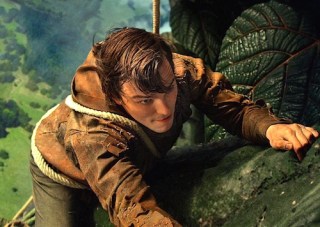 A computer-animated prologue wants to be the one from
 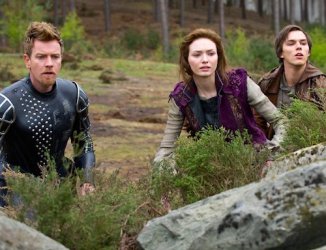 overacted characters, and bright-and-cheerful CGI are more or less acceptable, in a “it’s no classic but it’ll pass two hours just fine” kind of way. Produced on those kinds of terms, this might have passed muster for some. Might.
 100Films.co.uk