
Michael Gracey | 105 mins | streaming (UHD) | 2.39:1 | USA / English | PG / PG
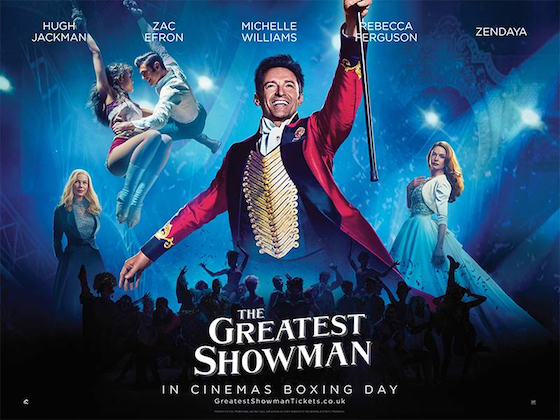
There’s nothing inherently festive about The Greatest Showman (if it has even one scene set around Christmas, I can’t immediately recall it), yet it was initially released on Boxing Day last year and now kicks off December’s premieres on Sky Cinema, and somehow the association feels entirely fitting. I guess it’s something to do with the tone and style of the film itself: a big, cheesy, schmaltzy, cheery musical — just the kind of thing many people like to wallow in during the big, cheesy, schmaltzy, cheery end-of-year festival. It’s almost a John Lewis advert in feature film form, only with upbeat original songs instead of whispery female covers of old hits.
Inspired very, very, very loosely by a true story, the eponymous gentleman is P.T. Barnum (Hugh Jackman), a man of low station in mid-19th century America who, via a cunning fraud, manages to buy a building that he turns into a museum of curiosities. With attendance poor, he adds a floor show featuring acrobatics and freaks. It’s slated by the critics, but curious audiences flock en masse. Barnum is suddenly a massive success — but at what cost to his personal life?
Well, virtually none, because there’s barely any jeopardy to be found here (apart from a little forced something to push it into a third act). But jeopardy is not the point of The Greatest Showman, which is all about being a crowd-pleasing good time — like the show-within-the-show, it was poorly received by critics but a huge word-of-mouth success: it never made it to #1 at the US box office, but nonetheless stayed in the top ten for 11 weeks and earned $434 million worldwide; its soundtrack album was such a hit that they’ve already released another album of cover versions. It’s a phenomenon, basically, and I do think the lack of worry or tension in the story is a contributing factor, especially in these troubling times. That kind of lightweightness doesn’t please the critically-minded, but it doesn’t bother those simply after a good time. And why should it?

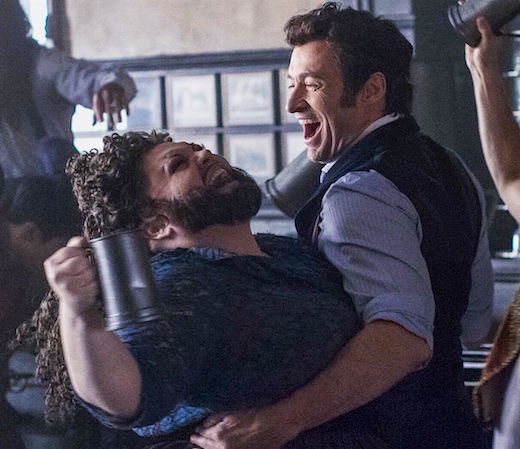
It’s a Musical through and through, the movie equivalent of a broad stage-grin and jazz hands. The numbers are of a different ilk to traditional Broadway style, but not misplaced — it’s modern chart-pop style songs and music video choreography, wrapped up in a big showy old-school musical vibe. I know everyone’s latched onto This Is Me as the film’s anthem, and Rewrite the Stars earned a single release because it’s a pop love song sung by kid-friendly Zac Efron and Zendaya, but the one number that really works for me is opener/closer The Greatest Show (it’s even better on the soundtrack, because it isn’t awkwardly sliced in two with the rest of the movie shoved in between, as it is on screen). If that song doesn’t end up being co-opted for opening ceremonies and things like that, it’ll be kind of a shame. And if I was to point to a runner-up favourite, I’d go for The Other Side purely for how it’s staged: a barroom duet between Jackman and Efron with impressive drinkography. And talking of the songs, the Honest Trailer contains some excellent spoofs of them.
Still probably best known as surly superhero Wolverine, Jackman was an established musical theatre star before his big-screen breakthrough, so this stuff is very much within his skill set — indeed, as his recently-announced world tour could attest, this show of song and dance may be more in his comfort zone than the superhero shenanigans. Either way, that he’s so effortlessly consummate at both proves he’s a performer of underestimated range. Less remarkable as allrounders are former Disney brats Efron (as a bored rich kid roped into Barnum’s enterprise) and Zendaya (whose qualifier for a freakshow seems to be that she’s somewhat dark skinned), but they’re perfectly adequate for their poppy against-all-odds romantic subplot. Less at home is Michelle Williams — not that she’s bad, but seeing her smiling and happy is weird…
Altogether, I can see why The Greatest Showman was unpopular with critics but a huge hit with audiences — it’s a proper crowd-pleaser; a big, cheesy, easy extravaganza, similar to its pop-style music. That’s not the sort of thing critics are enamoured of, but it is the kind of thing that tickles the fancy of the masses. On the whole, it didn’t appeal to me — there were things it could’ve done better without betraying what it was aiming for, I think, like that total lack of risk in the plot, but also things I was never going to like, such as the music style — but it did have its moments.

The Greatest Showman will be available on Sky Cinema from midnight tonight.






 Score:



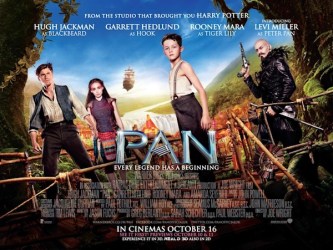 12-year-old Peter (Levi Miller) lives in an orphanage in World War 2 London… until the night pirates bungee in through the ceiling and kidnap a bunch of boys onto their flying galleon. Yes, really. From there it’s second star to the right and straight on ’til morning as the pirates take their new charges to Neverland, where they’re forced into the
  As said boy, Levi Miller manages to make Peter not intensely irritating, which is an achievement compared to other adaptations. Some of that is surely inherited from the writing and directing, but Miller gives a strong performance too. Hugh Jackman hams it up magnificently as Blackbeard, clearly having a riot. Rooney Mara may be miscast due to the colour of her skin (for all the complaints about whitewashing, her tribe is shown to be mixed race… which doesn’t necessarily excuse it), but her actual performance is very good. I felt like Garrett Hedlund was doing an impersonation of someone but I never quite got a handle on who (the character’s definitely written to be Han Solo, but the actor’s not copying Harrison Ford). Adele Akhtar brings comedy as Hook’s chum, Sam ‘Smee’ Smiegel, there are cameos of varying purpose from Amanda Seyfried and Kathy Burke, and Nonso Anozie is always a welcome presence, here playing Blackbeard’s henchman. Cara Delevingne doesn’t act so much as provide a human reference for the CGI.
 Having found Pan to be a very likeable fantasy adventure, I confess to being slightly confused by the response that saw it soundly trounced by most critics and viewers. The
  or Disney’s, aside from my aforementioned aversion to the eponymous hero), so I was perhaps more open to this Epic Fantasy reimagining. (In that last respect, it definitely falls into the same bracket as
 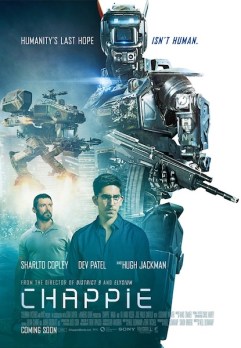 Neill Blomkamp seems to be on M. Night Shyamalan’s career path: a massively-praised Oscar-nominated breakthrough genre movie, followed by a series of increasingly maligned follow-ups.
 Yesterday I wrote about
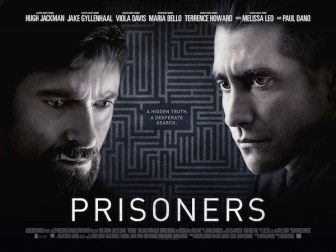
 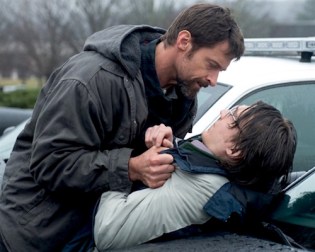 There’s a lot going on in Prisoners. While the basic format is straightforward, it’s realised in the form of a multi-stranded narrative full of well-drawn characters with complications of their own. Jackman and Gyllenhaal may be top billed and on the poster (well, an air-brushed waxwork vague approximation of Jackman was on
 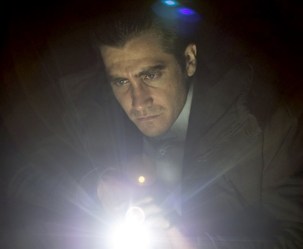 He’s not a bad detective, just not the usual genius-level investigator you normally find in thrillers, and at times you feel he’s muddling his way through the investigation as best he can. Aside from giving Loki the slightly-affected tic of blinking too much, Gyllenhaal offers a reasonably restrained performance. (I’d love to know what the blinking was in aid of, but the film is woefully understocked with special features.)
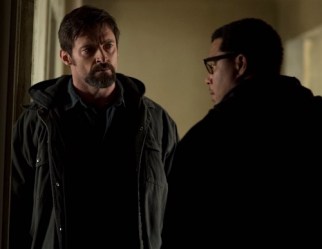 Denis Villeneuve’s direction gives the sense of a non-Hollywood background with the occasional arty shot choice or composition, though not to a distracting extent. He’s aided by serial Oscar loser Roger Deakins on DP duty, who once again demonstrates why he shouldn’t have a golden man already, he should have a cupboard full. The photography here doesn’t flaunt itself with hyper-grading or endless visual trickery, but is consistently rich and varied. Deakins may also be the best action cinematographer working — pair what he brought to
  As a thriller that is also a drama about people caught up in those events, and the lengths to which some of them may be prepared to go, Prisoners is a must-see for anyone with the stomach for some dark material (though don’t let me overemphasise that point — it’s not as bleak as, say,
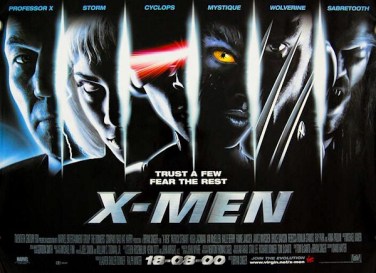
 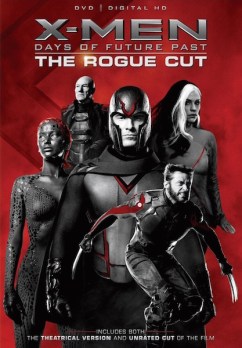 One of the big stories in the run-up to this fifth X-Men film’s release last year (my previous review is
 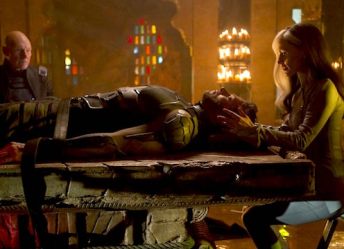 (though the theatrical cut only has 40 chapters, so I’m not entirely sure how that pans out). Most must be teeny extensions, however, and I look forward to
 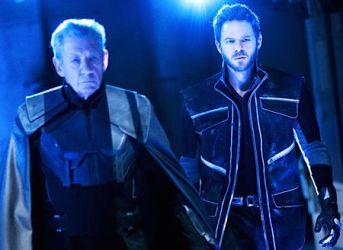 The Rogue Cut is worth seeing for anyone who enjoyed the theatrical version — and, in terms of a copy to own, the Blu-ray comes with both cuts and more special features (though it loses all the extras from the first release, including a few more deleted scenes) — but, unless you’re a huge fan of Rogue or Iceman, it’s not essential.
 I think I’ve previously discussed my life-long love of the X-Men franchise, so I shan’t go into detail again, but suffice to say Days of Future Past has been one of my most-anticipated movies ever since the title (which is that of a classic and influential story from the comics) was announced. Thank goodness, then, that the final result doesn’t disappoint.
 Beyond that, there’s the characters: the younger versions are having to deal with the fall-out from
  Not everyone gets to shine in a cast this big, although pretty much everyone gets a moment. The future-set cast have the least to do, people like Halle Berry turning up to do little more than show their face, though Stewart and McKellen get a moment or two worthy of their talents. After he was the focus of the last film, Fassbender is slightly shortchanged here; but after McAvoy gave him essential support in First Class, Fassbender plays the same service here, informing Charles’ journey. Of the new additions, Evan Peters as Quicksilver (that’s the one who’ll also be played by Aaron Taylor-Johnson in
  Later, there’s the aforementioned ‘slow-mo’ sequence, and the grand climax, which offers more “fly something big around” antics a la First Class’ submarine, only considerably grander. Yet for all the spectacle, the final moments once again come down to character: what is Magneto prepared to do? What is Mystique prepared to do? Will anyone listen to Charles? And so on. Even the much-vaunted Marvel Studios movies tend to base their climaxes in slabs of ‘epic’ CGI crashing into each other; Days of Future Past does that for a bit, then brings the characters back into focus for the real final beats.
 (Jennifer Lawrence being the third pillar of the past triumvirate, as they’ve already focused on Xavier and Magneto). While Days of Future Past does wrap up the majority of its threads (the open-ended ones are answered by previous films, if you want them to be), there’s plenty there to play with in the next film (and, perhaps, ones beyond that) if they want to… which they do.
 Once upon a time, Real Steel would have been rated PG, been aimed at 7- to 10-year-old boys, and would probably have been quite the success. In the current Hollywood moviemaking climate, however, it’s rated PG-13, consequently aimed at teenage boys and grown men who still have the tastes of teenage boys, and seems to be regularly slated in online comment sections.
 Some things are also distinctly unresolved: just why was Evil Lady prepared to pay $200,000 for a no-hope junkyard robot? I figured there was going to be some Nasty Secret to come out, especially as there’d been hints of the robot having extra abilities… but no. And what was up with the kid being 11 but Jackman always thinking he was 9? Figured that was going somewhere too. There’s talk now of a sequel — I hope such random bits weren’t intended as elaborate seeding for a follow-up, because that’s just irritating. That said, it would be nice if whoever’s in charge spotted those things and built on them in the sequel’s story.
 Real Steel is a good family movie, masquerading as a teenage-focused robot action blockbuster thanks to its 12 and PG-13 certificates. The true best audience for it will be those around the same age as the central kid: they won’t find him as annoying as older viewers will, and the whole robot fighting thing will just seem exciting.
 100Films.co.uk