
I’ve never been one to go in for the whole “watch only horror movies in October” thing. I’m not enough of a fan of the genre to delight in the prospect of immersing myself in it for 31 days straight; and, while I’m sure I have more than enough qualifying titles I want to see to fill that period (probably several times over), there’s so much else to watch too. I don’t know if I’ve ever gone a whole October without watching a single horror movie (I haven’t bothered to go back and check), but the very fact I think it’s possible says all it needs to, I feel.
That said, this year I did make a bit of an effort — while also aiming to hit my remaining Challenge categories, of course. So, for example, I picked out martial arts horror movies to tick off slot(s) in the Genre category; for my Rewatch, I looked to horror movies I’d been meaning to revisit; and for Blindspot, I specifically saved the two horror titles for this month — they weren’t originally included for that purpose (if they had been, I would’ve only picked one), but it’s a fringe benefit.
Well, those were my plans, anyway. Did I meet them all, or did I drift somewhere along the way? Read on to find out…

This month’s viewing towards my yearly challenge
#76 Attempt to Kill (1961) — Wildcard #7
#77 Man Detained (1961) — Wildcard #8
#78 Host (2020) — Failure #10
#79 Encounter of the Spooky Kind (1980) — Genre #7
#80 Erin Brockovich (2000) — Rewatch #10
#81 The Wages of Fear (1953) — WDYMYHS #9
#82 Rosemary’s Baby (1968) — Blindspot #9
#83 Dreadnaught (1981) — Genre #8
#84 Possession (1981) — Blindspot #10
#85 The Guest (2014) — Wildcard #9

- I watched ten feature films I’d never seen before in October.
- Eight of them counted towards my 100 Films in a Year Challenge, along with two rewatches.
- I only ‘needed’ to get to #83 this month, so I’m currently ahead of schedule. More on why that’s especially beneficial right now in the “next month” section.
- Outside of the Challenge, Encounter of the Spooky Kind was my 100th new film in 2024. That may not be my ‘official’ goal anymore, but hitting that milestone still feels worthy of note.
- This month’s Genre films were both chosen because they were also labelled as horror films. Encounter lived up to it; Dreadnaught was a stretch (it’s sort of like a slasher movie, but only in a handful of individual sequences, not across the entire movie).
- Three more Wildcards down, leaving just one for the final sixth of the year. I should have gone for a New Film on Halloween (I even had several horror options on hand), as I didn’t watch a 2024 release in October in the end, but I really fancied rewatching The Guest (which, if you don’t know, is set around Halloween, including a climax at the venue for a high school Halloween dance).
- Possibly my most film-snob-y habit / opinion / whatever is that I insist on watching (feature) films on a TV (or at the cinema, obv). I don’t watch them on a computer; nor on a tablet; certainly not on a phone. But I made an exception for Host, because it’s such a ‘Zoom call’ movie that it kinda felt wrong to watch it on my TV when it was just as easy to watch it on my desktop (because it’s streaming on iPlayer).
- This month’s Blindspot films were a pair of horror flicks I’d been saving especially for October, so I’m glad I got them both in. Specifically, they were Roman Polanski’s Rosemary’s Baby and Andrzej Zulawski’s Possession. Also, I’ve just realised they were both directed by Polish émigrés and about bad/abusive marriages. Coincidencetastic!
- I didn’t have any outright horror films to choose for this month’s WDYMYHS viewing, but I went for The Wages of Fear because it has “fear” in the title — as good a reason as any, I guess.
- From last month’s “failures” I watched Host.

The 113th Monthly Arbitrary Awards
 Favourite Film of the Month
It was a largely middling month, quality-wise, which would often make this category hard, but in fact made it easy, because one new film I watched was actually great and so stood head and shoulders above the others — that being Rosemary’s Baby. (I just realised the award title doesn’t actually specify “new film”, but it should. If rewatches were eligible, The Guest would’ve walked it.)
Least Favourite Film of the Month
The flip side to (almost) everything being middling is that there was nothing outright terrible. The two I’d single out at the bottom of the barrel are Dreadnaught and Attempt to Kill. The latter takes it because, although it’s not bad, it is thoroughly mediocre from beginning to end; and while I didn’t actually care for a lot of Dreadnaught, at least it has some fantastic sequences.
The Audience Award for Most-Viewed New Post of the Month
There was only one film review to compete with my monthly summary and “failures” this month. Whether or not the fact it was for an acclaimed film by a beloved director had any bearing on the post’s success, I don’t know; but either way, the victory goes to Incendies.

Every review posted this month, including new titles and the Archive 5


Just two months of the year remain, and I feel like I need to be tactically-minded to complete my goals — after all, I failed in my New 100 Films Challenge in both its first and second years, so perhaps a different focus is needed to get it over the line this time.
On the bright side, I’m currently ahead of target pace, which is potentially a big bonus. That should go without saying as a general point, but it’s specifically the case with regard to the end of December. The final weeks of the year are a bad time to be trying to catch up, or even stay on target, as Christmastime family commitments make it trickier to watch films (especially specific films, as opposed to “what can we find to appease everyone?”) If I can get further ahead of target in November, that might enable me to push through the final few Challenge films in early December. According to the rules, December could be left with a minimum of five films (a new film, a rewatch, a ‘failure’ from November, plus the twelfth films from Blindspot and WDYMYHS) — if I can get to #95 by the end of November, that would be super.
All of which said, I don’t want to ‘gamify’ my film viewing too much, because that tick-box mentality is not the right way to approach art. But it’s been my attitude (for almost 18 whole years now) that if having these goals pushes me to watch a film, rather than spending another evening deciding it would be easier to just veg on social media or whatever, that can only be a good thing.
 A woman wakes up on a beach in the middle of the night. Stumbling away, she comes across a beach house with three strangers inside. They establish that the last thing they remember was being in a nightclub when there was some kind of accident, and then they woke up here. Fortunately, they’re not stupid and quickly twig this place is some kind of afterlife, then begin to work out how to get out — not that they’re helped by the lighthouse beam which causes immense pain, or that if they run away from the house they end up back at the house, or the vicious smoke-monster that’s flying around…
 AfterDeath is billed in part as a horror, emphasised by the skull imagery used on the poster. It’s not particularly scary though, so if you’re after that kind of thrill then it’s one to miss. As single-location mysteries go, it’s not remarkably original or exceptionally engaging, but the story and its revelations are solidly executed and the whole is decently performed, providing you don’t strain your eyes trying to see what’s happening.
 Essie Davis is best known for playing the sassy title role in
 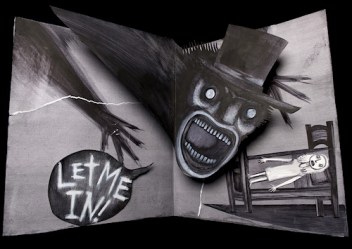 a horror film for people who think about what they’re watching, rather than just waiting for something to be thrown at the screen to make them jump. The slow burn tension will bore those content with the latter, who I suspect don’t tend to think a great deal (for one thing, they’d spot most of the jumps coming if they did).
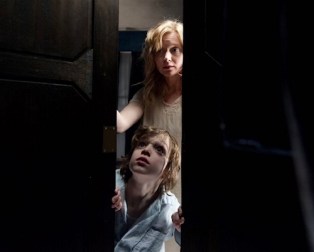 There is little in The Babadook that will make you jump, and even less that will make your stomach turn in disgust, but that’s absolutely fine. What it will do is chill your blood, make your hair stand on end, make you worry about every little creak or thump you hear elsewhere in the house after dark, and make you want to sleep with the lights on. Not just the bedroom lights, all the lights. Because once you’ve seen it, you can’t get rid of the Babadook.
 From the makers of
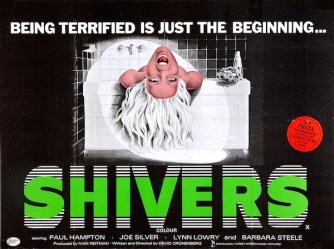 The first commercial (i.e. non-student) feature by horror maestro-to-be David Cronenberg, Shivers depicts the sexually-charged chaos that erupts after the spread of a man-made sexually-transmitted parasite in an isolated hyper-modern tower block.
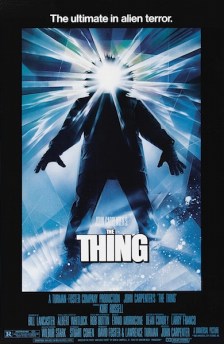 It’s just an ordinary day at the US Antarctic research base staffed by helicopter pilot MacReady (Kurt Russell) and his compatriots, until a helicopter buzzes overhead dropping grenades on a dog it’s pursued across the ice fields. The dog finds sanctuary in the US base; the helicopter and its crew are less fortunate. Realising it’s from a Norwegian facility an hour’s flight away, MacReady and the doctor brave inclement conditions to investigate. They find numerous corpses and the base burnt to ruins. What horrors befell the Norwegian base? And have they inadvertently brought them into their own…?
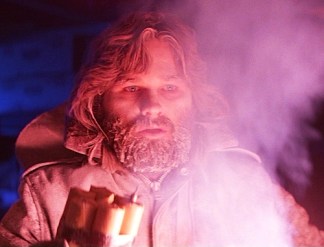 Even if you don’t want to get deep about it, The Thing has the “who’s human?” thrills to keep you engaged on that level. Accusations of boredom no doubt stem from the fact it’s a bit of a slow burn, the early acts building suspicion and unease as MacReady and co investigate. Even after the true nature of the threat is revealed, Carpenter paces himself, though the frequency of incidents begins to mount inexorably as we head towards the climax. Well, that’s just good structure.
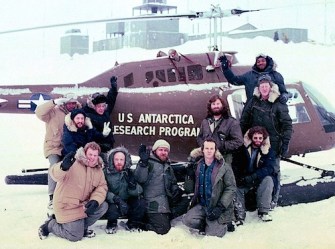 For me, it’s the psychological quandaries that are gripping and exciting, rather than any enjoyed disgust at the emetic special effects. However, knowing the characters a little better — thus caring if they’d been replaced or not, and also perhaps allowing us a chance to try to guess for ourselves — would have just made it that bit superior.
 A behind-the-scenes making-of with a difference, American Movie: The Making of Northwestern (to give its full title) is a documentary about wannabe-filmmaker Mark Borchardt attempting to produce a horror feature film with little more than some mates and good intentions, battling against a lack of money, interest, and dedication. It descends, quickly, into the kind of farcicality that leads some to assume it’s a
  Whatever you take away from it, American Movie feels like a must-see for certain sections of film fandom, particularly anyone who wants to make a movie themselves. Its appeal is broader than that though, an everyday story of adversity that isn’t so much overcome as temporarily averted. It’s not bleak or sad, but it is melancholic. And, whatever the morals of it, often laugh-out-loud funny.
 Based on the cult novel by Cracked.com editor David Wong, John Dies at the End is a bizarre horror-fantasy that defies easy explanation or summary.
 Originally produced for the 2010 FrightFest film festival, horror director Jake West’s feature-length documentary with the unwieldy title explores the ‘video nasty’ scare that gripped early-VHS-era Britain. Starting with a primer on the birth of home video, and what it was like to watch movies in those days (because, ladies and gents, we’ve now reached a point where even fans of that (second-)most adults-only of genres, the gory horror flick, are young enough to not recall a time before DVD), West uses archive news clips and a wide array of new talking head interviews to take the story from the UK’s first video recorders in 1978, through a newspaper-led panic, up to the infamous Video Recordings Act of 1984, which irrevocably (thus far, anyway) changed the face of home entertainment releasing in the UK.
 Focusing on the scare rather than the films embroiled in it makes this less a “horror documentary” and more a social history/pop culture one, though the liberal use of extreme clips from the movies in question shuts out anyone without a hardened stomach. (If you did want more on the films themselves, the DVD set that contains the documentary — Video Nasties: The Definitive Guide — includes 7½ hours of special features discussing all 72 ‘official’ video nasties alongside their trailers.) There’s room for little asides amongst the main narrative, though. One of the highlights is the story of an interviewee who was invited on to Sky News in the wake of the James Bulger murder and asked if the film many were holding responsible,
  There was some counterargument, however, which leads us to the film’s best interviewee, and surely a new hero to many: Martin Baker. Baker was one of a few (certainly the first, and for a time the only) critical/intellectual-type voices to speak out in defence of the films that were outraging so many. He’s to be commended not only for his valiant defence of, essentially, free speech at a time when his views were immensely unpopular; but also because he remains one of the most lucid and fascinating commenters in the documentary. He makes the clearest points about the need to not forget both what happened and how it was allowed to happen, lest it occur again.
 that force ISPs to attempt to censor what we can and can’t see on the internet, and just yesterday rushed through anti-privacy legislation without proper debate. Sad to say, many of the valuable lessons of the ‘video nasties’ brouhaha — lessons made explicit with superb clarity in Jake West’s excellent documentary — have not been heeded.
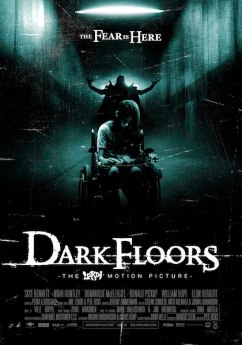 You may remember Lordi, the surprise winners of the 2006 Eurovision Song Contest. If that doesn’t help, they were the Finnish rockers all dressed up in monster suits. Here in the UK we gave them our highest number of points.
 100Films.co.uk