
Christmas TV is already underway in the UK (I believe the first things that were explicitly a “Christmas special” aired over the weekend) — so, before my usual Christmassy roundup, here’s one final regular TV column for 2020.

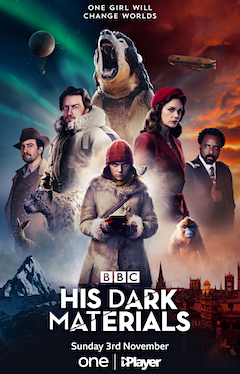
His Dark Materials Series 2
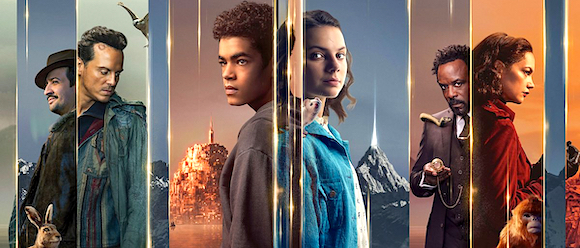
In a world where innumerable film and TV productions have been affected by Covid and its associated lockdowns, His Dark Materials got lucky: by hurrying on to produce their second series before the young cast aged too much, they’d virtually wrapped filming before the first UK lockdown hit. The only casualty: a standalone episode detailing what one character was up to during the rest of the season. That’s frustrating for fans (as I understand it, the events intended for that episode aren’t actually in the original novel, but were dreamt up afresh by the show’s writers in collaboration with original author Philip Pullman), and if you know there’s an episode missing then you can spot its absence (there are some scenes and references in the season finale that I wager would make more sense had we seen the missing episode), but the series mostly survives without it.
So, picking up from series one’s massive cliffhanger, this second run adapts the trilogy’s second novel, The Subtle Knife — a mysterious item of arguably even greater value than the Golden Compass that (sort of) lends its name to (the US version of) book one. Despite tackling a whole novel, I’ve seen some describe this season as boring, with too little incident. I guess that’s the advantage of waiting until the end and watching it all in just six days: I was suitably engrossed, and it moved, if not at a fair old lick, then certainly at a reasonable pace. But it’s not a show that’s always big on action — instead, it’s big on ideas, with underpinning concepts on the boundaries of science and fantasy that have to be explained and understood by the viewer. Nonetheless, there’s still plenty of conflict between our heroes and villains; and while it may seem clear who’s on which side, there are enough shades of grey, and emerging uncertainties about who’s really got the right motives, to keep it pleasantly complicated, engrossing, and believable.
I’m sure I once read that the original plan was to adapt the trilogy of novels over five seasons — one for book one, two each for books two and three. Now, they’ve reached the point where book two has been done in a single season, and now book three is plotted out to be completed in one more run of eight episodes too. But, shockingly, it hasn’t been commissioned yet. I bloody hope the BBC (and HBO) do the right thing, because I think overall this is an excellent show, with still-timely issues of freedom and control, that merits completion on screen. And, simply, I’m excitedly looking forward to the next (final) series already.
Update: This afternoon, while I was too busy writing this post to notice the news, the BBC and HBO officially recommissioned His Dark Materials for its third and final series. Hurrah!
The Good Place Season 4
 The Good Place ended forever ago, right? Well, the series finale originally aired back in January, so… this year, yeah, forever ago.
As with every previous season of the show, this one noodles around in a new setup for the first half-dozen-or-so episodes, before swinging into one long multi-part story through to the end of the season — and, in this case, the end of the series. In that respect, it’s always been kind of an odd show, structurally, and season four is no different. Most of the jeopardy and drama is resolved a couple of episodes before the end, leaving us to watch events play out for these characters we’ve come to love, rather than trying to keep us hooked primarily by plot, unlike pretty much every other programme ever. To be clear, this is not a criticism: it absolutely works. Rather than shooting for a series finale that has the big climax of the plot plus a bunch of rushed wrap-ups, here the more-than-double-length finale is like a coda to the entire show. It’s the series’ highest rated episode on IMDb, so I’m not alone in liking this approach.
The Good Place did, actually, start out as a show that seemed to be primarily about its plot — it’s name was mostly made off the back of one plot point in season one — but along the way it’s really developed a care for its ragtag gang of heroes, and taken us along for a once-in-an-afterlifetime ride with them, to the point where I’m actually kinda sad to see them go… but I loved watching them leave.
Baptiste Series 1
 The breakout star of BBC drama The Missing here gets his own spinoff series. Julien Baptiste is a retired police detective who specialises in finding missing people, which is exactly what he did across two series of The Missing (I reviewed the second here). But instead of a third series, he gets a spinoff, in which he… has to search for a missing person. Hm. But that’s just the inciting incident: before long, Julien finds himself embroiled in the affairs of an Eastern European criminal empire, with his family under threat. Okay, fair enough. Unfortunately, although Baptiste shares the same main creatives as its parent show — sibling screenwriters Harry and Jack Williams — what they’ve cooked up here just isn’t as inventive or captivating as their two seasons of The Missing, both of which were fantastic. Sure, they still conjure up plenty of unexpected twists and developments, but it lacks the same spark that was there before. But let’s not get carried away: it’s not a bad serial, just not as high-quality as the two seasons that preceded it. It’s been recommissioned, so perhaps next time they’ll recapture the magic.
Smiley’s People
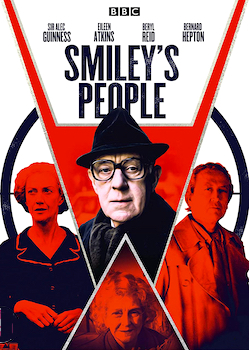 John le Carré’s spy mystery Tinker Tailor Soldier Spy is one of the most acclaimed works of the genre, and the 1979 TV adaptation is justly fêted as one of the great miniseries. But Tinker Tailor is actually the first book in a loose trilogy, and in 1982 they also adapted the third book (they skipped the second because its overseas settings were deemed too expensive; as I understand it, the plot also doesn’t have that much bearing on the overall events — this isn’t “one story in three parts” like many a trilogy). Smiley’s People doesn’t enjoy quite the same reputation as its forebear, and I’m afraid I’m not going to challenge that position. Like Baptiste, it’s not bad, it just lacks that je ne sais quoi that makes its predecessor a solid-gold classic. One thing they do share is a damnably complicated plot — I struggled to follow the narrative watching it one episode per day back to back, so goodness knows how anyone kept up with it once a week over a month and a half back in the ’80s.
I watched it on the BBC’s recently-released Blu-ray, which is a tough one to recommend it. It’s clearly been mastered from the original film (where possible — some negatives were missing so they had to resort to less-good elements), but then it’s been slathered in digital noise reduction (DNR) as if in some misguided attempt to hide that it was actually shot on grainy film stock as opposed to weirdly-soft HD video. It’s so rare for things to be over-DNRed these days that you’d think we were finally past it, but obviously not. And yet, while the series never looks as good as it could, the fact it has been restored means it’s a lot better than the old DVDs, and the chances of anyone ever doing it again and getting it right are basically non-existent. Sometimes, we just have to settle for what we can get. That certainly sounds like a le Carré moral, doesn’t it?
Elementary Season 7 Episodes 9-13
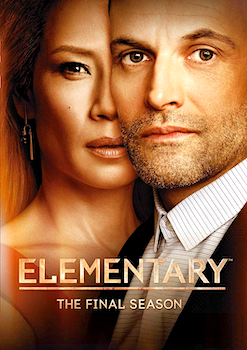 The other “Sherlock Holmes in the modern day” show finally came to an end last year, though I suspect its finishing shall remain more final: whereas Sherlock always had a stop-start “we could make more anytime” production, accompanied with cast & crew chatter about wanting to sporadically do make new episodes forever, Elementary is much more traditional US network TV show — and the diminishing episode orders of the final couple of seasons and summertime broadcasts of the last couple of seasons don’t suggest an enduring hit poised for a revival.
Despite that, the finale itself left things open for more, imitating Sherlock’s “Holmes and Watson continue” final beat. This kind of open-ended ‘ending’ fits a show like Sherlock, where there’s a realistic chance it will return someday. For a show like Elementary, where the chance it might ever return is infinitesimally small, it just feels inconclusive. Like, if you want it to be a true finale, you need to give some closure; an actual ending. As it is, despite a narrative that condenses several years and major life events (Joan gets cancer then goes into remission across a single cut), the episode fails to truly answer why this is the point at which we stop following Sherlock and Joan’s adventures.
There are some people who’ll tell you Elementary is better than Sherlock. I’m not one of them. I’ve warmed to it down the years, but I’ve never thought it was a particularly good realisation of Holmes and Watson — whatever its faults, Sherlock feels like it’s an attempt to adapt Arthur Conan Doyle’s work, whereas Elementary has taken a few names and basic character points and then gone its own way. I’ll concede that there are some things Elementary has done better, although that’s an almost-inevitable side effect of having c.22 episodes a year to play with instead of Sherlock’s three TV movies every couple of years. But it’s also an almost-standard US network procedural — I can remember every single episode of Sherlock, for good or ill, whereas very few of Elementary’s 154 instalments stick in my memory.
Things to Catch Up On
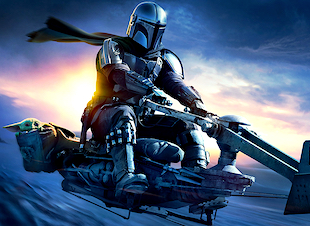 This month, I have mostly been missing The Mandalorian season 2. Well, as regular readers will know, I never even got round to season 1. Naturally, it’s been basically impossible to avoid spoilers — though as those amount to “look which legacy character has turned up this week” rather than actual plot stuff, perhaps it will be okay. Or maybe the series doesn’t really have any plot to spoil, it’s just endless fan service — that would certainly seem to tally with some people’s view of the show. Others love it though, so I’ll see for myself… someday…
Next month… will come after my regular Christmas TV roundup, which will likely include a bunch of seasonal sitcom specials, plus the New Year’s Day Doctor Who.
 Well, it certainly has been an eventful first half to this series of Doctor Who! Never mind bringing back the Master and destroying Gallifrey (again) in
  Social media and fan forums and whatnot have debated and analysed that revelation to death, so I won’t bother digging too much into all the possibilities of what it means — only time can tell. I will stake out this opinion, though: I am not a fan of the theory that she’s a pre-Hartnell version of the Doctor. The idea there were incarnations before the one we know as the first has always seemed disrespectful to me, somehow. Yeah, the Daleks ‘made’ Doctor Who, but Hartnell gave it his all too — without him week to week, and the effort he put into public appearances and the like, would the series have survived those early years? He’s not the only thing responsible for its success, and certainly not for its longevity, but he was The First — leave that be, thanks.
 The Star Trek series boldly goes where it’s never gone before: into the Prestige TV market. (Despite initial appearances, based on things like the reviews I’ve read and variably-sized season orders, I’m not sure Discovery was really “prestige TV” in the end.) Is it up to competing with the big boys of this peak TV era?
 I reviewed the first three episodes of His Dark Materials in
  It’s been
 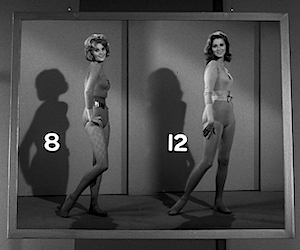 Moving beyond the top ten to complete the top 10% (i.e. the 16 best episodes), next is Number 12 Looks Just Like You (which, by-the-by, comes 10th on Thrillist). This is what some people might call “proper sci-fi” — an idea of the future spun out of what’s possible in the present, using it to present an analogy for the times we live in. And what is the analogy? In this case, there’s a few things you can read into it: mental health; conformism; the transition from childhood to adulthood; maybe all of the above; maybe something else. The only real downside is the episode hints at a wider world that isn’t explored. It’s mentioned in passing that the writing of Shakespeare, Keats, and others has been banned. Why? By whom? And while a bunch of middle-class white people are choosing which generic model they want to look like, what about other races? Class is less of an immediate issue because it seems this is a government-backed thing that everyone must undergo — but then, why do the lower classes get to look just the same as their ‘betters’? Surely there’d be different models depending on your social station? Never mind a 25-minute episode, someone could spin an entire series out of this… Still, having so much to ponder is one mark of a very good episode.
 Finally for now, the last episode in the top 16 (and the only one of today’s episodes not in anyone’s top ten), Nothing in the Dark. Probably best known for staring a young Robert Redford, it’s about an old woman who’s paranoid and agoraphobic due to her fear of meeting Death; but when Redford’s cop is shot right outside her door, she has to let him in to save his life. It’s a nice idea for a story, but (to loop back to what I was saying about The Masks) it feels a little slight in the execution. Half of the second act is taken up in a diversion with a demolition guy which is just that, a diversion. Still, there are very good performances from the two leads, and it comes with a well-meant little message by the end.
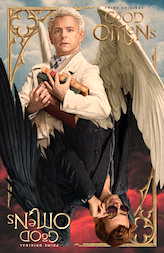 This month, I have mostly been missing Good Omens… again! I
 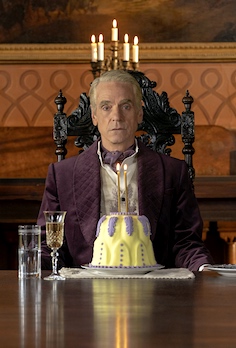 When I reviewed the premiere episode of this
 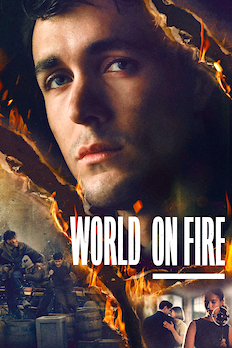 This is good enough that it probably would’ve been A Major Series if it had been made 15 to 20 years ago; heck, maybe even 10 years ago. Today… well, as my previous comment implies, it just doesn’t feel slick enough in the modern TV landscape. It has its plus points (the recreation of Dunkirk was suitably epic, at least compared to the low-key-ish earlier episodes, and Lesley Manville is always magnificent), and it’s done well enough to get recommissioned (thank goodness, because the finale left a tonne of stuff dangling as if it was a midseason episode), but I’ll be surprised if it ends up in the zeitgeist in the manner of, say, Downton Abbey. (Brief thoughts on episodes 1 and 2
  This ITV-produced BBC-aired crime drama is so popular that they recently recommissioned it for both a sixth and seventh series. Originally it took the form of two-parters adapted from novels, but for the past few series they’ve done original season-long six-episode storylines. For this run, the gang find themselves up against human traffickers, using Shetland as a waypoint to get slaves into the UK. Overall it’s not as engrossing or remarkable a story as the ones told in the
 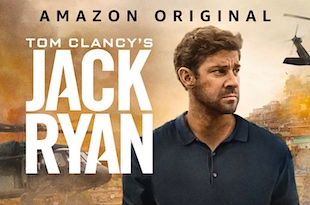 This month, I have mostly been missing Jack Ryan season 2 — perhaps not the most high-profile show I could mention here (it’s on Amazon Prime, which never gets the same buzz as Netflix, however hard they try), but I enjoyed
  100Films.co.uk